Showing posts with label Hammer. Show all posts

Monday, April 1, 2024

Highgate Horror (Part I of II)

IN SEARCH OF THE HIGHGATE VAMPIRE (1997)
The Pond Squire Ghost Chicken

Opened in 1839, Highgate Cemetery stands on redeveloped grounds from the manor and estate of Sir William Ashurst, Lord Mayor of London and director of the Bank of England. Renowned for its Romantic-Gothic architecture and Egyptian-style catacombs, the location was utilised by Hammer (TASTE THE BLOOD OF DRACULA, FRANKENSTEIN AND THE MONSTER FROM HELL) and Amicus (as opening credits for TALES FROM THE CRYPT and FROM BEYOND THE GRAVE).  

VAMPIRE myths are thick in Slavic lore, yet British bloodsuckers are more anaemic. The most notable homegrown example is the vampire of Highgate Cemetery in Swain's Lane, North London. Sightings of a tall, dark, leyline-loving figure in the Borough of Camden have been reported since the Victorian era, but came to prominence in the late 1960s and early 1970s, when the press proclaimed the culprit as undead, after reports of a floating, black-cloaked entity with hypnotic red eyes. And as we entered the Satanic Seventies, rumours circulated of witchcraft ceremonies within the cemetery grounds, and dead foxes drained of blood. 

Paranormal investigator and President of the British Psychic and Occult Society (BPOS), David Farrant, was a leading protagonist amongst the tombstones. IN SEARCH OF THE HIGHGATE VAMPIRE - its title clearly riffing on the pseudo-American documentaries and television series of the 1970s - was produced and directed by BPOS stalwart Dave Milner, under his Darkhouse Productions banner. This thirty-six minute video documentary is infused with a camp Goth aesthetic, and presented by Farrant himself. Seated throughout, he delivers his account laboriously and without any real insight, although there is a theory that the black magic rituals reinvigorated the legend into something much darker. Purely a BPOS puff piece, it does not mention Farrant's prison sentences for grave desecration and sending voodoo effigies to the police. A typically stilted conclusion is laughably nondescript: "as to the question of whether a vampire still exists at Highgate Cemetery, well, I can only say, yes."

David Farrant helped The Highgate Vampire to become one of London's most enigmatic urban legends, which has been exaggerated by collective hysteria, misidentification and hoax. Highgate Cemetery is also said to be haunted by a spectral cyclist, a faceless man and a floating nun.

Despite his reputation, Farrant comes across as shy, effeminate, and somewhat ethereal. Without naming names, he dismisses the involvement of another investigator, who is undoubtedly Sean Manchester. A Bishop of the Old Catholic Church, Exorcist and general defender of the faith, Manchester stated that the vampire was a Romanian nobleman, of whom he eventually banished in 1973 in another location altogether, in Crouch End. Most infamously, The Bishop declared he would hold an exorcism at Highgate on Friday 13th March 1970, which was covered on Thames television. Soon the grounds were overrun with makeshift vampire hunters, despite the best efforts of the police.

The feud between Farrant and Manchester lasted until David's death in 2019. This was not just a war of words, metaphysical confrontations were also planned (branded occult "duels to the death" or "psychic combats") though never realised. Essentially IN SEARCH OF THE HIGHGATE VAMPIRE is as shallow as the facts of the case, barely touching on the real meat of the matter: that of two individuals who were unable to accommodate the same consecrated ground.

Just when you thought Highgate has enough paranormal activity, consider the case of Sir Francis Bacon's otherworldly frozen chicken. This oddity sets up a variety of humourous tags, such as poultrygeist, chilling ghost and phantom foul. The chicken appears to run in wild circles before disappearing into the ether or, on one occasion, through a wall. The above is an illustration from The Evening News of December 10th, 1957.

The vampire flap seemed to have quashed the appearance of the area's other leading phantom, the frozen chicken of Pond Squire on Highgate Hill. In 1626, philosopher and statesman Sir Francis Bacon's notion of preserving food through freezing was indeed correct, but resulted in his premature demise and the creation of the apparition. Bacon acquired a plucked and gutted chicken then stuffed it with snow, but caught pneumonia and died soon after. Over the years there have been sightings of the distressed bird running around and maniacally flapping its wings, sometimes shrieking, sometimes silent. One of the last encounters was in 1970, when a courting couple's amorous actions were interrupted, the ghost chicken dropping from a tree branch onto their bench.

Thursday, February 1, 2024

The Hammer Vampire and Batman

Detective Comics - Heart of a Vampire (1976)

The undead and Gotham City's favourite son: The Dark Knight depicted by Gene Colan for the splash page of Batman #351 (September 1982).

IN 1970, artist and historian Jim Steranko wrote in The Steranko History of Comics: "Heavily steeped in Teutonic atmosphere, Batman conjured up visions of vampires with his black cloak, grim visage and white slit eyes. He moved through cubist backgrounds of warped perspectives and paranoiac tilt shots, of shadows and silhouettes that gave credence to the thought that he was more bat than man."

There is undoubtedly a subliminal connection between the vampire myth and the original specification of Batman. In an attempt to strike fear into the hearts of criminals and become a creature of the night, one of The Caped Crusader's inspirations was Bela Lugosi in Universal's 1931 DRACULA. Indeed, an initial foe was The Monk - a red suited vampire and hypnotist - that shows even during the early years the notion was firmly in play. Similarly Neal Adams - whose dynamic style restored Batman to his dark roots - cited Christopher Lee and the use of his cape as a major influence. In 1968, when the artist began his approach to the character, Lee was making his third appearance as The Count for Hammer with DRACULA HAS RISEN FROM THE GRAVE.

In the Detective Comics story Heart of a Vampire, after being dismissed from medical school, Gustav DeCobra continued his unorthodox experiments by robbing graves, which unfortunately included the resting place of a bloodsucker. 

The most literal merging of these two pop culture icons occurred in Detective Comics #455 (January 1976). Heart of a Vampire - written by Elliot S. Maggin and illustrated by Mike Grell (from uncredited thumbnails by Bernie Wrightson) - begins with Alfred and Bruce Wayne's car overheating miles outside of Gotham. When they enter a boarded-up house to find water for the radiator, they discover a coffin and vampire Gustav DeCobra. Batman puts a wooden stake through Gustav's chest, but hasn't penetrated the heart. A former doctor, DeCobra's research was in heart transplants, and Batman realises that he may have surgically moved his organ elsewhere. To find it, Bruce fights Gustav vigorously and listens for a rapid heartbeat; Batman notices that the grandfather clock gets louder as the confrontation progresses and grabs a wooden bow and arrow. Shooting the clock where the vampire had placed his heart, DeCobra dies as his corpse turns to a skeleton at the break of dawn.

Using photographic reference, Grell draws DeCobra as Christopher Lee, though the artist reluctantly changed the hair style and nose (and added a scar) at the insistence of editor Julie Schwartz. In addition, Heart of a Vampire references Hammer design and narrative: the house interior resembles the 1958 DRACULA (the tale also mimics the climactic battle), and a closeup of the coffin's padlock - dropping onto the floor without opening - is a direct lift from the non-Lee BRIDES OF DRACULA. 

Sunday, April 15, 2018

"New Thrills! New Faces! New Horror!"

HORROR OF FRANKENSTEIN (1970)

In the same year that David Prowse became The Green Cross Code Man, the Bristol native appeared in the second of his three roles as Mary Shelley's most famous creation.

JIMMY Sangster's HORROR OF FRANKENSTEIN is detested by Hammer purists for its comedic tone, and plays out as a parody of the previous respected entries. The film opens with Victor Frankenstein (Ralph Bates) at school, accompanied by friends Elizabeth (Veronica Carlson), Stefan (Stephen Turner) and Henry (Jon Finch). Victor arranges for the death of his father and travels to university in Vienna, where he acquires sidekick Wilhelm (Graham James) and impregnates the daughter of the Dean. Returning to Ingstad, Victor starts a series of experiments, using corpses delivered by a local body snatcher (Dennis Price) - who lets his wife do the digging. After electrocuting Wilhelm for complaining about his work - which includes reanimating a tortoise - Victor poisons Elizabeth's professor father (Bernard Archard) for his brain, but the organ is damaged and the resulting patchwork man is a mute thug (David Prowse).

Initiated as a start-over remake of CURSE OF FRANKENSTEIN, the picture dispenses with Peter Cushing's services and tries to introduce a younger generation (a failed attempt, as Cushing returned four years later in FRANKENSTEIN AND THE MONSTER FROM HELL). Despite the traditional 19th Century setting, HORROR OF FRANKENSTEIN is very much of its time - as illustrated by Bates' hair and puffy shirts - and quite anarchic, mixing additional plot threads (Elizabeth's finances, Stefan's crush on Victor) with comic relief (a severed arm making a V-sign) and grue (Victor's hands smearing his face with blood). Duelling femmes fatale O'Mara and Carlson are always watchable, but only Price can deliver a performance at the correct pitch. Bates, at this point being groomed to become the studio's next big star, is not so much a mad scientist but a psycho scientist, enjoying the thrill of the kill and rejoicing in the fact that he has this powerful monster ready to do his bidding. And when the creature eventually appears - an hour in, and sporting white cycling shorts - Prowse goes through the motions with a checklist of victims and a perfect physique which bestows its fragmented origins.

"You’ve put on weight in a couple of places"; Kate O’Mara is the bed-warming housekeeper of Hammer's relaunch of its Frankenstein franchise.

Reusing the Karnstein Castle set from THE VAMPIRE LOVERS, and even shooting most of its forest scenes on Elstree stages, there is a distinctly cheap and recycled feel. Furthermore, HORROR OF FRANKENSTEIN was not helped by a misleading marketing campaign, where it went out on a double bill with the sombre and gristly SCARS OF DRACULA (as Sangster states in Wayne Kinsey's Hammer Films: The Elstree Studio Years, "if people had gone to see it knowing it was shot light hearted they would have enjoyed it more [instead of] thinking it was a Gothic horror.") However, this twin feature did hold the distinction of the first Hammer movies to be totally financed by British companies, thanks to a deal between Sir James Carreras and ABPC/EMI. But Hammer's new partner would only distribute to England and the Commonwealth, leaving Carreras able to acquire just a small American distributor - Continental - to impossibly cover the whole of the United States market. 

The notion of deriving humour from such pseudo-scientific source material is an interesting one. Since Frankenstein was published in 1818, and Boris Karloff's seminal interpretation hit screens in 1931, Mary Shelley's serious text - and similar works - generate mythical themes and uncomfortable laughter. As the initial power of the book recedes in a collected consciousness, the tome gathers extraordinarily wide responses, snowballing a range of spoofs and humorous asides now over 200 years on. The level of comedic takes is mind-boggling, even to the point of delicious meta-levels: Mel Brooks' celebrated YOUNG FRANKENSTEIN, for example, used many pieces from James Whale's original laboratory set, and even in The Beatles film YELLOW SUBMARINE we had the Monster drinking a potion and becoming John Lennon.

Saturday, July 1, 2017

Demons of the 1970's (Part I of II)

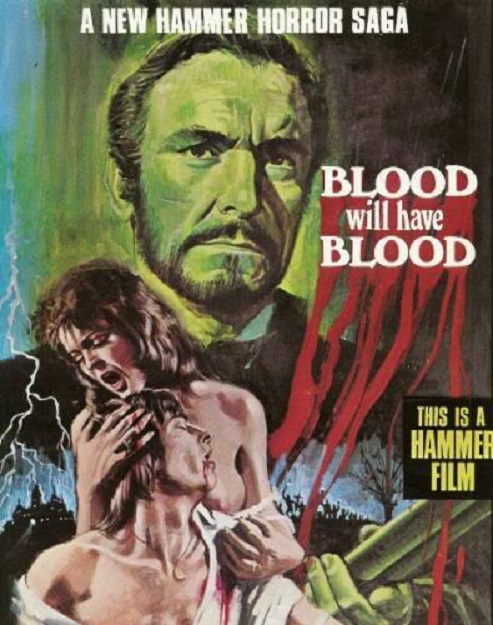
DEMONS OF THE MIND (1972)

One of Britain's last costumed Gothics, DEMONS OF THE MIND was filmed as BLOOD WILL HAVE BLOOD, exploring "dreams of sexual fear supressed through guilt."

AMID the dying embers of the 1970's British film industry, attempts to move into more psychological thrillers resulted in a number of underappreciated efforts. Dumped onto the wrong end of a double bill with TOWER OF EVIL, DEMONS OF THE MIND - directed by Peter Sykes and written by Christopher Wicking - is a Hammer production which focuses on Baron Friedrich Zorn (Robert Hardy), who fears he has passed on the "family madness" to son Emil (Shane Briant) and daughter Elizabeth (Gillian Hills). Held captive to curb their incestuous desires, Emil is at least released at night to murder women, while Elizabeth is "bled" to make her weak (making use of a vintage Scarificator from the British Museum). When discredited psychologist Falkenberg (Patrick Magee) arrives with his associate scholar Carl (Manfred Man singer Paul Jones), an experiment to rid Emil of his lust involving Inge (Virginia Wetherell) ends in another strangulation. The villagers, influenced by a deranged, self-styled Holy Man (Michael Hordern), decide that Zorn is the true demon, and stake him with a burning cross.

A mix of Hammer's Mittel Europe and fledgling psychiatry was one way the company attempted to make its product fresh, another was by infusing proceedings with new young directors and screenwriters. But DEMONS OF THE MIND is more cynical than satisfying, conveying a relentless dourness (quoting Psalm 38 "For my loins are filled with a loathsome disease, and there is no soundness in my flesh") where conventions are either twists or throwbacks: Magnee's unhinged Mesmerist and Van Helsing substitute helps no one ("Better men than I have been booted out of Vienna!"), an alleged Priest is a dangerous zealot, and the villagers revel in their own sadism.

In a role originally intended for Marianne Faithfull, Gillian Hills plays somnambulant Elizabeth Zorn. Faithfull was pulled late on due to insurance issues on her drug use.

A Poe-like story of an incestuous, murderous dynasty crumbling to dust, Zorn is driven by subconscious compulsions of his peasant bride's "virgin blood" and bare flesh (Zorn is a character undermined by Hardy's pantomime performance; to think we might have had Eric Porter, Paul Scofield, Dirk Bogarde or James Mason). Hordern is also overtly loopy, barely able to carry his over-sized wooden cross, and despite the emotional slant, DEMONS OF THE MIND actually serves up a copious amount of exploitative, early 70's gore: although optically fogged, Zorn's wife is seen to slash her wrists and throat in front of her children, but further scenes of Emil killing maiden aunt Helda (Yvonne Mitchell) with a bunch of keys and Zorn's climactic impalement are in no way shrouded.

The original pitch to Hammer by Frank Godwin - the composer-cum-independent producer who penned Strange Love for LUST FOR A VAMPIRE - was actually a werewolf picture. The studio was intrigued by Godwin's knowledge of the legend of Blutlust, and together with Wicking, formulated a treatment based on the Bavarian story of a man-wolf which was actually a psychopathic condition not understood by the medicine of the time. However, the tale was a complete fabrication, and Hammer did not warm to the werewolf elements anyway, leaving only a vague lycanthropic reference in the finished film where Zorn imagines himself stalking as an animal (to further the pseudo-werewolf angle, the muted cinematography is lensed by Arthur Grant, making his last Hammer picture in an association which started with THE CURSE OF THE WEREWOLF).

Wednesday, March 15, 2017

Back in Black

VAMPIRA (1974)

The cover to the MGM Limited Edition R1 DVD of VAMPIRA from 2011. Upon its theatrical release in the States, the production was re-christened OLD DRACULA by AIP, to cash in on Mel Brooks' YOUNG FRANKENSTEIN.

THIS Jeremy Lloyd-scripted travesty from World Film Services is not so much unfunny but downright insulting. Starting at Castle Dracula - now open to public tours - an aging Count (David Niven, fighting to keep his dignity) and his manservant Maltravers (Peter Bayliss) welcome a spooky photoshoot ("Most Biteable Playmate") from Playboy's London entourage, headed by Pottinger (Bernard Bresslaw). The Bunnies unwittingly give blood so the vampire can restore life to his beloved consort Vampira, who has been in a coma for fifty years after losing her immortality to an anaemic peasant. Finding the triple-O blood group to resurrect the Countess, the transfusion backfires as one of the models is black, a façade which Vampira adopts (as Teresa Graves). Hoping to reverse this mishap, The Count and Maltravers track down the girls in London, using Playboy feature writer Marc Williams (Nicky Henson) as their hypnotised pawn.

VAMPIRA mixes the British sex comedy with Hammer horror and Blaxploitation, but there is no flesh or blood on display. Now awakened, the titular character develops a bi-sexual lust, enjoying her environment and skin colour; not only does this new-found vigour mean her using phrases like "out of sight" and "jive turkey," she also goes to watch BLACK GUNN, dances lasciviously, and is now too energetic for the Count to handle. Unfortunately, this is undermined by a number of dismal dialogue choices, particularly when Maltravers tries to explain Vampira's change of appearance ("you don't think, Sir, the deep freeze wasn't working properly and she's - well - gorn orf?")

In the prolonged party sequence, Count Dracula and Maltravers attempt to swing well past the height of the Swinging London era.

More positively, the cast includes female luminaries Veronica Carlson and Penny Irving as Playboy Bunnies, Luan Peters as Pottinger's secretary, and MONTY PYTHON regular Carol Cleveland as a damsel in distress who is inexplicably helped by The Count. The standout however is Linda Hayden as Castle Dracula's disgruntled German student Helga. Although her Teutonic accent is as questionable as her Gallic attempts in CONFESSIONS FROM A HOLIDAY CAMP, Hayden excels in an almost cameo role, bitten and transformed into a white gowned, frizzy-haired succubus. Initially aiding the dinner guests, Helga is then ceremonially dispatched in an upright coffin in a macabre parody of THE GOLDEN SHOT. 

Wednesday, February 15, 2017

The Love of Darkness

CAT GIRL (1957)
RASPUTIN THE MAD MONK (1966)

"The love of darkness, the craving for warm flesh and blood … it is my legacy to you ... passed on from generation to generation of our family …  for 700 years!" Ernest Milton and Barbara Shelley provide the only sparks to this pedestrian programmer.

PRODUCED by Val Lewton and directed by Jacques Tourneur, RKO's 1942 CAT PEOPLE divided critics at the time, but is now considered a sophisticated classic. Telling the story of young Serbian Irena (Simone Simon), who believes herself to be a descendant of a race of people who turn into cats when sexually aroused, the style of the film concentrates on the theory that unseen terrors are more effective than visual ones (what Lewton referred to as "patches of prepared darkness"). This use of suggestive shadow, and the genre-defining shock Lewton Bus moment, was in contrast to the Universal trend of the time, who would make FRANKENSTEIN MEETS THE WOLF MAN a year later.

CAT GIRL - a British CAT PEOPLE from Insignia directed by Alfred Shaughnessy - barely registers as horror, its stagy and stilted execution making it hard to believe it was released in the wake of Hammer's game-changer, CURSE OF FRANKENSTEIN. Leonora (Barbara Shelley) is summoned to her ancestral estate by uncle Edmund Brandt (Shakespearean actor Ernest Milton, doing his best Ernest Thesiger impression). Recently married to Richard (Jack May), Leonora also brings friends Cathy and Allan (Patricia Webster and John Lee) to the house. Brandt's niece discovers that she is to be united with the soul of Edmund's pet leopard, continuing a family curse which enables mental control of the big cat to "kill ... kill." Under Leonora's control, the leopard savages her husband for having an affair with Cathy, then turns its attentions to Dorothy (Kay Callard), the wife of Leonora's true love Dr Marlowe (Robert Ayres).

Barbara Shelley - the "first leading lady of British horror" - is haunted Leonora. Shelley's looks and stature command the screen, with Barbara playing it commandingly straight.

Aside from Shelley and Milton, the performances are self-conscious (even leopard Chiefy, a performing cat from Southport Zoo, surprisingly lacks menace), and Ayres makes for a particularly characterless 'hero'. Shaughnessy - directing his only fantastic film before creating UPSTAIRS DOWNSTAIRS and planting the seed that would become Pete Walker's HOUSE OF WHIPCORD - couldn't remain positive about the release's own main legacy, lamenting in his autobiography "by using [Barbara Shelley] I fear we condemned a very beautiful and talented actress to a long career in horror films."

Similar to Shelley's Helen in DRACULA PRINCE OF DARNESS, when a hex kicks in, Leonora's sexual repression is unshackled. Now infused with feline aggression, things get weird when she briefly imagines herself turning into a leopard, and eats a budgie (off screen); Leonora's eyebrows also suggest a sudden predatory look (critic David Pirie argues that it is with CAT GIRL that British film heroines started to distort from their emotional norm, even if they are portrayed as mental patients and die violently). In her first starring role Shelley atypically shows off areas of flesh; yet any real charge is smothered by the picture's mundaneness, as a lingering shot of Leonora's naked back sees the camera pan away, leaving the maid to comment on her beauty.

"Everything else is darkness"; the hypnotic stare of Christopher Lee as RASPUTIN THE MAD MONK.

Directed by Don Sharp and scripted by Anthony Hinds, Hammer's RASPUTIN THE MAD MONK casts Shelley again under the spell of Christopher Lee in redressed sets from DRACULA PRINCE OF DARKNESS. After healing an innkeeper's wife and cutting off the hand of the keeper's daughter's suitor, Grigori Rasputin (Lee) is hauled before an Orthodox bishop on grounds of sexual immorality and violence. Preferring to give God "sins worth forgiving", Rasputin is unperturbed by the bishop's claims of Satanism. Heading for St Petersburg, the exiled Monk befriends struck-off Dr Zargo (Richard Pasco) and begins his campaign to infiltrate highest Russian society. This includes gaining influence over the Tsarina's ladies-in-waiting Sonia (Shelley) and Vanessa (Suzan Farmer), but his relentless sexual appetite and pursuit of wealth eventually leads to his death at the hands of Zargo and Ivan (Francis Matthews).

Initially announced in 1961 as THE SINS OF RASPUTIN, Hammer's brisk pseudo-exploration of "History's Man of Mystery" is dominated by Lee's extraordinary performance. Unlike his appearances as Dracula - often off-screen and reduced to set pieces - Rasputin is overpowering from his appearance at the Inn door. Passionately researching the role, the actor even sought advice on how to play a medically accurate death by cyanide poisoning. But the film was hampered by overspends on DRACULA PRINCE OF DARKNESS, foreshortening the script and scope; the production was also under the threat of legal action from Prince Felix and Princess Irina Yousoupoff, Felix being one of Rasputin's real-life assassins. Having successfully sued MGM over their 1932 release RASPUTIN AND THE EMPRESS, pressure from the Yousoupoff's is the reason that Hammer's surrogate assassin Ivan is Vanessa's brother rather than husband, and why Vanessa and Rasputin do not meet in the film's climax.

Thursday, September 1, 2016

"A Living Hell That Time Forgot!"

THE LOST CONTINENT (1968)

Actress/singer/songwriter Dana Gillespie - playing Sarah - makes the biggest impression, thanks to her 44-26-37 assets. Gillespie had previously appeared in the striptease exploiter SECRETS OF A WINDMILL GIRL and Hammer's THE VENGEANCE OF SHE.  

AFTER Michael Carreras hastily made PREHISTORIC WOMEN in the wake of ONE MILLION YEARS B.C.'s worldwide success, he would also be responsible for this Hammer fantasy loosely based on Dennis Wheatley's 1938 novel Uncharted Seas. On his rusty tramp streamer Corita, Captain Lansen (Eric Porter) has a cargo of illegal explosives (ten tonnes of water-sensitive Phosphor B) and an array of motley passengers (including a deported ex-mistress of a Third World president (Hildegard Knef), a blackmailer (Benito Carruthers), an alcoholic pianist (Tony Beckley) and an exiled abortionist (Nigel Stock)). When the ship becomes stranded on the floating swamp of the Sargasso Sea, the travellers must face such terrors as man-eating seaweed and a stranded Spanish galleon complete with Grand Inquisitor (Eddie Powell) and boy king "El Supremo" (Daryl Read).

Featuring imaginative sets and water tanks specially constructed at Elstree, THE LOST CONTINENT is a fun but convoluted picture which drowns under its own hyperbole ("SEE BLOOD-BEASTS battling over female flesh! TORTURE PITS for forbidden lovers! SACRIFICE to giant jaw-snapping molluscs! HELPLESS BEAUTIES attacked by crazed-kelp-monsters!"). It's really three films in one, a "ship of fools" tale, an adventure yarn, and an unintentional monster movie parody that relishes its kaiju-like creatures and cleavage. Originally released in America shortened by eight minutes, this truncated version actually replaced the longer cut in British circulation; DVD releases have restored this largely inconsequential footage, but there is one delirious scene where resident blonde Unity (Suzanna Leigh) is called a "hellcat" and almost punched during sex.

Gillespie's extensive musical output has encompassed pop, folk, rock and latterly blues. After performing backing vocals on 'It Ain't Easy' from David Bowie's Ziggy Stardust, she recorded an album produced by Bowie and Mick Ronson in 1973, Weren't Born a Man.

The Lost World subgenre is a popular staple of pulp novels and cinematic spectacle. H.Rider Haggard's King Solomon's Mines and the Hollow Earth work Symzonia; A Voyage of Discovery are often considered its printed paper springboard, exploring strange environments typically un-European. But THE LOST CONTINENT was a box office failure, released between Lost World picture peaks such as MYSTERIOUS ISLAND and the affection given to the Amicus/Edgar Rice Burroughs adaptations of the 1970's. Indeed, 1968 was a sobering year for fantastic cinema, a time with little regard for such a dynamic but ultimately empty release.

Friday, July 1, 2016

Into the Wilderness

CREATURES THE WORLD FORGOT (1971)

In April 1970, a Hammer-Columbia campaign was launched to find the "Screen's New Sex Symbol of the 70s" who would be offered the starring role in CREATURES THE WORLD FORGOT. Au pair, Penthouse pet and former Miss Norway Julie Ege was picked from over 2,000 replies; this is one of many publicity photos that attempted to make Ege the new Raquel Welch, a promotion in contrast to Michael Carreras' intention for a more historically accurate film.

AS exciting as watching cave paint dry, Don Chaffey's CREATURES THE WORLD FORGOT was the last of Hammer's prehistoric jaunts. After a volcanic eruption kills members of The Dark Tribe, Mak (Brian O'Shaughnessy) leads the survivors across a desert in search of a new home. They befriend a fair-haired tribe, the leader of which presents Mak with Noo (Sue Wilson), who gives birth to twin boys on the same day another woman delivers a mute girl (Marcia Fox), who an old witch (Rosalie Crutchley) adopts as her apprentice. Resentment escalates between the twins Rool (Robert John) and Toomak (Tony Bonner) when - after defeating a marauding tribe - Mak names Toomak as his successor and takes the defeated chief's daughter Nala (Julie Ege in an overwrought dark wig) as his wife. Even though Toomak saves his brother and his men from a forest tribe, Rool stakes Nala to a cliff-top pyre; Toomak saves Nala whilst the mute girl stabs an effigy of Rool, sending him falling to his death.

Shot in South West Africa, CREATURES THE WORLD FORGOT was another of freelance writer/producer Michael Carreras' attempts to lure Hammer away from their gothic underpinning. Unable to secure the budgets for his extravagant fantasies, the studio's fourth cave girl picture also excluded any cumbersome stop-motion dinosaurs that had delayed ONE MILLION YEARS B.C. and WHEN DINOSAURS RULED THE EARTH. But the studio also felt the picture could do without them anyway, punting the production into the then vogue of nihilistic, allegorical fantasies such as if... and 2001. For the late 60's/early 70's cinemagoer, there seemed no room for family adventures, typified by the box office failure of Ray Harryhausen's dino-cowboy epic THE VALLEY OF GWANGI; as the stop-motion master has noted, "a naked dinosaur just wasn't outrageous enough."

Julie Ege was far from happy with the long shoots in the Namib desert. Homesick and away from a newborn child, the actress also disliked her dark wig and cut-price bikini.

Before even a distribution deal or script was in place, Hammer commissioned Tom Chantrell to produce three concept posters, one of which even pitched a modern setting with jet fighters. Another outlandish concept came from Jeremy Burnham, who envisioned a subterranean world of murderous bat people, a story which was dismissed for the project but assigned another of Hammer's "posters", WHEN THE EARTH CRACKED OPEN. What eventually transpires is a gruntfest which fails to elaborate on its only interesting concept, that of the primeval mysticism and relationship between the characters played by Fox and Crutchley (and for creatures we are limited to an oryx, wildebeest and python).

CREATURES THE WORLD FORGOT acts as both a limp finale for Hammer's prehistoric filmography and the non-start of Ege as an international starlet. Aside from the studio's publicity fanfare, in reality it was the press coverage the Norwegian gained from her largely naked role in Marty Feldman's EVERY HOME SHOULD HAVE ONE that swung the casting choice. Subsequently Ege appeared in a handful of "last gasp" horror and sex pictures and retired from the industry soon after Derren Nesbitt's bawdy THE AMOROUS MILKMAN; working largely in the Oslo public health sector after training as a nurse, she succumbed to breast cancer in 2008.

Thursday, January 15, 2015

House of Video Nasty Horror

The Suppression of House of Hammer in America
Video Nasty (2014)

Uncredited cover art for Warren's House of Horror #1 (April 1978), an "ashcan" produced to quash Top Seller's intention of House of Hammer reaching US shores.

AT the beginning of 1978, the US publishing empire of Jim Warren - responsible for Famous Monsters of Filmland and the b&w comic magazines Creepy and Eerie - announced a new quarterly venture House of Horror to be made available through their in-house mail order service Captain Company. Yet the truth was that the publisher rushed this magazine - which was always intended as a one-shot - into print for copyright reasons, securing the name and halting Top Seller's plan to release their respected House of Hammer in America under the same title. Warren was infamous for his volatile working practices, but any publisher who had the audacity to challenge his domain particularly created embitterment. Both mags were reprints: hardly a House of Horror at all, Warren's effort revisited paste-ups from Famous Monsters such as the special effects of CLOSE ENCOUNTERS and the robots of STAR WARS; Top Seller's collation included John Bolton's CURSE OF THE WEREWOLF comic adaptation, a George A. Romero interview, and Brian Lewis' VAMPIRE CIRCUS cover which originally graced House of Hammer #17.

When Warren immediately filed for copyright infringement against the British invaders, the US courts upheld his claim, so Top Seller's American adventure lasted two issues: (Hammer's) House of Horror #1 and the next issue of the regular title, #19, which received limited distribution. Because of this, Top Sellers were forced to change the name of their homegrown version to (Hammer's) Halls of Horror with #20. This was a stunt the American publisher also pulled over the fabled birth of Eerie in 1965. Warren printed around 400 copies of House of Horror, but only 200 editions of Eerie #1 existed. Warren discovered that another publisher who used the same distributor was bringing out an imitation of Creepy called Eerie, thereby inventory material from Creepy was used to cobble together his version of the title, which was on the newsstands outside his distributor's building the following morning. The most ridiculous aspect was that Warren had his facts wrong: the company who challenged him was Eerie Publications, and the magazine in question was called Weird.

Each with a cover by Graham Humphreys, Video Nasty is a breezy Reaper comic that deals with weighty agendas.

Top Sellers supremo Dez Skinn remains tactful towards Warren, championing his business sense. Warren initially heard the news of the British assault in Comic Media News, where Skinn proudly announced 200,000 copies of his House of Horror were set to conquer America. By the most unlikely of coincidences, that same issue featured an interview with Warren, so the editor sent him a complimentary copy. The first Top Sellers knew of the situation was when their office received a letter from Warren’s lawyers, stating that shipping copies for US distribution would be infringing the copyright of their client’s “well established” House of Horror magazine on which a “considerable amount” had been spent. The hard fact is that, against this messy backdrop, American readers were deprived of a quality publication, instead left with the pictorial and pun-filled standard of Famous Monsters.

Former comic store owner turned independent writer, Mario Covone's six-issue Video Nasty is set in 1983 Kettering, and uses both the video panic in Britain, and the political climate of the era, as its provocative foundation. Along with Greek artist Vasilis Logios, Covone has produced a love letter to the genre, inspired by the documentary VIDEO NASTIES: MORAL PANIC, CENSORSHIP AND VIDEOTAPE and Lucio Fulci's THE BLACK CAT. Characters are archetypes without being bland, as the police, neo-Nazis and a film director turned media scapegoat are sucked into a pit of depraved murders. Mario's crisp dialogue creates a flowing yarn which exists in a fictionalised but recognisable tableau - the relocation from Manchester to Northampton of "God's Cop" Chief Constable James Anderton for example, as he instructs officer David Gorley to look at video nasties for case research (by the end of the second issue, Gorley has acquired ZOMBIE FLESH EATERS and CANNIBAL HOLOCAUST from his friendly video store). What inevitably hurts the book is the frighteningly sketchy interior art of Logios; proportions vary wildly from panel to panel, and what is even more surprising are the standard of Graham Humphreys' covers; while #5 and #6 have a grandiose power, the first four covers lack focus.

Monday, September 1, 2014

Experiment in Fear

THE QUIET ONES (2013)

"What did you expect? My head to spin around?" Debutant Olivia Cooke's performance is the highlight of Hammer's otherwise messy THE QUIET ONES. Similar to the 1970s era of Classic Hammer, where the studio struggled against an onslaught of progressive American cinema, the production ignores an interesting premise to portray a bias of shock.

THIS "Hammer production" actually encompasses five companies, five producers and four screenplay credits. No wonder the result is uneven, illustrating a collage of styles from found footage to retro supernatural terror. The picture begins at Oxford University in 1974, where chain-smoking Professor Coupland (Jared Harris) - assisted by students Krissi (Erin Richards) and Harry (Rory Fleck-Byrne) - is experimenting on troubled Jane Harper (Olivia Cooke). Coupland believes that the power of the human mind far outweighs any paranormal possibility ("you're not possessed, you're just unwell"), and the Professor hires cameraman Brian McNeil (Sam Clafin) to document events. But with funding suddenly withdrawn, the project moves to an isolated house where several manifestations take place and a scar on Jane's skin is unveiled. Brian researches the case of Evey Dwyer, a young girl raised in a satanic cult, but it transpires Jane is Evey, who unleashes her powers to murder the academics and leave Brian institutionalised.

The overused "based on true events" tag here relates to an exercise set in motion during 1972 by the Toronto Society for Psychical Research. The members aimed to explore the Tibetan Buddhist concept of "thoughtforms" by "willing" a ghost into existence. The group began by creating "Philip Aylesford", providing a backstory that he was an aristocratic Englishman living in the middle 1600s. After falling in love and concealing the gypsy Margo from his wife Dorothea, Aylesford commits suicide after being stricken with remorse by not defending his lover after she is burned at the stake. Initially meditating on the history of the character then holding séances, unsurprisingly there were no visitations, only an example of unconscious will within a proposed environment. This notion of a collective human hallucination is reduced to sensationalism for the picture: Jane/Evey not only seems to be mischievously channelling evil spirits akin to THE EXORCIST - after all, William Friedkin's tour-de-force was released in the UK in the year of the film's setting - but also sees the character emotionally lashing out in CARRIE vein, and a final third reverts to PARANORMAL ACTIVITY. At least the narrative makes effective use of Krissi's hot pants and Slade's 'Cum on Feel the Noize.'

Tuesday, July 1, 2014

Prehistoric Pap

WHEN DINOSAURS RULED THE EARTH (1970)

"Enter an age of unknown terrors, pagan worship and virgin sacrifice..." The "gigantic spectacle" of WHEN DINOSAURS RULED THE EARTH.

AFTER the world-wide success of ONE MILLION YEARS B.C., Hammer's first cash-in was actually completed while the Raquel Welch extravaganza was still in post-production: PREHISTORIC WOMEN. Even though the studio flirted with forgotten lands in 1967's THE LOST CONTINENT - whose monsters acted more as a prelude to Amicus' lost world pictures - Hammer's follow-up to ONE MILLION YEARS B.C. proper didn't appear until late 1970. Developed into a screenplay by director Val Guest from a treatment by novelist J.G. Ballard, WHEN DINOSAURS RULED THE EARTH begins with Kingsor (Patrick Allen) sacrificing blonde virgin Sanna (auburn-haired Victoria Vetri, sporting a blonde wig). She is saved when winds sweep her over a cliff and into the arms of Tara (Robin Hawdon), a man from a fishing tribe. Tara welcomes Sanna into his clan and they fall in love, much to the annoyance of Ayak (Imogen Hassall). When the moon appears in the sky for the first time the tribe panics, with Ayak accusing Sanna of witchcraft. The outsider flees into the jungle where she is forced to survive amid prehistoric beasts, which includes being accepted by a mother dinosaur as one of her own hatchlings.

The real curse of ONE MILLION YEARS B.C. was that Hammer found itself unable to afford the star attraction of Welch, or control the runaway success of its stop-motion animator Ray Harryhausen. Harryhausen was engaged with THE VALLEY OF GWANGI, and suggested Ohio-born SPFX creator Jim Danforth to lead Hammer's visual effects department on the picture. Danforth would eventually be rewarded with an Academy Award nomination, but only after an exhausting association with his employers. With little time for location work, a decreasing deadline and spiralling budget, he was aided by Roger Dicken, David Allen and Brian Johnson. Using real-life lizards and alligators as padding, the production still had to lose two major effects sequences: one involved a horde of giant ants, the other two pterodactyls. Against this backdrop of blood, sweat and tears, Danforth delivers a number of memorable scenes, such as villagers fighting off a rampaging Plesiosaur with flames, and a Triceratops pursuing a caveman to the edge of a precipice.

Imogen Hassall is jealous cave girl Ayak. Referred to as "the countess of cleavage" because of her revealing outfits worn at film premieres, the actress was a regular performer in 60s and 70s cinema and television. In 1980 - at the age of 38 - she committed suicide at her Wimbledon home by overdosing on Tuinal tablets.

The Canary Islands give WHEN DINOSAURS RULED THE EARTH an expansive glow that belies such juvenile fantasy. As with ONE MILLION YEARS B.C., there is no intelligible dialogue, only a series of grunts and gesticulations; in Wayne Kinsey's book Hammer Films: The Elstree Studio Years, Guest states "I invented and wrote a whole new language. I actually thought if we could do this really believing in what you're doing we may get away with it." Ballard said that he was "very proud that my first screen credit was for what is, without doubt, the worst film ever made." Why such an experimental new wave science fiction author would become involved with an immature Hammer dinosaur picture has remained a mystery to this day.

The movie is also hindered by 21-year-old Vetri, hardly an equal to the iconic Raquel Welch. In Tom Weaver's interview book Double Feature Creature Attack, Guest describes the starlet as "a nitwit" and "a real nothing, and a very strange mixed up lady." As Angela Dorian, Vetri was Playboy's Playmate of the Month for September 1967 and subsequently the 1968 Playmate of the Year. Before donning the fur bikini, Vetri turned down the title role of Stanley Kubrick's LOLITA, and worked mainly in television - including BATMAN and STAR TREK. But she did have a bit part in Roman Polanski's ROSEMARY'S BABY, and later appeared in sexploitation entries INVASION OF THE BEE GIRLS and GROUP MARRIAGE.

Victoria Vetri - aka Angela Dorian - in Playboy September 1967 finery.

Vetri made headlines in 2010 for shooting her fourth husband, Bruce Rathgeb. A year later the charge against her was reduced from attempted murder to attempted voluntary manslaughter, to which she pleaded no contest. The judge sentenced her to nine years in state prison. To further the Polanski connection, the model/actress was friends with Sharon Tate, and following Tate's horrific murder the Polish director gave Vetri his own gun - a Walther PPK - for self protection, a weapon alleged to have been used four decades later in the Rathgeb incident.

Monday, April 1, 2013

Curse of Kah-to-Bey

THE MUMMY'S SHROUD (1967)

South African non-actress Maggie Kimberly escapes the clutches 
of Eddie Powell in Hammer's third Mummy picture. 

EGYPT, 1920: a British archaeological expedition financed by businessman Stanley Preston (John Phillips) - comprising of Sir Basil Walden (Andre Morell), Preston's son Paul (David Buck), photographer Harry Newton (Tim Barrett) and psychic linguist Claire de Sangre (Maggie Kimberly) - discover the tomb of child prince Kah-to-Bey. Members of the find are soon being murdered by the Mummy of Prem (Hammer's regular stuntman and Christopher Lee double Eddie Powell), Kah-to-Bey's devoted servant, who can be revived by reading the words off the Prince's burial shroud.

Following Terence Fisher's magisterial THE MUMMY of 1959 and Michael Carreras' disposable 1964 release THE CURSE OF THE MUMMY'S TOMB, THE MUMMY'S SHROUD ("Beware the Beat of the Cloth-wrapped feet!") is a formulaic affair, and the last movie shot at Bray. Written and directed by John Gilling, and scripted by Anthony Hinds, the film starts with a painfully dull and micro-budgeted ancient Egyptian prologue - which includes Dickie Owen, the titular fiend from THE CURSE OF THE MUMMY'S TOMB, as the living Prem - and viewers will also be disappointed by the lack of cleavage, especially as so much is on offer from Kimberly's promotional poses. Unusually for Hammer, the glamour girl role is a character with a narrative function (the somnambulist Claire has the ability to read the "words of death"), but unfortunately Kimberly - who had just appeared in Gilling's secret agent spoof WHERE THE BULLETS FLY - is the worst actress in the Classic Hammer canon.

Studio Canal's Blu-ray/DVD was released in October 2012, containing two standout documentaries: an informative making-of and a touching tribute by Madeline Smith for husband David Buck.

As Jonathan Rigby points out in English Gothic: A Century of Horror Cinema, a telling sign of the relegated stature of Hammer's Mummy sequels is that stunt men were cast as the monster, following Christopher Lee's barnstorming performance in Fisher's original. The real monster of THE MUMMY'S SHROUD is Preston, expertly portrayed by Phillips as an arrogant coward: quick to enjoy the spoils, even quicker to escape when the curse starts to take hold. Elizabeth Sellars, as his wife Barbara, makes an excellent foil, and it is good to see Michael Ripper in a prolonged role as Preston's long-suffering valet, the myopic Longbarrow. Completing the cast are Catherine Lacey and Roger Delgado's scene-stealing turns as the mother-and-son team whose family have barred the entrance to Kah-to-Bey's tomb for centuries. In fact Lacey's role as fortune-teller Haiti, together with Barbara and Claire, form a trio of female characters with second sight, while the male protagonists are lambs to the slaughter. 

The Mummy has always been the slightest of movie monsters. Covered in bandages that barely conceal the decay beneath, and often reduced to stalk-and-slash with a mystical backdrop, the Mummy started life on film as a device for camera trickery; in both Melies' 1899 CLEOPATRA and Walter Booth's 1901 HAUNTED CURIOSITY SHOP, the creature was used to illustrate the joys of celluloid illusion. Unlike the literary origins of Dracula and Frankenstein, the springboard for the Mummy as a potential movie monster was enhanced by real life: the myths surrounding Howard Carter and Lord Carnarvon's 1924 expedition to uncover the tomb of Tutankhamen. In Hammer's fourth and final excursion into this sub-genre - BLOOD FROM THE MUMMY'S TOMB - the studio side-stepped including the bandaged menace altogether. Yet unlike Universal's arthritic Mummy movies, at least Hammer's ancient terrors were brutal threats.

Friday, March 1, 2013

Beast of Burden

AGAINST THE CROWD - MURRAIN (1975)
BEASTS (1976)

The thing in the wall: Jo (Jane Wymark) increasingly feels that she 
and her unborn child are in danger, in the BEASTS episode BABY.

MADE for the ATV anthology series AGAINST THE CROWD - a set of self-contained dramas focusing on outsiders - the Nigel Kneale-penned MURRAIN acted as an impromptu pilot for BEASTS, produced for the same ITV studio a year later. MURRAIN is the story of young vet Alan Crich (David Simeon), who discovers that a stretch of farmland may be hexed by Mrs Clemson (Una Brandon-Jones). Crich attempts to mediate between the alleged witch and the disgruntled local farmers, led by Mr Mably (Bernard Lee). Featuring Kneale's preoccupation of the clash between the supernatural and the rational, the play is also influenced by the writer's own superstitious locale growing up on the Isle of Man. There are no real scares in the programme, rather it is a character-and-mood piece where the viewer is left to draw their own conclusions.

Kneale's six stories for BEASTS would detail another of his favourite themes, that of primal instincts within civilised man, and the effects when repressed feelings are set free. BABY sees the mummified remains of a strange creature found in a country cottage; BUDDYBOY features a haunted dolphinarium; THE DUMMY has an actor taken over by his monster suit; SPECIAL OFFER tells of a gremlin loose in a mini-market; WHAT BIG EYES shows an amateur scientist carrying out experiments to turn himself into a wolf; and rats are on the rampage in DURING BARTY'S PARTY.

Set in North Cornwall, the farmers of MURRAIN believe a witch is responsible for the plight of their pigs, and the illness of a local boy.

Kneale was always an "ideas" man, but BEASTS shows a developing flair for character and dialogue. Thankfully then that the series features a number of stoic performances from fresh faces and seasoned veterans - including Simon MacCorkindale, T.P. McKenna, Martin Shaw, Clive Swift, Thorley Walters, Pauline Quirke and Elizabeth Sellars. Particularly effective are the verbal battles between Michael Kitchen's RSPCA officer and Patrick Magee's eccentric pet-shop owner in WHAT BIG EYES. For a such a character-driven series, the misses are uniform to a handful of weaker performances. Quirke is fine in SPECIAL OFFER, but her co-workers seem staid in what is in itself the silliest and most repetitive episode. BUDDYBOY is the oddest of the tales, and the fusion of Shaw as a porn theatre owner taking over a disused dolphin pool never quite gels in story or execution. The actor is suitably bullish, but the performance of Pamela Moiseiwitsch as a girl who has an umbilical connection with the ghost of the star dolphin is overtly glacial.

As BEASTS is made up of six totally unrelated entries, the quality ultimately dips, despite Kneale's impressive scope of imagination. The doom-laden BABY is almost a companion piece to MURRAIN, as it features another vet at odds with a superstitious rural community. It is widely considered to be the best - and certainly the most chilling - of the series, and as Andy Murray points out in his programme notes to the Network BEASTS DVD, BABY also has connections to QUATERMASS AND THE PIT, with builders unearthing "a sinister, ancient capsule which turns out to contain ... something." THE DUMMY is also a highlight, and a real joy for Hammer fans, as Kneale draws on his underwhelming experiences working for the production house. There is little doubt that with the casting of Walters and the feature being made by a fictional British company - REVENGE OF THE DUMMY - are thinly veiled snipes at his time with the famous studio.

Tuesday, September 11, 2012

Hammer Rides Out

THE DEVIL RIDES OUT (1968)
TO THE DEVIL A DAUGHTER (1976)

"The Goat of Mendes! The Devil Himself!" Eddie Powell dons the monster suit for Hammer's  THE DEVIL RIDES OUT.

TERENCE Fisher's THE DEVIL RIDES OUT is based on Dennis Wheatley's pot-boiling 1934 novel, and benefits from a Richard Matheson script which surgically cuts the fat from the author's most famous - but sprawling - work. It is also the most sumptuous-looking Hammer film produced by the studio after their move from Bray to Elstree. Set in 1920s London, Nicholas, the Duc de Richleau (Christopher Lee) and Rex Van Ryn (Leon Greene, dubbed by Patrick Allen) decide to pay a visit to Simon (Patrick Mower), the son of a late comrade. The duo find him hosting a gathering of The Left Hand Path, and under the influence of satanic priest Mocata (Charles Gray), Simon escapes. Consequently, our heroes must seek out the mysterious Tanith (Nike Arrighi) - the daughter of a French countess - who is destined to join their friend at a satanic ritual. When de Richleau and Van Ryn rescue the seemingly doomed pair, Mocata sends his supernatural forces to obtain those promised to him.

Aleister Crowley served as technical adviser to Wheatley's book, and THE DEVIL RIDES OUT illustrates a series of genuine arcana. Ceremonial details, allegiances to nineteenth century magician Eliphas Levi and dialogue (the Susamma ritual is not Matheson but the actual incantation) are all Crowleyesque in tone. A penny-dreadful villain in the novel, Gray's Mocata is the living incarnation of what Fisher often described as "the charm of evil." His central battle of wills with Lee are perfectly played, and the casting of Arrighi is also noteworthy, as her quirky beauty is suited to a role for a woman seeking spiritual awakening. But even with these strengths, the film was not the box office success Hammer had hoped, and packs less dread today when viewed outside of the cycle of satanic movies that would sweep through cinema until the mid-1970s. Particularly detrimental are the special effects, and the orgy that presages The Goat of Mendes is too tame to seem even remotely diabolical.

Christopher Lee and Nastassja Kinski in TO THE DEVIL A DAUGHTER. A tour de force for Lee, even Astaroth's effigy - a crucified bat in the source novel but a spread-legged hermaphrodite mounted on an inverted black cross in the film - befits Dracula.

Crowley's mandate to bring the Devil's offspring to Earth was channelled into his 1929 work Moonchild. This inspired a 1953 Wheatley novel that acts as the springboard for TO THE DEVIL A DAUGHTER, the last Classic Era Hammer Horror. The film tells of excommunicated Father Michael Rainer (Lee), who is head of a cult which rears innocent minors in a closed Catholic convent to serve Astaroth. One of his charges - Catherine Beddows (Nastassja Kinski) - has been chosen as the Devil's representative when she comes of age. Catherine's haunted father Henry (Denholm Elliott) enlists occult author John Verney (Richard Widmark) - an obvious Wheatley alter ego - as the girl's temporary guardian, and with the aid of his agent Anna (Honor Blackman) and her gallery-owner boyfriend David (Anthony Valentine), aim to halt Rainer's plans.

Directed by Peter Sykes, TO THE DEVIL A DAUGHTER was afforded the largest budget for any Classic Era Hammer film, but it was a troubled production. Widmark allegedly punched an electrician on set and considered the subject matter distasteful and beneath him; Christopher Wicking's typically anarchic script was constantly being rewritten by THE DUELLISTS scribe Gerald Vaughn-Hughes; and stuntman Eddie Powell suffered burns when set on fire for David's church-bound demise. There was also controversy surrounding Kinski, the scandalous teenage lover of Roman Polanski at the time; her naked cavorting in the final scenes - as the actress was born in 1961 - made them highly illegal. Even the money shot - when Catherine presses the bloodied demon child into her womb - exists only to adhere to EXORCIST-style shock tactics. Equally disappointing is the notoriously flat ending: in the original rough cut, an alternate conclusion saw Catherine return to the Bavarian convent to perpetuate the evil of Father Michael, but all we get is Verney halting the wave of evil by throwing a rock at Rainer's head.