Showing posts with label Roger Moore. Show all posts

Tuesday, February 1, 2022

Bond Back to Earth (Part II of II)

OCTOPUSSY (1983)

Negotiating on a picture-by-picture basis, Roger Moore appears in his penultimate Bond, despite screen tests by James Brolin and Michael Billington. With the announcement of an unofficial THUNDERBALL remake, Moore provided a safer pair of hands under the circumstances.

THE contrasting visuals of Berlin and India form the backdrop to the thirteenth official James Bond film, released the same year as Sean Connery's rival outing NEVER SAY NEVER AGAIN. In an original screenplay only fleetingly inspired by Ian Fleming's short story collection Octopussy and The Living Daylights, Roger Moore returns for his sixth 007 adventure. Renegade Soviet General Orlov (outrageous Steven Berkoff) forms an allegiance with charismatic smuggler and exiled Afgan prince Kamal Khan (Louis Jordan, a close friend of Cubby Broccoli). Orlov plans to detonate a nuclear bomb on a US military base in Germany, surmising that a subsequent withdrawal will leave Western Europe open to his loyalist forces. Khan double crosses fellow smuggler Octopussy (Maud Adams) and uses her travelling circus to unwittingly transport the bomb to the base, which Bond manages to deactivate at the last second.

Swedish model and actress Adams is perfect as the titular role; others considered included Sybil Danning, Faye Dunaway and Persis Khambatta (Barbara Carrera was actually offered the part, but chose to work on NEVER SAY NEVER AGAIN instead). Reviving an ancient Octopus cult, and living in a palace guarded by an all-female team of athletic assassins, Adams effortlessly brings the character to life. Octopussy is also fleshed-out with a back-story: she is the daughter of disgraced British agent Dexter Smythe, who 007 allowed to commit suicide rather than face the scandal and humiliation of a court martial; Smythe was found responsible for the theft of Chinese gold from North Korea, and the murder of two guides. 

Maud Adams featured in three Bonds. As well as her star turn here, Adams was Scaramanga's ill-fated lover in THE MAN WITH THE GOLDEN GUN, and an extra in A VIEW TO A KILL.

Despite the grounded intentions of director John Glen, silly gags, crude innuendo and racist lines ("that'll keep you in curry for a few weeks") still clash with some astounding sequences. While Bond's Tarzan yell, gorilla outfit and Barbara Woodhouseesque command of "sit!" to a tiger are low points, the sequence where 009 (Andy Bradford) is stalked and murdered by knife-throwing twins Mischka and Grischka (David and Tony Meyer) is tense and sinister, as is the use of a yo-yo buzz saw which kills Bond's ally in India Vijay (tennis professional Vijay Amritraj). Also, the opening credits sequence involving the Acrostar Mini Jet and a heat-seeking missile still stands up as one of the best, beautifully executed by a seamless mix of real jet, full-scale replicas and miniatures. This is a particular relief after the Blofeld debacle of FOR YOUR EYES ONLY, although completely unconnected to the main narrative.

With the "Battle of the Bonds" a non-starter as NEVER SAY NEVER AGAIN suffered production delays, OCTOPUSSY posted strong numbers with its summer release. Overall it is a very odd entry, and usually included in that ever-increasing number of 'Better of the Worst' Bonds. In order to reinforce the fact that you were watching the only official 007 movie of 1983, the Bond theme is even used to break the Fourth Wall, when Vijay plays it on a snake-charming flute.

Saturday, January 1, 2022

Bond Back to Earth (Part I of II)

FOR YOUR EYES ONLY (1981)

Even by 1981 standards, outrage greeted the original FOR YOUR EYES ONLY poster; consequently, the overly shown buttocks were obscured by an extended swimsuit or shorts. More than one model alleged that she was the owner of the perfect pins, but it was finally revealed they belonged to twenty-two-year-old New York model Joyce Bartle.

AFTER the outer space excess of MOONRAKER, James Bond returned with a more grounded thriller. This fifth 007 picture starring Roger Moore was the directorial debut of Bond editor and second unit helmsman John Glen, who would hold the post for the rest of the 1980s. While in Albanian waters, the British spy ship St George's sinks and takes with it a top-secret transmitter for Polaris submarines, the ATAC. Bond's retrieval of the device is complicated by the involvement of crossbow-wielding Melina Havelock (dubbed Carole Bouquet) - a daughter out to avenge the murder of her marine archeologist parents, who were assisting MI6 - and Greek shipping magnate Aris Kristatos (Julian Glover), who plans to sell the ATAC to the Russians. With the aid of Kristatos rival Columbo (Topol), James and Melina raid Aris' mountain stronghold, where Bond chooses to destroy the ATAC rather than let it fall into the hands of General Gogol (Walter Gotell). Personally arriving at the hide-out, Gogol seems strangely unconcerned about this conclusion.

Glen's tenure gave Bond a harder edge, but the silliness always crept in. Any serious tone is immediately lost here in the most ridiculous pre-credits sequence in 007 history. Riffing on the then furious legal battle between Eon and Kevin McClory over the ownership of SPECTRE and Blofeld, a nameless bald villain in a wheelchair (John Hollis) - replete with white cat - traps Bond in a remote-controlled helicopter. Filmed at Beckton Gasworks, the scene ends with James scooping up the wheelchair with the helicopter rail and dropping him into a smokestack (the villain's pleading line of offering 007 a "delicatessen in stainless steel" is also perplexing). It's all very AUSTIN POWERS, creating a particularly jarring feel as we next see a touching visit to Bond's wife's grave. The film also ends on a ludicrous note, with the appearance of Margaret and Denis Thatcher impersonators Janet Brown and John Wells.

Marvel adapted FOR YOUR EYES ONLY as Marvel Comics Super Special #19, also released as a two-issue run. Written by Larry Hama and penciled by Howard Chaykin, it was the second comic tie-in for Bond, following DR NO first published by British Classics Illustrated.

After MOONRAKER, Moore insisted he would not be returning. The usual panic of finding a replacement ensued - Mel Gibson has said he turned down the role - but Roger eventually struck a last-minute deal. It can be argued that Moore gives his best performance, despite the uneasy age difference between him and two of his leading ladies. Bouquet mixes haunted and glacial with wooden, as if she can hardly believe she is in a 007 movie, but any actual romantic involvement is left to late on. This is in stark contrast to Bond's awkward relationship with teenage bimbo ice-skater Bibi Dahl (real-life professional Lynn-Holly Johnson), sponsored by Kristatos as Olympic material. The character name play on baby doll may well fit the pouting attention-seeker, but her lusting for the secret agent and East German skiing champion/KGB agent Eric Kriegler (John Wyman) hardly fits the remit of a back-to-basics adventure. In fact, the most believable love interest is provided by Pierce Brosnan's late wife Cassandra Harris as fake countess Lisl, Columbo's mistress who spends a passionate evening with Bond before being murdered by Kristatos' mute hit man Locque (Michael Gothard).

Adapting themes from Ian Fleming's short stories For Your Eyes Only and Risico, the most effective action sequence - a shark-based keelhauling - is actually from Live and Let Die. Overlong and suffering from grainy photography and horrendous early 1980s fashions, FOR YOUR EYES ONLY plays it too safe, and is easily one of the most instantly disposable entries. At least the title song performed by Sheena Easton achieved notoriety - even though it replaced a highly superior Blondie effort - as it was nominated as Best Original Song at the Oscars and Golden Globes. To date, Easton is the only theme artist to appear in the actual title sequence.

Saturday, February 1, 2020

Bond and Beyond (Part II of II)

MOONRAKER (1979)

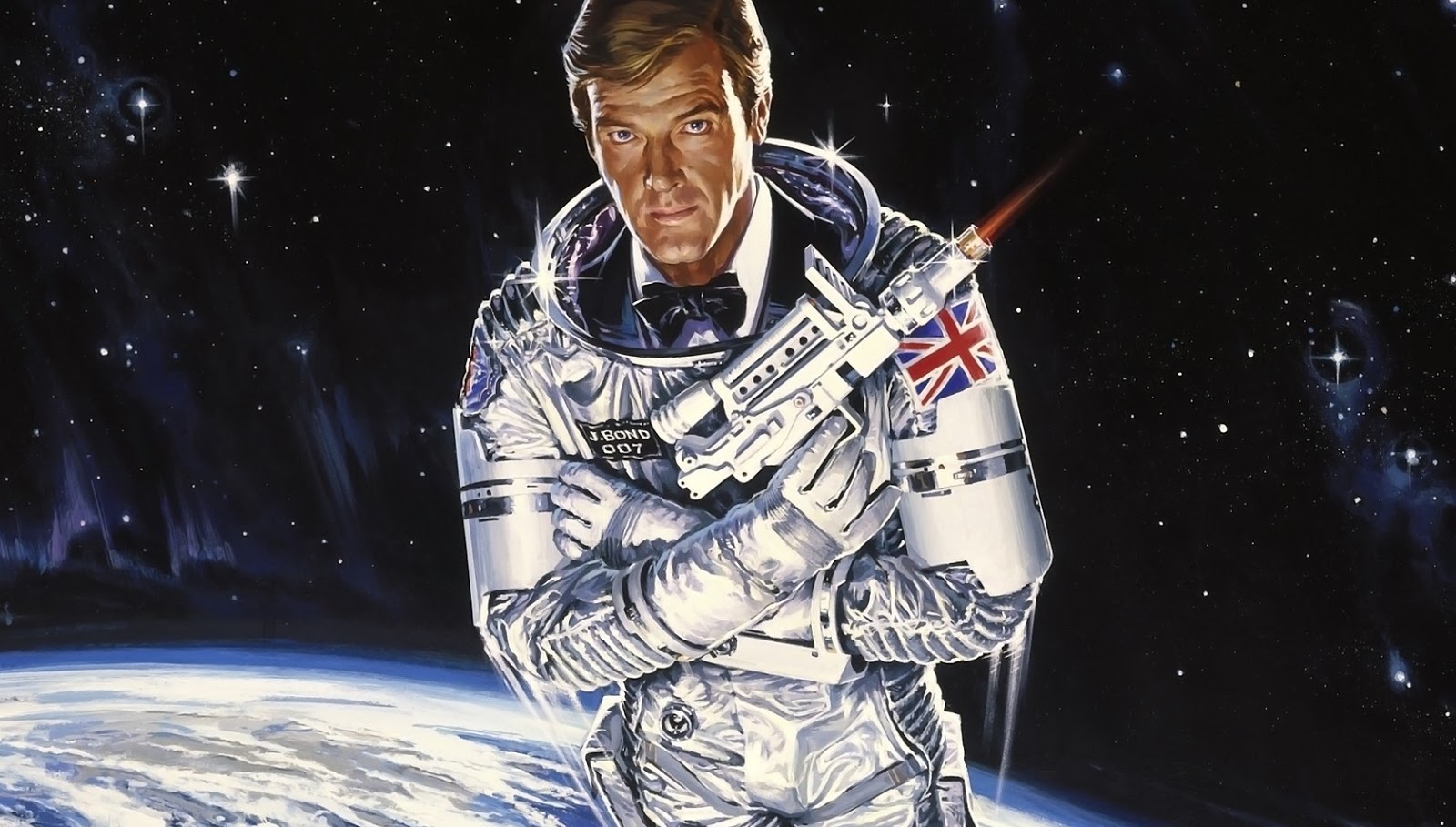
A fusion of YOU ONLY LIVE TWICE and THE SPY WHO LOVED ME, MOONRAKER sees Roger Moore in his fourth Bond movie, the first 007 picture to adhere to the summer Hollywood blockbuster.

THE largest grossing James Bond until GOLDENEYE, MOONRAKER is the most preposterous of all 007 adventures, but does benefit from stunning locations, extraordinary Ken Adam sets and Derek Meddings' Oscar-nominated effects. When Hugo Drax (Michael Lonsdale)'s Moonraker shuttle vanishes, Bond (Roger Moore) questions the billionaire at Drax's luxurious California estate. In Venice, Bond uncovers a laboratory manufacturing a deadly gas, which he learns is to destroy life on Earth so Drax Industries can preside over a master race on an opulent space station. Together with undercover CIA agent Holly Goodhead (Lois Chiles), United States Marines and former Drax henchman Jaws (Richard Kiel), 007 thwarts the plans and destroys the poison capsules jettisoned towards Earth. 

Because of prohibitive British tax laws, this movie became a £30m Franco-British co-production (which explains the high proportion of French cast and crew), and took precedence over FOR YOUR EYES ONLY because it could cash in on the STAR WARS phenomenon (even Cubby Broccoli admitted they went too far). MOONRAKER particularly suffers from loose editing, obvious product placement and an overbearing comedic tone; when Jaws - in the pre-credits sequence - lands without the benefit of a parachute onto a circus tent, it acts as a signpost of what is to come. Even Shirley Bassey can't save the insipid theme (allegedly offered to Kate Bush, who sensibly declined the offer). But the narrative is nonsensical: for a motion picture which prided itself on the technical advice from NASA, the space battle is still full of laser sound effects (the vacuum of the stars has never hindered filmmakers), and it is a mystery why the RAF are transporting a fuelled shuttle in the first place.

"Look after Mr Bond. See that some harm comes to him;" 
Michael Lonsdale is effortlessly creepy as Hugo Drax.

Performances are also negated by the superficiality. In stark contrast to his assured performance in THE SPY WHO LOVED ME, Moore telephones his eyebrows and charisma in, and looks nondescript in a number of outrageous sequences (especially on board the embarrassing inflatable gondola). Chiles makes for an appealing but functional Bond girl, and the effectiveness of Drax servant Chang (Toshiro Suga) is overshadowed by the slapstick. But this is nothing compared to Blanche Ravalec as Jaws' girlfriend Dolly, who, together with Sheriff Pepper, ranks as the most inappropriate role ever to grace a Bond. Pint-sized, pig-tailed and bespectacled, Jaws falls madly in love with Dolly and are inseparable for the rest of the film. Long standing characters are treated only on a rudimentary basis; though assigned to MI6's Brazilian HQ, Moneypenny (Lois Maxwell) carries on her sidelining during the Moore era with a brief appearance, but at least Maxwell's real-life daughter appears in a non-speaking role as one of Drax's perfect specimens.

Ian Fleming's original Moonraker novel of 1955 is the only Bond book that takes place solely in Britain, and consequently has been described as the author's hymn to England. Featuring a nuclear warhead destined for London, the film retains only the lead villain's name, the label of the rocket, and an undercover love interest. The novel paints a very different Drax, who is a Nazi in Britain under the employ of the Soviet Union; he has had plastic surgery and one side of face is permanently scarred. This, together with red hair and a moustache, sees Fleming liken the character to a ringmaster. Amazingly, the first adaptation of Moonraker was a year later on South African radio, with future BLOCKBUSTERS host Bob Holness as everyone's favourite secret agent.

Wednesday, January 1, 2020

Bond and Beyond (Part I of II)

THE SPY WHO LOVED ME (1977)

Nobody does it better; Roger Moore and Barbara Bach both give outstanding performances in this iconic Bond movie.

WHILE on a mission in Austria, Secret Agent James Bond 007 (Roger Moore) encounters a set of Russian operatives and kills Sergei Barsov (Michael Billington). Meanwhile, Allied and Soviet nuclear submarines are disappearing, so M (Bernard Lee) and his KGB counterpart General Gogol (Walter Gotell) assign 007 and leading Russian spy Major Anya Amasova (Barbara Bach) to work together and investigate. The leading suspect is reclusive Karl Stromberg (Curt Jurgens), a billionaire shipping magnate who has a unique operational base: Atlantis, a structure in the sea at the centre of his plans for a new aquatic world order. Bond and Amasova discover that Stromberg has been using his huge cargo ship Liparus to capture the submarines and imprison the crews, planning to use the subs to launch nuclear missiles to destroy civilisation. The two agents initially forge an uneasy alliance, which is further tested when Amasova realises that it was Bond who had murdered her lover, Barsov.

Freed from his strained relationship with Harry Saltzman, and following the lukewarm reception for THE MAN WITH THE GOLDEN GUN, Cubby Broccoli was determined to re-energise the Bond franchise. Yet the project was not a smooth ride: a disjointed script writing process - which had included the resurrection of SPECTRE and input of writers as diverse as Anthony Burgess and John Landis - was further shadowed by a court injunction obtained by Kevin McClory, who was attempting to remake THUNDERBALL. TV puppetmaster Gerry Anderson also instigated legal action when he discovered that some aspects of the script bore a resemblance to a MOONRAKER proposal he had submitted with UFO script editor Tony Barwick prior to DIAMONDS ARE FOREVER. Anderson was persuaded to drop the case, and rights were purchased by the producers.

A Steel-toothed character adapted from Ian Fleming's bad boy Horror, Richard Kiel's Jaws is one of the most recognisable Bond villains, but a missed opportunity. A nudging joke has the character bite and fight a shark at the end, but another less obvious tie-in is that JAWS director Steven Spielberg was approached to helm the picture, only to allegedly ask for too much creative control.

All this acts as problematic metaphors for Ian Fleming's novel The Spy Who Loved Me itself, the writer's most bizarre book. A total anomaly, it is written from the heroine's viewpoint, much of the action takes place in a motel room, and Bond himself doesn't appear until late on. Allegedly based on a true story, it was Fleming's intent to move away from the standard 007 format after criticisms of the Bond novels. After even greater disapproval, the author claimed at one point he just found the manuscript on his desk anyway. Consequently, when he sold the film rights of the books to Broccoli and Saltzman, Fleming specified that the source material was to be reinvented for the big screen and only the title could be used. 

With a screenplay eventually in place - a combined effort credited to Richard Malbaum and Christopher Wood - production designer Ken Adam warned Broccoli that no sound stages in existence could accommodate the envisioned tanker battle climax; when Cubby simply instructed "then built it," it marked the creation of the famous 007 Stage at Pinewood, and also illustrated the kingpin's determination for the most spectacular Bond yet. Made for a then gargantuan $13.5m, THE SPY WHO LOVED ME contains exemplary Derek Meddings modelwork and is generally a visual stunner - filming major sequences in Egypt, Sardinia and the Bahamas - and unleashes the beautiful Lotus Esprit into the pantheon of extraordinary gadgets. The female cast are also particularly stunning - even the hotel receptionist is played by Valerie Leon - and Bach remains one of the most attractive lead women ever to grace a Bond film.

Veteran German actor Curt Jurgens as Stromberg. Underdeveloped and underplayed, the villain joins the ranks of Gustav Graves from DIE ANOTHER DAY, Brad Whitaker from THE LIVING DAYLIGHTS, and Elliot Carver from TOMORROW NEVER DIES as most ineffective menaces in the world of James Bond.

In essence a YOU ONLY LIVE TWICE remake, director Lewis Gilbert returns for what is widely regarded as the high mark to Moore's tenure, but there are issues. The comedic one liners still grate, and Marvin Hamlisch's dated score cheapens the action. But the main problem is Stromberg; a wet fish himself, Jurgens even has webbed fingers, which are never directly referred to. One of the dullest of Bond villains, he is another adversary who is reduced to pushing buttons and issuing ultimatums (his demise is also anticlimactic, providing a low key shootout). Even his rogues gallery are a mixed bag: dubbed by Barbara Jefford, Caroline Munro sizzles as helicopter assassin Naomi, Milton Reid's hulking henchmen Sandor is soon despatched, and the effectiveness of Richard Kiel's dim-witted but determined Jaws (in a role where David Prowse and Will Sampson were considered) is diluted by being increasingly used for light entertainment, an issue taken to another level for MOONRAKER.