

Strangulation as art in Hitchcock’s penultimate picture.
IN England for his first feature since STAGE FRIGHT in 1950, Alfred Hitchcock's FRENZY seized the opportunity for what most critics term a return to form. Adapted by playwright Anthony Shaffer from Arthur La Bern's novel Goodbye Piccadilly, Farewell Leicester Square, FRENZY is the story of a series of rape-murders committed by suave Covent Garden fruit-merchant Bob Rusk (Barry Foster), who throttles women with a necktie. Being Hitchcock - himself the son of a greengrocer - suspicion falls on the wrong person, ill-tempered former-RAF officer turned bartender Richard Blaney (Jon Finch). The screenplay is crafted a little too deliberately, as the detective plot seems mechanical underneath its oh-so-English tone. But the film has long been greatly undervalued, and resurrects many conventions of the director's first hit, THE LODGER.
Hitchcock had laboured under censorship restrictions throughout his career, yet FRENZY was made when controls had eased. Consequently, the rape and murder of Blaney's ex-wife Brenda (Barbara Leigh-Hunt) is as explicitly nasty as the director ever got, and after this scene the film doesn't need to portray subsequent killings. This enables Hitchcock to execute one of his finest shots, as Blaney's girlfriend Babs (Anna Massey) is killed off-screen ("you're my type of woman") while the camera retreats backwards down the stairs, through the front door, and then across the street to join the people outside. And the sequence where Rusk has a tussle in a potato truck with Bab' uncooperative corpse - clutching the discriminating evidence of a tie pin - is the most black comedic scene Hitchcock ever filmed. It's rewarding to see Hitch - after fifty years in the business - still executing with such aplomb.
Hitchcock had laboured under censorship restrictions throughout his career, yet FRENZY was made when controls had eased. Consequently, the rape and murder of Blaney's ex-wife Brenda (Barbara Leigh-Hunt) is as explicitly nasty as the director ever got, and after this scene the film doesn't need to portray subsequent killings. This enables Hitchcock to execute one of his finest shots, as Blaney's girlfriend Babs (Anna Massey) is killed off-screen ("you're my type of woman") while the camera retreats backwards down the stairs, through the front door, and then across the street to join the people outside. And the sequence where Rusk has a tussle in a potato truck with Bab' uncooperative corpse - clutching the discriminating evidence of a tie pin - is the most black comedic scene Hitchcock ever filmed. It's rewarding to see Hitch - after fifty years in the business - still executing with such aplomb.
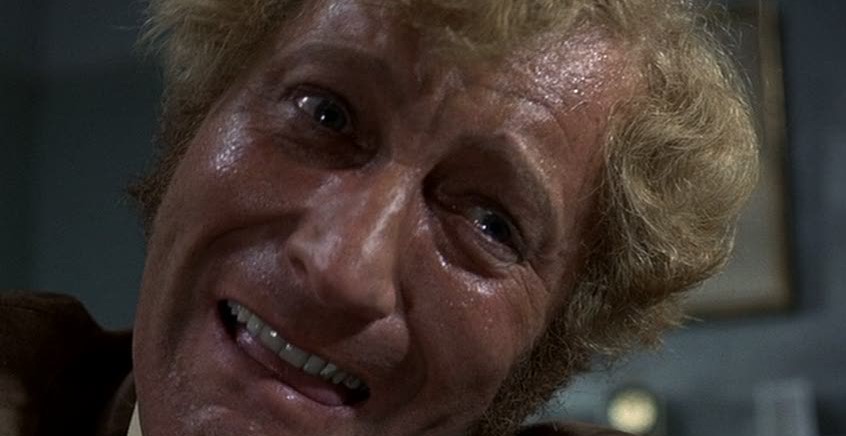
"Lovely, lovely”; Barry Foster is The Necktie Killer.
Claims that Hitchcock was a misogynist - or at least had a neurotic compulsion to mistreat women in his films - had increasingly haunted the auteur; true, Tippi Hedren's ordeal in the attic with THE BIRDS is gratuitous, but arises inevitably from dramatic situation. Even Hedren, despite her quarrels over the director's possessiveness, had no complaints about the support he normally gave her. In his private and professional live Hitchcock was always surrounded by women; he and his wife had one child, a daughter, and she produced three grandchildren, all females. There was a succession of women personal assistants, as well as the usual complement of secretaries, but his wife Alma was the most professional aid of all, and always the ultimate authority in the cutting room.
Similarly, Hitchcock's hatred of actors has been exaggerated. The director believed that performers should only concentrate on their artistic presentation and leave work on the script to the director and screenwriter. Before filming began, tensions grew between Hitchcock and Finch, with the actor earnestly telling reporters that the director seemed past his prime, and that the cast might have to improvise to improve the quaint script. Hitchcock never forgot this violation, and gave Finch no warmth on set, so the actor remained as off balance as Blaney throughout the story. Over the years, there was a persistent rumour that the director had said that actors were cattle; Hitchcock denied this - typically tongue-in-cheek - clarifying that he had only said that actors should be treated like cattle. For him, like the props, the performers were part of the film's setting.
Similarly, Hitchcock's hatred of actors has been exaggerated. The director believed that performers should only concentrate on their artistic presentation and leave work on the script to the director and screenwriter. Before filming began, tensions grew between Hitchcock and Finch, with the actor earnestly telling reporters that the director seemed past his prime, and that the cast might have to improvise to improve the quaint script. Hitchcock never forgot this violation, and gave Finch no warmth on set, so the actor remained as off balance as Blaney throughout the story. Over the years, there was a persistent rumour that the director had said that actors were cattle; Hitchcock denied this - typically tongue-in-cheek - clarifying that he had only said that actors should be treated like cattle. For him, like the props, the performers were part of the film's setting.

"The Governor" shooting in Covent Garden.
There is little hope in FRENZY, reflecting a world which is irrevocably fallen; women are harridans or naive lambs for the slaughter, while the men are either brutes (the hero Blaney is an implied wife-beater) or simpletons telling rape jokes over the bar, and the nicest people end up dead. Somehow the world seems to be at the end of its tether, where human beings are reduced to the same level as food and waste, and abandoned - as the rape scene suggests - by any rationale. In fact, FRENZY can be viewed as the culmination of a hostility against the world that Hitchcock begun back in the 1920s.

