Showing posts with label John Bolton. Show all posts

Thursday, January 15, 2015

House of Video Nasty Horror

The Suppression of House of Hammer in America
Video Nasty (2014)

Uncredited cover art for Warren's House of Horror #1 (April 1978), an "ashcan" produced to quash Top Seller's intention of House of Hammer reaching US shores.

AT the beginning of 1978, the US publishing empire of Jim Warren - responsible for Famous Monsters of Filmland and the b&w comic magazines Creepy and Eerie - announced a new quarterly venture House of Horror to be made available through their in-house mail order service Captain Company. Yet the truth was that the publisher rushed this magazine - which was always intended as a one-shot - into print for copyright reasons, securing the name and halting Top Seller's plan to release their respected House of Hammer in America under the same title. Warren was infamous for his volatile working practices, but any publisher who had the audacity to challenge his domain particularly created embitterment. Both mags were reprints: hardly a House of Horror at all, Warren's effort revisited paste-ups from Famous Monsters such as the special effects of CLOSE ENCOUNTERS and the robots of STAR WARS; Top Seller's collation included John Bolton's CURSE OF THE WEREWOLF comic adaptation, a George A. Romero interview, and Brian Lewis' VAMPIRE CIRCUS cover which originally graced House of Hammer #17.

When Warren immediately filed for copyright infringement against the British invaders, the US courts upheld his claim, so Top Seller's American adventure lasted two issues: (Hammer's) House of Horror #1 and the next issue of the regular title, #19, which received limited distribution. Because of this, Top Sellers were forced to change the name of their homegrown version to (Hammer's) Halls of Horror with #20. This was a stunt the American publisher also pulled over the fabled birth of Eerie in 1965. Warren printed around 400 copies of House of Horror, but only 200 editions of Eerie #1 existed. Warren discovered that another publisher who used the same distributor was bringing out an imitation of Creepy called Eerie, thereby inventory material from Creepy was used to cobble together his version of the title, which was on the newsstands outside his distributor's building the following morning. The most ridiculous aspect was that Warren had his facts wrong: the company who challenged him was Eerie Publications, and the magazine in question was called Weird.

Each with a cover by Graham Humphreys, Video Nasty is a breezy Reaper comic that deals with weighty agendas.

Top Sellers supremo Dez Skinn remains tactful towards Warren, championing his business sense. Warren initially heard the news of the British assault in Comic Media News, where Skinn proudly announced 200,000 copies of his House of Horror were set to conquer America. By the most unlikely of coincidences, that same issue featured an interview with Warren, so the editor sent him a complimentary copy. The first Top Sellers knew of the situation was when their office received a letter from Warren’s lawyers, stating that shipping copies for US distribution would be infringing the copyright of their client’s “well established” House of Horror magazine on which a “considerable amount” had been spent. The hard fact is that, against this messy backdrop, American readers were deprived of a quality publication, instead left with the pictorial and pun-filled standard of Famous Monsters.

Former comic store owner turned independent writer, Mario Covone's six-issue Video Nasty is set in 1983 Kettering, and uses both the video panic in Britain, and the political climate of the era, as its provocative foundation. Along with Greek artist Vasilis Logios, Covone has produced a love letter to the genre, inspired by the documentary VIDEO NASTIES: MORAL PANIC, CENSORSHIP AND VIDEOTAPE and Lucio Fulci's THE BLACK CAT. Characters are archetypes without being bland, as the police, neo-Nazis and a film director turned media scapegoat are sucked into a pit of depraved murders. Mario's crisp dialogue creates a flowing yarn which exists in a fictionalised but recognisable tableau - the relocation from Manchester to Northampton of "God's Cop" Chief Constable James Anderton for example, as he instructs officer David Gorley to look at video nasties for case research (by the end of the second issue, Gorley has acquired ZOMBIE FLESH EATERS and CANNIBAL HOLOCAUST from his friendly video store). What inevitably hurts the book is the frighteningly sketchy interior art of Logios; proportions vary wildly from panel to panel, and what is even more surprising are the standard of Graham Humphreys' covers; while #5 and #6 have a grandiose power, the first four covers lack focus.

Thursday, March 15, 2012

The Greatest Monsters of All

THE MONSTER CLUB (1980)

John Carradine, Vincent Price and friend 
fail to liven up this banal portmanteau.

PRODUCED by former Amicus supremo Milton Subotsky and directed by Hammer veteran Roy Ward Baker, THE MONSTER CLUB opens with horror writer Ronald Chetwynd-Hayes (John Carradine) being attacked by Eramus (Vincent Price), a vampire faint from lack of blood. Assuring the victim that his bite was not deep enough to cause effect, the grateful Eramus takes the author to the title establishment, where Eramus explains the basic rules of Monsterdom, and illustrates with three tales. We see the story of Angela (Barbara Kellerman), her bullish boyfriend George (Simon Ward), and Raven (James Laurenson), the gentle but repulsive Shadmock whose lethal power is his whistle. Secondly we learn of Lintom (Warren Saire), whose father (Richard Johnson) is a vampire. Lintom is having trouble at school and is befriended by what seems to be the local vicar, but is actually Pickering of Special Branch (Donald Pleasence), concerned with eradicating the undead. Finally, an American horror filmmaker (Stuart Whitman) is on a location scout, and finds what he is looking for in a village of ghouls. In the coda, Erasmus proposes Ronald for membership. But the creatures protest that Ronald is a human being, whereupon Erasmus, citing man's ingenuity for destruction, proves that humans are the greatest monsters of all.

Linking these stories are rock bands - including B.A. Robertson swathed in blue for 'I’m Just A Sucker For Your Love' and Stevie Lange singing the sordid tale of 'The Stripper' - while extras wearing mail-order monster masks gyrate their dance moves. Even in the wake of DAWN OF THE DEAD and FRIDAY THE 13TH, Subotsky ploughed on undeterred with his quaint, juvenile brand of terror. Moviegoers no longer identified with ghosts and vampires, let alone a joint full of them, but at least THE MONSTER CLUB doesn't take itself too seriously. The second story - re imagining the childhood of Subotsky as "Lintom Busotsky, vampire film producer" - has been justly cited as one of the worst stories to grace any anthology, and is certainly on the same disastrous scale as the killer piano from TORTURE GARDEN. But Pleasence relishes his role; no-one could have possibly, even in 1980, uttered lines like "I'll see you home from school. It’s alright, I’m not a stranger, I’m a clergyman" with such aplomb.

"You could still love me": a page of John Bolton artwork for the fabled THE MONSTER CLUB comic magazine.

The most interesting thing about THE MONSTER CLUB is its unorthodox evolution. With Price, Carradine and Pleasence signed, but no time to shoot any footage to promote the project at Cannes, Subotsky turned to Dez Skinn, publisher of House of Hammer magazine. The producer had always been envious that his main rival had a promotional outlet, and asked for a comic strip adaptation to sell the film. Writing the strip himself, Skinn assigned artists John Bolton (stories 1 and 3, plus framing sequences) and David Lloyd (for story 2). With a print run of just a few hundred copies, Subotsky had his tool to target buyers, but also had a document that would act as a unique storyboard and source book for the production. The strip later surfaced in Quality's relaunched Halls of Horror, and was also part of Eclipse's John Bolton's Halls of Horror comic under the title 'The Monster Cabaret'. Amusingly, Eclipse took the notion further by dovetailing Bolton's adaptations of THE CURSE OF THE WEREWOLF and ONE MILLION YEARS B.C. from House of Hammer into this two issue 'Micro-Series,' with Eramus acting as an EC-style horror host. For Bolton, his conceptual art lead to work on the movie itself, producing the striking 'Tree of Monsters' plaque in the club, and the 'Ghoul history' in the final segment.

Tuesday, February 1, 2011

Love Will Tear Us Apart

THE CURSE OF THE WEREWOLF (1961)

Oliver Reed and Yvonne Romain in an impossibly-staged publicity still. Reed and Romain had a closely tied association with Hammer; the actress plays Reed's mother - who dies in childbirth - for THE CURSE OF THE WEREWOLF, then became his fiancee in CAPTAIN CLEGG before sharing their third appearance in THE BRIGAND OF KANDAHAR.

UNLIKE the literary origins of Dracula and Frankenstein, zombies and werewolves are rooted in folklore. Consequently, the living dead and shape-shifting sub-genres have treated film as their developing texts: George A. Romero basically re-invented the zombie with NIGHT OF THE LIVING DEAD, while THE WOLF MAN similarly set the precedence for romantic dread. Subsequent werewolf appearances were negligible until advances in make-up effects unleashed a slew of transformation pictures in the early 1980s, where THE HOWLING and WOLFEN developed lycanthropic societies coexisting with humans, and THE COMPANY OF WOLVES a link with menstruation. This exploration also seemed in tandem with developing body horror concerns, not only with cinema spectacles such as THE THING and VIDEODROME, but with the onset of AIDS.

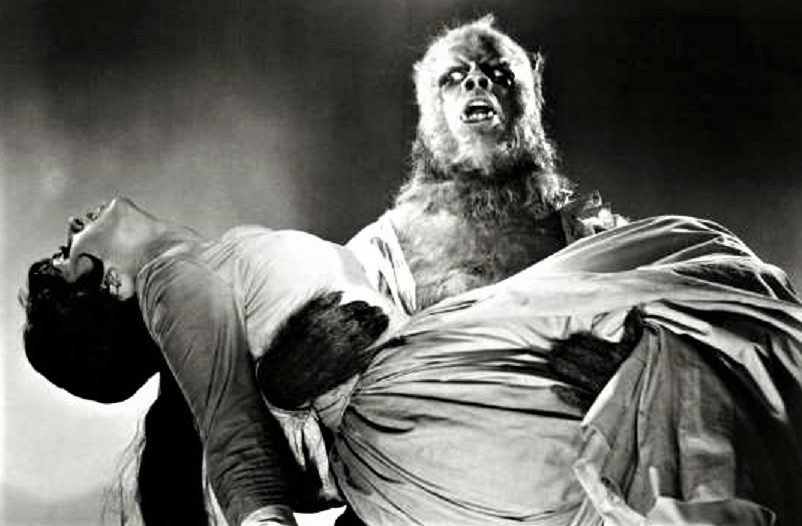
Werewolves were limited to a triptych of releases during the British horror period of the 1960s and 70s. Amicus’ lupine whodunit THE BEAST MUST DIE was joined by two features inspired by Guy Endore’s 1933 novel The Werewolf of Paris: Hammer's THE CURSE OF THE WEREWOLF and Tyburn's LEGEND OF THE WEREWOLF. Directed by Terence Fisher and written by producer Anthony Hinds under the pseudonym John Elder, THE CURSE OF THE WEREWOLF is by far the best remembered. It is a flawed, visceral melodrama of lycanthropy from birth to death, ponderous in its pacing, but the film effectively focuses on the inner turmoil of man into wolf, benefiting from make-up artist Roy Aston's most accomplished work and arguably propelling young Oliver Reed onto the road to stardom. Pulverised by the Monthly Film Bulletin which claimed the film was "a singularly repellent job of slaughter-house horror," the picture ranks as one of the most brutal of all Hammer productions.

Oliver Reed's werewolf was the cover star of Warren publishing's low-brow Famous Monsters of Filmland #12 (June 1961).

The film opens with a beggar (Richard Wordsworth) visiting Castillo Siniestro, where the Marquis (Anthony Dawson) is celebrating his wedding. The beggar irritates the nobleman, who has him thrown into the dungeons where he remains forgotten by all but the jailer and his mute daughter (Yvonne Romain). After many years - with the Marquis decrepit and his wife long dead from his brutish behaviour - the Marquis sexually assaults the servant girl. When she rejects his advances, he has her thrown into the dungeon where the beggar - now reduced to a slavering animal - rapes her then dies in the act of violation. When the girl is freed, she stabs the Marques to death and flees into the woods, where kindly scholar Don Alfredo (Clifford Evans) rescues her. The girl dies in labour after giving birth to a son from her ordeal, and as the young Leon (Justin Walters) grows, he is increasingly troubled by dreams of drinking blood. Diagnosed with lycantrophy, the only cure is for Leon to be within a loving environment. Reaching manhood, Leon (Oliver Reed) - denied access to his love Cristina (Catherine Feller) - goes on a murderous rampage.

Endore's source material emphasises a number of aspects that cinema - at the time - could not dare to adhere to. Endore's rapist was a priest, not a beggar, for example, and the afflicted Bertrand and his love Sophie in the book avoid the violent effects of his transformation by cutting into parts of her body and allowing him to suck her blood ("her body was a fountain of blood to him, and it was if her body responded to his needs, like a nursing mother with milk.") In contrast, the film superficially represents the bond between Leon and Cristina in typical Hollywood fashion - the closest to a love story Fisher achieved  - that never touches on such sado-masochistic tendencies. Furthermore, the movement of the novel's locales to Santa Vera, Spain, centre around the abandoned Spanish Inquisition drama THE INQUISITOR/THE RAPE OF SABENA. After distributors Columbia feared condemnation by the Catholic Church's Legion of Decency, the project was pulled from Hammer's schedule, leaving a number of sets taking shape on the Bray lot which were then integrated into Fisher's film.

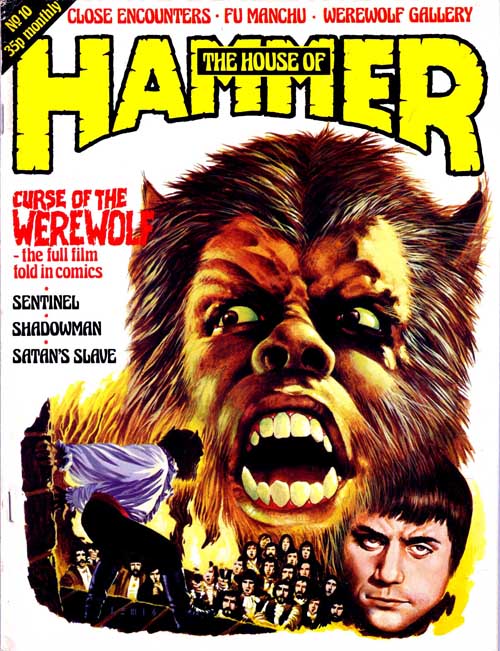
The House of Hammer #10 (January 1978) included a comic adaptation of THE CURSE OF THE WEREWOLF. Drawn by John Bolton, the strip acted as the flagship for this special werewolf issue.

With Reed not appearing until roughly the halfway mark, the extended prologue detailing Leon's lurid conception is suitably heady but prolonged. It is detrimental to the mechanics of the film that Reed and Evans' central performances could not be afforded more screen time, but the movie suffers from a number of time anomalies, surprising considering Fisher's trademark linear style: Leon’s feelings for his eternal love develop too quickly and off-screen, and Alfredo somehow narrates the preceding events which he could not have been akin to. Hammer also adheres to several cliches of the werewolf picture but also establishes new ones of its own. Lycanthropy is presented not as a disease but as an accursed birthright, and Leon's bestial instincts can be suppressed by the feelings of inner peace and comfort brought about by love, while the emotions of rage and frustration have precisely the opposite effect. Therefore Leon is subconsciously in control of his own fate, his werewolf dependent not just on the occurrence of a full moon but also upon Leon's state of mind. But like most cinematic werewolves, the character is not painted as a villain but as a personable young man ultimately condemned to a second existence of blood lust by circumstance.

Ashton's make-up effects for the wolfman, the Marquis and the beggar are uniformly excellent. Aston himself had suggested to Hinds that Reed's bone structure would be ideal for the role, and the success of the monster is that it is part-man and part-wolf, encapsulating Reed's ferocious snarls, especially starling when blood drips from his mouth. With this avenue for human expression, the tragedy of the werewolf is not lost, unlike later films which are reliant on mechanical effects and CGI, which overshadow any levels of performance. The Marquis' design explored how make-up could define a character's prolonged debauchery - especially memorable in the scene where Dawson picks his skin in an attempt to improve his appearance for the servant girl - and the beggar's own mutation into beast would not feel out of place on The Island of Doctor Moreau.

Universal - who owned the source material - contracted Hammer to make THE CURSE OF THE WEREWOLF. A film very much playing like THE WOLF MAN's bastardised relative, its horde of "Angry Mob" villagers who hound Leon at the climax - seen here underpinning this one-sheet - was Universalesque in its own right.

Dawson is suitably lecherous as the Marquis, and Wordsworth - having been similarly effective as the man/monster of THE QUATERMASS XPERIMENT - is both touching and frightening in a role ranging from abused beggar to feral man. Evans brings a subtle facade to the role of adoptive father, emotionally distraught yet resolved to end his sons misery. Without question, however, it is Reed's film. While the "Hammer Heavy" was evidently not quite the finished article at this point in his career, his portrayal conveys pathos and menace and amusingly, when he does appear, he's soon working in a winery, surrounded by bottles. Romain is enchanting as the exotic, raven-haired servant, but the rest of the cast are a mixed bag. Michael Ripper is wide-eyed as Old Soak and Desmond Llewellyn makes an appearance as a footman, but John Gabriel - as a priest - and Martin Matthews - as Leon's best friend - bring nothing to their roles. And in a refreshing quirk, Peter Sallis appears as mayor Don Enrique, 45 years away from similar circumstances voicing Wallace in the clay-mation favourite THE CURSE OF THE WERE-RABBIT.