Showing posts with label Dinosaurs. Show all posts

Tuesday, July 1, 2014

Prehistoric Pap

WHEN DINOSAURS RULED THE EARTH (1970)

"Enter an age of unknown terrors, pagan worship and virgin sacrifice..." The "gigantic spectacle" of WHEN DINOSAURS RULED THE EARTH.

AFTER the world-wide success of ONE MILLION YEARS B.C., Hammer's first cash-in was actually completed while the Raquel Welch extravaganza was still in post-production: PREHISTORIC WOMEN. Even though the studio flirted with forgotten lands in 1967's THE LOST CONTINENT - whose monsters acted more as a prelude to Amicus' lost world pictures - Hammer's follow-up to ONE MILLION YEARS B.C. proper didn't appear until late 1970. Developed into a screenplay by director Val Guest from a treatment by novelist J.G. Ballard, WHEN DINOSAURS RULED THE EARTH begins with Kingsor (Patrick Allen) sacrificing blonde virgin Sanna (auburn-haired Victoria Vetri, sporting a blonde wig). She is saved when winds sweep her over a cliff and into the arms of Tara (Robin Hawdon), a man from a fishing tribe. Tara welcomes Sanna into his clan and they fall in love, much to the annoyance of Ayak (Imogen Hassall). When the moon appears in the sky for the first time the tribe panics, with Ayak accusing Sanna of witchcraft. The outsider flees into the jungle where she is forced to survive amid prehistoric beasts, which includes being accepted by a mother dinosaur as one of her own hatchlings.

The real curse of ONE MILLION YEARS B.C. was that Hammer found itself unable to afford the star attraction of Welch, or control the runaway success of its stop-motion animator Ray Harryhausen. Harryhausen was engaged with THE VALLEY OF GWANGI, and suggested Ohio-born SPFX creator Jim Danforth to lead Hammer's visual effects department on the picture. Danforth would eventually be rewarded with an Academy Award nomination, but only after an exhausting association with his employers. With little time for location work, a decreasing deadline and spiralling budget, he was aided by Roger Dicken, David Allen and Brian Johnson. Using real-life lizards and alligators as padding, the production still had to lose two major effects sequences: one involved a horde of giant ants, the other two pterodactyls. Against this backdrop of blood, sweat and tears, Danforth delivers a number of memorable scenes, such as villagers fighting off a rampaging Plesiosaur with flames, and a Triceratops pursuing a caveman to the edge of a precipice.

Imogen Hassall is jealous cave girl Ayak. Referred to as "the countess of cleavage" because of her revealing outfits worn at film premieres, the actress was a regular performer in 60s and 70s cinema and television. In 1980 - at the age of 38 - she committed suicide at her Wimbledon home by overdosing on Tuinal tablets.

The Canary Islands give WHEN DINOSAURS RULED THE EARTH an expansive glow that belies such juvenile fantasy. As with ONE MILLION YEARS B.C., there is no intelligible dialogue, only a series of grunts and gesticulations; in Wayne Kinsey's book Hammer Films: The Elstree Studio Years, Guest states "I invented and wrote a whole new language. I actually thought if we could do this really believing in what you're doing we may get away with it." Ballard said that he was "very proud that my first screen credit was for what is, without doubt, the worst film ever made." Why such an experimental new wave science fiction author would become involved with an immature Hammer dinosaur picture has remained a mystery to this day.

The movie is also hindered by 21-year-old Vetri, hardly an equal to the iconic Raquel Welch. In Tom Weaver's interview book Double Feature Creature Attack, Guest describes the starlet as "a nitwit" and "a real nothing, and a very strange mixed up lady." As Angela Dorian, Vetri was Playboy's Playmate of the Month for September 1967 and subsequently the 1968 Playmate of the Year. Before donning the fur bikini, Vetri turned down the title role of Stanley Kubrick's LOLITA, and worked mainly in television - including BATMAN and STAR TREK. But she did have a bit part in Roman Polanski's ROSEMARY'S BABY, and later appeared in sexploitation entries INVASION OF THE BEE GIRLS and GROUP MARRIAGE.

Victoria Vetri - aka Angela Dorian - in Playboy September 1967 finery.

Vetri made headlines in 2010 for shooting her fourth husband, Bruce Rathgeb. A year later the charge against her was reduced from attempted murder to attempted voluntary manslaughter, to which she pleaded no contest. The judge sentenced her to nine years in state prison. To further the Polanski connection, the model/actress was friends with Sharon Tate, and following Tate's horrific murder the Polish director gave Vetri his own gun - a Walther PPK - for self protection, a weapon alleged to have been used four decades later in the Rathgeb incident.

Saturday, February 15, 2014

Perils of Linda Hayden

BABY LOVE (1968)
QUEEN KONG (1976)


An excellent kitchen sink drama transported to a wealthy homestead, BABY LOVE portrays damaging and unsatisfied relationships that toil away whatever the background.

BABY LOVE is a complex, underrated sexual pot-boiler, based on the novel by Tina Chad Christian, which sees Luci (Linda Hayden, in a striking debut) live with her promiscuous, hard-drinking mother (an ethereal Diana Dors). Coming home from school she discovers her mother's body in the bathtub, the parent having slit her wrists. Doctor Robert Quayle (Keith Barron), the mother's former lover, receives a letter pleading with him to look after the wayward child. Robert takes Luci to his luxurious home on a trial basis, where she meets his wife Amy (Anne Lynn) and their teenage son Nick (Derek Lamden). Luci holds Robert responsible for her mother's death, and soon her developing sexuality causes friction, manipulating the mechanics of the household by teasing Nick and making advances to Amy.

Hardly a Lolita clone, Luci is a young woman struggling with her feelings of loss at such an informative age, craving the love and intimacy that has been taken away from her; even the attentions of a stranger is better than no attention at all (in one scene, she welcomes a man stroking her legs at a cinema). Hayden - who allegedly lost her virginity during a publicity tour for the film - is amazingly mature in posture and shows, even at this age, that she has no qualms about stripping off for the camera. Indeed, you have to wonder how these scenes - especially when linked with her provocative actions - were ever allowed. Similar to Nastassja Kinski's involvement in TO THE DEVIL A DAUGHTER, at the age of fifteen Hayden is shown naked from behind and also has a few brief topless scenes, blatantly breaking UK obscenity laws and making it extremely unlikely that BABY LOVE could ever get a certificate from the BBFC today. The rare ‘18' rated VHS releases from 1988 and 1994 also seem to show a lack of knowledge by the censorship board.

While BABY LOVE didn’t provide the stardom that producer Michael Klinger had been grooming Hayden for, it did lead to a career in horror and sexploitation, such as this cameo in QUEEN KONG. 

The film explores resentment and tension with ambiguous relish. For example, when Luci grasps Amy's breast in bed (as she sucks her thumb in her sleep) the viewer can either see the sequence as subconscious lesbian flirtation or a child's need for the comfort of a mother's bosom. Thus Amy's growing frustration may be a sexual one, or that the baby girl she has so craved - particularly in an increasingly cold marriage and masculine household - has instead come to her as a young woman. The film has been criticised of taking a more melodramatic slant at the climax, but the shift does illustrate the level of psychological damage Luci has suffered. And the final scene shows Luci's blossoming from the nubile orphan's twisted sexuality to a maturing manipulator who uses allure as her main instrument of communication.

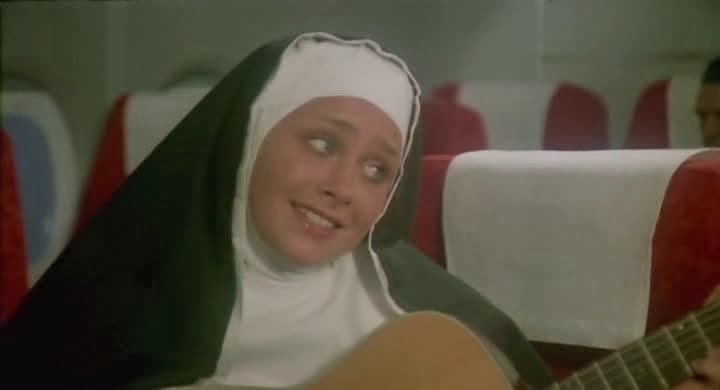
At the other end of the cinematic spectrum, Hayden appeared as The Singing Nun in the atrocious feminist "comedy" QUEEN KONG. Rushed into production on the news that Dino de Laurentiis was remaking the 1933 RKO classic (Dino subsequently issued an injunction against the picture's release), we follow filmmaker Luce Habit (Rula Lenska), who takes Ray Fay (Robin Askwith) - and her all-girl crew - to Africa on yacht The Liberated Lady. Eventually reaching “Lazanga Where They Do the Konga,” they discover a tribe where men are the servants. The Queen (Valerie Leon) prepares Ray as a sacrifice to the simian goddess, but the gorilla is so taken with the hippie dropout she takes him to her lair. When Luce and her crew rescue Ray, they manage to subdue the beast and return to London. But unlike the original, Queen Kong is saved when Ray rallies the oppressed women of our capital. Playing like a terminal merger between the CONFESSIONS and CARRY ON franchises, the only amusement is playing "spot the extra," which includes VAMPYRES star Marianne Morris and future 'ALLO! 'ALLO! mainstay Vicki Michelle.

Monday, February 14, 2011

"You Can't Mesmerise Me, I'm British!"

AT THE EARTH’S CORE (1976)

Caroline Munro is at her most beautiful in AT THE EARTH'S CORE; every male wanted the actress to be a nubile slave girl above anything else.

AMICUS produced a trio of Lost World features: THE LAND THAT TIME FORGOT, AT THE EARTH’S CORE and THE PEOPLE THAT TIME FORGOT, all of which were based on the novels of Edgar Rice Burroughs and shared the same producer (John Dark), director (Kevin Conner) and leading man (Doug McClure). Subscribing to the mentality of matinee cinema, these escapist adventures were released to coincide with school holidays; the 'Saturday morning' ethic has a heritage that stretches back to the serials of the 1930s and 40s, but also applied to the cinematic spin-offs DR WHO AND THE DALEKS and DALEKS' INVASION EARTH 2150 AD, which were co-financed by Amicus under the Aaru banner. Peter Cushing’s portrayal of the eponymous Time Lord in both of these films has much in common with his character Dr Abner Perry in AT THE EARTH’S CORE: a stereotypically British eccentric professor – who stubbornly carries his trusty umbrella at all times - created for a stereotypically juvenile target audience.

Perry – together with David Innes (McClure) – set out to test their earth-boring Iron Mole machine. However, they unexpectedly arrive at the centre of the Earth, where in the cavernous underworld of Pellucidar primitive humans – such as Dia (Caroline Munro, "SEE: The seductive Dia, Princess of the land of Pellucidar") – are enslaved by a prehistoric race of birds with mind-altering powers, the Mahars. With the help of Innes' two-fists and Perry's scientific know-how (plus a skill with bow and arrow), the humanoid tribe overcome their beastly oppressors. Unsurprisingly, AT THE EARTH'S CORE's ending is very different from the book; in Burroughs’s version, Innes escapes to discover that his companion in the Iron Mole is not Dia but the corpse of a Mahar, placed there by Hooja, the Sly One. The film eschews this ghoulish ending in favour of a suitably light-hearted climax, where the Mole emerges through the lawn of the White House.

Peter Cushing plays the Professor similar to his Doctor Who, mixing British eccentricity and stoic, colonial spirit.

Lost World features are synonymous with rubber monsters, and AT THE EARTH’S CORE ("An Adventure Beyond Any Ever Before Filmed!") is no exception. Here we have a lizard/parrot crossbreed pursuing Perry and Innes; the lumbering hippopotamus which Innes is forced into combat; and a fire-belching toad-beast ("SEE: The MOSOPS, whose fiery breath withers trees & plants"). Making amends for these misfires are the distinctly more malicious Mahars, the female mutated pterodactyls ("SEE: The vicious MAHARS, bird-women who feed on human flesh"). Using telepathy to communicate with their foot soldiers - the diminutive spear-toting Sagoths ("SEE: The cruel SAGOTHS, animal-faced soldiers of Pellucidar") - the nastiest moments come at meal times, where the juiciest slave girls are lined up in their chamber.

It is easy to forget Cushing’s more light-hearted roles (Perry's comment to his avian captors "you cannot mesmerize me, I’m British” echoes his quip from HORROR EXPRESS, "monster? we’re British you know!"). In isolated moments of his filmography, the actor gave a jovial twist which was otherwise consumed by his magisterial horrors. Early in his career he played a student in the Laurel and Hardy vehicle A CHUMP AT OXFORD, before developing his comedic craft in BBC productions such as TOVARICH and COMEDY PLAYHOUSE: THE PLAN. Television would also call at the height of his Hammer Horror excesses - Cushing was featured repeatedly as a guest on THE MORECAMBE AND WISE SHOW wondering when he was going to be paid - but the actor was wasted in latter box office "comedies" TENDRE DRACULA and SON OF HITLER. As a bookstore owner in TOP SECRET, Cushing sported a grotesquely large eyeball (the punch line to which he is first seen gazing through a magnifying glass), an arresting image for this most unassumingly playful of men.

Monday, March 1, 2010

Beswick Rules

ONE MILLION YEARS B.C. (1966)
PREHISTORIC WOMEN (1966)

Martine Beswick - a B-Movie queen before the term was created - as Kari in the bewildering PREHISTORIC WOMEN. Here is the actress on the cover of Britain's short-lived movie magazine Showtime (May 1966).

HAMMER'S biggest commercial hit and greatest folly, Don Chaffey's ONE MILLION YEARS B.C. was a success jointly because of Ray Harryhausen's stop-motion dinosaurs and Raquel Welch's doeskin and fur bikini. The feature is a hopelessly anachronistic melange of prehistoric man, volcanoes and reptiles; not only is the film a scientific abnormality, it is also an aberration in the context of the maturing cinematic landscape of the 60s. Away from Harryhausen's creations, ONE MILLION YEARS B.C.'s wafer-thin plot tells of a mixed-tribe love affair between Tumak (John Richardson) of the Rock People and Loana (Welch) of the Shell People. It is all marvellously silly stuff - Michael Carreras' screenplay is devoid of dialogue, relying instead on grunting and pointing.

The sequel to ONE MILLION YEARS B.C. was actually completed while the dino-epic was still in post-production. PREHISTORIC WOMEN - initially released in the UK as SLAVE GIRLS - was hastily devised by Carreras to optimise the costumes and Elstree sets made for the earlier film, and to include the talents of its supporting player, Jamaican-born model/actress Martine Beswick. This fatuous, non-dinosaur production opens with African big game hunter David Marchant (Michael Latimer) mysteriously transported back in time (or is he dreaming?) to the kingdom of a fabled white rhinoceros cult. He encounters Saria (Edina Ronay), one of a number of fair-haired tribe women oppressed by a group of dark-haired vixens led by the evil Queen Kari (played with infectious relish by Beswick).

Ray Harryhausen’s Allosaurus during the village raid sequence of ONE MILLION YEARS B.C. All of his stop motion creatures are filled with enough charisma to act the entire human cast off the screen.

With her angular facial features and stunning physique, Beswick commands attention every moment she's on screen, not so much stealing the film from the others as to rip it from them and devour it whole. Beswick first came to the attention in a pair of James Bond movies - FROM RUSSIA WITH LOVE (as wrestling gypsy Zora) and THUNDERBALL (as Jamaican spy Paula Caplan) - and in her first starring role here Beswick treats Queen Kari seriously, alternately seductive, childish and sluttish. When the warriors first push Marchant before the Queen, she parades in front of him naked, oblivious to anything remotely resembling modesty.

Produced, directed and written (under the pseudonym of Henry Younger) by Carreras, PREHISTORIC WOMEN is fittingly dismissed by critics and Hammer historians alike. However, the movie is a treasure trove for connoisseurs of camp; not only do the phallic implications of the rhino horn make for uneasy viewing, the climactic rhino-on-tracks is unintentionally hilarious. Additionally, the script is a litter of hyperbole, trumped by "the women are sad, and when the heart is heavy, the feet are not light - let there be no more dancing," a statement which the viewer can only wish for during the seemingly endless tribal dance numbers.