Showing posts with label Voodoo. Show all posts

Monday, April 1, 2019

The Man in the Crimson Hood

THE OBLONG BOX (1969)

Alister Williamson is doomed Edward Markham and Sally Geeson sexpot maid Sally in a promotional shot for this AIP release.

THE first film to co-star Vincent Price and Christopher Lee, Gordon Hessler's THE OBLONG BOX starts in Africa, where Julian Markham (Price) discovers that brother Edward (Alister Williamson) has been cursed by voodoo. Back in England, Julian keeps Edward chained in a remote room of the Markham estate, his mental and physical states disintegrating. However, Edward plans to escape with the help of Trench (Peter Arne), Norton (Carl Rigg) and witch doctor N'Galo (Harry Baird), drugging him to give the temporary appearance of death; once buried, Trench and Norton will exhume the coffin and grant him freedom. But Trench pockets his fee and Edward is actually dug up by grave robbers - replete with coffin - for the use of Dr Neuhartt (Lee). Wearing a crimson hood, Edward vows to repay "some very important debts" while staying with Neuhartt, blackmailing the physician for his liaisons with body snatchers.

Scripted by Lawrence Huntington with "additional dialogue" by Christopher Wickling, THE OBLONG BOX has the thinnest of connections to its source Edgar Allan Poe story (it all owes more to H.P. Lovecraft - with its arcane lore and a disfigured outsider - and Rudyard Kipling's The Mark of the Beast). Originally to be directed by Michael Reeves before his own premature death, to further WITCHFINDER GENERAL connections Price is reunited with Hilary Dwyer as his younger sweetheart Elizabeth, but the actor - originally to play both brothers - looks disinterested and tired. Although beautifully shot by John Coquillon, it is a picture of missed opportunities; Price and Lee only share one scene together despite their marquee value (in fact, Lee's death scene), and the reveal of Edward's condition results in what looks to be little more than a bee-stinged nose, particularly disappointing after its long build-up.
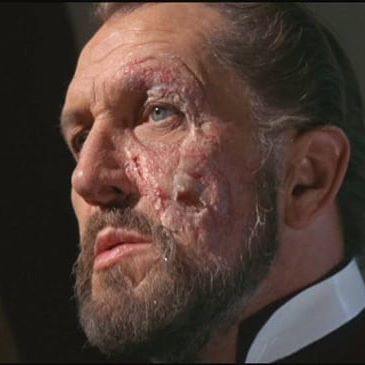
Vincent Price as the diseased Julian Markham. By this stage in his career the actor grew weary of the Edgar Allan Poe adaptations, particularly within the saturation of the late 1960s horror film market.

THE OBLONG BOX belongs to that horror subgenre - THE MUMMY, PLAGUE OF THE ZOMBIESTHE REPTILE, THE GHOUL et al - that echo colonial guilt (remarkably, Hessler's film was banned in Texas for being "pro-Negro"). Julian laments his attitude ("we sinned out there in Africa all right, plundering their land - and we're still stealing their wealth, though they're too innocent to know it") and is revealed to have been the intended recipient of the curse. There is a quiet justice to the conclusion, as Edward bites the hand of his brother, passing on the psoriasis-based condemnation. But ultimately the much re-worked and bloated script carries little gravitas, instead grabbing from more substantive works with no cohesive payoff. This unfocused starting point is further undermined by turgid pacing and padding (the tavern sequences in particular).

Sunday, May 1, 2016

Asylum of Horrors

TALES THAT WITNESS MADNESS (1973)

"Does anyone here love me?" Joan Collins in Mel, where her husband's attentions shift to a tree which he sculpts into the female form.

OFTEN mistaken for an Amicus portmanteau, possibly because of the contemporary setting, this Freddie Francis-helmed anthology was actually made by World Film Services. TALES THAT WITNESS MADNESS was inspired by Amicus' ASYLUM released the previous year, not least because of its mental patient setting, but also by its general outlandishness. Psychiatrist Dr Tremayne (Donald Pleasence) relates four cases to Dr Nicholas (Jack Hawkins, dubbed by Charles Grey): in Mr Tiger, introverted boy Paul (Russell Lewis) confides with an "imaginary" tiger against a backdrop of warring parents; an inherited Penny Farthing causes trouble for antique dealer Timothy (Peter McEnery) and girlfriend Ann (Suzy Kendall); Mel is a piece of tree art that starts frictions between husband and wife Brian (Michael Jayston) and Bella (Joan Collins); and Luau tells of human sacrifice involving literary agent Auriol (Kim Novak) and her daughter Ginny (Mary Tamm), where the latter is consumed to appease an Hawaiian god.

Based on short stories by actress Jennifer Jayne (credited here as Jay Fairbank) - who played Donald Sutherland's vampire bride in DR TERROR'S HOUSE OF HORRORS - TALES THAT WITNESS MADNESS is as literal and silly as most of the Amicus product, but elevated to watchable status by its cast (save for Novak who broke a four year hiatus to overplay her highly unlikable character after replacing Rita Hayworth). Jayston and Collins are particularly in tune to their slice of camp nonsense, Bella understandably annoyed not just because of her husbands wandering eye, but also because Mel - the name carved into its trunk - is damaging her cream shag pile carpet. If there is any overall underlying trend, it is a festering resentment with domesticity and the routine of married/working life.

In what is potentially the most interesting tale, Suzy Kendall encounters a haunted portrait and a time-distorting Penny Farthing.

Similar to the unevenness inherent in comedy sketch shows, the anthology subgenre is noted for its varied quality. As Mark Gatiss stated in BBC4's A HISTORY OF HORROR, it is fun to piece together your favourite portmanteau stories into a single outing; Mel could provide the icing on the cake to the wackiest, perhaps together with the reptile sequence from SECRETS OF SEX, the vampire film producer storyline from THE MONSTER CLUB, and the killer piano from TORTURE GARDEN. Yet the origins of the multi-tale film are held in much higher esteem, taking a cue from the episodic structure of Gothic novels The Monk and Melmoth the Wanderer (1876 and 1878 respectively). In fact, it was German silent cinema which first embraced the notion with Richard Oswald's EERIE TALES, Fritz Lang's DESTINY and Paul Leni's WAXWORKS. DESTINY, in particular, opens up The Grim Reaper as a leading character, omnipresent force and deadly puppet master.

Thursday, March 1, 2012

House of the Uncanny

DR TERROR'S HOUSE OF HORRORS (1965)
THE UNCANNY (1977)

The Protagonist is revealed as Death himself in the climax of
Freddie Francis' DR TERROR'S HOUSE OF HORRORS.

GESTATING from a proposed television series to be hosted by Boris Karloff, DR TERROR'S HOUSE OF HORRORS - Amicus' first anthology - has dated badly. Despite a title that suggests a haunted house or wax museum setting, the framing device actually takes place in a train. Five men are thrown together - apparently by chance - into a railway carriage where they are joined by Dr Schreck (Peter Cushing), who offers to read their futures as prophesied by a tarot deck, his House of Horrors. Each of the five stories are based on horror archetypes: Werewolf deals with Jim Dawson (Neil McCallum), a young architect uncovering the tomb of Count Valdemar, who has cursed the descendants of the man who killed him; The Creeping Vine is the tale of Bill Rogers (Alan Freeman) and a sentient plant; Voodoo has jazz musician Biff Bailey (Roy Castle) visiting the West Indies and stealing the beat of black magic; Disembodied Hand sees painter Eric Landor (Michael Gough) persecuted by Brian Sewellesque art critic Franklyn Marsh (Christopher Lee); and Vampire tells of Dr Bob Carroll (Donald Sutherland), attempting to set up a surgery in a small town where there is a blood-sucker on the loose.

Opening with Schreck enquiring "room for one more in here?" - a direct reference to the Hearse Driver segment of Ealing's seminal portmanteau DEAD OF NIGHT - the stories are unintentionally funny and predictable, subscribing to Amicus co-founder and scriptwriter Milton Subotsky's child-like view of horror. Although there are virtually no exterior establishing shots, Francis' staging and Alan Hume's photography manage to convey some atmosphere and suspense, but DR TERROR'S HOUSE OF HORRORS is notorious for the Voodoo section. A direct steal from Cornell Woolrich's short story Papa Benjamin, everything about the foreign locale is presented as sinister, with White represented as normal while black – with the exception of cockney Kenny Lynch – portrayed as the dangerous other. In contrast, the Disembodied Hand's scenes between Lee and Gough - playing together for the first time since DRACULA - are immensely entertaining, and this story also benefits from Landor's genuinely unnerving severed digits (an Amicus favourite).

"Cats aren't always cute and cuddly!" Felines are pure evil and the true masters of the world, according to Denis Heroux's THE UNCANNY. This Italian A sheet poster is more striking than anything in the film.

By 1977, the anthology format was not so much faltering but on life support. THE UNCANNY is a batty British/Canadian production co-produced by Subotsky. The film begins with writer Wilbur Gray (Peter Cushing) convinced that cats are taking over, and presents a manuscript to his publisher Frank Richards (Ray Milland). This leads to three tales illustrating Gray's claims: the first ("London, 1912") involves Miss Malkin (Joan Greenwood), who bequeaths her fortune to her cats only for the felines to wreak vengeance when a maid and son conspire to steal her fortune; the second ("Quebec Province 1975") is a black magic story of an orphaned girl whose cat is bullied by her new family; and the final segment ("Hollywood, 1936") has horror star Valentine De'ath (Donald Pleasence) killing his wife with the help of his mistress Edina (Samantha Eggar), only to be menaced by the dead woman's cat. Bookmarked by two pretentious quotes, its all gloriously idiotic, and ends on a memorable shot of Gray's eerie breath, lying dead after being ravaged by his tormentors.