Showing posts with label Quatermass. Show all posts

Tuesday, November 1, 2022

Strange World of Terror

THE STRANGE WORLD OF PLANET X (1958)
THE TROLLENBERG TERROR (1958)


THE STRANGE WORLD OF PLANET X is a scientific cautionary tale adapted from the 1957 Rene Ray novel of the same name; a made-for-TV serial, adapted by Ray, had aired previously in the UK and was the basis for the feature.

WITH the arrival of commercial television in September 1955, ITV was determined to follow in the successful science fiction footsteps of the BBC's Professor Quatermass. Two examples - THE STRANGE WORLD OF PLANET X and THE TROLLENBERG TERROR - were masterminded by former atomic scientist Quentin Lawrence. When they also jumped Quatermass-like to the big screen, Lawrence would direct the latter, and both would star grizzled American character actor Forrest Tucker. THE STRANGE WORLD OF PLANET X (released in the United States as THE COSMIC MONSTER) is a painfully dull affair, as the magnetic field experiments of single-minded Dr Laird (Alec Mango) cause freak storms and cosmic radiation that mutates insects and spiders. Laird is assisted by American Gilbert Graham (Tucker) and Michele Dupont (Gaby Andre), who is accepted into the fold once the physicists and the Ministry of Defence except that not only is she a woman but also French. 

Even when a space invader arrives, he is modeled on Klaatu from THE DAY THE EARTH STOOD STILL. Well-spoken and spelling out the situation to the leads, "Mr. Smith" (Martin Benson) reveals himself to be an extraterrestrial emissary, warning that our orbit will be destabilised if Laird's work continues. Complete with obligatory pub scenes and verbal diarrhea, the effectiveness of the mutated creatures is also hindered by the use of micro-graphic stock footage. If any footnote is needed, the production holds the distinction that it was the only time British films ventured into the giant insect sub-genre. 

"The nightmare terror of the slithering eye that unleashed agonising horror on a screaming world!;" THE TROLLENBERG TERROR vacates its freezing mist. 

THE TROLLENBERG TERROR (released in the United States as THE CRAWLING EYE) sees UN troubleshooter Alan Brooks (Tucker) investigating unusual accidents in a (fictional) Swiss mountain range. Traveling to the Trollenberg Observatory to aid Professor Crevett (Warren Mitchell), Brooks meets London-based mind-reading sister act Anne and Sarah Pilgrim (Janet Munro and Jennifer Jayne). A Radioactive cloud sits heavily over the mountains, and when the suspended particles start to duplicate and move towards the hotel, large, one-eyed tentacled monsters attack. Retreating to the heavily fortified observatory, the beasts are subjected to Molotov cocktails and aerial firebombing.

The special effects are not so special; one cloud was achieved by filming a piece of cotton wool on a photograph, and the monsters are too goofy to be taken seriously (their tentacles are also too thin to be threatening). Jimmy Sangster's script is surprisingly unfocused, as several details are left dangling: in a plot thread lifted from Bram Stoker's Dracula, the creatures view psychics as a prime threat, but why do they have a fascination with beheading victims, yet spare others to transform into homicidal zombies? In such a perilous situation you would always follow the likes of Brooks over journalist Philip Truscott (Laurence Payne, retained from the serial) though Truscott gets the girl. In fact Munro is the highlight in her ultimately pointless ESP role, but fairs better than Jayne, who could easily be credited as "Sister Standing Looking Worried."

Sunday, January 15, 2017

Drama Nation

DRAMA PLAYHOUSE - THE INCREDIBLE ROBERT BALDICK (1972)
DOCTOR WHO - THE ANDROID INVASION (1975)

"He cannot resist the inexplicable; almost any happening qualifies for his interest so long as it is out of the ordinary." Terry Nation's stab at DRAMA PLAYHOUSE created Robert Baldick.

FORMING part of the third season of DRAMA PLAYHOUSE - the BBC's launching pad for potential series - THE INCREDIBLE ROBERT BALDICK: NEVER COME NIGHT was Terry Nation's first completed work for the Corporation's drama department since his six episodes of DOCTOR WHO - THE DALEKS' MASTER PLAN in 1965. Directed by Cyril Coke, this never-commissioned pilot is a Victorian Gothic with the titular Baldick (Robert Hardy) an eccentric detective/scientist who owns his own steam locomotive and has a pet owl. A fusion of Sherlock Holmes and Fox Mulder, Hardy plays Baldick with suffocating gusto, but there are too many themes in too short a running time to create a satisfying whole. Elements of Victorian literature (loyal assistants, windswept nights) and Gothic fiction (secrets in the woods, ruined abbey, failed exorcism, unruly villagers) are further complicated by the alien artefact sting, a payoff that is not just a narrative anomaly but an unnecessary Quatermass-like "resolution".

Squire Aldington (Reginald Marsh) and Reverend Elmstead (James Cossins) discover the corpse of a young woman in the reputedly haunted ruins of Duvel Woods Abbey. Elmstead visits friend Robert Baldick, in the hope that the unconventional sleuth will assist in this latest of murders to effect Boardington village ("local legend has it that the deaths go back into prehistory.") Aided by his valet Thomas Wingham (Julian Holloway) and burly gamekeeper Caleb Selling (John Rhys-Davies), Baldick delves into local parish records, and discovers that the Abbey has long been associated with human sacrifice. Excavating deeper within the crypt, fear and anxiety grips the group; Thomas is pulled into a chamber below, which is full of human bones and pervaded by a sense of absolute evil. Baldick is convinced that the Abbey contains a distillation of the terrors and phobias of all the people who have visited the enclose, and later studies a strange object he retrieved from the floor: a small metal box containing intricate electrics and runic symbols.

DOCTOR WHO - THE ANDROID INVASION was the second of two non-Dalek scripts Terry Nation turned in for the series (the first was THE KEYS OF MARINUS from 1964).

Although beautifully shot and well received, the programme suffered from scheduling problems which was triggered by a behind-the-scenes tussle over the name of the character. BALDICK was originally to be shown on 6th September, but in the immediate aftermath of the Munich Olympic massacre, it was removed at the last moment and eventually aired at a later than usual time slot on 2nd October. However, the original airdate of 23rd August was quashed by legal ambiguities between the BBC and Robert Baldick Junior, a PhD student whose father Dr Robert Baldick - an Oxford French literature academic - had granted Nation permission to use his name. Unfortunately Baldick Senior died before the broadcast date, and head of drama serials Andrew Osborn eventually conceded that - although it was too late to change the pilot - the name would change if the venture would develop.

For DOCTOR WHO - THE ANDROID INVASION, Nation invented the rhinoceros-like Kraals, who go to finite trouble to create an exact replica of an English village and populate it with synthetic organisms to rehearse an invasion of Earth. Chief Kraal scientist Styggron (Martin Friend) also intends to release a deadly virus to aid resistance, but this is ultimately as unnecessarily convoluted as BALDICK. Themes of duplication and mind-draining are lost in a number of silly plot elements, most of all duping astronaut Crayford (Milton Johns) in thinking he has lost an eye by simply giving him an eye-patch. On the surface this is a minor entry in the Time Lord's greater Gothic scheme of the mid-70's, but it does cover interrogation - The Doctor (Tom Baker)’s subjection to the Analysis Machine - and 1950’s Sci-Fi paranoia; Crayton may be a critical laughing stock, but is a man in identifiable flux.

Monday, February 15, 2016

Primal Disorder

QUATERMASS (1979)
THE QUATERMASS CONCLUSION (1979)

Sir John Mills is the fragile face of dystopian Britain in ITV's QUATERMASS serial, here making the cover of Time Out. Mills' performance has largely been underappreciated over the years, but as Tim Lucas points out in his Video Watchdog review (#106, April 2004), the actor is "steeped in the irony of a visionary whose ideas have been perverted and abused by the less visionary corporations he served."

NIGEL Kneale's long awaited fourth Quatermass television serial - directed by Piers Haggard - finally arrived on ITV in 1979, four years after the BBC's option had expired. Suffering from a long gestation period, and a fanfare that was quashed by a technicians strike which delayed the broadcast, QUATERMASS is doom-laden and lethargic. In a decaying near future, an elderly Professor Quatermass (a stoic John Mills, persuaded into the role by his wife) longs to be reunited with his runaway granddaughter. During a joint United States/Soviet space venture, the hardware is struck by an unearthly beam of light; it soon transpires that this ray is also striking ancestral gathering points around the globe - including stone circles and Wembley Stadium - and harvesting the Planet People, disillusioned youth of Earth who long for their misguided paradise in the stars. With the help of a radio telescope centre barely run by Joe Kapp (Simon MacCorkindale), and latterly a group of Pensioners, the rocket scientist succeeds in repelling the alien intrusion, but only at the cost of his and his granddaughter's life (thanks to a big nuclear "red button.")

Originally written in 1973, Kneale's exploration of youth alienation and the space race were relevant, but by 1979 are too distant topics to act as a successful hook. Kneale's often prophetic reading of society is limited to the Planet People being forerunners to New Age travellers, yet the writer had intended them to be proto-punks. In fact, QUATERMASS is more a wearying of life story, where youth and the elderly are warring species (and complete with internal frictions; even the usually sedate Planet People have their Kickalong (Ralph Arliss), apparently modelled on Charles Manson). The writer was usually lukewarm at best about the performers of his work, here labelling Mills as not having the authority of Quatermass, and questioned the casting of MacCorkindale as a rational and intelligent man; he also dismisses Barbara Kellerman, who play's Kapp's wife Clare, for her bouts of smiling. But Kneale himself must shoulder a great portion of the blame for a story that never permeates past its core idea.

Ashen-faced Simon MacCorkindale, Barbara Kellerman and John Mills in the TV Times listing of the second episode 'Lovely Lightning' (31st October 1979).

Haggard, who had provided a blueprint for folk horror with BLOOD ON SATAN'S CLAW, firmly places the Planet People within their spiritual, sexual landscape, but this is no longer a world for myth and legend, only one that reflects a Nazi concentration camp iconography: once harvested, ashes hang thick in the air and powdered flesh and bone seep into the earth (and to further a quasi-Third Reich agenda, in a dirty, makeshift London marketplace, books are on offer only because they can "burn well.") Unfortunately the director provides everything too flat for its own good, undermining what should have been the showpiece sequence of the Wembley stadium incarcerations, which is only memorable for Quatermass' dialogue on the sky ("the colour of vomit.") 

This relentless sombre atmosphere inevitably created a muted Press reaction, describing QUATERMASS as "pedestrian," "capable humdrum" and even "mumbo-jumbo." This was particularly galling for the amount of money and extensive location filming invested in it; made on 35mm Panavision stock by the Euston Films umbrella of Thames, a lucrative £1.25m budget was made available for the four-part programme and a re-edited, 106-minute theatrical version for overseas (entitled THE QUATERMASS CONCLUSION). This truncated cut basically sliced in half the first, second and fourth episodes, with only brief sequences used from episode three, where Quatermass is saved and befriended by the underground OAPs. However, in the post-STAR WARS world there was little room for downbeat cinema science fiction, and the film version made only sporadic appearances across North American, and the intended UK dates never transpired.

Tuesday, November 1, 2011

Terrors Below and Above

X THE UNKNOWN (1956)
QUATERMASS 2 (1957)

Fuelled on the then-current fears of radioactivity,
X THE UNKNOWN is Quatermass without the nuances.

IN the wake of THE QUATERMASS XPERIMENT's success, Hammer approached the mentor of their breakthrough picture - Nigel Kneale - for permission to use the Quatermass character in a sequel. When Kneale refused ("I said 'No, you can't - it's mine' - they were funny people"), the company progressed with Leslie Norman's X THE UNKNOWN, from an original screenplay by Jimmy Sangster. The film begins with a sudden appearance of what seems to be volcanic fissure in military grounds. When a soldier, then a young boy, die of first-degree radiation burns, Dr Adam Royston (Dean Jagger) - a scientist working on a radio signal capable of neutralising bombs  - investigates. Collaborating with McGill (Leo McKern), a representative for Atomic Security, Royston surmises that an opening has unleashed a mass of energy from the centre of the Earth, a sentient being that has fed off natural radiation for millions of years.

X THE UNKNOWN is sombre 50s Hammer, using its premise of internal horrors primarily for budgetary reasons - at least the studio wouldn't have to build expensive sets and spaceships. Royston is no Quatermass, and the sloppy movement of the titular creature (which, when finally glimpsed, looks like chocolate mousse) mimics the film's lack of thrills. Impervious to "Machine gun bullets! Dynamite! Flame Throwers!," this combination of radiation and molten crust is often mentioned in the same breath as THE BLOB which followed a year later, yet the latter was an extraterrestrial mineral, and X shares more in common with particle masses CALTIKI THE IMMORTAL MONSTER and THE H-MAN. Where X THE UNKNOWN does deliver is with its disintegrating radiographer; Phil Leakey placed a heating element in a plastic skull housing a wax mask of actor Neil Hallett, a scene which is still a show-stopper.

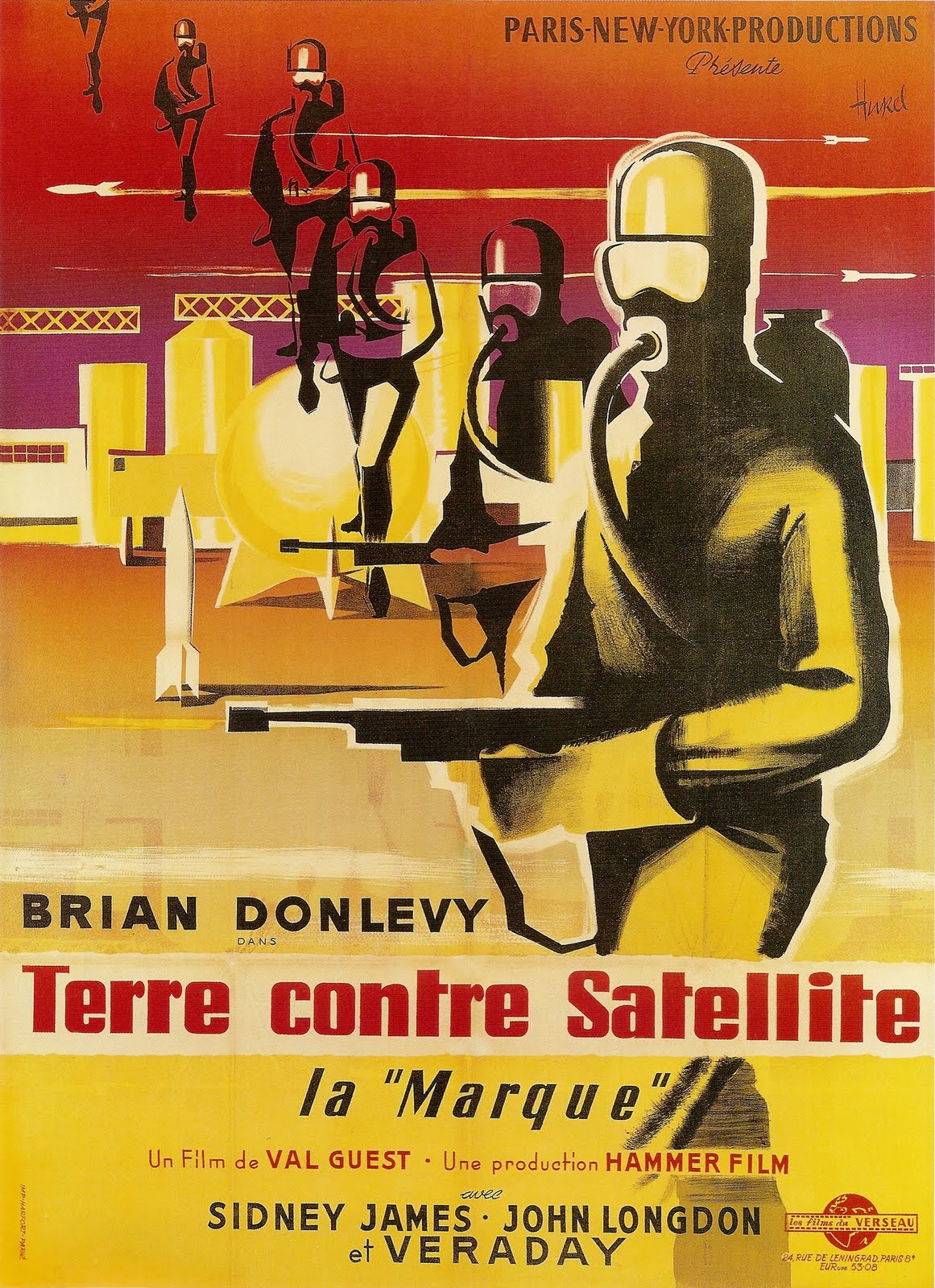
A stylish French poster for QUATERMASS 2 makes the paramilitary zombie guards centre stage.

When Hammer did return with Quatermass at the helm a year later, the result - in contrast - was one of the finest science fiction films produced by a British studio. Val Guest's QUATERMASS 2 sees metallic meteorites rain down on Winnerden Flats, a town near a highly guarded chemical plant. Professor Quatermass (Brian Donlevy) is startled to discover that contact with the shells causes deadly infection, and that the facilities - supposedly producing synthetic food - appear to be modelled on his own aborted moonbase design. Quatermass uncovers a sinister conspiracy that extends to Government level, and has to battle zombie-like guards who will stop at nothing to protect the top secret complex. With the aid of old friend Inspector Lomax (John Longden), the Professor discovers that the plant is in fact housing an alien invasion, and that gestalt creatures have been arriving inside the meteorites.

Britain's answer to INVASION OF THE BODY SNATCHERS, QUATERMASS 2 drips with postwar paranoia. Scripted by Kneale (from his 1955 BBC teleplay) and Guest, the film is as urgently paced as the alien takeover (the actors even indulge in "cue biting"). Kneale was always critical of Donlevy's brutish approach to the beloved scientist, but the actor's forcefulness here actually works with the rapidly unfolding horrors and realisations, especially when the Professor commandeers a guard uniform to infiltrate the plant. This insurrection culminates in a memorable pressure control room scene, where oxygen is being pumped to kill the alien manifestation in the plant domes. When workers venture out to talk to their "superiors," they are murdered and their body parts stuffed into the pipes to impede the oxygen flow, an action, as Jonathan Rigby states in his book English Gothic, is "as grotesque an image of capitalist exploitation as can be imagined."

Sunday, May 1, 2011

Pit of History

QUATERMASS AND THE PIT (1967)

One of the best Hammer productions, QUATERMASS AND THE PIT is science fiction as audacious as 2001, with considerable less pretension. Here the film is being shown in a double-bill with CIRCUS OF FEAR.

SCIENCE fiction is a genre of ideas, apprehensive about the universe and our role within it; H.G.Wells was obsessed with human insignificance, and George Orwell our capacity for authoritarian evil. Away from the US style bug-eyed monsters and space cadets, British SF is sullied by a dark ocean of history and class struggle, yet today we live in a world of perpetual surveillance, apocalyptic pathogens and computer hyperconnectivity which has not only blurred fact and fiction, but eroded boundaries of national identity and personal space (in Fredric Brown’s one-page story Answer, when a new supercomputer is asked if there is a God, it replies "Yes, now there is a God.") London, in particular, has suffered at the hands of SF, with differing intellectual richness; DOCTOR WHO featured numerous "creature of the week" alien invasions, and on a more dystopian level totalitarian regimes have been evident in Nineteen Eighty-Four, A CLOCKWORK ORANGE and BRAZIL. More bombastically, LIFEFORCE found the capital overrun by space vampires, and in REIGN OF FIRE a hibernating dragon is awakened by construction work on the London underground.

QUATERMASS AND THE PIT is the greatest "London under supernatural siege" picture, and a seminal ideas film. Based on Nigel Kneale's BBC series, Hammer's version  - directed by Roy Ward Baker from Kneale's screenplay - begins with the discovery of ape men skeletons during work at Hobbs End underground station. When a strange metal container is found, it is thought to be a German V2, but this is quashed when Professor Quatermass (Andrew Keir) finds insect creatures inside. He believes that these beings came from Mars five million years ago, and helped humanity to gain racial consciousness. The Martian psychokinetic energy lies dormant in mankind and the horned insect figures are remembered in human memory as The Devil. Working with Dr Matthew Roney (James Donald) and his assistant Barbara Judd (Barbara Shelley), Quatermass uncovers Hobbs End as a hotspot for the paranormal and now - with the full uncovering of the spaceship - the dormant powers become active.

Penguin's 1960 QUATERMASS AND THE PIT novel was published with a cover illustration by the author's brother, Bryan Kneale.

Kneale has always been abrasive of the stealing of his ideas, particularly by DOCTOR WHO. But here the writer borrows from Arthur C. Clarke’s Childhood’s End - a novel about a race of aliens who resemble the classic image of The Devil - and also Clarke's The Sentinel, a short story which was expanded and modified into Kubrick's 2001. Although the releases are poles apart in budget, both films share a great deal thematically: the impact of alien intelligence upon human evolution and the consequences of that intervention being discovered. But while 2001's alien intelligence is arguably one of teacher and observer, Kneale suggests that Martian genetics are actively malevolent, transferring the Martians own instinct to kill the other into the ape men who they experimented upon. Consequently, the human urge to hate, despise and destroy is explained through the fact that, as is explicitly stated, “we ARE the Martians!”

Kneale's concept of induced human violence is linked with the equally sensational notion that rationalises our conception of haunting and The Devil, explaining apparitions ("ghosts... [are] phenomena that were badly observed and wrongly explained") and demonology in one handy revelation. Consequently, QUATERMASS AND THE PIT portrays our layered heritage of old, weird Britain with historical and supernatural clout unlike any other. The film is lensed by Arthur Grant in his trademark muted style, providing a perfect feel for a film so obsessed with bones and ancient mythology. The scenario of unearthing a long-buried evil is addressed with equal zeal in BLOOD ON SATAN'S CLAW, where a skull is uncovered by a farmer's plough; this artifact turns the young people of a 17th-century village into a cult with a penchant for erotic blood sacrifices. Shooting with an abundance of low camera angles, this amplifies the feeling of being watched by some ancient other.

Sunday, March 13, 2011

Hammer Monster Mash

THE QUATERMASS XPERIMENT (1955)
THE GORGON (1964)

"All Earth Stands Helpless!" Aware that the Quatermass name held no weight in the United States, THE QUATERMASS XPERIMENT was retitled SHOCK! then THE CREEPING UNKNOWN, and cut by United Artists. The movie was released with THE BLACK SLEEP, which featured Basil Rathbone as a mad scientist opening the brains of his victims to discover a means to cure his wife's tumour. It was alleged that this double-bill literally scared a nine-year-old boy to death, who died of a ruptured artery during a showing in Illinois.

HAMMER were always happy to capitalise on established hits; having drawn on radio (Dick Barton, PC49), the studio looked towards television with a truncated version of Nigel Kneale's THE QUATERMASS EXPERIMENT. While most British production houses regarded the X certificate as a kiss of death for the box office, Hammer hoped that the title change to XPERIMENT would be a marketing ploy to help the financially stricken company. Thankfully the film was a hit; without THE QUATERMASS XPERIMENT, it would be doubtful that Hammer would have survived to create the celebrated Gothic horrors that are so entrenched in our heritage.

The film begins with experimental rocket ship Quatermass 1 crash landing at Oakley Green. This opening - where the phallus-like craft plunges into the ground breaking the monotony of two coy lovers - is a fitting allegory for the arrival of Hammer horror. In this instant, the domesticity of the British feature film makes way for a new order of directness. Professor Bernard Quatermass (Brian Donlevy) - the British rocket group scientist responsible for launching the ship without official sanction - discovers that two of the three crew members have disappeared. The sole survivor - Victor Carroon (Richard Wordsworth) - is suffering from low blood pressure, pulse and heart rate. As Carroon's condition worsens, the astronaut plunges his fist into a cactus, starting a consumption by an alien organism which mimics the plant form. Quatermass tracks the creature to Westminster Abbey, and before its spores can spread, is electrocuted.

Richard Wordsworth's alien-infected Carroon in THE QUATERMASS XPERIMENT is an unwilling martyr to Professor Quatermass' abrasive scientific crusade. The actor would later bring similar sympathetic tendencies to the role of the feral beggar in THE CURSE OF THE WEREWOLF.

In keeping with a long-established pattern, a Hollywood star was contracted for the benefit of stateside distribution. Fading heavy Donlevy was selected much to Kneale's horror (Donlevy's alcoholism reducing the actor to read off cue cards) and in 1995 the writer was still vociferous of the actor's portrayal: "I may have picked Quatermass' surname out of a phone book but his first name was carefully chosen: Bernard, after Bernard Lovell, the creator of Jodrell Bank. Pioneer, ultimate questing man. Donlevy played him as a mechanic, a creature with a completely closed mind. He could make nothing of any imaginative lines, and simply barked and bawled his way through the plot. A bully whose emotional range ran from annoyance to fury." Donlevy's Quatermass is indeed pointed and bullish, refusing to waste time even when considering Carroon's increasingly catatonic suffering ("there's no room for personal feelings in science ... some of us have a mission").

As well as the wayward Donlevy, American Margia Dean plays Carroon's wife Judith. Suffering from indifferent post-synching, Dean was imposed upon director Val Guest because she was reportedly the girlfriend of American co-producer Robert Lippert. Thankfully the British cast feature strongly: David King-Wood as Dr Briscoe, Harold Lang as private eye Christie and Thora Hird as Rose the baglady are uniformly excellent, with Jack Warner's Inspector Lomax shadowing his trademark role in DIXON OF DOCK GREEN. Wordsworth's heart-rending performance, however, is the highlight; communicating an unbearable loneliness through mime, the success of the actor's illustration of a once intelligent man consumed by forces beyond his control was key to Hammer when contemplating their re-imagining in THE CURSE OF FRANKENSTEIN. Discovering body horror years before Cronenberg, Wordworth's poignancy matches Karloff's Frankenstein, particularly in the scene with a little girl (Jane Asher), which mirrors Karloff's lakeside encounter with Maria (Marilyn Harris). It is this sequence that we glimpse Carroon in human form for the last time, as if the innocence of the child evokes a last note of sympathy.

The girl who befriends Carroon in THE QUATERMASS XPERIMENT is played by Jane Asher, who seventeen years later would star in Nigel Kneale's THE STONE TAPE.

Many characters and sub-plots are inevitably missing when compressing the television serial to feature length - for example, the intriguing notion that the alien ether had made Carroon absorb the other two astronaut's minds - but such trimming makes THE QUATERMAS XPERIMENT a fast-paced thriller which is made even more immediate by Guest's gritty, semi-documentary style. Perhaps one constriction too many was the change made to the Westminster Abbey conclusion; instead of the explosive climax in the film, on television Quatermass appeals to the human consciousness within the alien, which wills itself to death. Totally lost upon the feature is the teleplay's framing of this climax within a fictionalised live BBC broadcast - which must have raised a few eyebrows of those tuning in late - but although THE QUATERMASS XPERIMENT loses this particular faux realite, Guest's feature does incorporate one of the earliest examples of found footage in cinema history: a silent video feed shows the bombardment of Q1 by the cosmic rays which cause Carroon's transformation.

While the changes to the teleplay are in the interests of producing a box office success, the cuts made by United Artists for the Americanised THE CREEPING UNKNOWN release are, in fact, insulting. Nearly three minutes of footage is removed - mostly cheapening the London Zoo sequence - but the devil is in the detail: Donlevy and Dean receive above the title billing opposed to Donlevy and Warner in the British version, and the titles also downplay the importance of Kneale's play. Furthermore, American prints eliminate acknowledgments to the BBC, The Air Ministry, the Marconi Wireless Telegraph Co, The British Interplanetary Society, The Post London Authority and General Radiological Ltd, as well as replacing the closing "A Hammer Production, produced at Bray Studios" with a simple "The End."

Having exhausted the gallery of classic movie monsters, Hammer turned to mythology for inspiration, resulting in THE GORGON being one of the studio's most poetic and haunted achievements.

When THE CURSE OF FRANKENSTEIN was unleashed, it set in motion an initial burst of robust Hammer Horrors that focused on dominating male characters. THE GORGON, however, made seven years later, started a trend towards predatory yet well-spoken female parts that fundamentally weakened narrative. Hammer's later move from Bray to Elstree was detrimental enough, but this gender shift resulted in a hit-and-miss series of films which portrayed murderous but sexualised lead woman: for every measured entry like FRANKENSTEIN CREATED WOMAN and HANDS OF THE RIPPER, there was THE WITCHES and LUST FOR A VAMPIRE.

The last Hammer film to combine the talents of stars Peter Cushing, Christopher Lee and director Terence Fisher, THE GORGON is overwhelmingly fatalistic.  Set in 1910, the film focuses on the village of Vandorf, which has been suffering a series of mysterious deaths for five years. However, the local doctor Namaroff (Cushing) has been concealing that the victims were all turned to stone, and suspects that the derelict Castle Borski is housing Megaera, the last of the legendary Gorgons. When an artist's model and her unborn child are turned to stone, her boyfriend Bruno (Jeremy Longhurst) hangs himself, which results in the boy's grieving father Professor Heitz (Michael Goodliffe), his second son Paul (Richard Pasco) and Paul's mentor Professor Meister (Lee) investigating.

Barbara Shelley in THE GORGON. Ballet dancer Prudence Hyman played Shelley's monstrous alter ego with the infamous stiff snake-hair.

Ambiguities add to this dream-like storyline. Hammer may have looked to mythology for new monsters, but the Greek Megaera was not even a Gorgon, rather a deity who causes jealousy. It is unclear why The Gorgon only appears during the full moon, as is the question of why - after thousands of years - the spirit has possessed a human, Namaroff's assistant Carla (Barbara Shelley). Although her back story is never elaborated on, Carla was an amnesia victim who came to Vandorf for treatment, the doctor exhibiting both concern and deeper feelings for his patient. Shelley brings her usual grace and strength to the role, but the inversion of Cushing and Lee's usual screen persona's creates mixed results. Cushing plays the stern, humourless authority role that Lee would normally be presented with, Namaroff a tormented variation of Cushing's Frankenstein as he struggles with guilt and unrequited love. Lee, however, seems uneasily cast in an unflattering greying facade.

The doctor's observation "the most noble work of God, the human brain, is the most revolting to the human eye," underlines Fisher's grim approach. With only some humorous asides from Meister to relieve the gloom ("don't use long words, Inspector; they don't suit you"), the director's emphasis on the pain of romance has great depth, with the central love triangle being the most poignant to be found in Fisher's oeuvre. Despite THE GORGON being considered a second-tier release by Hammer historians, It is an intimate picture which uses its careful pace as a necessity of its mood. Indeed, there are scenes that rank with the best of Fisher: Heitz's call to the Castle Borski, for example, and the sequence where the doomed father attempts to pen a letter to Paul during his gradual petrification.

Sunday, November 18, 2007

Devil's End

DOCTOR WHO - THE DAEMONS (1971)

DOCTOR WHO’s Moriarty: Roger Delgado is The Master.

SHOWN as part of BBC4’s recent Archaeology Night, THE DAEMONS fits neatly under this banner for two reasons. Firstly, this Jon Pertwee DOCTOR WHO serial revolves around the live broadcast (on BBC3 no less) of the excavation of an ancient barrow. Secondly, the episodes themselves are something of a treasured relic; shortly after transmission, four of the original five colour videotapes were wiped. Luckily, BBC Enterprises had made a black-and-white film copy and a colour version (also now lost) for overseas sales. In the 1990s, the BBC painstakingly produced a watchable colour restoration using the black-and-white film and the colour signal from a fan’s home-recording made in the United States.

The Master (Roger Delgado) - posing as local vicar Mr Magister - uses black magic in an attempt to assimilate the powers of Azal. The story’s underlying theme of science versus magic is established early on, then explored during the episodes in which the viewer learns that many of the magical traditions and images are in fact a product of the Daemons “psionic science.” Viewed today, the story suffers from Pertwee's arrogant and inconsistent attitude, and the monumentally inappropriate line when The Doctor refers to Hitler as a “bounder.” The serial is also weakened by its somewhat simplistic denouement - Jo (Katy Manning)’s offered self-sacrifice makes Azal self-destruct - but there's also much to enjoy: in dog collar garb and latterly scarlet ceremonial robes, Delgado’s Master is a highlight, the epitome of evil charm.

The stone gargoyle Bok (Stanley Mason) is brought to life as a servant to the Master. Whether this is because of The Master’s rituals or as a side effect of Azal’s appearance is never made clear.

The Time Lord’s writers had always transformed generic material for their own ends, but the Pertwee/UNIT era drew on Nigel Kneale’s Quatermass to create a template for a large run. The Third Doctor’s first story SPEARHEAD FROM SPACE, for example, gleefully referenced - to put it politely - QUATERMASS II. THE DAEMONS’ plot is not the most groundbreaking regardless of outside influences - witchcraft in an English village has long been a staple ingredient - and the idea of an impenetrable dome barrier had previously been used in John Wyndham’s The Midwich Cuckoos. But ultimately THE DAEMONS recalls QUATERMASS AND THE PIT, with its televised opening of an ancient burial mound which turns out to contain an alien spacecraft, whose dormant crew use technology which Mankind has come to know as Magic.

Thursday, March 1, 2007

Into the Unknown

Quatermass at the BBC (1953-2005)

André Morell, the definitive Professor Quatermass, in QUATERMASS AND THE PIT.

THE stories of Nigel Kneale explore science, superstition and social issues. Although hating the tag "science fiction writer", his work, nonetheless, takes us through experiences that leaves us brighter and more aware, speculating on all the mysteries that remain to be clarified. He was one of the genre’s most illuminating humanists, a confrontational individual who used his writing as a metaphor for our problematic times. Kneale often painted cynical landscapes of our future and developed into a masterful satirist, whose tweaks at mankind’s expense proved just as prophetic as his works undertaken in a more sombre mood. His abundance of intelligent ideas tapped into contemporary fears and a succinct observation of human behaviour. Comparisons to H. G. Wells cannot be underestimated; Kneale was a genuine seer, predicting the disintegration of broadcasting and society, typified by his depiction of Reality TV in THE YEAR OF THE SEX OLYMPICS.

Kneale’s arrival as a staff writer at the BBC coincided with television’s post-Coronation mass appeal. Early drama was dominated by unambitious stage and literary adaptations, and there is some justification in Mark Gatiss’ claim that the writer invented popular television. During the 1950s, Kneale wrote three serials featuring his most famous character, British Rocket scientist Professor Bernard Quatermass. Each broadcast live, THE QUATERMASS EXPERIMENT, QUATERMASS II and QUATERMASS AND THE PIT all made a lasting impact on the nation’s consciousness, and were also subsequently made into films by Hammer. Manned space flights were years away, but THE QUATERMASS EXPERIMENT presented them as near docu-drama; viewers were terrified by the realistic presentation of astronaut Victor Carroon (Duncan Lamont) returning to Earth in the grip of alien infection. Its sequel, QUATERMASS II, features a heavily guarded government refinery, supposedly a factory for synthetic food, but in fact an alien-breeding colony nurtured on poison gas and processed human blood. And in QUATERMASS AND THE PIT, a capsule unearthed on a London building site is found to contain the remains of Martians and augmented ape-men, tapping into the dormant Martian mental faculties bred into Mankind and provoking a gigantic race purge. QUATERMASS AND THE PIT is the most complex and bleakest in the trilogy, portraying the human condition as an irreversible alien experiment, and Kneale’s only remedy is restraint against the ancient destructive urges implanted in us. This last serial was shown at a time when newly arrived Caribbean immigrants – the so-called Windrush Generation – faced widespread daily abuse.

The Quatermass Memoirs were broadcast on BBC Radio 3 in 1996. The series mixes a new monologue by Kneale - in which he discusses the genesis and development of Quatermass - together with archival material and a dramatised strand in which the Professor discloses his reasons for reclusion and discusses his demons with a persistent reporter.

THE QUATERMASS EXPERIMENT evokes the wartime blitz spirit, while QUATERMASS II tackles the threat of an Orwellian "enemy within." Unlike the bombastic spectacle of American horror films of this period, Kneale’s aliens use humans as involuntary symbiotic hosts as part their life cycle, or as a means of continuing their species. Consequently, the strongest emotion evoked by the Quatermass stories is one of disgust. The tales create images that allude to things that are universally repulsive: faeces, urine, rotting flesh, foul odours and deformed bodies, a literary technique used more by writers of horror and supernatural fiction. In THE QUATERMASS EXPERIMENT, there is the physiological deterioration of Carroon whose arm resembles an exfoliating cancer, not to mention the gelatinous remains of the missing crewmembers, the slime the creature leaves in its wake, and the deformed bodies of those it has drained of life. Similarly, QUATERMAS II has foul-smelling gases and faecal aliens writhing in the excremental "food" inside pressure domes, and QUATERMASS AND THE PIT takes place almost entirely in a mud-filled excavation in which the decomposing bodies of the Martians are discovered.

In April 2005, BBC4 aired a new QUATERMASS EXPERIMENT, the BBC’s first live drama broadcast since a series of lunchtime plays in 1983. Shown as the centrepiece of the channel’s ‘TV on Trial’ season – a re-evaluation of the medium from the 1950s to the 2000s - like almost everything involving Kneale’s character, the production is literally an experiment; it takes risks, suffers from underfunding but certainly is heroic. With only the first two episodes of the original series surviving, the idea of creating a two hour condensing of the writer’s scripts was a fine one, if only for the nerve of its staging and to have a more complete document for posterity. The setting is a notional present day via 1955, leading to an almost alternate feel to the 21st century in which there has seemingly been little space exploration and terms like "pressure suit" are still in use. Kneale’s references are only lightly updated, like casting Anglo-Indian actress Indira Varma as the astronaut’s wife, who delivers her 1953 dialogue without seeming as comically cut-glass as the original actress, Isabel Dean. And as a replacement for the Coronation-friendly Westminster Abbey, which saw the mutated Carroon’s demise in the original, the finale takes place at the Tate Modern Gallery, an inspired choice in finding an equivalent symbol of pride in an era where Royal association is forever receding. Not only does it provide a vast, shadowed space for Quatermass (Jason Flemyng)’s "casting-out" of the alien lifeform within its fabric and air, the Tate acts as a stringent metaphor in a cultural shift from religion to art.

Jason Flemyng is the Professor in BBC4’s rendering of THE QUATERMASS EXPERIMENT.

Other changes, however, are less successful. In the year Christopher Eccleston became the new DOCTOR WHO, the casting of Flemyng as a younger Professor seems to appeal to the same primetime mentality. Flemyng delivers his high-tech speak as well as anyone, but being the same age as the actors playing the astronauts and his colleagues creates both a symbolic and plot problem. Most of his scenes are with seasoned performers as Adrian Dunbar, David Tennant and Mark Gatiss, over whom he cannot adhere to the same boffin-like authority of Reginald Tate’s Quatermass from the initial serial. Tate was undeniably in charge, but Flemyng is too often on the defensive, as if any of his co-stars could challenge his role.