Wednesday, October 1, 2025
Andy Milligan in London (Part II of II)
Friday, August 1, 2025
Andy Milligan in London (Part I of II)
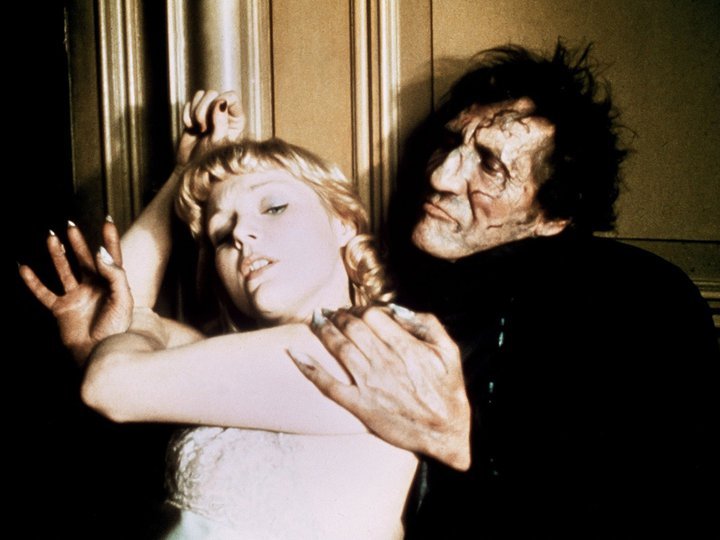
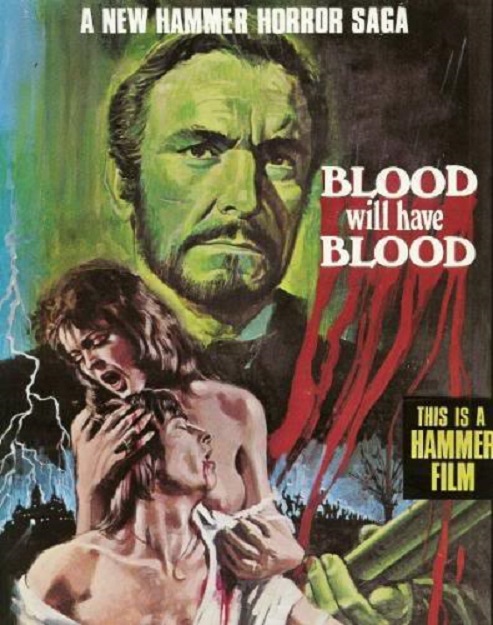
It could generously be said that Milligan modernised vampires before Hammer's DRACULA, A.D. 1972, and played with lore akin to CAPTAIN KRONOS VAMPIRE HUNTER. For example, the ghoul women politely say hello before biting their victims, although they don't have fangs. In further quirks the undead use chloroform, as well as having blood pressure reduced by leeches and being able to move around in daylight thanks to an injection that counteracts the sun. Painfully ponderous and talkative, the washed-out look adds to the Gothic austerity, with Reed revealing in the madness (and certainly getting the best lines).
Sunday, June 1, 2025
"Where Science and the Occult Clash!"
AGAINST the backdrop of several Trustee murders who support an orphanage on a Scottish island, one young girl, Mary Valley (Gwyneth Strong), is taken to a London hospital after a coach crash and suffers psychological issues. Psychiatrist Dr Haynes (Keith Barron) and journalist Joan Foster (Georgia Brown) interview the girl's wayward biological mother Anna Harb (Diana Dors), a prostitute and convicted murderer. When Haynes is killed, the hospital's senior member Sir Mark Ashley (Peter Cushing) and friend Colonel Charles Bingham (Christopher Lee) take their enquiries to the orphanage, as Anna also travels to the location hoping to reunite with her child. Ashley and Bingham eventually uncover the sinister truth: personalities are being transplanted into the children.
Tuesday, August 1, 2023
Black As Sin
POSSUM (2018)
THE feature directorial debut of Matthew Holness, POSSUM is an expansion of his short story from The New Uncanny: Tales of Unease. Comma Press had the writers read Freud's theory of the uncanny, then asked them to choose a fear and provide a story (Holness combined two, doppelgängers and dummies). The film sees puppeteer Philip (Sean Harris) returning to his childhood home where his uncle Maurice (Alun Armstrong) has been living for some time, who raised him after the death of his parents. The haunted Philip revisits places significant to his formative years, as he attempts to understand the past and rid himself of his unnerving puppet, a spider with a human head and a thousand yard stare.
POSSUM draws on silent expressionist horror and English Gothic, especially THE INNOCENTS. Jack Clayton's adaptation of The Turn of the Screw shares a lot of POSSUM's foundation, namely an inherent sadness through problematic sexual awakening. This examination of trauma is expertly brought to live by performance and fractured narrative, and even the surrounding forest - with its warped branches - symbolise spindly spider legs (when Maurice attacks at the climax, he puts his fingers into Philip's mouth, providing a further nod to arachnid digits). Another plus is the score by The Radiophonic Workshop, marking the studio's first soundtrack purposely constructed for a feature film. Actually more a sound design for mental anguish, pieces include unreleased material by Delia Derbyshire.
Philip has never recovered from a corrupted innocence, with his monosyllabic speech and movement reminiscent of childlike mannerisms and anxieties. Even the rhyme, "Mother, Father, what’s afoot? Only Possum, black as soot et al," lovingly illustrated in a sketchbook, bridges the simplicity of youth to his adult existence. Harris would remain in character throughout the shoot to the point where Holness felt that he was working with Philip rather than Harris. Both lead actors only interacted with each other while filming scenes together, further enhancing the feeling of separation and tension.
Wednesday, June 1, 2022
Force of Nature
Sunday, May 1, 2022
Britain in the Raw
GOODBYE GEMINI (1970)
COOL IT CAROL benefits from a solid Murray Smith script and strong performances (we are naturally enthused by Joe and Carol to the extent that the pimping sequence is quite harrowing). Unsurprisingly the papers couldn't see past the smut, describing it as "liable (if not calculated) to corrupt" (Evening News) and "a patch of untreated effluent" (Sunday Times). Similar to Walker's exploitation breakthrough HOUSE OF WHIPCORD, COOL IT CAROL portrays corruption as being far more dictated (and practiced) by those with higher moral standing, where sexual possession is seen as commodity (even in the filmmaker's 1969 travesty SCHOOL FOR SEX, a Judge takes over promiscuous reigns). After all, this is a London for the domain of young players, greasy businessmen and seedy politicians, in Soho clubs with indoor swimming pools.
Adapted from Jenni Hall's experimental and fragmented 1964 novel Ask Agamemnon, the film abandons the book's Greek tragedy and fantasy sequences for a more linear experience, focusing more on Julian's incestuous yearning. Although it is hard to categorise - psychological sexploitation is perhaps nearest the mark - GOODBYE GEMINI is a surprisingly dull affair. Geeson (at the height of her career following TO SIR WITH LOVE) and Potter (fresh from Fellini's SATYRICON) are overshadowed by Kanner's stellar performance; neither does their journey gel with the older performers ("two old tombstones" Michael Redgrave as "member of parliament with a heart" and partygoer Freddie Jones). It is all too hedonistic to be enjoyable; self-indulgence is one thing, but no production can cope with such a quirky mix of naivety and ruthlessness. At least the fashions and party scenes are garish enough to hold interest, priming Gibson for helming Hammer's DRACULA A.D. 1972.
Wednesday, September 1, 2021
Séance and Sensibility
Abramelin and its demand for intricate, long-term preparation is credited to 14th-century Egyptian magician Abra-Melin, and plays out like a binding contract. In 1897, The Book of the Sacred Magic of Abramelin the Mage was translated into English by British occultist Samuel L. MacGregor Mathers, and was highly influential in the Hermetic Order of the Golden Dawn. Aleister Crowley - at the time a young member - started preparations for seeking the angel in Boleskine House, but abandoned this plan during the Hermetic Order division of 1901. The one thing that Mathers, Crowley and, indeed, most occultists, take from Abramelin is the existence of a benevolent demigod; consequently, a master or supreme magus can feed any number of charismatic and egotistical myth-makers.
Sunday, August 1, 2021
Ghost Breakers
It was during his time as story editor on ALFRED HITCHCOCK PRESENTS that director Gordon Hessler discovered the film's source novel by Jay Bennett. An adaptation was rejected for the show, but became his theatrical directorial debut. Yet CATACOMBS cannot shake off its feel of an extended anthology episode; Merrill - himself a veteran of Hitchcock's TV programme - is perfectly cast as the aging gigolo, and Cookson is frightening and glacially fragile (when Raymond carries his wife in his arms, Ellen seems to eerily transform into a mannikin). The tension is simple but effective (the sound of Ellen's walking cane, the moving of locked door knobs), and although the double twist ending will not surprise all, it nevertheless is a satisfying climax to a well made and entertaining thriller.
Shot at an old psychiatric hospital near Uxbridge, DARK PLACES was the only release from Glenbeigh/Sedgled, but it had a great poster. Helmed by Don Sharp, DARK PLACES is a pedestrian haunted house/psychological thriller that is also rarely discussed at length. Following the death of an aging asylum inmate, Edward Foster (Robert Hardy) inherits an old mansion with a grim reputation: a woman, the housekeeper and two children have disappeared without trace. However Edward is more interested in the £210,000 hidden somewhere behind the walls. Unfortunately there are others who also want the money: Dr Ian Mandeville (Christopher Lee) and his sister Sarah (Joan Collins), together with solicitor Mr Prescott (Herbert Lom). With Sarah helping Edward at the mansion, and the siblings faking paranormal occurrences, the building and its backstory start to affect Foster's fragile psyche. Possessed by the spirits of the deceased, he begins his own murder spree.
Similar to the feel of CATACOMBS, DARK PLACES plays more like a TV movie, hampered by uncharismatic direction and photography. Hardy has a lot of character aspects to grapple with and manages to just about carry the film, while the all-star cast are wasted (although Collins inevitably shines as the sexually conniving sleuth). Even the flashback sequences have quality performers in small roles, with Jean Marsh and Jane Birkin. The notion of the Mandeville fake haunting is never developed; in fact, the realisation that strange things are actually happening is only met with brief puzzlement. It's a shame, as this interesting trope dates back to earlier stories such as THE CAT AND THE CANARY and THE GHOST BREAKERS, particularly in the context of money and induced madness.
Thursday, July 1, 2021
The Cat Creeps
The all-star cast give performances that could generously be described as unconventional, portrayals of people who are all killers one way or another: disgraced doctor Henry (Daniel Massey, whose father Raymond had spent a night at James Whale's THE OLD DARK HOUSE), big game hunter Susan (Honor Blackman) and her lesbian lover Cicily (Olivia Hussey), who shot an employer attempting to rape her, war hero Charlie (Peter McEnery) and songwriter Paul (Michael Callan), obliquely "the biggest killer of all" according to West. It's a hodgepodge of goofiness undermined by strange lapses: why is Cyrus' formalities in sound, for example, and the two climatic shootings are completely bloodless.
Monday, March 1, 2021
We Are for the Dark
Friday, February 1, 2019
Skeletons in the Closet
GHOST STORIES (2017)
THESE two films focus on academics who have to question their sceptic beliefs towards the paranormal. Adapted from Fritz Leiber's 1943 novel Conjure Wife, Sidney Hayer's NIGHT OF THE EAGLE has sociology Professor Norman Taylor (Peter Wyngarde) discovering that his perfect wife Tansy (big-band singer Janet Blair) is actually a Witch, and has been practising her craft since their honeymoon. Tansy has manipulated Taylor's rising career at Hempnell Medical College, and discovering this, the Professor destroys all of her inventory of magical paraphernalia. Thereafter Taylor suffers a number of sinister situations, one of which is an accusation of "violating" one of his students. It transpires that his path is now being orchestrated by the hostile intent of another faculty wife, Flora Carr (Margaret Johnston), driven by both educational and sexual jealousy.
Fittingly shot in moody monochrome by Reginald Wyer, the movie is underplayed in the tradition of Val Lewton, and possesses a tangible chill. NIGHT OF THE EAGLE is comparable to NIGHT OF THE DEMON in its more adult approach to the uncanny, and Hayers cut large portions of occult and voodoo material from the original script - by Richard Matheson, Charles Beaumont and George Baxt - to concentrate on the plight of the Taylors. The Eagle itself - a stone embodiment that rests at the entrance of the school - comes to life with risible results, but it can't take away the fact that Hayer's film is a beautifully played classic of British horror; Wyngarde and Blair convince at every level of their descent, but Johnston steals the show with her permanently off-kilter performance.
Based on their own Olivier Award-nominated stage show, Jeremy Dyson and Andy Nyman's GHOST STORIES arrived on a wave of glowing reviews and hype that no film could fully justify. This three-part anthology mashes together Amicus and the BBC GHOST STORY FOR CHRISTMAS strand for old school scares and J-Horror that builds to a hokey finale that undermines its own building premise. Professor Goodman (Nyman) is given a trio of unsolved mysteries by his assumed-deceased idol Charles Cameron: Tony Matthews (Paul Whitehouse) is a night watchman of a disused female correctional facility, haunted by the spirit of a young girl; jittery teenager Simon Rifkind (Alex Lawther) encounters a Satyr in the woods; and country-based stockbroker Mike Preddle (Martin Freeman) is plagued by a poltergeist while awaiting his IVF-induced child.
The performances embrace its emotional tropes of family resentment, belief systems and childhood traumas. Simon's story is the most effective - underpinned by some wonderful black humour (Sooty and Sweep anyone?) - but these powerfully-played themes grate somewhat with its peripheral ghosts and jump scares, and the atmospherically barren landscapes of concrete halls, a daytime pub and an out-of-season caravan park. It's worth a second watch to pick up the easter eggs, but they are not so much Ghost stories as Ghost settings. In conclusion, it contains too odd a mix even for a horror movie, and reeks heavily of Nyman's misdirection and overblown showmanship evident in his association with Derren Brown.
The most grounded argument from supernatural skeptics is not so much if ghosts exist, but why the human psyche actually needs them; ultimately it is a longing for comfort, away from the harsh and bleak reality of death. More specifically, the biggest difference in NIGHT OF THE EAGLE and GHOST STORIES handling of their respective Professor's is that Taylor's professional life is manipulated by the constant indignation of females, whether in the name of love - Tandy is even willing to die for him as he has much more to offer the world - or bitterness. Conversely, everything in Goodman's journey is devoid of women; partnerless and childless, he exists in a closed, work-dominated world. Though when Flora Carr sets fire to a pyramid of Tarot cards - the otherworldly equivalent of the character's beloved Bridge evenings - and spits "burn, Witch, burn," Goodman has certainly opted for a less suffocating existence.
Thursday, February 15, 2018
"Tops in Total Horror!"
RELEASED in the United States under the nonsensical banner CRUCIBLE OF HORROR, this ambiguous, dreamlike melodrama takes its cue from Henri-Georges Clouzot's celebrated psychological thriller LES DIABOLIQUES. Walter Eastwood (Michael Gough) runs his upper middle class family with suffocating repression: wife Edith (Yvonne Mitchell) has retreated into painting from years of neglect, son Rupert (Simon Gough) is a facsimile of the patriarch working for the same insurance firm, and it is only rebellious daughter Jane (Sharon Gurney) who strives for a life beyond these watertight walls. When Walter discovers sixteen-year-old Jane has been sleeping with a friend from his golf club - and that she has also stolen money from the premises - he horse-whips her to sleep, while in an adjacent room Rupert turns up the volume in his headphones. Listening to her daughter's cries of pain, Edith is awakened from her trance-like state, and the following morning openly whispers to Jane "lets kill him."
Monday, January 15, 2018
Unnatural Born Killers
PREVENGE (2016)
Dubbed "gratuitously violent, fearfully sick, but it was a good script" by Cushing, the posters to CORRUPTION stated that "no woman will be admitted alone to see this super-shock film." Rowan's murder sequences are still jaw-dropping today, amplified by the use of hand-held close-ups. With hair flapping around his sweaty crazed glare, the actor's slaying of a topless prostitute - stabbing her repeatedly on the floor before smearing his bloodied hands on her breasts then removing her head - is not only British horror's most shocking sequence, it also points towards the Seventies sleaze to come. The delirium is added another two layers with the arrival of Georgie and his gang in Seaford - an out of left field final act which sees a massacre by an out-of-control surgical laser - and amid production bickering, the "is it a dream?" ending.
Written, directed and starring Alice Lowe, PREVENGE defies description - in a good way. Too easily labelled a sardonic, jet black comedy, it is also a meditation on loss and the mental process of pregnancy. Shot in two weeks to accommodate Lowe's real-life condition, and enveloped by an outstanding Goblinesque score by Toydrum, textures increase with subsequent viewings to reveal - almost - an art film. Ruth (Lowe) is a pregnant woman who goes on a killing spree, seeking revenge on the people she claims accountable for her partner's death on a climbing trip; struggling with her conscience and prepartum psychosis, the unborn child speaks to Ruth from the womb, coaching her to kill ("If you don't do as I say blood will be shed, one way or another.")
Lowe's performance flicks between deadpan, psychotic, angst and turmoil (possibly in equal measures). The casting is strong with numerous fan-favourites: DAVID BRENT LIFE ON THE ROAD's Jo Hartley as the Midwife, GAME OF THRONES' Gemma Whelan as Len, and THE WITCH's Kate Dickie as a businesswoman who succumbs to a throat-slitting straight out of Argento. One sequence is spontaneously filmed in Cardiff on Halloween night, and it is this ethic which makes PREVENGE seem consistently fresh in style if not always in content. The murders are effective, but the visuals seem to unfold in some other brooding universe, and Lowe has mischievously likened the feel to BLADE RUNNER. Yet you can see her thinking; in Ridley Scott's milestone, Vangelis' jazz-influenced score underpinned the yearning of remembrance, driving the narrative similarly to Toydrum's often thunderous electronica.
Tuesday, August 1, 2017
Demons of the 1970's (Part II of II)
FULL CIRCLE (1977)
Larraz has long favoured mansions in his pictures, and the warring of the sexes; here they are quite literally foundations for exploring the horror motif of characters yearning for lost loves. Taking several inspirations from REPULSION, the director uses a mirror and the ticking of a clock to replicate Roman Polanski's idea of lulling the viewer into a false sense of security, before delivering bludgeoning shock tactics. Vanity Celis points out in her essay which accompanies the BFI Blu-ray that Larraz' contribution to the sexual anxieties of the Gothic tradition is "a safety net found in the auxiliary subtext of lesbian love," and the production - similar to Jorge Grau's THE LIVING DEAD AT MANCHESTER MORGUE, Juan Carlos Fresnadillo’s 28 WEEKS LATER and Alfronso Cuaron’s CHILDREN OF MEN - captures the English landscape more effectively than native filmmakers, creating an agitation that resonates more deeply in the outsider's eye.
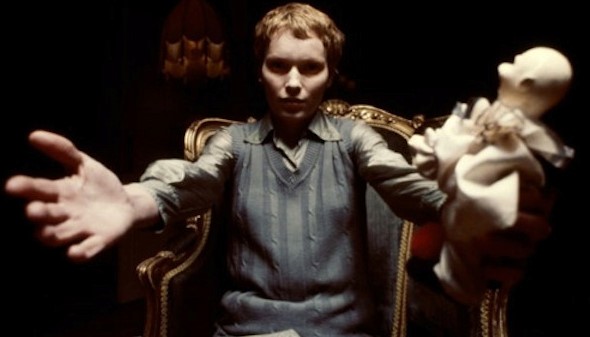
In a moving final scene Julia welcomes the ghostly Olivia into her arms, the camera then pans around an armchair to reveal that Julia has a fatal neck wound. This not only brings us full circle from Katie's demise, but leaves the viewer wondering if Olivia has claimed another victim from her otherworldly plane, or the tortured mother has committed suicide. The willowy Farrow carries the whole burden of grief superbly, and quite rightly male players are kept to the margins (husband Magnus (Keir Dullea) is purely abandoned, and friend Mark (Tom Conti) suffers an unnecessarily sensationalised death)). The film also benefits from beautiful cinematography and a piano/synthesiser score which manages to underpin and elaborate on the unease.
Saturday, July 1, 2017
Demons of the 1970's (Part I of II)
AMID the dying embers of the 1970's British film industry, attempts to move into more psychological thrillers resulted in a number of underappreciated efforts. Dumped onto the wrong end of a double bill with TOWER OF EVIL, DEMONS OF THE MIND - directed by Peter Sykes and written by Christopher Wicking - is a Hammer production which focuses on Baron Friedrich Zorn (Robert Hardy), who fears he has passed on the "family madness" to son Emil (Shane Briant) and daughter Elizabeth (Gillian Hills). Held captive to curb their incestuous desires, Emil is at least released at night to murder women, while Elizabeth is "bled" to make her weak (making use of a vintage Scarificator from the British Museum). When discredited psychologist Falkenberg (Patrick Magee) arrives with his associate scholar Carl (Manfred Man singer Paul Jones), an experiment to rid Emil of his lust involving Inge (Virginia Wetherell) ends in another strangulation. The villagers, influenced by a deranged, self-styled Holy Man (Michael Hordern), decide that Zorn is the true demon, and stake him with a burning cross.
A mix of Hammer's Mittel Europe and fledgling psychiatry was one way the company attempted to make its product fresh, another was by infusing proceedings with new young directors and screenwriters. But DEMONS OF THE MIND is more cynical than satisfying, conveying a relentless dourness (quoting Psalm 38 "For my loins are filled with a loathsome disease, and there is no soundness in my flesh") where conventions are either twists or throwbacks: Magnee's unhinged Mesmerist and Van Helsing substitute helps no one ("Better men than I have been booted out of Vienna!"), an alleged Priest is a dangerous zealot, and the villagers revel in their own sadism.
A Poe-like story of an incestuous, murderous dynasty crumbling to dust, Zorn is driven by subconscious compulsions of his peasant bride's "virgin blood" and bare flesh (Zorn is a character undermined by Hardy's pantomime performance; to think we might have had Eric Porter, Paul Scofield, Dirk Bogarde or James Mason). Hordern is also overtly loopy, barely able to carry his over-sized wooden cross, and despite the emotional slant, DEMONS OF THE MIND actually serves up a copious amount of exploitative, early 70's gore: although optically fogged, Zorn's wife is seen to slash her wrists and throat in front of her children, but further scenes of Emil killing maiden aunt Helda (Yvonne Mitchell) with a bunch of keys and Zorn's climactic impalement are in no way shrouded.
The original pitch to Hammer by Frank Godwin - the composer-cum-independent producer who penned Strange Love for LUST FOR A VAMPIRE - was actually a werewolf picture. The studio was intrigued by Godwin's knowledge of the legend of Blutlust, and together with Wicking, formulated a treatment based on the Bavarian story of a man-wolf which was actually a psychopathic condition not understood by the medicine of the time. However, the tale was a complete fabrication, and Hammer did not warm to the werewolf elements anyway, leaving only a vague lycanthropic reference in the finished film where Zorn imagines himself stalking as an animal (to further the pseudo-werewolf angle, the muted cinematography is lensed by Arthur Grant, making his last Hammer picture in an association which started with THE CURSE OF THE WEREWOLF).


.jpg)