Showing posts with label ITV. Show all posts

Thursday, October 1, 2026

Clarke's Cabinet of Curiosities

ARTHUR C. CLARKE'S MYSTERIOUS WORLD (1980)
ARTHUR C. CLARKE'S WORLD OF STRANGE POWERS (1985)
ARTHUR C. CLARKE'S MYSTERIOUS UNIVERSE (1994 - 95)

 The "prophet of the space age," Arthur C. Clarke invented the communications satellite and was one of the "big three" SF writers of the time, with Robert Heinlein and Isaac Asimov. Immigrating to Sri Lanka (then Ceylon) in 1956, this aided his homosexuality with more open laws.

THESE time capsules of fortean exploration were all produced by Yorkshire Television, the first two lasting thirteen half-hour episodes, and the last twenty-six. An overview to mainstream topics - Bigfoot, UFOs, Tunguska et al - ARTHUR C. CLARKE'S MYSTERIOUS WORLD sees the scientist and author ("living in retreat" in Sri Lanka) act as a voice of reason amongst the eyewitness reports. ARTHUR C. CLARKE'S WORLD OF STRANGE POWERS follows the same format but, by delving into more abstract phenomena, is the lesser of the three. Unintentionally hilarious highlights include famous authors channeling new work from beyond the grave, "thoughtography," spoon-bending parties and a dowsing vet. And in a continuation of the newscaster as narrator - MYSTERIOUS WORLD was voiced by Gordon Honeycombe - STRANGE POWERS has Anna Ford.

One might expect ARTHUR C. CLARKE'S MYSTERIOUS UNIVERSE to venture out into the cosmos, but we are again in similar (and revisited) territory, covering mythical creatures, ancient legends, ghosts, the Bermuda Triangle and big cats. Narrated by Carol Vorderman - two years before her presenting stint on OUT OF THIS WORLD for the BBC - this is more polished than the 1980s efforts. There is a delightful look at crop circles, which underlines English eccentricity to a playful degree, but there are certainly darker shifts: the part on Haiti zombie potions is particularly nightmarish, as is the opening episode's coverage on the alleged non-purification of Saint Francis Xavier's corpse.

Clarke spent four years collaborating with Stanley Kubrick on 2001: A SPACE ODYSSEY. Kubrick once said of Clarke: "he has the kind of mind of which the world can never have enough, an array of imagination, intelligence, knowledge, and a quirkish curiosity which often uncovers more than the first three qualities."

Clarke is a dry host, but he is not out to falsify, only to reach out. You get the impression that Arthur would like nothing more than come face-to-face with a Sasquatch or Alien, but he isn't going to show himself up in front of camera, unlike the gamut of personalities fronting the Chariots of the Gods-type "documentaries" of the 1970s, or IN SEARCH OF.... By STRANGE POWERS Clarke has grown more confident and even whimsical, no doubt aided by the more outlandish narrative; for example, a fortune teller based on mathematics requires Arthur to count his footsteps from his house to their meeting place as part of essential requirements. The presenter has tried to "steer a course between scepticism and credulity," and whatever your beliefs the programmes provide a springboard for conversation; "I don't pretend to have all the answers," the scientist tells us, "but the questions are certainly worth thinking about."

Monday, March 1, 2021

We Are for the Dark

NIGHT VOICES - THE HOSPICE (1987)
GHOSTS - THREE MILES UP (1995)

The weird tales of Robert Aickman (1914 - 81) have a psychological and expressive richness which have gained comparison with M.R. James. Still relatively unknown, four of his stories were adapted for NIGHT VOICES: The Hospice, The Inner Room, Hand in Glove and The Trains.

THE obscure HTV anthology NIGHT VOICES was produced by Patrick Dromgoole, a coordinator of fondly remembered ITV programmes such as SKY and CHILDREN OF THE STONES. THE HOSPICE was directed by Dominique Othenin-Girard, who would go on to very little notoriety by helming franchise entries HALLOWEEN 5 and OMEN IV: THE AWAKENING. THE HOSPICE is based on a story by the master of strangeness, Robert Aickman, and beautifully adapted by XTRO scribe Robert Smith. A bizarre purgatory tale, Maybury (Jack Shepherd) finds himself in the eponymous building, a lavish country house filled with ambiguous and eccentric characters such as the maĆ®tre d’ (Alan Dobie) and an alluring young woman (Marthe Keller). Maybury begrudgingly accepts the offer to stay the night and is put in a room with Bannard (Jonathan Cecil), but a surreally restless night continues to an evenly more unsettling dawn, as he at last escapes the confines by being given a lift in the back of a hearse.

Like all great artists and writers, their essence is difficult to pin down; on the written page The Hospice begins "It was somewhere at the back of beyond," a good place to start in the unravelling of Aickmanesque. The six episodes of NIGHT VOICES were made in 1987 and 1988 but not broadcast until 1993, creating a fitting state of flux richly illustrated in the author's netherworlds. Aickman’s characters often find themselves trapped in a series of poetic events unconnected by logic, and few stories end clearly. A driven conservationist, Aickman had a disdain for modern living, and his draw to the supernatural can in some part be explained by giving him a platform to unmake an ordinary world. Yet for a person who preferred the past, this did not seem to include conventional gender roles; Aickman’s best stories feature women as liberated protagonists, while men suffer from varying strains of anxiety and repression.

Blackpool-born Jacqueline Leonard commands the GHOSTS episode THREE MILES UP. Leonard has been one of our leading television actresses, which has included runs in PEAK PRACTICE, EASTENDERS and CORONATION STREET. 

GHOSTS was another six episode series, this time on BBC1 primetime in January and February 1995. THREE MILES UP is an adaptation of a story written by Elizabeth Jane Howard, which first appeared in the 1951 collection We Are for the Dark, co-authored by her then lover Aickman. Directed by Lesley Manning - best known for GHOSTWATCH - Billy (Douglas Henshall) and John (Dan Mulland) are estranged brothers who aim to repair their relationship after the death of their mother. They decide to go on a houseboat holiday, and after Billy blows an old whistle that the mother said to use if they were in trouble, they soon discover Sara (Jacqueline Leonard) sleeping under a fallen tree. As the trip becomes increasingly dreamlike - together with a recurring vision of the brothers as boys watching the mother drown in a freak cellar flood - Billy and John both fall under Sara's measured spell. When she recommends taking a route unmarked on the map, the brothers also succumb to a watery demise.

With Billy's history of mental illness and John resenting all the years he had looked after him, this premise is already alienating and underlyingly hostile. The passing landscape of a waterways journey adds to the detachment, and apart from one effective jolt scare THREE MILES UP is a slow-burning descent into impending doom. Henshall and Mulland are functional at best, and it is Leonard who carries the story, eerily glacial as her particular Mother Earth overpowers thoughts and processes. It is a fitting entry for both Aickman and Howard; Aickman co-founded the Inland Waterways Foundation, where Howard was a part-time secretary.

Sunday, April 1, 2018

Haunt of Fear

Nostalgia and the Rise of Hauntology

"When Bagpuss wakes up, all his friends wake up too." Bagpuss, Professor Yaffle and the Organ Mice in the fondly remembered BAGPUSS from 1974. The titular cat's description of "saggy ... and a bit loose at the seams" typifies the disjointed melancholy of the Hauntology movement.

POPULAR culture surrounds us in a whirlwind of nostalgia. Nostalgia was first described as a psychosomatic disease, rooted in the desire of soldiers to return home; this longing for the motherland is so strong that it induces a doleful, mental state. Swiss physician Johannes Hofer first used the term in 1688, and the disorder came to be associated particularly with Swiss soldiers, who were so susceptible to nostalgia when they heard a particular milking song, that its playing was punishable by death. Confusing the past and the present, and the real and the imaginary, our preference for the sights, sounds and smells of yesteryear often has its foundation in the carefree wonders of childhood. It was Immanuel Kant who stated that people who were steeped in nostalgia were triggered not so much for an actual place as for the time of youth. David Lowenthal's The Past is a Foreign Country considers that nostalgia preys on the past to construct a form of escapism; and by savouring these ruins of artificiality, author Susan Stewart condemns the condition as a "social disease," maintaining that the past is something unspoilt, utopian and unreachable.

British television in the 70s exists in what writer and radio presenter Bob Fischer describes as "cosy wrongness," a grainy and blurred netherworld that - because of its pre-digital, incomplete heritage - can be a nostalgic notion that actually extends to the early 80s Video Nasty flap of VHS degradation. BBC shows of the polyester decade - such as DOCTOR WHO, A GHOST STORY FOR CHRISTMAS, THE STONE TAPE and COUNT DRACULA - showed the corporation embracing the Gothic, but also fortolded how this portentously gloomy sub-genre would mutate into visual art Hauntology. Hauntology was coined by Jacques Derrida in his 1993 book Spectres of Marx, and taken up by critics who referenced contemporary culture's persistent recycling and incapacity to escape old forms. If nostalgia is sentimental perspective, Hauntology bleeds into our psyche like a spectre who gestures towards what is inevitably an intellectual abyss. 

Music Has the Right to Children was the debut studio album from Boards of Canada, and hailed as a seminal Hauntology work. The piece was described as a "thing of wonder" and "the aural equivalent of old super 8 movies."

Fischer has also highlighted the children's programme BAGPUSS as a prime example of 70s "vague disquiet." This strange shadow world’s mixture of scrambled memories and weird, bygone images is explored in the Hauntology concept, where the presence of being is replaced by absent or deferred parallels, a yearning for a future that never arrived. Hauntological music has been particularly tied to British culture, an alternate reality constituted from the stagnation of the postwar period. This soundscape is expertly captured by the 1998 album Music Has the Right to Children by Scottish electronic duo Boards of Canada. Subsequently, musicians and artists whose formative years were in the 70s have developed their own Hauntology analogue synth brands and universes. In 2005 Jim Jupp and Julian House founded Ghost Box Records and the fictitious world of Belbury, an eerie English village straight out of John Wyndham. Similarly, writer and graphic designer Richard Littler created Scarfolk together with spoof book covers and dystopian government pamphlets that evoke the distinct Penguin Classics and Public Information Films so entrenched from the period. 

Saturday, April 1, 2017

"They're Only Worthless Whores!"

JACK THE RIPPER (1973)
JACK THE RIPPER (1988)

The Ripper File, published in 1975, was a companion to the 1973 BBC JACK THE RIPPER docu-series.

DR Thomas Stowell's article in the November 1970 Criminologist instigated a resurgence of interest in the Whitechapel Murders. Implicating the grandson of Queen Victoria, it set in motion a snowballing of misconceptions welcomed by Stephen Knight's 1976 bestseller Jack The Ripper: The Final Solution. Stowell drew comparisons between the evisceration of the women and the disembowelment of deer shot by the aristocracy on their estates, and surmises that - although not named directly - Prince Albert Victor went mad after contracting syphilis in the West Indies. Three years later, JACK THE RIPPER was a six-part BBC "documentary investigation" into the killings, which mixed period re-enactments with contemporary sleuthing from fictional Detective Chief Superintendents Barlow (Stratford Johns) and Watt (Frank Windsor), characters popular on Z-CARS and its sequels SOFTLY, SOFTLEY and BARLOW AT LARGE.

This cross-pollination discusses suspects, forensic examinations and conspiracies in stuffy ad infinitum, and after five hours concludes there is insufficient evidence to determine who Jack was. Written by Elwyn Jones and John Lloyd, the programme builds a foundation for masonic influence - after all, Watt has read prominent mason Commissioner Warren's autobiography - with analysis of the wall message "The Juwes are The men That Will not be Blamed for nothing." With no substantiation to the Ripper crimes, let alone Freemasonry, this fixation with the scrawl on Goulston Street is one of many blind alleys the broadcast creates for itself. And just when you think no more information could be squeezed in, the show's surprise witness is held back to the final moments: Joseph 'Hobo' Sickert, illegitimate son of suspect/painter Walter Sickert. Self-scripted and shot on Super-8, Joseph recalls his strange genealogy and conveys Royal Physician Sir William Gull (as did Stowell) and driver John Netley, and also surmises threat of revolution.

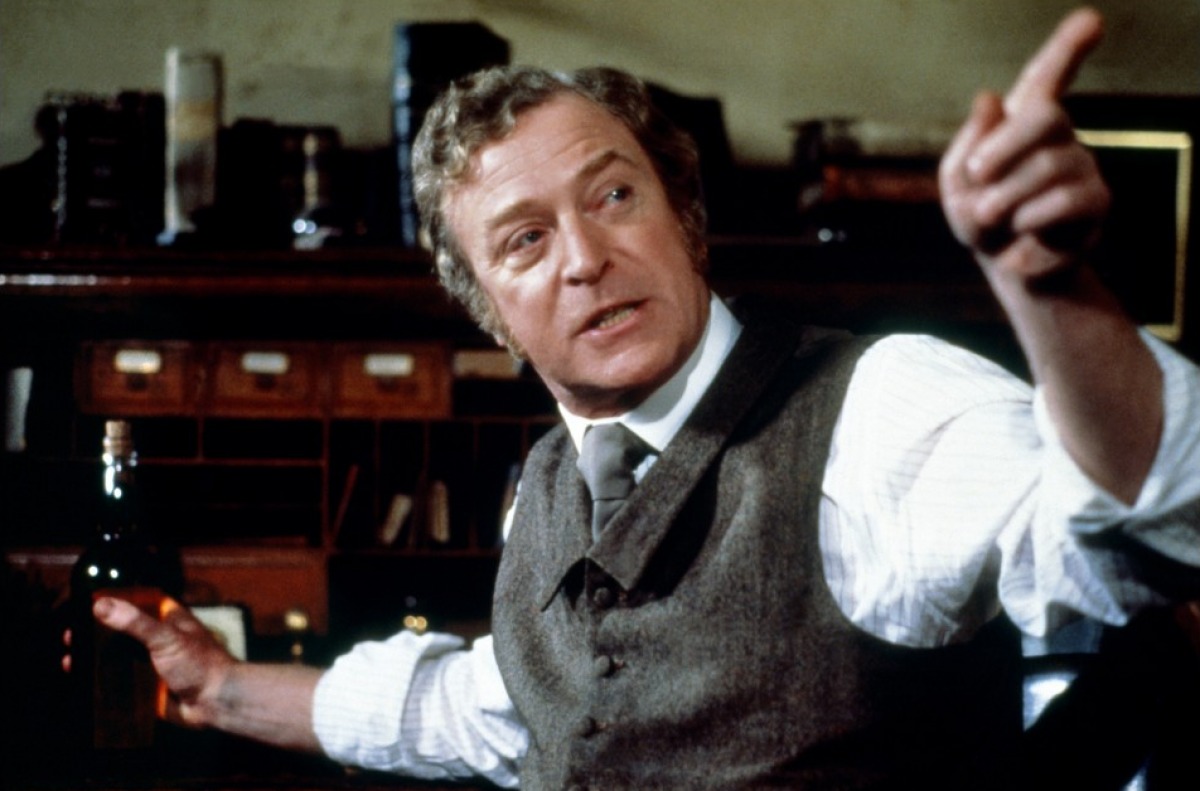
"You told me to bring you Jack the Ripper. You sign that piece of paper and I will ... tonight!" Michael Caine - as Inspector Frederick Abberline - is the casting coup of ITV's out-of-control JACK THE RIPPER.

After this bombshell, the East London Advertiser sent Knight to interview Joseph. Fleshed out into his "Final Solution," Knight details an elaborate conspiracy theory involving the British royal family, freemasonry and Walter Sickert. He concluded that the victims were murdered to cover up a secret marriage between the second-in-line to the throne, Prince Albert Victor, Duke of Clarence and Avondale, and working class Catholic Annie Elizabeth Crook. Crook and the couple's daughter are consequently spirited away, and a quintet of Whitechapel tarts - privy to the circumstances through the employment of one of their number (Mary Kelly) as the child's Nanny - were disposed of by a team of high profile assassins. However, when Knight's frenzy of misinformation builds to implicating his father more than to Joseph's liking, 'Hobo' withdrew his co-operation and put on record that he had made everything up.

Made to coincide with the Ripper centennial, ITV's bombastic drama JACK THE RIPPER was a ratings winner, casting Michael Caine as Inspector Abberline and Lewis Collins as Sergeant George Godley. Director and co-writer David Wickes - who had helmed two episodes of the BBC series - stated that he had been allowed unprecedented access to Scotland Yard files, and that his production would be revealing the true identity of Jack for the first time. However, after pressure from numerous Ripperologists Wickes withdraw this claim, but the series still begins with a disclaimer on behalf of the production staff: "our story is based on extensive research, including a review of the official files by special permission of the Home Office and interviews with leading criminologists and Scotland Yard officials." Wickes' announcement that he had filmed several alternative endings lends no credence to the unfolding structure, and was more likely another publicity stunt.

Abberline adopts his usual measured methods with coachman John Netley (George Sweeney) in ITV's JACK THE RIPPER.

Comprising of two ninety-minute episodes broadcast on consecutive evenings in October 1988, the series' revelation that Sir William Gull (Ray McAnally) was the killer is laughably old hat, after threads lead the viewer to the likes of American stage actor Richard Mansfield (Armand Assante), socialist George Lusk (Michael Gothard) and Queen Victoria's clairvoyant Robert Lees (Ken Bones). The melodramatic story also takes great liberties in characterisation: Abberline's alcoholism is present solely for dramatic licence, and George Lusk's depiction as an anarchic troublemaker hides the fact that Lusk was actually a nondescript businessman and church warden. Although the crime scenes are the most authentic part - particularly Mary Kelly's Miller's Court slaying - the rest exists in its own self-important, distorted world, which advances nothing on Knight's book or the BBC serial. When Gull eventually breaks ("they're only worthless whores!,") the surgeon's jolting transformation from kind family man to barking mad is as abrupt as Abberline's bawling.

Thursday, December 1, 2016

Paint It Black

OMNIBUS - SCHALCKEN THE PAINTER (1979)
ITV PLAYHOUSE - CASTING THE RUNES (1979)

Dou (Maurice Denham), once a student of Rembrandt, sells his niece to a Sepulchral for a casket of gold in SCHALCKEN THE PAINTER.

THE first incarnation of the BBC's A GHOST STORY FOR CHRISTMAS strand ended with pretentious episode THE ICE HOUSE in 1978. The two programmes here attempt to carry on the tradition, the first often confused as an official entry, and the second directed by the series' talisman on ITV. Actually screened as part of OMNIBUS, Leslie Megahey's SCHALCKEN THE PAINTER is a fictional exploration of real life seventeenth-century Dutch artist Godfried Schalcken. Adapted from Sheridan Le Fanu, Schalcken (Jeremy Clyde) is a student of Gerrit Dou (Maurice Denham) and admirer of Dou's niece Rose (Cheryl Kennedy); Schalcken is as lifeless as the canvas he devotes himself to, and loses Rose's hand to deathly stranger Vanderhausen (John Justin).

If the story has a message at all, it is that females can become detached objects and property; when Rou's niece is bound to the cadaverous Vanderhausen, it serves as a metaphor on the cruelty of woman as breeding stock. The slow narrative and detached composition has flatteringly been likened to Kubrick, but the programme stands more as a companion piece to another OMNIBUS adaptation, Jonathan Miller's WHISTLE AND I'LL COME TO YOU. Whereas Miller takes M.R. James and reflects supernatural image as mental breakdown, Megahey sees Le Fanu's tale as an artist's shattering loss of hope.

CASTING THE RUNES was released on Network DVD in 2007. This disc also included ITV Schools' rare adaptation of Mr Humphreys and His Inheritance, and the documentary A PLEASANT TERROR: THE LIFE AND GHOSTS OF M.R. JAMES.

In M. R. James' Casting the Runes - first published in 1911's More Ghost Stories - Edward Dunning is a researcher for the British Museum, who has recently appraised The Truth of Alchemy by occultist Mr Karswell. He begins seeing the name John Harrington wherever he goes, and learns that this individual had also reviewed Karswell's work, but died in a freak accident. Following the celebrated 1957 film version NIGHT OF THE DEMON directed by Jacques Tourneur, the story was adapted twice on British independent television: in 1968 as a third season MYSTERY AND IMAGINATION, and again as an eleventh season PLAYHOUSE.

Directed by A GHOST STORY FOR CHRISTMAS regular Lawrence Gordon Clark, CASTING THE RUNES was another attempt at a contemporary updating. Shot on videotape and 16mm film, the central protagonist is a woman, Prudence Dunning (Jan Francis), the producer of an investigative television programme that is critical of the practises of Karswell (Iain Cuthbertson). With a limited running time, this take suffers from scenes which have previously been so effective in other adaptations - there is no sĆ©ances, and no Halloween garden party - and what remains creates an imposing but underdeveloped demonologist; Karswell is reduced to building a model dolls house and putting a live spider in one of the beds to satisfy this particular brand of curse.

Monday, February 15, 2016

Primal Disorder

QUATERMASS (1979)
THE QUATERMASS CONCLUSION (1979)

Sir John Mills is the fragile face of dystopian Britain in ITV's QUATERMASS serial, here making the cover of Time Out. Mills' performance has largely been underappreciated over the years, but as Tim Lucas points out in his Video Watchdog review (#106, April 2004), the actor is "steeped in the irony of a visionary whose ideas have been perverted and abused by the less visionary corporations he served."

NIGEL Kneale's long awaited fourth Quatermass television serial - directed by Piers Haggard - finally arrived on ITV in 1979, four years after the BBC's option had expired. Suffering from a long gestation period, and a fanfare that was quashed by a technicians strike which delayed the broadcast, QUATERMASS is doom-laden and lethargic. In a decaying near future, an elderly Professor Quatermass (a stoic John Mills, persuaded into the role by his wife) longs to be reunited with his runaway granddaughter. During a joint United States/Soviet space venture, the hardware is struck by an unearthly beam of light; it soon transpires that this ray is also striking ancestral gathering points around the globe - including stone circles and Wembley Stadium - and harvesting the Planet People, disillusioned youth of Earth who long for their misguided paradise in the stars. With the help of a radio telescope centre barely run by Joe Kapp (Simon MacCorkindale), and latterly a group of Pensioners, the rocket scientist succeeds in repelling the alien intrusion, but only at the cost of his and his granddaughter's life (thanks to a big nuclear "red button.")

Originally written in 1973, Kneale's exploration of youth alienation and the space race were relevant, but by 1979 are too distant topics to act as a successful hook. Kneale's often prophetic reading of society is limited to the Planet People being forerunners to New Age travellers, yet the writer had intended them to be proto-punks. In fact, QUATERMASS is more a wearying of life story, where youth and the elderly are warring species (and complete with internal frictions; even the usually sedate Planet People have their Kickalong (Ralph Arliss), apparently modelled on Charles Manson). The writer was usually lukewarm at best about the performers of his work, here labelling Mills as not having the authority of Quatermass, and questioned the casting of MacCorkindale as a rational and intelligent man; he also dismisses Barbara Kellerman, who play's Kapp's wife Clare, for her bouts of smiling. But Kneale himself must shoulder a great portion of the blame for a story that never permeates past its core idea.

Ashen-faced Simon MacCorkindale, Barbara Kellerman and John Mills in the TV Times listing of the second episode 'Lovely Lightning' (31st October 1979).

Haggard, who had provided a blueprint for folk horror with BLOOD ON SATAN'S CLAW, firmly places the Planet People within their spiritual, sexual landscape, but this is no longer a world for myth and legend, only one that reflects a Nazi concentration camp iconography: once harvested, ashes hang thick in the air and powdered flesh and bone seep into the earth (and to further a quasi-Third Reich agenda, in a dirty, makeshift London marketplace, books are on offer only because they can "burn well.") Unfortunately the director provides everything too flat for its own good, undermining what should have been the showpiece sequence of the Wembley stadium incarcerations, which is only memorable for Quatermass' dialogue on the sky ("the colour of vomit.") 

This relentless sombre atmosphere inevitably created a muted Press reaction, describing QUATERMASS as "pedestrian," "capable humdrum" and even "mumbo-jumbo." This was particularly galling for the amount of money and extensive location filming invested in it; made on 35mm Panavision stock by the Euston Films umbrella of Thames, a lucrative £1.25m budget was made available for the four-part programme and a re-edited, 106-minute theatrical version for overseas (entitled THE QUATERMASS CONCLUSION). This truncated cut basically sliced in half the first, second and fourth episodes, with only brief sequences used from episode three, where Quatermass is saved and befriended by the underground OAPs. However, in the post-STAR WARS world there was little room for downbeat cinema science fiction, and the film version made only sporadic appearances across North American, and the intended UK dates never transpired.

Friday, March 1, 2013

Beast of Burden

AGAINST THE CROWD - MURRAIN (1975)
BEASTS (1976)

The thing in the wall: Jo (Jane Wymark) increasingly feels that she 
and her unborn child are in danger, in the BEASTS episode BABY.

MADE for the ATV anthology series AGAINST THE CROWD - a set of self-contained dramas focusing on outsiders - the Nigel Kneale-penned MURRAIN acted as an impromptu pilot for BEASTS, produced for the same ITV studio a year later. MURRAIN is the story of young vet Alan Crich (David Simeon), who discovers that a stretch of farmland may be hexed by Mrs Clemson (Una Brandon-Jones). Crich attempts to mediate between the alleged witch and the disgruntled local farmers, led by Mr Mably (Bernard Lee). Featuring Kneale's preoccupation of the clash between the supernatural and the rational, the play is also influenced by the writer's own superstitious locale growing up on the Isle of Man. There are no real scares in the programme, rather it is a character-and-mood piece where the viewer is left to draw their own conclusions.

Kneale's six stories for BEASTS would detail another of his favourite themes, that of primal instincts within civilised man, and the effects when repressed feelings are set free. BABY sees the mummified remains of a strange creature found in a country cottage; BUDDYBOY features a haunted dolphinarium; THE DUMMY has an actor taken over by his monster suit; SPECIAL OFFER tells of a gremlin loose in a mini-market; WHAT BIG EYES shows an amateur scientist carrying out experiments to turn himself into a wolf; and rats are on the rampage in DURING BARTY'S PARTY.

Set in North Cornwall, the farmers of MURRAIN believe a witch is responsible for the plight of their pigs, and the illness of a local boy.

Kneale was always an "ideas" man, but BEASTS shows a developing flair for character and dialogue. Thankfully then that the series features a number of stoic performances from fresh faces and seasoned veterans - including Simon MacCorkindale, T.P. McKenna, Martin Shaw, Clive Swift, Thorley Walters, Pauline Quirke and Elizabeth Sellars. Particularly effective are the verbal battles between Michael Kitchen's RSPCA officer and Patrick Magee's eccentric pet-shop owner in WHAT BIG EYES. For a such a character-driven series, the misses are uniform to a handful of weaker performances. Quirke is fine in SPECIAL OFFER, but her co-workers seem staid in what is in itself the silliest and most repetitive episode. BUDDYBOY is the oddest of the tales, and the fusion of Shaw as a porn theatre owner taking over a disused dolphin pool never quite gels in story or execution. The actor is suitably bullish, but the performance of Pamela Moiseiwitsch as a girl who has an umbilical connection with the ghost of the star dolphin is overtly glacial.

As BEASTS is made up of six totally unrelated entries, the quality ultimately dips, despite Kneale's impressive scope of imagination. The doom-laden BABY is almost a companion piece to MURRAIN, as it features another vet at odds with a superstitious rural community. It is widely considered to be the best - and certainly the most chilling - of the series, and as Andy Murray points out in his programme notes to the Network BEASTS DVD, BABY also has connections to QUATERMASS AND THE PIT, with builders unearthing "a sinister, ancient capsule which turns out to contain ... something." THE DUMMY is also a highlight, and a real joy for Hammer fans, as Kneale draws on his underwhelming experiences working for the production house. There is little doubt that with the casting of Walters and the feature being made by a fictional British company - REVENGE OF THE DUMMY - are thinly veiled snipes at his time with the famous studio.

Monday, October 1, 2012

"Who is this who is coming?"

OMNIBUS - WHISTLE AND I'LL COME TO YOU (1968)
A PLEASANT TERROR: THE LIFE AND GHOSTS OF M.R.JAMES (1995)
A GHOST STORY FOR CHRISTMAS - WHISTLE AND I'LL COME TO YOU (2010)


Montague Rhodes James (1862-1936) - provost of King's College, Cambridge, and later Eton - was a medieval scholar, antiquary, expert on Bible apocrypha, and Father of the Modern Ghost Story.

SET against backgrounds that are scholastic or ecclesiastic, often apparitions in the fiction of M.R. James are connected with or evoked by material objects, such as the bronze whistle from the ruins of a Templars' preceptory in 'Oh, Whistle and I'll Come to You, My Lad' - James' famous short story which was first collected in his Ghost Stories of an Antiquary of 1904 - and the Anglo Saxon crowns that prevent invasion in 'A Warning to the Curious'. In several of his stories there are also hints of bygone Satanism; like the warlock Karswell in 'Casting the Runes', James conjured unfathomable, ancient manifestations into a more rational age. As Tony Earnshaw states in the September 2012 issue of Sight & Sound, "James sets his horrors on the periphery of his protagonists sight and understanding, [changing] modern horror with his penchant for fateful inevitability."

Even though James' ghost stories are set within credible historic tableau, they are also classics of psychological terror: his phantasms are presented so vividly and effectively as to evoke physical shock. For the son of a parson - and a lifelong member of the Church of England - his ghosts are surprisingly outlandish, and are described by a precise framing of language that sits to evoke imagination. Kim Newman notes in Fortean Times #292 (September 2012), "his ghosts are hairy, wet-lipped, capriciously violent, smelly, all too tangibly there even when they're unseen." For example, in 'The Tractate Middoth' we meet a spectre with thick cobwebs over its eyes; an unnameable thing in 'The Uncommon Prayer Book' resembles "a great roll of old, shabby, white flannel"; and in 'Mr Humphreys and his Inheritance' there is a form "with a burnt human face" that emerges "with the odious writhings of a wasp creeping out of a rotten apple."

In the 1968 version of WHISTLE AND I'LL COME TO YOU, the mind of Professor Parkin (Michael Hordern) erodes like the subsiding graveyard where his troubles began.

Jonathan Miller's adaptation of 'Oh Whistle and I'll Come to You, My Lad' for the BBC's OMNIBUS is a seductively slow drama of a man being haunted by his own repressions. Professor Parkin (Michael Hordern) - a fussy, absent-minded bachelor from Cambridge - goes on holiday to a small seaside hotel. While walking he finds a graveyard and picks up a whistle lying in the undergrowth. That evening he discerns a Latin inscription on the side of the instrument - "who is this who is coming?" - and blows the whistle. Next morning over breakfast, he has a pivotal conversation with The Colonel (Ambrose Coghill), where the Professor scoffs at the notion of ghosts. The Colonel replies with a Hamlet quote, "there are more things in heaven and earth than are dreamt of in your philosophy," to which the Professor counters, "there are more things in philosophy than there are in heaven and earth." That night Parkin suffers a nightmare in which he is pursued by a shape across the beach, and in the morning the maid queries why both beds in his room appear to have been slept in.

The best visual treatments of James' works are almost silent films, showcasing an elemental struggle that seeps into landscape, character and setting. Miller's work emphasises Parkin as an outsider by showing people conversing by mumbles and snatches of words, as if the viewer is listening to others the way Parkin does because of his years of scholastic solitude. The climax - where the Professor is horrified to see bedclothes rise and attempt to form a shape - leaves a spectral chill while mimicking one's expectations of ghosts under white sheets. It also illustrates the importance of the breakfast conversation, as it is The Colonel who tries to calm Parkins' hysteria and mask the "dangers of intellectual pride" as spoken by Miller's opening narration.

The 2010 version of WHISTLE AND I'LL COME TO YOU - where Parkin (John Hurt) struggles with his materialism - was a refreshingly austere inclusion to the Christmas TV schedule.

Directed by Andy de Emmony and written by Neil Cross, the 2010 version relocates the story from Suffolk to the West Country coast. Inexplicably replacing the whistle with an encrypted ring, this time Parkin (John Hurt) is a married man but tormented by his wife Alice (Gemma Jones)'s dementia ("a body that has outlasted the existence of the personality: more horrifying than any spook or ghoul.") After placing her into a nursing home, Parkin - a "scientist" - is riddled with guilt, and embarks on a walking holiday. Before long he is seeing a shrouded figure on the beach, and being kept awake at night by increasingly disturbing sounds. Similar to Miller's version, de Emmony is not concerned with dialogue; menacing rattles fill a sparse soundscape, as isolation of loss is explored, rather than the isolation of an unattached academic. It is a relentlessly desolate adaptation, offering no hope and no afterlife: "there is nothing inside us" Parkin states, "there are no ghosts in these machines. Man is matter, and matter rots."

In December 1995, Anglia TV broadcast the fifty-minute A PLEASANT TERROR: THE LIFE AND GHOSTS OF M.R.JAMES. This astonishingly insightful documentary is part talking heads and part dramatisation, and attempts to address two key questions: if James viewed his prose largely as entertainments - which started as readings to pupils and friends - why do they resonate so deeply; and was there an occurrence in the author's personal life that influenced such an educated man to look beyond this world. Interviewees include Christopher Lee - who clearly speaks from the heart of his affection for the tales - and Jonathan Miller - who surmises that James' tactile descriptions provide a universal air of dread. Although the programme uncomfortably detours into James' sexuality at the half-way mark, we soon reach the real meat: the events described in 'A Vignette', which was first published in a November 1936 edition of The London Mercury. This short "confessional" piece was written just before his death, and hints at an unnerving experience in James' childhood.

Friday, April 1, 2011

Faking It

SCIENCE REPORT - ALTERNATIVE 3 (1977)
SCREEN ONE - GHOSTWATCH (1992)

Presented and narrated by well-known broadcaster Tim Brinton, ALTERNATIVE 3 purports to be an investigation into the UK's brain drain, uncovering a plan to make the Moon and Mars habitable in the event of an environmental catastrophe on Earth.

DUE to have been broadcast on April 1st under the fictional SCIENCE REPORT strand, ALTERNATIVE 3 was written by David Ambrose and directed by Christopher Miles. It begans by detailing a number of disappearances and deaths of physicists, engineers and astronomers. Claiming that these were involved in a secret American/Soviet plan in outer space, scientists had determined that the Earth's surface would be unable to support life for much longer due to climate change. In 1957, Dr Carl Gerstein (Richard Marner) proposed that there were three alternatives to this problem: the drastic reduction of humans, the construction of shelters to house government officials and a cross section of the population, and to populate Mars via the Moon. The programme ends by showing a 1962 landing on the Martian surface; as American and Russian voices celebrate their achievement, something stirs beneath the soil.

In the grand tradition of CRIMEWATCH and BADGERWATCH, Stephen Volk's GHOSTWATCH involved BBC personnel (hosted by Michael Parkinson, with Mike Smith manning the phones and Sarah Greene and Craig Charles roving reports) performing a live, fake investigation of poltergeist activity. Like the most effective examples, the story centers around family relationships and prepubescent girls, areas which it is felt that the viewer will show compassion. The culprit in this case is a malevolent ghost nicknamed Pipes, from his habit of knocking on the house's plumbing. We also learn that Pipes is the spirit of a psychologically disturbed man, himself believed to have been troubled by the spirit of child killer. In the end, the reporters realise that the transmission itself is acting as a national seance, with the spirits taking control of the studio and possessing Parkinson. As part of its climatic melee, Greene is sucked into a cupboard and presumed dead, which, at this point, one hopes the programme had been real.

Michael Parkinson adorns the cover of the Radio Times promoting GHOSTWATCH's Halloween night screening. His typically forlorn performance was one of the key elements duping people to believe the drama was showing true, live events.

ALTERNATIVE 3 and GHOSTWATCH illustrate how easily the viewer can be fooled if they are presented in acknowledged formats. Both were fronted by well-known television personalities which instantly gives gravitas, but it is difficult to understand how such a high volume of viewers can be fooled by interviews which are too polished to have been spontaneous, and ignore closing credits which name actors and writers. GHOSTWATCH, in particular, resulted in an outcry of which only the Great British Public could manifest. The BBC were besieged with calls criticising its misleading and disturbing nature, and the ensuing hysteria included the case of Martin Denham - a mental retard so "hypnotised and obsessed" by the show he committed suicide - and a woman who demanded recompense for a pair of jeans because her husband was so terrified he soiled himself. Additionally, a report in the British Medical Journal described two cases of GHOSTWATCH-induced post-traumatic stress disorder in children, the first PTSD caused by television.

The legacies of both programmes are far-reaching. Conspiracy theorists are still feeding and elaborating on the prophetic propositions of Dr Carl Gerstein, and GHOSTWATCH was ahead of its time in the sub-genre of horror vĆ©ritĆ©, which would break out in everything from television shows such as MOST HAUNTED and horror hits THE BLAIR WITCH PROJECT, REC, CLOVERFIELD and PARANORMAL ACTIVITY. MOST HAUNTED is an interesting faux pas, as after many viewer complaints - usually about "spiritualist medium" Derek Acorah - Ofcom cleared the show of any deception, ruling it entertainment and not to be taken seriously. Ofcom ruled that it contained "a high degree of showmanship that puts it beyond what we believe to be a generally accepted understanding of what comprises a legitimate investigation".

Even George A. Romero "rejigged the myth" for his celebrated zombie cycle with DIARY OF THE DEAD, meta-drawing on TV fakery and the boom in found footage movies.

The whole bogus vĆ©ritĆ© is a fascinating topic in its own right, and closely associated with the rise of the found footage horror movie. Subscribing to a basic showmanship evident from the onset of motion pictures, faux terrors embrace all archetypes, be it the haunted backwoods of BLAIR WITCH, the video diary of a serial killer in THE LAST HORROR MOVIE, Ruggero Deodato’s quintessential Third World CANNIBAL HOLOCAUST, or undead apocalypses both in Britain and America (ZOMBIE DIARIES, DIARY OF THE DEAD). These films feed off our modern obsession with self-important documentation, looking for personal, superficial value. At least within the horror genre, this moronic tendency usually has a blood-filled, EC-style payoff.

Monday, March 21, 2011

Hampden House of Horror

HAMMER HOUSE OF HORROR (1980)

The House That Bled To Death is a double-twist shocker featuring a priceless scene where a pipe spurts blood over children at a party. A family move into the dilapidated abode where a man had carved up his wife with an ornamental machete, though the new owners have an Amityville-like agenda of their own.

TELEVISION always served Hammer films well. After all, if it wasn't for the success of their adaptation THE QUATERMASS XPERIMENT, it is likely that their vivid re-imaginings of Frankenstein and Dracula would have never been made. By the 1970s, Hammer's usual output of costumed gothique was in its death throes, slices of entertainment that seemed frozen in time. However, the studio's big screen spin-off of ON THE BUSES was a box-office phenomenon, leading the studio on a comedic vein which included LOVE THY NEIGHBOUR and MAN ABOUT THE HOUSE. Hammer's attempts to make TV projects of their own resulted in four separate ventures; the series under consideration here was followed by HAMMER HOUSE OF MYSTERY AND SUSPENSE, but earlier projects were TALES OF FRANKENSTEIN - an abortive pilot starring Anton Diffring - and seventeen episodes of JOURNEY TO THE UNKNOWN.

British horror had largely become past tense from the mid-70s; Tigon's last official release was the sex film COME PLAY WITH ME, and Amicus ceased production after THE PEOPLE THAT TIME FORGOT in 1979, the same year in which Hammer called in the receivers. But two former board members, Brian Lawrence and Roy Skeggs, assumed control and immediately began looking at ways to revitalise the company. Lawrence and Skeggs needed a new base of operations and leased Hampden House in Buckinghamshire - close to Hammer's spiritual home of Bray - to develop a new series for television. A former private house and exclusive Girl's School, the majestic property and surrounding areas are used ad infinitum, and most of the production, including the editing, was overseen there. Assembling their crew, the two men unsurprisingly drafted in a number of former Hammer employees, including directors Peter Sasdy, Alan Gibson and Don Sharp, visual effects man Ian Scoones, and James Bernard scored two stories.

Diana Dors and her brood in Children of the Full Moon, a long way from Oliver Reed and THE CURSE OF THE WEREWOLF.

Funded by ITC and screened between 13th September and 6th December 1980, the 13 episodes of the HAMMER HOUSE OF HORROR were refreshingly bleak, mixing contemporary horror and titillation in the manner of Norman J. Warren (with Frankenstein and Dracula nowhere in sight). Hampered by meagre budgets, pedestrian scripts and flat direction, the fifty-minute stories are surprisingly watchable, thanks to their variety of topics - devil worship, time-travelling witches, cannibalism and Nazi pet shop owners - and stars such as Hammer favourites Peter Cushing, John Carson and Robert Urquhart, together with Brian Cox, Jon Finch and Warren Clarke et al (a young Pierce Brosnan appears as a randy jogger victim, a character so incidental that he's even denied an onscreen death).

HAMMER HOUSE OF HORROR falls into that notion lovingly referred to as guilty pleasures. Even the worst entry, Carpathian Eagle, stars Suzanne Danielle as a psychotic seductress/writer who rips out the heart of her victims with a dagger. The best two episodes hold up as memorable slabs of TV horror: The Two Faces of Evil is a dazzling doppelganger yarn with a genuinely jolting prologue, and the delirious The Mask of Satan sees a morgue worker believing he has a disease engineered to bring Satan to Earth. The rest of the output fall somewhere in between; at least Rude Awakening attempts something different in its total abandonment of logic, with adulterous estate agent Denholm Elliott persistently accused of murdering his wife; and VAMPIRE CIRCUS helmer Robert Young brings some stylish flourishes to the voodoo-themed Charlie Boy.