Showing posts with label Anthony Hinds. Show all posts

Wednesday, February 15, 2017

The Love of Darkness

CAT GIRL (1957)
RASPUTIN THE MAD MONK (1966)

"The love of darkness, the craving for warm flesh and blood … it is my legacy to you ... passed on from generation to generation of our family …  for 700 years!" Ernest Milton and Barbara Shelley provide the only sparks to this pedestrian programmer.

PRODUCED by Val Lewton and directed by Jacques Tourneur, RKO's 1942 CAT PEOPLE divided critics at the time, but is now considered a sophisticated classic. Telling the story of young Serbian Irena (Simone Simon), who believes herself to be a descendant of a race of people who turn into cats when sexually aroused, the style of the film concentrates on the theory that unseen terrors are more effective than visual ones (what Lewton referred to as "patches of prepared darkness"). This use of suggestive shadow, and the genre-defining shock Lewton Bus moment, was in contrast to the Universal trend of the time, who would make FRANKENSTEIN MEETS THE WOLF MAN a year later.

CAT GIRL - a British CAT PEOPLE from Insignia directed by Alfred Shaughnessy - barely registers as horror, its stagy and stilted execution making it hard to believe it was released in the wake of Hammer's game-changer, CURSE OF FRANKENSTEIN. Leonora (Barbara Shelley) is summoned to her ancestral estate by uncle Edmund Brandt (Shakespearean actor Ernest Milton, doing his best Ernest Thesiger impression). Recently married to Richard (Jack May), Leonora also brings friends Cathy and Allan (Patricia Webster and John Lee) to the house. Brandt's niece discovers that she is to be united with the soul of Edmund's pet leopard, continuing a family curse which enables mental control of the big cat to "kill ... kill." Under Leonora's control, the leopard savages her husband for having an affair with Cathy, then turns its attentions to Dorothy (Kay Callard), the wife of Leonora's true love Dr Marlowe (Robert Ayres).

Barbara Shelley - the "first leading lady of British horror" - is haunted Leonora. Shelley's looks and stature command the screen, with Barbara playing it commandingly straight.

Aside from Shelley and Milton, the performances are self-conscious (even leopard Chiefy, a performing cat from Southport Zoo, surprisingly lacks menace), and Ayres makes for a particularly characterless 'hero'. Shaughnessy - directing his only fantastic film before creating UPSTAIRS DOWNSTAIRS and planting the seed that would become Pete Walker's HOUSE OF WHIPCORD - couldn't remain positive about the release's own main legacy, lamenting in his autobiography "by using [Barbara Shelley] I fear we condemned a very beautiful and talented actress to a long career in horror films."

Similar to Shelley's Helen in DRACULA PRINCE OF DARNESS, when a hex kicks in, Leonora's sexual repression is unshackled. Now infused with feline aggression, things get weird when she briefly imagines herself turning into a leopard, and eats a budgie (off screen); Leonora's eyebrows also suggest a sudden predatory look (critic David Pirie argues that it is with CAT GIRL that British film heroines started to distort from their emotional norm, even if they are portrayed as mental patients and die violently). In her first starring role Shelley atypically shows off areas of flesh; yet any real charge is smothered by the picture's mundaneness, as a lingering shot of Leonora's naked back sees the camera pan away, leaving the maid to comment on her beauty.

"Everything else is darkness"; the hypnotic stare of Christopher Lee as RASPUTIN THE MAD MONK.

Directed by Don Sharp and scripted by Anthony Hinds, Hammer's RASPUTIN THE MAD MONK casts Shelley again under the spell of Christopher Lee in redressed sets from DRACULA PRINCE OF DARKNESS. After healing an innkeeper's wife and cutting off the hand of the keeper's daughter's suitor, Grigori Rasputin (Lee) is hauled before an Orthodox bishop on grounds of sexual immorality and violence. Preferring to give God "sins worth forgiving", Rasputin is unperturbed by the bishop's claims of Satanism. Heading for St Petersburg, the exiled Monk befriends struck-off Dr Zargo (Richard Pasco) and begins his campaign to infiltrate highest Russian society. This includes gaining influence over the Tsarina's ladies-in-waiting Sonia (Shelley) and Vanessa (Suzan Farmer), but his relentless sexual appetite and pursuit of wealth eventually leads to his death at the hands of Zargo and Ivan (Francis Matthews).

Initially announced in 1961 as THE SINS OF RASPUTIN, Hammer's brisk pseudo-exploration of "History's Man of Mystery" is dominated by Lee's extraordinary performance. Unlike his appearances as Dracula - often off-screen and reduced to set pieces - Rasputin is overpowering from his appearance at the Inn door. Passionately researching the role, the actor even sought advice on how to play a medically accurate death by cyanide poisoning. But the film was hampered by overspends on DRACULA PRINCE OF DARKNESS, foreshortening the script and scope; the production was also under the threat of legal action from Prince Felix and Princess Irina Yousoupoff, Felix being one of Rasputin's real-life assassins. Having successfully sued MGM over their 1932 release RASPUTIN AND THE EMPRESS, pressure from the Yousoupoff's is the reason that Hammer's surrogate assassin Ivan is Vanessa's brother rather than husband, and why Vanessa and Rasputin do not meet in the film's climax.

Saturday, March 1, 2014

Crash and Tyburn

LEGEND OF THE WEREWOLF (1975)
THE GHOUL (1975)

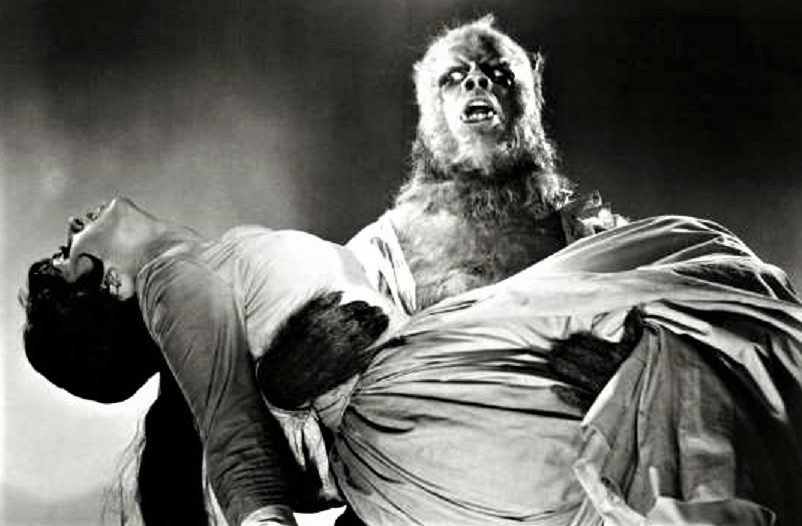
LEGEND OF THE WEREWOLF on the cover of the last issue of Monster Mag (Vol 2 #4, August 1976).

SON of cinematographer and director Freddie Francis, Kevin Francis founded Tyburn in an attempt to recreate the Hammer Horrors of his childhood. A slaughterhouse employee turned Hammer staffer - he had provided the outline for TASTE THE BLOOD OF DRACULA - the problem was that it was 1973, and horror cinema was becoming immersed in a new realism. Freddie would helm the two pictures here, yet his well documented disdain for the genre - and even greater contempt for its fans - would be mixed with a problematic working relationship with his son. LEGEND OF THE WEREWOLF sees wolves adopt a young boy named Etoile, who is discovered by a freak show fronted by Maestro Pamponi (Hugh Griffith). After growing up, Etoile (David Rintoul) makes his way to Paris where his ability to communicate with animals impresses a zookeeper (Ron Moody) who offers him a job. When Etoile becomes infatuated with prostitute Christine (Lynn Dalby), his resentment for her clients makes him transform into a werewolf. Piecing together the mystery, police pathologist Professor Paul (Peter Cushing) becomes convinced that a man-wolf is responsible.

As with CURSE OF THE WEREWOLF, the picture is based on Guy Endore's 1933 novel The Werewolf of Paris, and is also written by Anthony Hinds. It was announced under the misleading title of PLAGUE OF THE WEREWOLVES, and even though the film may return the story to its Parisian setting, this tepid production portrays its wolf attacks with mundane rapid cuts, red-tinted POV shots and close-ups of bloodied fangs. Thankfully the performances are earnest and entertaining: Cushing is unsurprisingly the star as he gradually unravels the crimes, Dalby gives a sympathetic performance as the archetypal tart with a heart, and Moody passes amicably as the abrasive zookeeper. Of the supporting players Roy Castle is typically irritating as a squeamish and bumbling photographer, while Michael Ripper makes the most of his cameo as "Sewerman."

Don Henderson as THE GHOUL. Prior to becoming an actor, Henderson was a detective sergeant with Essex police; ironically his most celebrated role was as fictional crime stopper George Bulman, who appeared in three TV series: THE XYZ MAN, STRANGERS and BULMAN.

Using sets built for THE GREAT GATSBY, THE GHOUL is a much more feverish affair. The film opens with four upper class twits - Geoffrey (Ian McCulloch), Angela (Alexandra Bastedo), Billy (Stewart Bevan) and Daphne (Veronica Carlson) - embarking on a car race to Land's End. But as fog closes in on Daphne and Billy, the blonde is whisked away by unhinged gardener Tom (John Hurt) to the remote mansion of defrocked clergyman Doctor Lawrence (Peter Cushing). Lawrence has returned from India with a family secret and a mystical servant (Gwen Watford), and unbeknown to Lawrence’s visitors, his son (Don Henderson in sandals) resides in the attic and suffers from uncontrollable bouts of stabbing and cannibalism.

Moving between misty marshlands and interior splendour, THE GHOUL exists in a hazy otherworld, with Cushing's commanding performance providing the actor with several art-imitating-life moments as he mentions his departed wife. As with CITY OF THE DEAD, THE GHOUL shares striking similarities with the structure of PSYCHO. We have a strong-willed blonde literally racing cross-country before stopping to rest at a location where she is murdered; even the killing is Hitchcockesque with a knife cutting through curtains (here, it is mosquito netting that surrounds her bed). Daphne's car is also disposed of with a push (a cliff rather than a bog) and Geoffrey is dispatched Martin Balsam-like falling backwards down stairs. The production also plays like a recycling of Hammer's THE REPTILE, with its English family corrupted by an evil Indian sect.

Monday, April 1, 2013

Curse of Kah-to-Bey

THE MUMMY'S SHROUD (1967)

South African non-actress Maggie Kimberly escapes the clutches 
of Eddie Powell in Hammer's third Mummy picture. 

EGYPT, 1920: a British archaeological expedition financed by businessman Stanley Preston (John Phillips) - comprising of Sir Basil Walden (Andre Morell), Preston's son Paul (David Buck), photographer Harry Newton (Tim Barrett) and psychic linguist Claire de Sangre (Maggie Kimberly) - discover the tomb of child prince Kah-to-Bey. Members of the find are soon being murdered by the Mummy of Prem (Hammer's regular stuntman and Christopher Lee double Eddie Powell), Kah-to-Bey's devoted servant, who can be revived by reading the words off the Prince's burial shroud.

Following Terence Fisher's magisterial THE MUMMY of 1959 and Michael Carreras' disposable 1964 release THE CURSE OF THE MUMMY'S TOMB, THE MUMMY'S SHROUD ("Beware the Beat of the Cloth-wrapped feet!") is a formulaic affair, and the last movie shot at Bray. Written and directed by John Gilling, and scripted by Anthony Hinds, the film starts with a painfully dull and micro-budgeted ancient Egyptian prologue - which includes Dickie Owen, the titular fiend from THE CURSE OF THE MUMMY'S TOMB, as the living Prem - and viewers will also be disappointed by the lack of cleavage, especially as so much is on offer from Kimberly's promotional poses. Unusually for Hammer, the glamour girl role is a character with a narrative function (the somnambulist Claire has the ability to read the "words of death"), but unfortunately Kimberly - who had just appeared in Gilling's secret agent spoof WHERE THE BULLETS FLY - is the worst actress in the Classic Hammer canon.

Studio Canal's Blu-ray/DVD was released in October 2012, containing two standout documentaries: an informative making-of and a touching tribute by Madeline Smith for husband David Buck.

As Jonathan Rigby points out in English Gothic: A Century of Horror Cinema, a telling sign of the relegated stature of Hammer's Mummy sequels is that stunt men were cast as the monster, following Christopher Lee's barnstorming performance in Fisher's original. The real monster of THE MUMMY'S SHROUD is Preston, expertly portrayed by Phillips as an arrogant coward: quick to enjoy the spoils, even quicker to escape when the curse starts to take hold. Elizabeth Sellars, as his wife Barbara, makes an excellent foil, and it is good to see Michael Ripper in a prolonged role as Preston's long-suffering valet, the myopic Longbarrow. Completing the cast are Catherine Lacey and Roger Delgado's scene-stealing turns as the mother-and-son team whose family have barred the entrance to Kah-to-Bey's tomb for centuries. In fact Lacey's role as fortune-teller Haiti, together with Barbara and Claire, form a trio of female characters with second sight, while the male protagonists are lambs to the slaughter. 

The Mummy has always been the slightest of movie monsters. Covered in bandages that barely conceal the decay beneath, and often reduced to stalk-and-slash with a mystical backdrop, the Mummy started life on film as a device for camera trickery; in both Melies' 1899 CLEOPATRA and Walter Booth's 1901 HAUNTED CURIOSITY SHOP, the creature was used to illustrate the joys of celluloid illusion. Unlike the literary origins of Dracula and Frankenstein, the springboard for the Mummy as a potential movie monster was enhanced by real life: the myths surrounding Howard Carter and Lord Carnarvon's 1924 expedition to uncover the tomb of Tutankhamen. In Hammer's fourth and final excursion into this sub-genre - BLOOD FROM THE MUMMY'S TOMB - the studio side-stepped including the bandaged menace altogether. Yet unlike Universal's arthritic Mummy movies, at least Hammer's ancient terrors were brutal threats.

Friday, June 15, 2012

Kiss of Dracula

THE KISS OF THE VAMPIRE (1963)
KISS OF EVIL (1966)
COUNTESS DRACULA (1971)

Isobel Black as Tania in THE KISS OF THE VAMPIRE. Her first feature, the Edinburgh-born actress shifts effortlessly between beguiling and malevolence; as Tim Lucas notes in his Video Watchdog review, "[Tania] is never shown biting anyone out of hunger, but rather to indulge a childlike, yet severe, streak of sadism."

DON Sharp's THE KISS OF THE VAMPIRE is a Hammer vampire film without Peter Cushing or Christopher Lee, but well worth investing your time. Shot with a colourful Gothic angle by Alan Hume, the setting is an isolated area of Bavaria, 1910. Honeymoon couple the Harcourts - Gerald (Edward de Souza) and Marianne (Jennifer Daniel) - experience car trouble and are forced to stay in the unfortunately named Grand Hotel, whose only other guest is reclusive alcoholic Professor Zimmer (Clifford Evans). Doctor Ravna (Noel Willman) - owner of the chateau that sits imposingly above the locale - invites them to dinner and their association with his seemingly charming family grow. When the pair attend a masked ball, however, they discover that Ravna is the head of a vampire cult. Zimmer performs a ceremony known as the Corpus Diabolo Levitum which forces "evil to destroy itself"; with the ritual taking the form of a swarm of vampire bats (apparently props purchased from Slough and Maidenhead branches of Woolworths), they smother Ravna and his gowned disciples.

THE KISS OF THE VAMPIRE develops themes from Terence Fisher's magisterial BRIDES OF DRACULA. Teenage cult member Tania (Isobel Black) imitates Greta from the earlier film by trying to coax a newly buried initiate from the grave; Zimmer extrudes a bite similar to Cushing's branding iron scene; and Anthony Hinds' script also explores vampirism as a social disease/order. Additionally, there are direct transfers from dropped BRIDE sequences: Zimmer interrupting his own daughter's funeral to throw a spade through the coffin lid, and the climactic bat attack (a scene vetoed by Cushing on the grounds that Van Helsing would never evoke evil himself). But Sharp's film has attractions of its own, notably Black's performance: in one scene, Tania tears open the shirt of our hero, scoring her fingernails down his chest, upon which our quick-thinking leading man smears the blood in the form of a crucifix. 

Ingrid Pitt and Sandor Eles star in COUNTESS DRACULA.

Released with the tagline "Shocking! - Horrifying! - Macabre!" THE KISS OF THE VAMPIRE was less so when NBC acquired the film from Universal in 1966. Considered too brazen for television viewing as it stood, most of the quirky erotica - and Zimmer's pre-credits shovel scene - was cut and replaced by specially shot footage in Los Angeles by Irving J. Moore, a director who would become synonymous with episodes of DALLAS and DYNASTY. Now titled KISS OF EVIL, these new, bland insertions - totalling around fifteen minutes to fill a two hour slot - tell of a local couple whose teenage daughter rebels when they attempt to prevent her attending the masked ball. The most interesting thing about the TV version is the casting: the mother is played by Virginia Gregg, who gained fame by voicing Mrs Bates in PSYCHO, while the daughter is portrayed by Sheilah Wells, once flatmate of Sharon Tate.

COUNTESS DRACULA is Hammer's pedestrian take on the legend of Elizabeth Báthory, a countess of Hungarian nobility who allegedly killed and bathed in the blood of young virgins to retain her beauty. Made by two Hungarian émigrés working in England - producer Alexander Paal and director Peter Sasdy - it tells of Countess Elisabeth Nádasdy (a robust but dubbed Ingrid Pitt), who discovers that her youth and libido can be temporarily restored if she bathes in the blood of young, virgin women. Her steward and lover Captain Dobi (Nigel Green) kidnaps and murders local girls, whilst she pursues Imre Toth (Sandor Eles), a young soldier. As a cover for her crimes while in her rejuvenated state she takes the identity of her own daughter, a plan that is complicated when her actual daughter Ilona (Lesley-Anne Down) returns home. Despite Báthory's blood-drenched legacy, the production is more historical drama/fairy tale, as Jeremy Paul's script focuses on the aging, widowed Countess. The handsome sets and costumes - inherited from ANNE OF A THOUSAND DAYS - give the film a splendid tableaux, but Sasdy's theme of the disintegrating family unit was much more successful in TASTE THE BLOOD OF DRACULA.

Tuesday, February 1, 2011

Love Will Tear Us Apart

THE CURSE OF THE WEREWOLF (1961)

Oliver Reed and Yvonne Romain in an impossibly-staged publicity still. Reed and Romain had a closely tied association with Hammer; the actress plays Reed's mother - who dies in childbirth - for THE CURSE OF THE WEREWOLF, then became his fiancee in CAPTAIN CLEGG before sharing their third appearance in THE BRIGAND OF KANDAHAR.

UNLIKE the literary origins of Dracula and Frankenstein, zombies and werewolves are rooted in folklore. Consequently, the living dead and shape-shifting sub-genres have treated film as their developing texts: George A. Romero basically re-invented the zombie with NIGHT OF THE LIVING DEAD, while THE WOLF MAN similarly set the precedence for romantic dread. Subsequent werewolf appearances were negligible until advances in make-up effects unleashed a slew of transformation pictures in the early 1980s, where THE HOWLING and WOLFEN developed lycanthropic societies coexisting with humans, and THE COMPANY OF WOLVES a link with menstruation. This exploration also seemed in tandem with developing body horror concerns, not only with cinema spectacles such as THE THING and VIDEODROME, but with the onset of AIDS.

Werewolves were limited to a triptych of releases during the British horror period of the 1960s and 70s. Amicus’ lupine whodunit THE BEAST MUST DIE was joined by two features inspired by Guy Endore’s 1933 novel The Werewolf of Paris: Hammer's THE CURSE OF THE WEREWOLF and Tyburn's LEGEND OF THE WEREWOLF. Directed by Terence Fisher and written by producer Anthony Hinds under the pseudonym John Elder, THE CURSE OF THE WEREWOLF is by far the best remembered. It is a flawed, visceral melodrama of lycanthropy from birth to death, ponderous in its pacing, but the film effectively focuses on the inner turmoil of man into wolf, benefiting from make-up artist Roy Aston's most accomplished work and arguably propelling young Oliver Reed onto the road to stardom. Pulverised by the Monthly Film Bulletin which claimed the film was "a singularly repellent job of slaughter-house horror," the picture ranks as one of the most brutal of all Hammer productions.

Oliver Reed's werewolf was the cover star of Warren publishing's low-brow Famous Monsters of Filmland #12 (June 1961).

The film opens with a beggar (Richard Wordsworth) visiting Castillo Siniestro, where the Marquis (Anthony Dawson) is celebrating his wedding. The beggar irritates the nobleman, who has him thrown into the dungeons where he remains forgotten by all but the jailer and his mute daughter (Yvonne Romain). After many years - with the Marquis decrepit and his wife long dead from his brutish behaviour - the Marquis sexually assaults the servant girl. When she rejects his advances, he has her thrown into the dungeon where the beggar - now reduced to a slavering animal - rapes her then dies in the act of violation. When the girl is freed, she stabs the Marques to death and flees into the woods, where kindly scholar Don Alfredo (Clifford Evans) rescues her. The girl dies in labour after giving birth to a son from her ordeal, and as the young Leon (Justin Walters) grows, he is increasingly troubled by dreams of drinking blood. Diagnosed with lycantrophy, the only cure is for Leon to be within a loving environment. Reaching manhood, Leon (Oliver Reed) - denied access to his love Cristina (Catherine Feller) - goes on a murderous rampage.

Endore's source material emphasises a number of aspects that cinema - at the time - could not dare to adhere to. Endore's rapist was a priest, not a beggar, for example, and the afflicted Bertrand and his love Sophie in the book avoid the violent effects of his transformation by cutting into parts of her body and allowing him to suck her blood ("her body was a fountain of blood to him, and it was if her body responded to his needs, like a nursing mother with milk.") In contrast, the film superficially represents the bond between Leon and Cristina in typical Hollywood fashion - the closest to a love story Fisher achieved  - that never touches on such sado-masochistic tendencies. Furthermore, the movement of the novel's locales to Santa Vera, Spain, centre around the abandoned Spanish Inquisition drama THE INQUISITOR/THE RAPE OF SABENA. After distributors Columbia feared condemnation by the Catholic Church's Legion of Decency, the project was pulled from Hammer's schedule, leaving a number of sets taking shape on the Bray lot which were then integrated into Fisher's film.

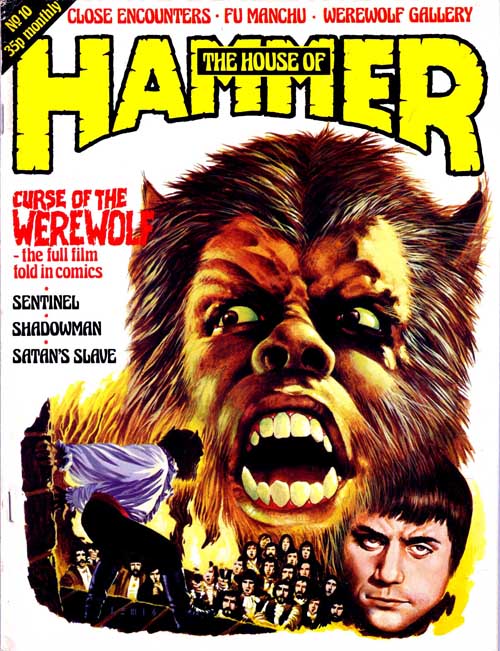
The House of Hammer #10 (January 1978) included a comic adaptation of THE CURSE OF THE WEREWOLF. Drawn by John Bolton, the strip acted as the flagship for this special werewolf issue.

With Reed not appearing until roughly the halfway mark, the extended prologue detailing Leon's lurid conception is suitably heady but prolonged. It is detrimental to the mechanics of the film that Reed and Evans' central performances could not be afforded more screen time, but the movie suffers from a number of time anomalies, surprising considering Fisher's trademark linear style: Leon’s feelings for his eternal love develop too quickly and off-screen, and Alfredo somehow narrates the preceding events which he could not have been akin to. Hammer also adheres to several cliches of the werewolf picture but also establishes new ones of its own. Lycanthropy is presented not as a disease but as an accursed birthright, and Leon's bestial instincts can be suppressed by the feelings of inner peace and comfort brought about by love, while the emotions of rage and frustration have precisely the opposite effect. Therefore Leon is subconsciously in control of his own fate, his werewolf dependent not just on the occurrence of a full moon but also upon Leon's state of mind. But like most cinematic werewolves, the character is not painted as a villain but as a personable young man ultimately condemned to a second existence of blood lust by circumstance.

Ashton's make-up effects for the wolfman, the Marquis and the beggar are uniformly excellent. Aston himself had suggested to Hinds that Reed's bone structure would be ideal for the role, and the success of the monster is that it is part-man and part-wolf, encapsulating Reed's ferocious snarls, especially starling when blood drips from his mouth. With this avenue for human expression, the tragedy of the werewolf is not lost, unlike later films which are reliant on mechanical effects and CGI, which overshadow any levels of performance. The Marquis' design explored how make-up could define a character's prolonged debauchery - especially memorable in the scene where Dawson picks his skin in an attempt to improve his appearance for the servant girl - and the beggar's own mutation into beast would not feel out of place on The Island of Doctor Moreau.

Universal - who owned the source material - contracted Hammer to make THE CURSE OF THE WEREWOLF. A film very much playing like THE WOLF MAN's bastardised relative, its horde of "Angry Mob" villagers who hound Leon at the climax - seen here underpinning this one-sheet - was Universalesque in its own right.

Dawson is suitably lecherous as the Marquis, and Wordsworth - having been similarly effective as the man/monster of THE QUATERMASS XPERIMENT - is both touching and frightening in a role ranging from abused beggar to feral man. Evans brings a subtle facade to the role of adoptive father, emotionally distraught yet resolved to end his sons misery. Without question, however, it is Reed's film. While the "Hammer Heavy" was evidently not quite the finished article at this point in his career, his portrayal conveys pathos and menace and amusingly, when he does appear, he's soon working in a winery, surrounded by bottles. Romain is enchanting as the exotic, raven-haired servant, but the rest of the cast are a mixed bag. Michael Ripper is wide-eyed as Old Soak and Desmond Llewellyn makes an appearance as a footman, but John Gabriel - as a priest - and Martin Matthews - as Leon's best friend - bring nothing to their roles. And in a refreshing quirk, Peter Sallis appears as mayor Don Enrique, 45 years away from similar circumstances voicing Wallace in the clay-mation favourite THE CURSE OF THE WERE-RABBIT.

Monday, February 1, 2010

Rising from the Moat

DRACULA HAS RISEN FROM THE GRAVE (1968)

Christopher Lee's Prince of Darkness is again reduced to petty revenge, this time lusting after Veronica Carlson's Maria.

DIRECTED by Freddie Francis and scripted by Anthony Hinds, DRACULA HAS RISEN FROM THE GRAVE is set a year after the vampire's death by drowning at the end of Terence Fisher's DRACULA, PRINCE OF DARKNESS. A priest (Ewan Hooper) finds a woman with bite marks hanging dead inside his church bell, a discovery that further convinces the parishioners that this place of worship – which is touched at dusk by the shadow of Dracula's castle – is tainted by the unholy. A visiting Monsignor (Rupert Davies) - disgusted by the townsfolk fear of an already vanquished monster - takes the priest to the Count's castle and places a giant golden cross across the door, though not before a storm causes the priest to fall down the mountain and bleed, conveniently, on the shattered ice that has imprisoned Dracula (Christopher Lee). Free to resume his demonic business, the Count seeks revenge on the Monsignor and his blond niece Maria (Veronica Carlson), who's in love – much to the Monsignor's disapproval – with God-denying baker Paul (Barry Andrews).

Like most Hammer Dracula films, the Count is given little to do, here lurking in the basement of the bakery-cum-public house, staring imperiously and baring his fangs on cue. Being a Francis film, its weak script and continuity are offset by a series of exquisite set pieces - none more effective than Paul's attempted staking of Dracula. Francis and cinematographer Arthur Grant use a dour, restrained tableaux, which gives the one big colour (red, inevitably) maximum impact. At the climax, after falling - in an unlikely manner - onto the golden cross, Dracula cries tears of blood and, for once, has the tragic nobility of Bram Stoker's source novel. Francis also makes the most of the lenient censorship which was extant by 1968: there is ample blood, and the liberal approach to sex is illustrated by lower necklines and more orgasmic shrieks.

Carlson’s mix of good looks and pale complexion made her one of Hammer’s most striking leading ladies.

Although DRACULA HAS RISEN FROM THE GRAVE dabbles with intolerance and Christian discovery, it lacks the tension and dynamism that Fisher habitually brought to equally poor scripts. But perhaps Fisher's overall reputation was enhanced by his lesser involvement as the Hammer empire was running out of steam; his earlier masterpieces were certainly made when the studio was more clear-cut and less commercially confused. This change from Fisher-like efficiency to the stylish dashes of Francis seems to mirror Hammer's shift from their confined, spiritual home of Bray Studios to the more sprawling Elstree and Pinewood. The intimate feel and tone of such Bray-filmed classics as THE CURSE OF FRANKENSTEIN and THE PLAGUE OF THE ZOMBIES is ultimately lost on the bigger sound stages, and such releases as LUST FOR A VAMPIRE and THE SATANIC RITES OF DRACULA typify a certain loss of soul.

Monday, August 24, 2009

Twilight of the Dead

FRANKENSTEIN AND THE MONSTER FROM HELL (1974)

David Prowse is The Creature in Hammer’s last gasp for Gothic Horror.

WITH an absurdly low budget, Terence Fisher's asylum-set FRANKENSTEIN AND THE MONSTER FROM HELL - scripted by Anthony Hinds - is a grim epitaph for the Baron and Fisher himself, a Hammer Horror - unlike many of the period - which didn't rely on sex to try to elevate its fortunes. Hollywood had once stood in line to finance the studio's profitable output, yet the vogue for Gothique had passed; when Frankenstein (Peter Cushing) is told that he’s mad, he laughs and in a line penned by the actor himself replies "oh possibly. I must admit I’ve never felt so elated in my life. Not since I first … but that was a long time ago."

As in TASTE THE BLOOD OF DRACULA, a franchise character is partnered with a younger equivalent - here surgeon Simon Helder (Shane Briant) - and the film benefits from remaining focused on the making of the monster, rather than cutting away to various asides (even the Baron's servant (Madeline Smith) is mute and inconsequential). Cushing - looking alarmingly gaunt and frail - is ill-served by a blonde curly wig and top hat, which only accentuates his thin frame and bony structure. Despite this, the actor remains as obsessive and athletic as always; a standout scene features Cushing's trademark leap, jumping onto - then off - a table, and wrapping a chloroformed coat around the Monster's head. Underneath the awkward, hulking and hairy creature suit, David Prowse gives perhaps his only performance in movies. None too pleased about his new skin, the abomination's dilemma is best conveyed when he caresses the violin possessed in his previous life, only to moments later smash it when realising the futility of the situation.

NIGHT OF THE LIVING DEAD made Hammer
seem outdated by comparison.

The decline of Hammer can be linked to its failure to understand the cultural shift that the end of 60s cinema represented. British filmmakers such as Michael Reeves and Pete Walker - together with American directors George A. Romero, Tobe Hooper and Wes Craven - moved horror into a new phase of intense violence that made Hammer's output positively quaint. Even by the mid-60s trouble was looming, with rising production costs and increasing competition, but Hammer seemed uninterested in nurturing new talent as their output became increasingly formulaic and threadbare both intellectually and in physical production (a good example being the unconvincing exteriors of the miniature asylum here).

Romero's nihilistic NIGHT OF THE LIVING DEAD did for the horror genre what Hammer achieved in 1957 with THE CURSE OF FRANKENSTEIN: it made everything before it seem dated and predictable. Romero's film looked like a newsreel, where economy was turned into an artistic value; Hammer, still largely stick in a Victorian world of vampires and mummies, lacked any connection to contemporary existence. This New Order created a change away from the tidiness of the British horror film and created a tableau where monsters and humans could no longer be easily distinguished. This loss of generic identity pulled British horror towards sexploitation, which was proving to be a formidable and cost-effective box-office attraction during a period of decline. But there was also an acute divergence and mutation in storylines: consider the Hammer and Shaw Brothers marriage for THE LEGEND OF THE SEVEN GOLDEN VAMPIRES, and Amicus' werewolf whodunit THE BEAST MUST DIE.

Thursday, January 1, 2009

The Soul of Frankenstein

FRANKENSTEIN CREATED WOMAN (1967)

Austrian model Susan Denberg had a limited screen career, and is best remembered for her role in this Hammer classic. Here Denberg appears as Playboy's Playmate of the Month in August 1966.

FRANKENSTEIN CREATED WOMAN - scripted by Anthony Hinds - is the most metaphysical of all Hammer Horrors, with Terence Fisher returning to the studios' mad scientist cycle after Freddie Francis' controversial departure THE EVIL OF FRANKENSTEIN. The Baron (Peter Cushing) is engaged in a series of experiments to determine whether the soul departs the body at the point of death, assisted by alcoholic Doctor Hertz (Thorley Walters), and dogsbody Hans (Robert Morris). In a local tavern, three young bloods taunt Hans' disfigured sweetheart Christina (Susan Denberg), and are forcibly expelled by Hans and her landlord father Kleve (Alan MacNaughtan). When the trouble-makers return, they bludgeon Kleve to death and Hans - the son of a convicted murderer - is unjustly accused and executed. Distraught, Christina drowns herself. When the Baron succeeds in placing Hans' soul in Christina's body, the combination fuses the woman's emotional scars with Hans' vengeful rage, resulting in a split personality bent on using her new-found beauty to seduce and kill the murderers.

Cushing is seldom better than the trial scene, which includes a priceless thumbing of the Bible. Rapier-witted, Frankenstein is clearly an intellectual giant compared to the inhabitants of this particular rural Balkan setting, where his arrogance seems justified. Although Denberg does not have the gravitas of a Barbara Shelley or an Ingrid Pitt, the dubbed actress holds up remarkably well. Morris recalls Denberg as sweet and friendly, yet caught up with the Roman Polanski "crowd," often appearing on set under the influence. Unfounded rumours have circulated over the years that Denberg died of a drug overdose in 1967, and that she had mental health problems due to an addiction to LSD.

Martin Scorsese selected FRANKENSTEIN CREATED WOMAN as part of a National Film Theatre season of his favourite movies in 1987.

Rigorously circular in structure - its first phase framed by two decapitations, the second by two drownings - the miserable events of FRANKENSTEIN CREATED WOMAN take on a tragic inevitability. The film's low-key finale has been greatly criticised, but as Christina recreates her suicide, she is at once putting Hans to rest and reclaiming her individual soul. What most engages the viewer is the human identification, and it is this element for which Frankenstein has neither time nor appreciation. With his work once again in tatters, it fails this time because there is something in the fragmented Christina that cannot permit it to succeed. The Baron is unwilling or unable to accommodate this humanity, providing the first clue to his disintegration in FRANKENSTEIN MUST BE DESTROYED, and eventual downfall in FRANKENSTEIN AND THE MONSTER FROM HELL.

Saturday, December 15, 2007

Drink A Pint of Blood A Day

TASTE THE BLOOD OF DRACULA (1969)

Anti-father and Anti-Christ: Christopher Lee and Linda Hayden on the cover of Little Shoppe of Horrors #4 (April 1978). Cast primarily as seductresses and nymphets, Hayden is one of a handful of British actresses who can look back on a genuinely dizzying career in film and television.

TASTE THE BLOOD OF DRACULA - directed by Peter Sasdy - was one of Hammer’s most troubled productions. There were accusations of script plagiarism from Freddie Francis’ son Kevin - who had handed in a rejected treatment entitled DRACULA’S FEAST OF BLOOD - a drama which indirectly lead to Anthony Hinds relinquishing his directorship of the studio. When an already disillusioned Christopher Lee insisted on a percentage of the American gross to appear again in his signature role, Hammer took the unimaginable step of replacing him with Ralph Bates. But by the time Warner Bros-Seven Arts reminded the studio that co-finance was on the condition that Lee played the Count, the actor’s late u-turn caused Dracula to be a supporting character in his own movie.

Hargood (Geoffrey Keen), Paxton (Peter Sallis) and Secker (John Carson) are three Victorian gentlemen whose charitable work in the East End is, in reality, a front for illicit thrills. At a brothel run by the effeminate Felix (Russell Hunter), Hargood has his prostitute taken from him by the contemptuous Courtley (Bates), who is known to dabble in the black arts. Courtley takes the three men to visit Weller (Roy Kinnear), who sells them the clasp, signet ring, cloak and powdered blood of Dracula. In a deconsecrated church, Courtley mixes his own blood with the powder in a ceremony to summon the Prince of Darkness, but his new-found colleagues refuse to drink the concoction; as the Acolyte chokes on the blood, the three men panic and beat him to death. During the night, Dracula is reborn, vowing to destroy those who have killed his servant by the mesmeric manipulation of the men’s previously obedient children.

Christopher Lee’s fourth outing as The Count for Hammer followed on directly from the actor’s stint in Jess Franco’s EL CONDE DRACULA.

Enveloped by one of James Bernard’s strongest scores, TASTE THE BLOOD OF DRACULA hints at the brutality and breasts to come in Hammer’s twilight years and, despite its troubles, is a film that skilfully unravels the hypocrisy of Victorian society as well as adhering to the progressive anti-establishment ethos of the times. Dracula may be pushed to the sidelines, but with the character acting as an omnipresent puppet master, his presence becomes no less imposing, acting as a Charles Manson-like catalyst for the “liberated” youths. In fact, the highlight of the film is the metamorphosis of Alice Hargood (Hayden) and Lucy Paxton (Isla Blair) from prissy little rich girls to vulpine harlots; in a particularly powerful sequence, the suitably loathsome Hargood - alluring to incestuous desires - drunkenly prepares to beat his daughter for her forbidden alliance with a male suitor. Confronting Alice in her bedroom and brandishing a riding crop, Alice’s escape into the arms of The Count is one of relief, and, having telepathically issued her instructions, recedes into the darkness as Alice hits her father with a shovel, twinkling with impish glee. Hayden uses her innocent face to ironic effect as Dracula’s main complicit in the ensuing retribution. And on a more trivial note, look out for Madeline Smith as a young prostitute.

Saturday, September 15, 2007

The Last Gothic

SCARS OF DRACULA (1970)

New Zealander Anouska Hempel bares her fangs. The actress also played "Australian Girl" in ON HER MAJESTY'S SECRET SERVICE and the title role in Pete Walker's TIFFANY JONES. Now a hotelier and designer, she married Allied Dunbar chairman Mark Weinberg in 1980, becoming one of the richest woman in Britain. During 1998 Hempel bought the right's to Walker's film and Russ Meyer's slave picture BLACK SNAKE - where she stars as Lady Susan - in order to keep them out of circulation.

HAMMER’s bloodiest film, SCARS OF DRACULA - scripted by Anthony Hinds - is also one of its most beautifully shot, defying its typically meagre budget. Braking the sequence began with their original DRACULA, no attempt is made to link it to the conclusion of the previous entry, TASTE THE BLOOD OF DRACULA. The Prince of Darkness (Christopher Lee) is afforded more screen time and dialogue, uttering his lines in a dreamy tone (under pasty make-up) that could be the result of Lee’s oft-quoted desire to express “the loneliness of evil” and the curse of immortality. Alternatively, it could be the disenchantment of an actor tiring of a limiting role (John Forbes-Robertson was considered before Lee was persuaded to return, but would later be cast as The Count in THE LEGEND OF THE 7 GOLDEN VAMPIRES). What is grating is that the film dispenses with Hammer's sensual lord vampire to create an atmosphere of brutal violence. The young cast are tepid at best (a miscast Dennis Waterman as Simon, the dubbed Jenny Hanley as Sarah, and Christopher Matthews as womaniser Paul), but the real meat comes from the supporting cast, with Patrick Troughton transforming Dracula’s urbane butler Klove into a masochistic errant boy, and Anouska Hempel as concubine Tania.

The last of the studio’s Gothic Draculas - and developed as a double bill with Jimmy Sangster's equally misguided THE HORROR OF FRANKENSTEIN - the film revels in 70s-style exploitation. Dracula is consequently transformed into a sadist, mystifyingly stabbing vampiric Tania to death, and branding Klove with a white-hot sword. He also impales Paul on a metal hook, and sends legions of bats to massacre an entire church of women and children; even the story is set in motion by a bat vomiting blood on the Count’s remains. Away from the general gore, Hind's screenplay is a plethora of nonsense: for example, the opening of "The Angry Mob" burning down the castle doesn't seem to have disrupted the interior. Director Roy Ward Baker’s preparatory work apparently drew him to actually read Dracula, inspiring the filmmaker to add an "unprecedented" shot from the novel of The Count scaling his castle’s wall which he claimed was his “only contribution … to the Dracula cycle” (obviously he had never seen DRAKULA ISTANBUL’DA, filmed seventeen years previously). In fact, the film’s “only contribution” is to have the most laughable bouncing rubber bats in British horror film history.

During the climax, Jenny Hanley's cleavage is ravaged by a vampire bat, eager to tear away her crucifix necklace. This "blood on breasts" sequence would have been unheard of for less liberal times.

During the audio commentary on Optimum's R2 DVD of 2006 - woodenly moderated by Marcus Hearn - Lee and Baker wax lyrical about the classic cinema dictum "less is more," views that particularly contradict the nature of the film they are viewing. Comments on The Count's shift towards frenzied violence are almost an afterthought, with the duo more lost in their silver screen legacies and after-dinner like recollections. Its a particularly meandering and name-dropping vocal from Lee, who quite rightly highlights the standard of actors Hammer cast in bit parts (here, Michael Ripper as the innkeeper, Michael Gwynn as a priest and Bob Todd as the Burgomaster), but he also makes the amazing statement that not only is Dracula's stabbing of Tania nonsensical, that such a scene is troublesome in the annals of influencing true crime.

Wednesday, February 1, 2006

Hammer's Cornwall Classics

THE PLAGUE OF THE ZOMBIES (1966)
THE REPTILE (1966)

The stunning Jacqueline Pearce, fresh from RADA, gives standout performances in both of these Hammer favourites.

FILMED back-to-back, and utilising much of the same production crew and sets, THE PLAGUE OF THE ZOMBIES and THE REPTILE were both directed by John Gilling. Each picture portrays an anti-colonial stance, and Hammer’s renowned class dynamic (that is, treading a noble path between the ignorance of the working class, bound by fear and superstition, and the unfettered power craving of the upper class). But the notion of the aristocracy as carriers of infection is crystallised in these two releases. Using the same basic story conceit as the Bela Lugosi favourite WHITE ZOMBIE, THE PLAGUE OF THE ZOMBIES belongs to the list of genuine classics in the studio’s back catalogue. Here, Sir James Forbes (Andre Morell), Professor of Medicine at London University, receives a letter from former pupil Dr Peter Tompson (Brook Williams). Now practising in Cornwall, Tompson tells of a mysterious malady which has overrun his village. The rash of deaths in the district, of which Tompson’s wife Alice (Jacqueline Pearce) is one of the latest victims, is ultimately traced to local Squire Clive Hamilton (John Carson). After returning from Haiti, Hamilton has become a black magician, using voodoo to reactivate the dead to staff his inherited, reopened tin mine.

Maximising its desolate setting, THE PLAGUE OF THE ZOMBIES is a model of economy and invention. The rural English setting, far from the usual Central European milieu, allows Gilling to use the pre-existing class structure to frightening effect; a film in which an aristocrat murders his lowly subjects in order to put them to work in daddy’s tin mine, unpaid as well as undead, would appear to operate on levels deeper than that of schlock horror. Indeed, the zombies' appearance, dressed in ragged brown robes, even suggests a link with medieval peasantry. The director shows sensitivity to Christian themes that characterised Terence Fisher’s work for Hammer; the Squire's enterprise is an immoral subversion of the Christ-story, and Tompson's recollection of his dream - "I dreamed I saw the dead rise; all the graves in the churchyard opened, and the dead came out" - is an allusion to Matthew 27:52-53. The great strength of the film, however, are the three performances from Morell, Pearce and Carson. Morell projects a moral bedrock that is necessary to carry the picture, expertly combining unflappable suavity with a deeply felt moral outrage. Pearce’s account of the living but ailing Alice is one of the most delicate performances in any horror film, and her all-too-brief reincarnation is one of the most terrifying. And Carson’s persona, a cool magnetism mixed with chilling repugnance, inevitably invites comparison to Christopher Lee.

THE PLAGUE OF THE ZOMBIES’ lumbering ghouls preceded NIGHT OF THE LIVING DEAD by two years. Squire Hamilton’s dilapidated characters opened the way for the armies of increasingly malevolent living dead that flowed in their wake; the first zombie appearance on the nocturnal hillside, together with the celebrated nightmare sequence - in which the undead dig their way out of the ground and advance with outstretched hands - are both highly influential.

THE REPTILE - scripted by Anthony Hinds - opens with a lengthy pre-credits sequence, in which a young Cornish landowner is lured across a moor by exotic music, only to be bitten to death by a lethally poisonous assailant. His property is inherited by his brother, Harry Spaulding (Ray Barrett), who learns that he died of causes described by locals as "The Black Death", symptoms of which are identical to those bitten by a King Cobra. In fact, neighbouring theologist Dr Franklyn (Noel Willman)’s daughter Anna (Jacqueline Pearce) has been cursed by the Snake People of Borneo, to transform into a half-human snake creature as punishment for her father’s professional exposure of their religious cult.

Slower and more stately than THE PLAGUE OF THE ZOMBIES, THE REPTILE nonetheless is rich in atmosphere, and its carefully orchestrated tension belie its support feature status. Pearce, in another splendidly intense performance, makes for a fascinatingly sympathetic character, despite her clumsy – but oddly endearing – transformation make-up. The actress transcends the papier mache face mask by investing the Reptile with a sinuous grace, encased in a black gown of watered silk and a pony tail slithering incongruously down her back. Appearing as if to have strayed into the lurid landscape of Hammer Horror, Franklyn is more suited to M. R. James’ stories in which antiquarian scholars pay a terrible price for their academic zeal. The theologist’s Malay manservant (Marne Maitland) seems like the conventionally negative ‘Yellow Peril’ figure, but it is worth pointing out that though the evil in the film originates in the East, it only chooses to infiltrate England thanks to the blundering presumptions of a Westerner. Unlike Squire Hamilton, Franklyn hardly seems a villain at all, but both characters are tainted by their exposure to other cultures; as these two releases appear to illustrate, time spent in a foreign country invariably corrupts an Englishman's soul.