Showing posts with label Peter Sykes. Show all posts

Thursday, November 1, 2018

Web of Fear

VENOM (1971)
DOCTOR WHO - PLANET OF THE SPIDERS (1974)

Serbian actress (and later politician) Neda Arneric is the siren of VENOM, beguilingly erotic and self destructive. Elected as a member of the Democratic Party in 2000, she withdrew from public politics after the "remote voting" scandal, when her vote was registered in Serbian Parliament while on holiday in Turkey.

SPIDERS have a tradition in horror, large or small. On the silver screen, Jack Arnold directed two of the most loved during the 1950s: science goes awry and creates a giant TARANTULA!, and a household spider strikes fear into THE INCREDIBLE SHRINKING MAN. Towards the end of the decade Bert I. Gordon made EARTH VS THE SPIDER, and the 1970s saw the release of two classics: Wisconsin suffered THE GIANT SPIDER INVASION, and even William Shatner had to try and prevent a small Arizona town from becoming a KINGDOM OF THE SPIDERS (to no avail). More recently we have endured ARACHNID, BIG ASS SPIDER!, ARACHNOPHOBIA and Arizona again was the battle zone of EIGHT LEGGED FREAKS, where a spider farm suffered a toxic waste spillage.

VENOM is an appealing curio and the directorial debut of Peter Sykes. While holidaying in a Tyrolean village, artist/photographer Paul Grenville (Simon Brent) discovers hypnotic redhead Anna (Neda Arneric) in the woods, who has a mysterious spider mark on her shoulder. Making the acquaintance of Huber (Gerard Heinz) and his seductive daughter Ellen (Sheila Allen), Grenville is introduced to tales of the "spider goddess," a legend of the area, where a female phantom kills any men who becomes sexually involved ("they say if anyone touches me, the spiders come"). Yet her visage has been purposely created to scare off locals from a Nazi plot producing nerve agents from spider venom, funded by priceless stolen paintings and led by Anna's renegade scientist father (Terence Soall).

VENOM was released on Region 2 DVD by Fabulous Films in 2015, whose product blurb is as off kilter as the production itself.

Feeling more like a Euro-thriller than British horror, VENOM stands out with its stunning Bavarian location, odd camera angles and dreamlike ambiguity (it opens with a flashback nude bathing romp tinted green, and why not?). Anyone who is already confused should definitely avoid the American edit, which was picked up by New Line and retitled LEGEND OF SPIDER FOREST. Cut by over ten minutes, this includes dialogue referencing situations not included, and a general trimming of violent and erotic scenes. The full ninety minute movie includes an array of weirdness: softcore flogging, cows with flower garlands on their heads, and a climactic nod to Norman Bates. This must have caused an impression with Hammer, who assigned Sykes to direct DEMONS OF THE MIND the following year. 

On the small screen, the DOCTOR WHO serial PLANET OF THE SPIDERS explored Barry Letts' personal obsession with Zen Buddhism; it is the only occasion where a WHO producer and co-writer also directed the episodes. Since his discharge from UNIT, Mike Yates (Richard Franklin) is part of a Tibetan meditation group in rural England. While visiting, Sarah Jane (Elisabeth Sladen) and Yates stumble across resident Lupton (John Dearth) performing an incantation, which conjures up a giant spider. The Buddhist centre is actually a front to contact a powerful alien force that manifest as a large Arthropod; the spider is an emissary from the Metebelis 3 ruling council, sent to recover a blue crystal that The Doctor (Jon Pertwee) previously found there and that has now been returned to him by Jo Grant (Katy Manning) from her trip to the Amazon. The Doctor recognises Abbot K'anpo (George Cormack) as his former Time Lord guru and, at his prompting, returns to Metebelis 3, where a human colony revolt has failed. The Great One spider uses the crystal to complete a lattice which she believes will increase her mental powers to infinity.

A giant Arthropod attempts to exert telepathic control in DOCTOR WHO - PLANET OF THE SPIDERS. 

A weak six-partner to finish Pertwee's tenure, PLANET OF THE SPIDERS suffers from its grating use of the colour-separation overlay technique and an indulgent, nonsensical chase sequence. The original season climax was to be THE FINAL GAME, where The Master would sacrifice his life to save The Doctor in an act of redemption. This was abandoned due to the death of Delgado while filming in Turkey for the French/German TV mini-series LA CLOCHE TIBETAINE (however, Delgado's legacy exists on an obtuse level, as his widow Kismet provides the voice for the Queen Spider). Despite its flaws, the programme taps into the widespread fear of Arthropods, which research has suggested that may be innate to humans, and an exaggerated form of instinctive responses that helped early bipedal primates to survive.
Saturday, July 1, 2017

Demons of the 1970's (Part I of II)

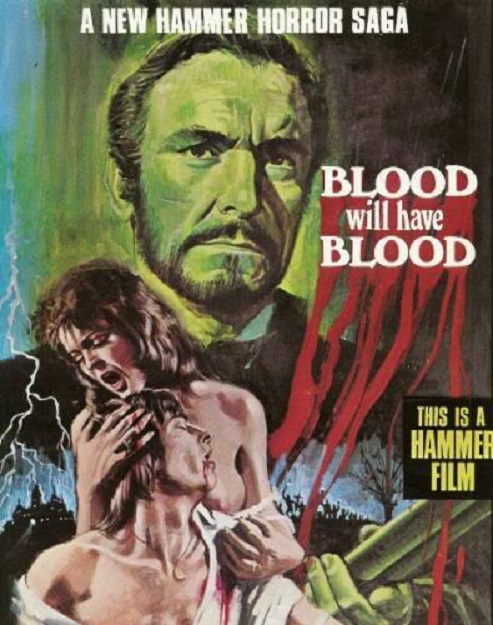
DEMONS OF THE MIND (1972)

One of Britain's last costumed Gothics, DEMONS OF THE MIND was filmed as BLOOD WILL HAVE BLOOD, exploring "dreams of sexual fear supressed through guilt."

AMID the dying embers of the 1970's British film industry, attempts to move into more psychological thrillers resulted in a number of underappreciated efforts. Dumped onto the wrong end of a double bill with TOWER OF EVIL, DEMONS OF THE MIND - directed by Peter Sykes and written by Christopher Wicking - is a Hammer production which focuses on Baron Friedrich Zorn (Robert Hardy), who fears he has passed on the "family madness" to son Emil (Shane Briant) and daughter Elizabeth (Gillian Hills). Held captive to curb their incestuous desires, Emil is at least released at night to murder women, while Elizabeth is "bled" to make her weak (making use of a vintage Scarificator from the British Museum). When discredited psychologist Falkenberg (Patrick Magee) arrives with his associate scholar Carl (Manfred Man singer Paul Jones), an experiment to rid Emil of his lust involving Inge (Virginia Wetherell) ends in another strangulation. The villagers, influenced by a deranged, self-styled Holy Man (Michael Hordern), decide that Zorn is the true demon, and stake him with a burning cross.

A mix of Hammer's Mittel Europe and fledgling psychiatry was one way the company attempted to make its product fresh, another was by infusing proceedings with new young directors and screenwriters. But DEMONS OF THE MIND is more cynical than satisfying, conveying a relentless dourness (quoting Psalm 38 "For my loins are filled with a loathsome disease, and there is no soundness in my flesh") where conventions are either twists or throwbacks: Magnee's unhinged Mesmerist and Van Helsing substitute helps no one ("Better men than I have been booted out of Vienna!"), an alleged Priest is a dangerous zealot, and the villagers revel in their own sadism.

In a role originally intended for Marianne Faithfull, Gillian Hills plays somnambulant Elizabeth Zorn. Faithfull was pulled late on due to insurance issues on her drug use.

A Poe-like story of an incestuous, murderous dynasty crumbling to dust, Zorn is driven by subconscious compulsions of his peasant bride's "virgin blood" and bare flesh (Zorn is a character undermined by Hardy's pantomime performance; to think we might have had Eric Porter, Paul Scofield, Dirk Bogarde or James Mason). Hordern is also overtly loopy, barely able to carry his over-sized wooden cross, and despite the emotional slant, DEMONS OF THE MIND actually serves up a copious amount of exploitative, early 70's gore: although optically fogged, Zorn's wife is seen to slash her wrists and throat in front of her children, but further scenes of Emil killing maiden aunt Helda (Yvonne Mitchell) with a bunch of keys and Zorn's climactic impalement are in no way shrouded.

The original pitch to Hammer by Frank Godwin - the composer-cum-independent producer who penned Strange Love for LUST FOR A VAMPIRE - was actually a werewolf picture. The studio was intrigued by Godwin's knowledge of the legend of Blutlust, and together with Wicking, formulated a treatment based on the Bavarian story of a man-wolf which was actually a psychopathic condition not understood by the medicine of the time. However, the tale was a complete fabrication, and Hammer did not warm to the werewolf elements anyway, leaving only a vague lycanthropic reference in the finished film where Zorn imagines himself stalking as an animal (to further the pseudo-werewolf angle, the muted cinematography is lensed by Arthur Grant, making his last Hammer picture in an association which started with THE CURSE OF THE WEREWOLF).

Thursday, May 1, 2014

Much Ado About Murder

THE HOUSE IN NIGHTMARE PARK (1973)
THEATRE OF BLOOD (1973)

"What a funny lot!" Frankie Howerd holds the key to 
THE HOUSE IN NIGHTMARE PARK.

SINISTER shenanigans are afoot in Peter Sykes' THE HOUSE IN NIGHTMARE PARK, an alleged horror comedy written by Clive Exton and Terry Nation. Described by George Melly as "as British as nailing a kipper to the underside of an unsympathetic seaside landlady's dining-room table," the film follows Edwardian thespian Foster Twelvetrees (Frankie Howerd) - "Greatest Master of the Spoken Word" - scraping a living by giving hammy performances to embarrassed audiences. Invited to provide a reading - so he believes - at a spooky mansion owned by the Hendersons, the actor finds himself embroidered in a nefarious plot involving deadly snakes, hidden family secrets and a mad woman in the attic. 

For the turn of the 1970s, the sets have a fittingly tired look for the dilapidated gothic subgenre, and direct references are plenty: THE CAT AND THE CANARY and PSYCHO are chiefly evoked, and the Hendersons heritage - like the protagonists of THE REPTILE and THE GHOUL - are Anglo-Indian. Yet Howerd looks uncomfortable in his starring role: with no asides to camera and his opportunity for innuendo cut to a minimum, the comedian seems subdued (apart from the classic line "Do I play the piano? Does Paganini play the trumpet?"). Aside from Howerd, the actors portraying the Henderson's are an arresting group: Ray Milland heads the clan as the blandly evil Stewart, Hugh Burden is abrasive retired major Reggie, Kenneth Griffith is homicidal vet Ernest, and Elizabeth MacLennan is effective as unconventional heroine Verity. If the humour falls flat, the film works better as a straight horror, especially a veiled old crone in black with a meat cleaver, and a truly bizarre dance sequence where the family relive their time as "Henderson's Human Marionettes."

Vincent Price - in a tour-de-force performance - and
Robert Morley in Harbour's THEATRE OF BLOOD.

Douglas Hickox's THEATRE OF BLOOD tells of Shakespearean actor Edward Lionheart (Vincent Price) who - with the aid of daughter Edwina (Diana Rigg) and a community of down-and-outs  - murders members of a self-absorbed 'Critics Circle' for failing to give him the recognition he feels he deserves. Apparently committing suicide, Lionheart returns to mastermind a series of Bard-inspired demises, including nods to Julius Caesar (stabbing), Cymbeline (beheading), The Merchant of Venice (an improvised pound of flesh) and in the most memorable scene Meredith Merridew (Robert Morley) is fed his own "children" in a pie (here, poodles) referencing Shakespeare's bloodiest play Titus Andronicus. 

The most literate of all horrors, THEATRE OF BLOOD is also filled with sly visual Shakespearean motifs, down to the name of an outside broadcast unit ([Stratford-Upon-]Avon Television). Price was particularly enthused by the quality of cast around him - Michael Hordern, Arthur Lowe, Dennis Price, Diana Dors, Madeline Smith - and brings pathos to a role that gave him a an opportunity to exorcise his own critical demons.

Tuesday, September 11, 2012

Hammer Rides Out

THE DEVIL RIDES OUT (1968)
TO THE DEVIL A DAUGHTER (1976)

"The Goat of Mendes! The Devil Himself!" Eddie Powell dons the monster suit for Hammer's  THE DEVIL RIDES OUT.

TERENCE Fisher's THE DEVIL RIDES OUT is based on Dennis Wheatley's pot-boiling 1934 novel, and benefits from a Richard Matheson script which surgically cuts the fat from the author's most famous - but sprawling - work. It is also the most sumptuous-looking Hammer film produced by the studio after their move from Bray to Elstree. Set in 1920s London, Nicholas, the Duc de Richleau (Christopher Lee) and Rex Van Ryn (Leon Greene, dubbed by Patrick Allen) decide to pay a visit to Simon (Patrick Mower), the son of a late comrade. The duo find him hosting a gathering of The Left Hand Path, and under the influence of satanic priest Mocata (Charles Gray), Simon escapes. Consequently, our heroes must seek out the mysterious Tanith (Nike Arrighi) - the daughter of a French countess - who is destined to join their friend at a satanic ritual. When de Richleau and Van Ryn rescue the seemingly doomed pair, Mocata sends his supernatural forces to obtain those promised to him.

Aleister Crowley served as technical adviser to Wheatley's book, and THE DEVIL RIDES OUT illustrates a series of genuine arcana. Ceremonial details, allegiances to nineteenth century magician Eliphas Levi and dialogue (the Susamma ritual is not Matheson but the actual incantation) are all Crowleyesque in tone. A penny-dreadful villain in the novel, Gray's Mocata is the living incarnation of what Fisher often described as "the charm of evil." His central battle of wills with Lee are perfectly played, and the casting of Arrighi is also noteworthy, as her quirky beauty is suited to a role for a woman seeking spiritual awakening. But even with these strengths, the film was not the box office success Hammer had hoped, and packs less dread today when viewed outside of the cycle of satanic movies that would sweep through cinema until the mid-1970s. Particularly detrimental are the special effects, and the orgy that presages The Goat of Mendes is too tame to seem even remotely diabolical.

Christopher Lee and Nastassja Kinski in TO THE DEVIL A DAUGHTER. A tour de force for Lee, even Astaroth's effigy - a crucified bat in the source novel but a spread-legged hermaphrodite mounted on an inverted black cross in the film - befits Dracula.

Crowley's mandate to bring the Devil's offspring to Earth was channelled into his 1929 work Moonchild. This inspired a 1953 Wheatley novel that acts as the springboard for TO THE DEVIL A DAUGHTER, the last Classic Era Hammer Horror. The film tells of excommunicated Father Michael Rainer (Lee), who is head of a cult which rears innocent minors in a closed Catholic convent to serve Astaroth. One of his charges - Catherine Beddows (Nastassja Kinski) - has been chosen as the Devil's representative when she comes of age. Catherine's haunted father Henry (Denholm Elliott) enlists occult author John Verney (Richard Widmark) - an obvious Wheatley alter ego - as the girl's temporary guardian, and with the aid of his agent Anna (Honor Blackman) and her gallery-owner boyfriend David (Anthony Valentine), aim to halt Rainer's plans.

Directed by Peter Sykes, TO THE DEVIL A DAUGHTER was afforded the largest budget for any Classic Era Hammer film, but it was a troubled production. Widmark allegedly punched an electrician on set and considered the subject matter distasteful and beneath him; Christopher Wicking's typically anarchic script was constantly being rewritten by THE DUELLISTS scribe Gerald Vaughn-Hughes; and stuntman Eddie Powell suffered burns when set on fire for David's church-bound demise. There was also controversy surrounding Kinski, the scandalous teenage lover of Roman Polanski at the time; her naked cavorting in the final scenes - as the actress was born in 1961 - made them highly illegal. Even the money shot - when Catherine presses the bloodied demon child into her womb - exists only to adhere to EXORCIST-style shock tactics. Equally disappointing is the notoriously flat ending: in the original rough cut, an alternate conclusion saw Catherine return to the Bavarian convent to perpetuate the evil of Father Michael, but all we get is Verney halting the wave of evil by throwing a rock at Rainer's head.