Showing posts with label Peter Arne. Show all posts

Monday, April 1, 2019

The Man in the Crimson Hood

THE OBLONG BOX (1969)

Alister Williamson is doomed Edward Markham and Sally Geeson sexpot maid Sally in a promotional shot for this AIP release.

THE first film to co-star Vincent Price and Christopher Lee, Gordon Hessler's THE OBLONG BOX starts in Africa, where Julian Markham (Price) discovers that brother Edward (Alister Williamson) has been cursed by voodoo. Back in England, Julian keeps Edward chained in a remote room of the Markham estate, his mental and physical states disintegrating. However, Edward plans to escape with the help of Trench (Peter Arne), Norton (Carl Rigg) and witch doctor N'Galo (Harry Baird), drugging him to give the temporary appearance of death; once buried, Trench and Norton will exhume the coffin and grant him freedom. But Trench pockets his fee and Edward is actually dug up by grave robbers - replete with coffin - for the use of Dr Neuhartt (Lee). Wearing a crimson hood, Edward vows to repay "some very important debts" while staying with Neuhartt, blackmailing the physician for his liaisons with body snatchers.

Scripted by Lawrence Huntington with "additional dialogue" by Christopher Wickling, THE OBLONG BOX has the thinnest of connections to its source Edgar Allan Poe story (it all owes more to H.P. Lovecraft - with its arcane lore and a disfigured outsider - and Rudyard Kipling's The Mark of the Beast). Originally to be directed by Michael Reeves before his own premature death, to further WITCHFINDER GENERAL connections Price is reunited with Hilary Dwyer as his younger sweetheart Elizabeth, but the actor - originally to play both brothers - looks disinterested and tired. Although beautifully shot by John Coquillon, it is a picture of missed opportunities; Price and Lee only share one scene together despite their marquee value (in fact, Lee's death scene), and the reveal of Edward's condition results in what looks to be little more than a bee-stinged nose, particularly disappointing after its long build-up.
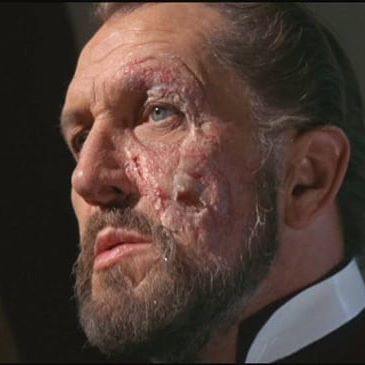
Vincent Price as the diseased Julian Markham. By this stage in his career the actor grew weary of the Edgar Allan Poe adaptations, particularly within the saturation of the late 1960s horror film market.

THE OBLONG BOX belongs to that horror subgenre - THE MUMMY, PLAGUE OF THE ZOMBIES, THE REPTILE, THE GHOUL et al - that echo colonial guilt (remarkably, Hessler's film was banned in Texas for being "pro-Negro"). Julian laments his attitude ("we sinned out there in Africa all right, plundering their land - and we're still stealing their wealth, though they're too innocent to know it") and is revealed to have been the intended recipient of the curse. There is a quiet justice to the conclusion, as Edward bites the hand of his brother, passing on the psoriasis-based condemnation. But ultimately the much re-worked and bloated script carries little gravitas, instead grabbing from more substantive works with no cohesive payoff. This unfocused starting point is further undermined by turgid pacing and padding (the tavern sequences in particular).

Sunday, February 1, 2015

The Fordyke Saga

THE BLACK TORMENT (1964)

A panting Edina Ronay makes for a memorable opening to THE BLACK TORMENT. The Anglo-Hungarian daughter of food critic Egon and mother of actress/writer Shebah, Edina was noteworthy for her fleeting turns in A STUDY IN TERROR and PREHISTORIC WOMEN. In the mid-70's she retired from the screen to take up fashion design, specialising in knitwear.

TAKING its cue from Hammer's costumed gothics, Compton's THE BLACK TORMENT is an underappreciated gem that also draws upon the aura of Mario Bava and the eloquent staging of Roger Corman's Poe pictures. Set in the spring of 1780, the film opens with a young woman fleeing across a nocturnal wood, as a murderous assailant gives chase. After being attacked and left to die, she utters the name ... Sir Richard! Days later, Sir Richard Fordyke (John Turner) returns to his Devon estate with second wife Elizabeth (Heather Sears). Although he has been away in London for three months, villagers claim to have seen the aristocrat riding through the woods, chased by the spirit of his first wife Anne, who supposedly committed suicide four years previously. With Sir Richard increasingly being manipulated into an alleged ancestral madness - including finding his crippled father hanging - he turns to magistrate Colonel Wentworth (Raymond Huntley) to help him solve the mystery. The final revelation is less a surprise more a sign-posted but illogical confirmation: this particular backward "evil twin" brother can not only rape and pillage, but place detailed orders to a Tiverton saddle maker.


The posters for THE BLACK TORMENT went into hyperbolic overdrive: "terror creeps from the fringe of fear to the pit of panic"; "the screen shudders with raw and violent savage suspense!"; "...by the screaming terror of a woman's fear" et al. Underneath this barrage you actually get a richly rendered production filled with solid performances (though Turner often subscribes to Elizabeth's line "Oh Richard, you're overwrought") and meticulous supporting players such as Peter Arne (whose trademark swarthy villain is a role identical to his appearance in THE HELLFIRE CLUB) and Patrick Troughton (who appears as a stable groom). A colour long associated with sensations of infinity and imagination, cinematographer Peter Newbrook smothers the film in languorous blue, and as Jonathan Rigby argues in English Gothic, perhaps a more apt title would have been THE BLUE TORMENT. Known for his moving camera and zooms, director Robert Hartford-Davis was indulging in his lush sets and costumes - including the obligatory low-cut frocks - until an on-set visit from the studio's wheeler-dealer partners Michael Klinger and Tony Tenser. Compton had already committed to a number of projects so budgets were tighter than ever, and after running three days behind schedule, allegedly Tenser ripped out ten pages from the shooting script in front of the director and proclaimed "there you are, you're back on schedule."

Wednesday, October 16, 2013

Their Satanic Majesties Request

THE HELLFIRE CLUB (1961)
TERROR (1978)

French A style poster for New World's THE HELLFIRE CLUB, more pulp adventure than demonic horror.

THE real-life Hellfire Club was famed for its debauchery and devil worship, the name given to several establishments in Britain and Ireland as meeting places for "persons of quality," who wished to take part in immoral acts. Founded in 1719 London, The Club motto Fais ce que tu voudras (Do what thou wilt) was a philosophy associated with François Rabelais' fictional abbey at Thélème, and later adopted by Aleister Crowley. Set in 18th century England, THE HELLFIRE CLUB tells of circus acrobat Jason (Keith Michell), in his attempt to reclaim the estate of his estranged father Lord Netherton (Andrew Faulds), leader of The Hellfire Club. Years earlier, Jason as a boy (Martin Stephens) is whipped by his father after walking in on an orgy, and together with his mother (Jean Lodge) flees with Timothy (David Lodge). Jason discovers that his cousin Thomas (Peter Arne) has stolen his inheritance, and together with lawyer Merryweather (Peter Cushing), plans to bring an end to the deceit and break the grip of The Club on King George II’s rule. 

Although billed as a guest star, Cushing's fussy but erudite character is pivotal to the fate of English society (the actor later adapted Merryweather's demeanor for his takes on Doctor Who and Abner Perry). Because of Cushing's presence and its lush staging, the film is often mistaken for a Hammer release; but there is no bite to the picture, limiting itself to a handful of orgies where most of the participants remain fully clothed. Directed by Robert S. Baker and Monty Berman from a script by Leon Griffiths and Jimmy Sangster, it is more swashbuckling melodrama, using The Club as a pinning to hang its elaborate fight scenes and love interests (redheads Adrienne Corri and Kai Fischer). Like most cinematic heroes brandishing a sword, Jason is not only morally perfect but also irresistible to women, and Michell gives a likable performance as he gathers his circus comrades to do battle with the hierarchy.

With a running time of only 80 minutes, TERROR is a whirlwind of gore, semi-nudity and in-jokes. Amazingly, the film topped the UK box office charts for a week in early 1979.

TERROR takes a more traditional approach to the devil. Reuniting director Norman J. Warren with scriptwriter David McGillivray after SATAN'S SLAVE, TERROR is not so much an unashamed rip-off of Dario Argento's operatic gore noir SUSPIRIA but a star-struck reaction to it. The movie starts with a witch hunt and a beheading, subsequently revealed to be a "film within a film" being watched in the same house where hundreds of years before the events being portrayed on screen took place. The witch exacts her revenge on the ancestors of her persecutors, one of whom is the production's director, James Garrick (John Nolan). After a makeshift hypnosis goes awry, the curse takes on a more direct approach, including death by lighting equipment, murderous film cans (in reality nine faulty prints of SATURDAY NIGHT FEVER specially supplied by Rank Laboratories) which leads to a very Argentoesque window-pane decapitation, and aspiring actress Carol (Glynis Barber) is impaled to a tree trunk.

The performances are generally competent, but James and Ann Garrick (Carolyn Courage) both have too little screen time to develop the family curse scenario. Instead, the focus is on Les Young's coloured filters to provide TERROR with a suitably garish tableau and enhance the hallucinatory disregard for logic. The opening "film within a film" acts both as a Hammer Gothic pastiche and a expostulation of it, but this is not the only nod to a cinematic heritage; the viewer is also treated to a fictitious softcore film called BATHTIME WITH BRENDA, scenes heavily indebted to experiences not necessarily enjoyed by Warren and McGillivray in their careers. Other points of interest are a nightclub act you won't forget in a hurry, and a red herring sequence culminating in a Peter Mayhew cameo.