Showing posts with label Pete Walker. Show all posts

Sunday, May 1, 2022

Britain in the Raw

COOL IT CAROL (1970)
GOODBYE GEMINI (1970)

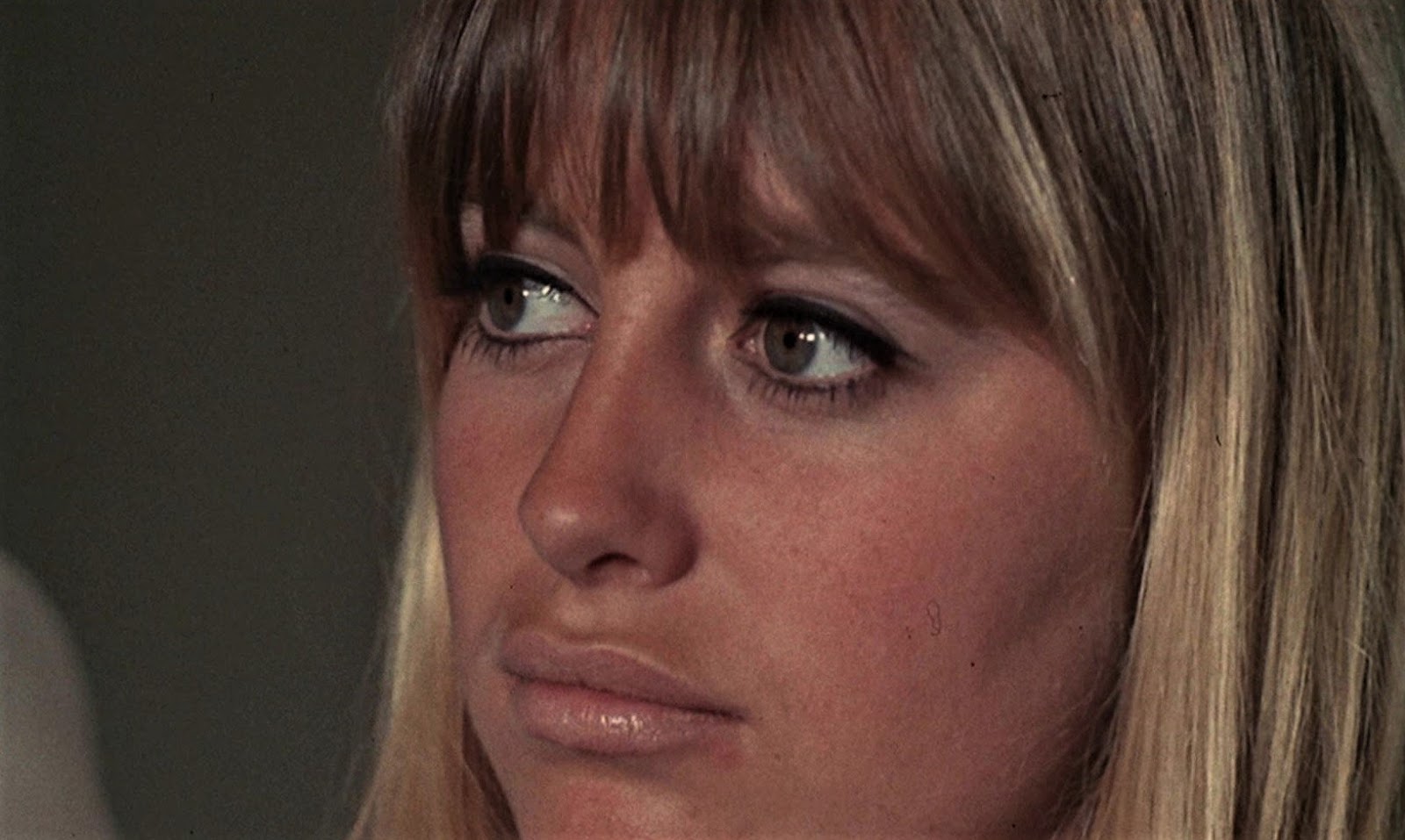
Released by AIP in the United States as DIRTIEST GIRL I EVER MET, COOL IT CAROL is a kitsch time capsule of swinging London that also started Britain's love affair with Robin Askwith's naked arse.

COOL IT CAROL and GOODBYE GEMINI were released within four months of each other in the latter half of 1970, both telling tales of young couples traveling to London. Inspired by a true story, COOL IT CAROL is part sex comedy part cautionary tale, and Pete Walker's finest slice of sexploitation before shifting to horror. Butcher boy Joe Sickles (Robin Askwith) and garage attendant Carol Thatcher (Janet Lynn in a role intended for Susan George) leave Shropshire to seek fame and fortune. With Joe unable to find work, he soon becomes Carol's manager, Thatcher guiding their wealth through modelling, cheap porn loops and prostitution ("it's only a fuck - I can't believe people pay good money for it.") As Carol becomes a high class call girl with Sheikh and cabinet minister clients, the pair become tired of fabricated existence and return home to resume their old jobs. 

COOL IT CAROL benefits from a solid Murray Smith script and strong performances (we are naturally enthused by Joe and Carol to the extent that the pimping sequence is quite harrowing). Unsurprisingly the papers couldn't see past the smut, describing it as "liable (if not calculated) to corrupt" (Evening News) and "a patch of untreated effluent" (Sunday Times). Similar to Walker's exploitation breakthrough HOUSE OF WHIPCORD, COOL IT CAROL portrays corruption as being far more dictated (and practiced) by those with higher moral standing, where sexual possession is seen as commodity (even in the filmmaker's 1969 travesty SCHOOL FOR SEX, a Judge takes over promiscuous reigns). After all, this is a London for the domain of young players, greasy businessmen and seedy politicians, in Soho clubs with indoor swimming pools.

Judy Geeson, Martin Potter and Alexis Kanner enjoy a London on the threshold of hippie disintegration in GOODBYE GEMINI.

Judy Geeson and Martin Potter star as fraternal birth partners Jacki and Julian Dewar in Alan Gibson's GOODBYE GEMINI. A companion piece to MUMSY, NANNY, SONNY AND GIRLY in its portrayal of childlike family interaction, Jacki and Julian, on a University break, are sent by their father to an old Chelsea Embankment house and immediately hospitalise their elderly governess. They frequent London's underground party scene - complete with Jacki's teddy bear Agamemnon - and are soon ensnared by hustler Clive Landseer (Alexis Kanner with elaborate sideburns). Clive is using the Dewars to shroud him from gangster Road Barstowe (Mike Pratt), who he owes a large gambling debt; Clive blackmails Julian by plying him with whiskey and marijuana then taking him to a hotel room with two transvestite prostitutes. When Landseer is stabbed to death by the twins in a ritual - dressed in bed sheets as makeshift ceremonial robes - Agamemnon is cut in half, and Jacki goes on the run.

Adapted from Jenni Hall's experimental and fragmented 1964 novel Ask Agamemnon, the film abandons the book's Greek tragedy and fantasy sequences for a more linear experience, focusing more on Julian's incestuous yearning. Although it is hard to categorise - psychological sexploitation is perhaps nearest the mark - GOODBYE GEMINI is a surprisingly dull affair. Geeson (at the height of her career following TO SIR WITH LOVE) and Potter (fresh from Fellini's SATYRICON) are overshadowed by Kanner's stellar performance; neither does their journey gel with the older performers ("two old tombstones" Michael Redgrave as "member of parliament with a heart" and partygoer Freddie Jones). It is all too hedonistic to be enjoyable; self-indulgence is one thing, but no production can cope with such a quirky mix of naivety and ruthlessness. At least the fashions and party scenes are garish enough to hold interest, priming Gibson for helming Hammer's DRACULA A.D. 1972.

Monday, February 1, 2021

School of Shadows

SCHOOL FOR SEX (1969)
HOUSE OF THE LONG SHADOWS (1983)

SCHOOL FOR SEX unfairly lures the viewer into a cliched catastrophe; even its director/producer/writer Pete Walker calls it "terrible."

MOST British sex comedies are unsexy and unfunny, but Pete Walker's SCHOOL FOR SEX - sold on its title alone - is also terminally boring. After the sudden death of his parents, bounder Giles Wingate (Derek Aylward) - on a suspended sentence for embezzlement - inherits a country estate. Yet his wealth is soon diminished by a series of gold-digging wives, leading him to take revenge: setting up a "school for sex" which trains young female offenders to fleece money from millionaires for a third of the profit. Wingate converts his house for the venture and employs ex-boxer Hector (Nosher Powell) and dipsomaniac Duchess of Burwash (Rose Alba) as staff; with a steady flow of girls from a corrupt probation service, anti vice campaigners finally lead Wingate back to court.

Similar to COME PLAY WITH ME, SCHOOL FOR SEX was a triumph of marketing, hiding the embarrassment underneath. One of Walker's biggest box office successes, the film was particularly popular in the United States and France, where punters - high on the sexual revolution - were duped with fake promises of underage sex even in the more risqué export version (in fact, American success is enshrined: during the opening of SHAFT, when Richard Roundtree strides down 42nd Street, he passes the Rialto Cinema advertising "first New York show, SCHOOL FOR SEX.") Yet, while Walker draws on the permissive age, the result is a regressive opposite; we are still in the realm of the stereotypical British farce, pigeon-holing carnal urges like a pre-war sex tussle.

In Pete Walker's only film as a "director for hire," Christopher Lee, John Carradine, Peter Cushing and Vincent Price occupy the HOUSE OF THE LONG SHADOWS. 

Fourteen years later, Walker's final release HOUSE OF THE LONG SHADOWS is also renowned for cranking up the boredom and living in the past. Publisher Sam Allyson (Richard Todd) makes a $20,000 bet with author Kenneth Magee (Desi Arnaz Jr) that he cannot write a novel in the classic tradition within 24 hours. Allyson arranges for Magee to write at the secluded and empty Baldpate mansion in Wales as not to be distracted. The writer is soon interrupted by Allyson's secretary Mary Norton (Julie Peasgood), holidaying couple Andrew and Diana Caulder (Richard Hunter and Louise English), and buyer Corrigan (Christopher Lee). The main source of disruption however are the Grisbanes, with father Elijah (John Carradine) and daughter Victoria (Sheila Keith, in a role originally intended for Elsa Lanchester) initially posing as caretakers. It transpires that the Grisbanes are the house owners - welcoming back sons Lionel (Vincent Price) and Sebastian (Peter Cushing) - for a final night of retribution on their murderous sibling Roderick.

Based on the 1913 novel Seven Keys to Baldpate by Earl Derr Biggers, which became the hit stage play by George M. Cohan, this often adapted story is given a Gothic makeover but wastes a stellar cast. Scripted by Michael Armstrong for Cannon, HOUSE OF THE LONG SHADOWS is too much of a throwback for 1980s blockbuster cinema, and consequently was a box office failure. The Seven Keys to Baldpate foundation itself was old school, with its gangsters, stolen jewels and femme fatales, and morphing into a comedic chiller only changes the nature of the cliched failure. The production escalates into a number of absurd twist endings, but Price, Lee and Cushing play off each other delightfully, and are obviously relishing this opportunity of screen time together. In fact Lionel's dialogue "All of us, locked in the past forever ... now we too must crumble into dust" acts an obituary for the films that made them famous. Unfortunately there is little chemistry between Arnaz and Peasgood, though the actresses' theatrical delivery could be seen to make sense in hindsight.

Louise English as bickering Diana Caulder in HOUSE OF THE LONG SHADOWS. The actress, singer and dancer is best remembered as a regular on THE BENNY HILL SHOW.

The photography of Norman Langley attempts to capture a Roger Corman/Poe vibe, but cannot shake the crusty ambience that sank that other "out of time" failure THE MONSTER CLUB. It is ironic that Walker should bow out with such blandness, after making his name with gratuitous sex and violence (English's acid demise is the only nastiness here). Another factor against the Walker grain is the moral of the climactic cop-outs; Magee - known for pulp novels - learns that he should be more empathetic to his craft and value characterisation over cash. However post-production tinkering over the more comedic elements, in order to promote the work as a horror film, did not create any winners.

Wednesday, February 15, 2017

The Love of Darkness

CAT GIRL (1957)
RASPUTIN THE MAD MONK (1966)

"The love of darkness, the craving for warm flesh and blood … it is my legacy to you ... passed on from generation to generation of our family …  for 700 years!" Ernest Milton and Barbara Shelley provide the only sparks to this pedestrian programmer.

PRODUCED by Val Lewton and directed by Jacques Tourneur, RKO's 1942 CAT PEOPLE divided critics at the time, but is now considered a sophisticated classic. Telling the story of young Serbian Irena (Simone Simon), who believes herself to be a descendant of a race of people who turn into cats when sexually aroused, the style of the film concentrates on the theory that unseen terrors are more effective than visual ones (what Lewton referred to as "patches of prepared darkness"). This use of suggestive shadow, and the genre-defining shock Lewton Bus moment, was in contrast to the Universal trend of the time, who would make FRANKENSTEIN MEETS THE WOLF MAN a year later.

CAT GIRL - a British CAT PEOPLE from Insignia directed by Alfred Shaughnessy - barely registers as horror, its stagy and stilted execution making it hard to believe it was released in the wake of Hammer's game-changer, CURSE OF FRANKENSTEIN. Leonora (Barbara Shelley) is summoned to her ancestral estate by uncle Edmund Brandt (Shakespearean actor Ernest Milton, doing his best Ernest Thesiger impression). Recently married to Richard (Jack May), Leonora also brings friends Cathy and Allan (Patricia Webster and John Lee) to the house. Brandt's niece discovers that she is to be united with the soul of Edmund's pet leopard, continuing a family curse which enables mental control of the big cat to "kill ... kill." Under Leonora's control, the leopard savages her husband for having an affair with Cathy, then turns its attentions to Dorothy (Kay Callard), the wife of Leonora's true love Dr Marlowe (Robert Ayres).

Barbara Shelley - the "first leading lady of British horror" - is haunted Leonora. Shelley's looks and stature command the screen, with Barbara playing it commandingly straight.

Aside from Shelley and Milton, the performances are self-conscious (even leopard Chiefy, a performing cat from Southport Zoo, surprisingly lacks menace), and Ayres makes for a particularly characterless 'hero'. Shaughnessy - directing his only fantastic film before creating UPSTAIRS DOWNSTAIRS and planting the seed that would become Pete Walker's HOUSE OF WHIPCORD - couldn't remain positive about the release's own main legacy, lamenting in his autobiography "by using [Barbara Shelley] I fear we condemned a very beautiful and talented actress to a long career in horror films."

Similar to Shelley's Helen in DRACULA PRINCE OF DARNESS, when a hex kicks in, Leonora's sexual repression is unshackled. Now infused with feline aggression, things get weird when she briefly imagines herself turning into a leopard, and eats a budgie (off screen); Leonora's eyebrows also suggest a sudden predatory look (critic David Pirie argues that it is with CAT GIRL that British film heroines started to distort from their emotional norm, even if they are portrayed as mental patients and die violently). In her first starring role Shelley atypically shows off areas of flesh; yet any real charge is smothered by the picture's mundaneness, as a lingering shot of Leonora's naked back sees the camera pan away, leaving the maid to comment on her beauty.

"Everything else is darkness"; the hypnotic stare of Christopher Lee as RASPUTIN THE MAD MONK.

Directed by Don Sharp and scripted by Anthony Hinds, Hammer's RASPUTIN THE MAD MONK casts Shelley again under the spell of Christopher Lee in redressed sets from DRACULA PRINCE OF DARKNESS. After healing an innkeeper's wife and cutting off the hand of the keeper's daughter's suitor, Grigori Rasputin (Lee) is hauled before an Orthodox bishop on grounds of sexual immorality and violence. Preferring to give God "sins worth forgiving", Rasputin is unperturbed by the bishop's claims of Satanism. Heading for St Petersburg, the exiled Monk befriends struck-off Dr Zargo (Richard Pasco) and begins his campaign to infiltrate highest Russian society. This includes gaining influence over the Tsarina's ladies-in-waiting Sonia (Shelley) and Vanessa (Suzan Farmer), but his relentless sexual appetite and pursuit of wealth eventually leads to his death at the hands of Zargo and Ivan (Francis Matthews).

Initially announced in 1961 as THE SINS OF RASPUTIN, Hammer's brisk pseudo-exploration of "History's Man of Mystery" is dominated by Lee's extraordinary performance. Unlike his appearances as Dracula - often off-screen and reduced to set pieces - Rasputin is overpowering from his appearance at the Inn door. Passionately researching the role, the actor even sought advice on how to play a medically accurate death by cyanide poisoning. But the film was hampered by overspends on DRACULA PRINCE OF DARKNESS, foreshortening the script and scope; the production was also under the threat of legal action from Prince Felix and Princess Irina Yousoupoff, Felix being one of Rasputin's real-life assassins. Having successfully sued MGM over their 1932 release RASPUTIN AND THE EMPRESS, pressure from the Yousoupoff's is the reason that Hammer's surrogate assassin Ivan is Vanessa's brother rather than husband, and why Vanessa and Rasputin do not meet in the film's climax.

Saturday, October 1, 2016

"It's a Creepy Business, Darling"

WORST FEARS (2016)
HORROR ICON (2016)

The Nucleus DVD of WORST FEARS not only tidies up the anthology, but also completes the mockumentary HORROR ICON.

THIS direct-to-DVD portmanteau collects seven shorts - all but one written by David McGillivray - and surrounds them with new framing footage by Jake West featuring The Storyteller (McGillivray himself). The tales, made between 2004 and 2011, are kept fresh by their different locations - filmed in Marrakech, Lisbon, Nice and London - and underpinned by a typically home-grown seediness and array of familiar faces. This Nucleus Films version is the second attempt at a WORST FEARS splicing, the first - a "horror hostess" cut with news presenter Juliette Foster in the role - premiered at the Electric Picture Palace, Suffolk, in 2007, and was instantly disowned by McGillivray's director Keith Claxton. In this revamp, McGillivray seems at home in the re-shot linkage, his camp façade wryly adding gravitas to the tales to come.

Tincture of Vervain stars "Her Ladyship" Fenella Fielding, disappointed with a provincial group of elderly witches ("I thought you'd like a bickie"); Wednesday has an Eastern European cleaner falling into the clutches of Anna Wing and Victor Spinetti; In the Place of the Dead sees a Djinn literally devouring a disastrous marriage; Mrs Davenport's Throat mixes airport arrivals with Herschell Gordon Lewis; Child Number Four is a creepy child yarn based on Gavin Smith's The Scarecrow; After Image tells of a photographer learning his true fate; and the secret of a strange apartment is revealed in We're Ready for You Now. 

Are you prepared to face your worst fears? David McGillivray - described by Starburst as "a bit of a legend" - is The Storyteller.

Known for his self-deprecating sense of humour, McGillivrey refers to himself as a "prolific writer, mostly of hack journalism, but also lowbrow films, plays, and radio and television programmes" who "is becoming increasingly unreliable, grouchy and difficult to work with.” Originally a critic for Monthly Film Bulletin, his life-long involvement in theatre was a gift when making the shorts contained here, enabling him to have a list of contacts long enough to fill gaps when they inevitably appeared (especially as no one was paid. The Scarecrow in Child Number Four, amazingly, was even played by passing acquaintance David Brett, of Flying Pickets fame).

The DVD also includes HORROR ICON, which started life in 2007. Now completed and edited by West, this faux documentary attempts to track down the elusive figure of David McGillivray, a long-standing shadow over the heady days of 70's British horror and softcore. Interviewees either refuse to talk about McGillivray or are uniform in their distain, charting a parallel universe that implicates the writer and producer in Columbian drug smuggling. This one-note joke wears thin even though the piece is only thirty minutes long, but it is fun to see Norman J. Warren diss McGillivray, and hear
Pete Walker instantly put the phone down on just the utterance of the name of his partner-in-crime.

Wednesday, May 1, 2013

Slasher Sleaze

SCHIZO (1976)
THE COMEBACK (1978)

The Daily Mail described SCHIZO as "polished, pernicious cods wallop."

IN the 1970s, Pete Walker made a series of films more sophisticated than the exploitative titles implied. SCHIZO is an under appreciated slasher given added cult status by the fact that the leading lady is Lynne Frederick, who was married to Peter Sellers and died of substance abuse at the age of 39. The film opens with night shift worker William Haskin (Jack Watson) reading in a newspaper that ice-skating star Samantha Gray (Frederick) is to marry wealthy manufacturer Alan Falconer (has-been pop star John Leyton). Haskin starts to stalk Gray, who looks for reassurance to her psychiatrist Leonard Hawthorne (John Fraser), lover of her best friend Beth (Stephanie Beacham). Gray tells Hawthorne that when she was a young girl, she witnessed Haskin stab her mother during a lover's quarrel. After serving sentence he now is after Samantha; or is there a different connotation?

Walker has always heralded the twist ending as something fresh, but the climax is more of a contrived confirmation than a revelation. Screenwriter David McGillivray struggled to add meat to Walker's bones of a story - delivering a first draft allegedly only 42 pages long - and there is evidence here that the Walker-McGillivray partnership was going through the motions. Yet there are several effective shock sequences - death by hammer and knitting needle - and a roving camera and close-ups generate tension and menace. The casting of Watson is a big plus, an actor able to suggest a lot by doing very little, whose worn facade and controlled stares makes his character genuinely unsettling. As Steve Chibnall points out in Making Mischief: The Cult Films of Pete Walker, the main difference with SCHIZO when compared to the film maker's more famous canon of work - HOUSE OF WHIPCORD, FRIGHTMARE et al - is that previously Walker explored contrasts between aged killers and youth culture; here we have the victimisation of common man.

Redemption's remastered US import Blu-ray of THE COMEBACK, released in February.

Quitting school at 15, Frederick appeared in a number of supporting roles in the early 1970s, including Dora Mueller in VAMPIRE CIRCUS. As Julian Upton acutely states in Fallen Stars: Tragic Lives and Lost Careers, the actress "went from appearing in SCHIZO to marrying one" when she tied the knot with Sellers. Within weeks, Frederick's emotional destruction began, amid violent attacks, the actor's increasing heart problems, and Sellers' plummeting box office appeal. After Sellers' death, his widow binged on drink and drugs; in his hastily revised will, Frederick was left almost everything, while his three children were left an insultingly token sum. Frederick subsequently married David Frost then LA heart specialist Barry Unger, filling the Unger marital home with photographs of Sellers and even devoting a room to his memory. Sellers biographer Roger Lewis describes Lynne as Seller's "supernatural double or fellow lost soul; except she acquired his insanities without the compensations of his genius."

Walker followed SCHIZO with THE COMEBACK, and in an attempt to appeal to an American market in the wake of the crippled British film industry, the most conventional. Gone are the low-key locale of Walker's earlier triumphs; now the viewer sees locations for the rich and famous. Reuniting the director with the scriptwriter of DIE SCREAMING, MARIANNE, Murray Smith, the picture sees crooner Jack Jones cast as Nick Cooper, a faded singer returning to England from the US to make a comeback album. His ex-wife has been murdered in their docklands penthouse, a fact unknown to him as he is staying in a mansion maintained by Mr and Mrs B (Bill Owen and Sheila Keith). Increasingly disturbed by nocturnal sounds, and driven to a breakdown by the discovery of a rotting corpse then a head in a hatbox, Cooper discovers that Mr and Mrs B are exacting revenge for the suicide of their daughter, an obsessive fan who could not accept his marriage. Both psychological thriller and violent mystery, THE COMEBACK never quite gels, but Walker manages a memorable conclusion when our nominal hero confronts the dastardly duo.

Sunday, April 21, 2013

Carnage and Carnality

THE FLESH AND BLOOD SHOW (1972)

"If it wasn't so tragic and horrible, it would almost make a movie script."

THE bluntly independent horror output of Pete Walker often depicted society itself as the monster, a clinically cold England that tries to cast off the shackles of the past, only to be smothered by a tide of permissiveness after generations of repression. Unlike Hammer or Amicus, Walker's monsters are not based in the supernatural, rather symbolically drawn from a bygone age. Scripted by Alfred Shaughnessy, Walker's first venture into horror, THE FLESH AND BLOOD SHOW, tells of a young acting troupe led by Mike (Ray Brooks) residing in an abandoned seaside theatre. The group - which includes Julia (Jenny Hanley), Carol (Luan Peters), Simon (Robin Askwith), Sarah (Candace Glendenning) and Jane (Judy Matheson) - are engaged by a mysterious agent to produce a musical review. When the aspiring thespians are picked off by a hooded prowler, the killer is revealed to be distinguished actor Sir Arnold Gates (Patrick Barr), who previously entombed his wife and her lover alive during a production of Othello.

THE FLESH AND BLOOD SHOW explores the relationship between life and illusion and the connection between acting and promiscuity. Gates' outburst - "They're all the same, young actors, filthy and degenerate lechers, all of them. And the females, flaunting their bodies, offering their thighs and their breasts. Scum! Excrement!" - subscribes to a world where performance is being eroded by the body. Sir Arnold's views reflect those of Walker himself, whose contempt for the acting profession is illustrated by him saying "If I could make films without actors, I would rather do it," a standing that has also been noted by many of his scriptwriters, particularly David McGillivray, who quotes the director as describing actors as "egotistical poofs" and actresses "pompous prostitutes." Not content to having his dramatis personae reduced to ciphers and sex-crazed starlets, Walker obliged the scantily-clad performers to suffer for their art by shooting THE FLESH AND BLOOD SHOW in February. 

Best remembered for presenting MAGPIE, Jenny Hanley was briefly a Bond girl in ON HER MAJESTY'S SECRET SERVICE and survived the SCARS OF DRACULA.

Using the concept of Ten Little Indians, THE FLESH AND BLOOD SHOW is a rich British giallo similar to TOWER OF EVIL. Both these features include the staples of the slasher film before this much-maligned sub-genre really existed. It is also interesting to note how the film sows the seeds of Walker's stabs on the establishment that would flow freely in his more famous output. The small town where the picture plays out feels creepy enough on its own even without the aid of the maniac on the loose, but THE FLESH AND BLOOD SHOW's major fault is its incredibly murky photography. Also to the production's detriment is its use of an experimental 3-D process - seen only in a flashback to the wartime Othello production - which appears so late in the proceeding to lose any real shock value.

Sunday, February 12, 2012

Satan's Playthings

AND SOON THE DARKNESS (1970)
ASSAULT (1971)


AND SOON THE DARKNESS sees English nurse Pamela Franklin contend with a serial killer and the language barrier in rural France. The film was needlessly remade in 2010, where American girls go on a bike trip in a remote part of Argentina.

THESE thrillers both exploit rural settings as key plot devices, and play like a rebuttal to the sexual freedom of the Love Generation. Directed by Robert Fuest from a script by Brian Clemens and Terry Nation, AND SOON THE DARKNESS tells the story of Jane (Pamela Franklin) and Cathy (Michele Dotrice), two young student nurses from England on a cycling holiday through rural France. Jane intends to keep to a schedule, but Cathy wants to enjoy the surroundings at a slower pace, especially the local males. This conflict of interests leads to an argument where Jane leaves Cathy to lounge at an off-road spot. However, when Jane returns she can find no trace of her friend and, asking around, learns that a few years ago another blond woman was sexually assaulted and killed in the area. Joined by scooter-riding Paul (Sandor Eles), who claims to be a detective for the Sûreté, the evidence leaves Jane unsure as to whether he might be the killer.

The movie is set completely in broad daylight and unfolds almost real-time over a single afternoon. The bare openness of the fields and countryside brood with sinister effect, as the provincial landscape is a foreboding character in itself. The French language notably is not subtitled so the viewer feels the same alienation as Jane ("Meutre? That's French for "murder" isn't it?"), who is faced with a catalogue of unnerving locals all strangely lukewarm about the need to find Cathy; even the English schoolmistress Jane encounters is matter-of-fact ("loathsome business, sex.") AND SOON THE DARKNESS may be too slow-burning for some - especially as it shows restraint at a time when nudity and gore were beginning to characterise most output - but this British film prefigures the Backwoods Brutality cycle that would be defined by the classic slices of Americana THE LAST HOUSE ON THE LEFT, THE TEXAS CHAIN SAW MASSACRE and THE HILLS HAVE EYES.

An uninspired tale of killer-baiting, ASSAULT is also known under a dizzying amount of alternative titles, including THE CREEPERS, IN THE DEVIL'S GARDEN, TOWER OF TERROR and even SATAN'S PLAYTHINGS. This is a 1980 re-release ad mat for a Miami theatre.

Based on Kendal Young’s novel The Ravine, Sidney Hayer's ASSAULT begins in Devil’s End wood, where Heatherdene Arts School student Tessa Hurst (Lesley-Anne Down) is raped. When a second girl is attacked and murdered in the same location, detective Velyan (Frank Finlay) is struggling for clues, as Hurst is psychologically traumatised and unable to speak. Velyan seeks the help of Dr Greg Lomax (James Laurenson) in profiling the offender, and eyewitness art mistress Julie West (Suzy Kendall) offers herself as bait by using tabloid journalist Denny (Freddie Jones) to run a story announcing she is about to complete a photo fit painting of the killer. The investigation takes on a different angle when Lomax decides to use Pentothal on Tessa to bring her out of her comatose state, but when he arrives at the hospital dispensary to collect the drug, it transpires that a fellow doctor has taken the supply.

Although any number of Italian gialli were set in Britain and/or were UK co-productions, ASSAULT is unique in that it a completely British giallo, illustrating plot devices made famous by the genre. Sadly, unlike the Italian entries, the cinematography here is staid and unimaginative, and the execution linear and logical. The production uses that infamous British trait of casting twenty year old vixens as fifteen year schoolgirls, and dressing them in mini-skirts short enough to get any real schoolgirl expelled. The most lurid scene involves the headmistress's lecherous husband Leslie (Tony Beckley) and a student librarian on a ladder; the "student" is played by Janet Lynn, a British sex star of the period who had featured the year before in Pete Walker's COOL IT, CAROL. Finlay and Laurenson make turgid investigators, and it rests with honey-blond Kendall - who starred in Dario Argento's notable giallo THE BIRD WITH THE CRYSTAL PLUMAGE - to bring some interest to the screen.

Thursday, December 1, 2011

Die Screaming, Susan George

DIE SCREAMING, MARIANNE (1971)
FRIGHT (1971)
STRAW DOGS (1971)


Susan George in Pete Walker's DIE SCREAMING, MARIANNE. George was astutely described by Leslie Halliwell as "British leading lady, former child actress; usually typed as sexpot."

BLOND, olive-skinned Susan George made the most of her nymphet/spoiled girl demeanour in this trio of cult films, two of which were cheap exploitation, the other a masterpiece which defined her career. DIE SCREAMING, MARIANNE begins with Marianne 'Hips' McDonald (George) - working as a go-go dancer in Portugal - almost run over by sports car driving tourist Sebastian (Christopher Sandford). Returning to England, Sebastian impulsively proposes marriage, and in a Pythonesque turn of events, Marianne marries best man Eli (Barry Evans) instead. Back in Portugal, Sebastian tells Marianne's disgraced magistrate father (Leo Genn) of her whereabouts; The Judge and Marianne's unhinged half-sister Hildegarde (Judy Huxtable) are willing to kill the dancer unless she reveals a Swiss bank account number containing an inheritance of £700,000 and damning evidence on her father, which Marianne's mother secreted away before dying in mysterious circumstances.

DIE SCREAMING, MARIANNE is an antiseptic mystery thriller which never lives up to its title. The film was a troubled production which was suspended because of frictions between its young cast, according to director Pete Walker, yet screenwriter Murray Smith suggests the problems were more financial. Whatever the reason, the meandering script surprisingly lacks nudity, sex and violence after an appealingly garish opening credits sequence, which sees George gyrating to the theme music in a black bikini against a glowing red backdrop. With its extensive location shooting its all too glossy and respectable to ever create the erotic charge Walker yearned for, though the incestial relationship between The Judge and Hildegarde provides some memorable tensions ("I ought to spank you - only you'd like it.")

"The scream you can hear is your own." The scariest thing about FRIGHT is that the dream sequence from THE PLAGUE OF THE ZOMBIES plays on television. This is the cover to Optimum's R2 DVD, released in January 2010. 

One of the first films to explore a babysitter tormented by an escaped psychopath, Peter Collinson's FRIGHT is another dull affair. Amanda (George) is hired as a babysitter for Tara (Tara Collinson, the director's son), the infant of Jim and Helen Lloyd (George Cole and Honor Blackman). But unknown to Amanda, Helen and Jim are not a married couple heading out to celebrate their anniversary, but are going to meet a psychologist to discuss Helen’s husband Brian (Ian Bannen), who has been placed in an asylum. Back at the house, Amanda is harassed by would-be boyfriend Chris (Dennis Waterman), and spooked by various noises. When she finds Chris battered unconscious, in her panic she lets in an apparently friendly neighbour. But that person is in fact Brian, who has escaped from custody.

Amanda is a plucky heroine, paving the way for the multitude of final girls to come, and Tudor Gates' script deals with a good many plot elements that would become staples of the bludgeoning slasher genre: the beleaguered babysitter, the boyfriend playing pranks and/or pestering the heroine for sex, the friendly neighbour/visitor who may not be what they seem, phone cords cut et al. Yet it all feels too dated; 'Nanette' sings a tepid song (Ladybird) over the opening titles, Waterman is embarrassing in pink flares and cardigan ("Oi reckon you've got a lovely pair of Bristols"), and Bannen overacts to a point of parody (in his Video Watchdog review, Charlie Largent is more lenient, likening his growls to Karloff while referencing SON OF FRANKENSTEIN). The film also has the most ineffective police force you're ever likely to see, and it is amusing to note that the Constable is played by Roger Lloyd ('Trigger') Pack.

George in STRAW DOGS. Sam Peckinpah's Westcountry Western was accused of glamouring rape and glorifying misogynistic sadism. 

Cast on the strength of these minor outings, George gives an extraordinary performance as Amy in Sam Peckinpah's STRAW DOGS. The film exists at the heart of Amy's world, a rural West of England of which her and American mathematician husband David (Dustin Hoffman) have relocated. The couple soon realise that his intellect and her girl next door image cause resentment, factors festering with the couple's own marital problems. In the final act, David runs over suspected paedophile Henry (an uncredited David Warner) and takes him home, unaware that he has broken the neck of a flirtatious teenager. When the girl's drunken father (Peter Vaughan) discovers that the couple are hiding Henry, a whiskey-fuelled posses besiege David and Amy's abode of Trencher's Farm.

Shot by John Coquillon - who similarly gave us a tableaux of rural English violence for WITCHFINDER GENERAL - STRAW DOGS is a draining experience. The notorious double rape sequence is still troublesome, particularly because of its ambiguity: after initially resisting her first assailant - former boyfriend Charlie Venner (Del Henney) - Amy appears sympathetic toward him, seemingly on the grounds of their past relationship during her formative years. During the climactic pitched battle - which includes a shotgun blast to the father's foot and Venner dispatched in the giant jaws of an antique poachers trap - David becomes as bestial as the raiders, and loves it. David's regression - or progression? - to feral state defending his home feeds Peckinpah's career-long blood lust. The director had read books by Robert Ardrey, who hypothesised that man's voracious appetite for violence is not the product of environment or childhood trauma as Marx or Freud believed, but pure instinctual drives, creating a murderous ape who fashions ever more sophisticated weaponry to satisfy a desire for control of territory. It is this need for territory, not women, that subscribes most to Peckinpah's oeuvre, and the climactic chaos leaves Amy suitably abandoned at film's end.

Monday, August 24, 2009

Twilight of the Dead

FRANKENSTEIN AND THE MONSTER FROM HELL (1974)

David Prowse is The Creature in Hammer’s last gasp for Gothic Horror.

WITH an absurdly low budget, Terence Fisher's asylum-set FRANKENSTEIN AND THE MONSTER FROM HELL - scripted by Anthony Hinds - is a grim epitaph for the Baron and Fisher himself, a Hammer Horror - unlike many of the period - which didn't rely on sex to try to elevate its fortunes. Hollywood had once stood in line to finance the studio's profitable output, yet the vogue for Gothique had passed; when Frankenstein (Peter Cushing) is told that he’s mad, he laughs and in a line penned by the actor himself replies "oh possibly. I must admit I’ve never felt so elated in my life. Not since I first … but that was a long time ago."

As in TASTE THE BLOOD OF DRACULA, a franchise character is partnered with a younger equivalent - here surgeon Simon Helder (Shane Briant) - and the film benefits from remaining focused on the making of the monster, rather than cutting away to various asides (even the Baron's servant (Madeline Smith) is mute and inconsequential). Cushing - looking alarmingly gaunt and frail - is ill-served by a blonde curly wig and top hat, which only accentuates his thin frame and bony structure. Despite this, the actor remains as obsessive and athletic as always; a standout scene features Cushing's trademark leap, jumping onto - then off - a table, and wrapping a chloroformed coat around the Monster's head. Underneath the awkward, hulking and hairy creature suit, David Prowse gives perhaps his only performance in movies. None too pleased about his new skin, the abomination's dilemma is best conveyed when he caresses the violin possessed in his previous life, only to moments later smash it when realising the futility of the situation.

NIGHT OF THE LIVING DEAD made Hammer
seem outdated by comparison.

The decline of Hammer can be linked to its failure to understand the cultural shift that the end of 60s cinema represented. British filmmakers such as Michael Reeves and Pete Walker - together with American directors George A. Romero, Tobe Hooper and Wes Craven - moved horror into a new phase of intense violence that made Hammer's output positively quaint. Even by the mid-60s trouble was looming, with rising production costs and increasing competition, but Hammer seemed uninterested in nurturing new talent as their output became increasingly formulaic and threadbare both intellectually and in physical production (a good example being the unconvincing exteriors of the miniature asylum here).

Romero's nihilistic NIGHT OF THE LIVING DEAD did for the horror genre what Hammer achieved in 1957 with THE CURSE OF FRANKENSTEIN: it made everything before it seem dated and predictable. Romero's film looked like a newsreel, where economy was turned into an artistic value; Hammer, still largely stick in a Victorian world of vampires and mummies, lacked any connection to contemporary existence. This New Order created a change away from the tidiness of the British horror film and created a tableau where monsters and humans could no longer be easily distinguished. This loss of generic identity pulled British horror towards sexploitation, which was proving to be a formidable and cost-effective box-office attraction during a period of decline. But there was also an acute divergence and mutation in storylines: consider the Hammer and Shaw Brothers marriage for THE LEGEND OF THE SEVEN GOLDEN VAMPIRES, and Amicus' werewolf whodunit THE BEAST MUST DIE.

Sunday, March 2, 2008

A Bit of Mischief

HOUSE OF WHIPCORD (1973)
FRIGHTMARE (1974)
HOUSE OF MORTAL SIN (1975)

FRIGHTMARE’s iconic poster art depicts Sheila Keith’s pre-Abel Ferrara use of power drills as an implement of murder, and is the film that best illustrates Pete Walker and David McGillivray’s distinctive brand of grot guignol.

FOR a regrettably brief period, Pete Walker made some of the most striking movies to come out of 1970s British cinema, at a time when the country’s film industry was in serious decline. Segued from sexploitation, Walker’s pictures tend to be downers (even his sex films are depressing), often featuring sadistic authority figures punishing anyone (but usually young women) who don’t conform to their strict codes. He has denied there being any political subtext to his work; however, HOUSE OF WHIPCORD is dedicated to "...those who are disturbed by today's lax moral codes and who eagerly await the return of corporal and capital punishment," suggesting Walker isn't entirely unsympathetic towards his villains. Although never undergone a critical reappraisal in the same way as American contemporaries Tobe Hooper and Wes Craven, the producer/director maintains an avid cult following, commenting on his filmography “…all I wanted to do was create a bit of mischief." Walker is an auteur: his films are technically competent, if declining to indulge in grandstanding displays of technique that might have won him more recognition in the manner of Ken Russell.

By directing films set in the Home Counties, Walker bucked the trend of English Gothic; instead of mad scientists and cloaked vampires, his films dwell on old ladies and teenage tearaways. In HOUSE OF WHIPCORD - the first of four collaborations with critic-scriptwriter David McGillivray - Walker delivers a deliciously raw view of what happens when individuals decide to mete out justice in their own backyard. Ann-Marie de Vernay (Penny Irving) - a naïve French model living in London - is enticed by playboy Mark E. Desade (Robert Tayman) into spending some time at his parent's house. But Julia finds herself imprisoned in a corrective institute run by Mark's mother Mrs Wakehurst (Barbara Markham), and senile Justice Bailey (Patrick Barr). Overseen by sadistic warders Walker (the filmmaker’s illuminus, Sheila Keith) and Bates (Dorothy Gordon), she exists in a living hell where minor infractions are punished by whipping, and subsequent misdemeanours result in hanging. As the prison’s intractable sergeant-at-arms, Keith delivers her lecherous lines (“I’m going to make you ashamed of your body di Vernay … I’m going to see to that personally”) with venomous aplomb. Less admirably, Irving is possibly the most irritating Gallic damsel-in-distress (“zees cannot be!”), and the film does suffer from a too tidy resolution, and a bundle of day-for-night scenes.


Censor Stephen Murphy’s fanciful conviction that HOUSE OF WHIPCORD’s self-appointed governors Wakehurst and Bailey were savage lampoons of Mary Whitehouse and Lord Longford led him to pass the film with only the deletion of a single whiplash effect.

Although Michael Powell's PEEPING TOM is far superior in an artistic sense, HOUSE OF WHIPCORD shares that film's troubling evocation of the agony brought by imminent death and the way in which the viewer responds to it; Peter Jessop's deliberately dark lighting suggests all manner of depravities which aren't directly on screen. Indeed, one of the defining features of Walker's style is that the overwhelming impression of brutal violence is often much more disturbing than anything which is shown. The torture scenes aren’t in the same league as Ilsa, yet the forced haircuts, sham legalities and ghastly institutional food are far more credibly appalling; instead of titillating shower scenes or lesbian gropings, we have unerotic nudity in uncomfortable surroundings.

Another facet of Walker is an extraordinary sense of the impotence of men to do anything to protect the women they care about. Time and again, the male characters who should be heroic are pleasant types, but totally ineffectual. When the battered heroine escapes, lorry driver Mr Kind (Ivor Salter) hands her back to Wakehurst under the impression that the prison is a clinic where she will be treated for her wounds, and the apparent hero (Ray Brooks) arrives too late. Walker seems to find women much more interesting, and this immediately marks out his work in a world - exploitation horror - which, at the time, tended to have women as purely victims. Walker's heroines may often be victimised but they are also vivid, tough and proactive. If they fail, it's not for lack of trying.

Despite her long and varied career on stage and television, Sheila Keith is best remembered for her collaborations with Walker, FRIGHTMARE being the only time she had a lead role.

Arguably Walker's best film, FRIGHTMARE turns the concept of the family unit upside down. In a black and white prologue, Dorothy Yates (Keith) is sentenced to rehabilitation in a psychiatric ward for her uncontrollable taste for human flesh. Her husband - Edmund (Rupert Davies) - is sentenced along with her, leaving their daughter, Debbie (an alarmingly credible Kim Butcher), in the care of Jackie (Deborah Fairfax), Edmund's child from a previous marriage. Years later, both Dorothy and Edmund have been released and live an isolated life out in the country. In London, Debbie has become an embittered juvenile delinquent, much to the dismay of Jackie and her psychiatrist boyfriend, Graham (Paul Greenwood). Unfortunately Dorothy's bloodlust continues unabated, with people falling prey to power drills, pokers and pitchforks.

Although Davies brings a complex pathos in his fine performance as Edmund, this is unquestionably Keith's show. FRIGHTMARE allows her to run the gamut from a tremulous and confused aging woman to a crazed, bloodthirsty maniac in the span of a few seconds, and her attacks are explicit and intense. Although Walker clearly sees her as a threat to society, he gives her enough quiet moments - made genuinely touching by Keith's performance. Walker cleverly subverts expectations by pointing out that corruption stems not from the swinging lifestyle shown at the beginning of the film, but rather from barbaric familial practices spread down from one generation to another which fester under the noses of polite society. From a technical standpoint this is also one of Walker's most accomplished features, creating an oppressive atmosphere as he contrasts the bustling city life with the dark, damp, lonely country locations, all enhanced by a chilling Stanley Myers score. FRIGHTMARE is a tightly constructed piece from McGillivray which invites the viewer to decide who amongst the Yateses is the biggest monster.


Influenced by Walker’s Catholic school background, HOUSE OF MORTAL SIN (released in America as THE CONFESSIONAL) is another enduring classic.

Not as condemned for its assault on the Catholic church as Walker would have liked, HOUSE OF MORTAL SIN was made in an era when priests were good press in genre movies as exorcists and advisers. This melodrama taps into abuses of power, and the channelling of repressed sexuality into ultra-violence, as Father Xavier Meldrum (Anthony Sharp) secretly tapes confessions and develops obsessions with young women. In McGillivray’s intricate script, the writer packs in several Walkeresque murders by flaming censer, poisoned communion wafers and a string of rosary beads, while a more distinguished cast bring to life an interesting array of characters: Susan Penhaligon and Stephanie Beacham as sleuthing sisters, Sheila Keith as a one-eyed lovelorn housekeeper, Hilda Barry’s bedridden mother and Norman Eshley as the more approachable Father Cutler.

But Sharp is simply spellbinding as Meldrum, at once frighteningly mad and genuinely tragic. Like several other cast members, Sharp was apparently dismayed by the subject matter, and its impossible to tell from his feverish performance whether we are watching Meldrum’s or Sharp’s self-disgust. Meldrum approaches his victims Dracula-like, achieving a brilliant role reversal as his glimmering crucifix becomes an object of terror rather than reassurance. The eruption of violence within such a genteel actor more accustomed to playing minor civil servants or stooging for Morecambe and Wise, makes them all the more unsettling.