Showing posts with label Oliver Reed. Show all posts

Sunday, December 1, 2024

Werewolf at the BBC

NATIONWIDE: THE HEXHAM HEADS (1976)

Fifteen years after its release, Oliver Reed's first starring role in Hammer's CURSE OF THE WEREWOLF was still haunting audiences. Or, more specifically, fleetingly glimpsed on a current affairs programme.

IF you wanted to get started on the trail of UFOs, Bigfoot and the Loch Ness Monster, or delve into the mystery of the Bermuda Triangle, the 1970s was the time for you. Part of the reason why the selling of the paranormal was so resolute in this decade is that a large majority of the stories purported to be based on real events, murder cases or ancient texts and artefacts. However perplexing the case of the Hexham Heads is, it resonates because we are looking at mundane settings, with dark, ancient powers creeping into the modern world. 

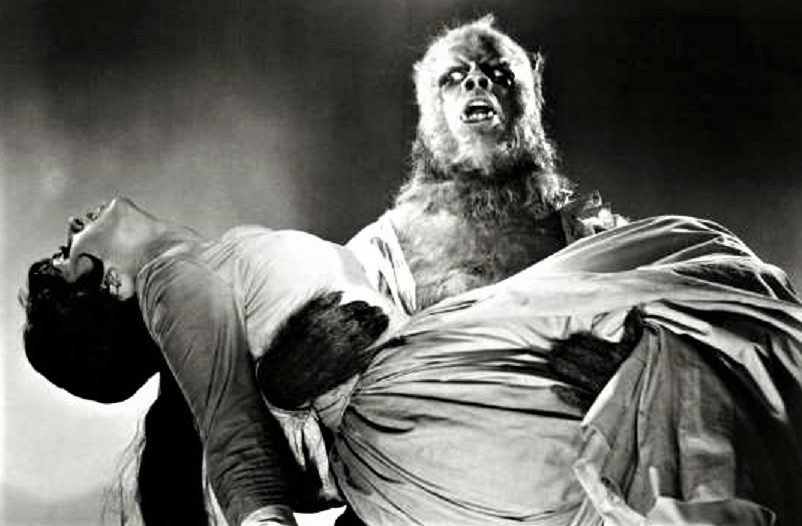
When two small stone heads were dug up in a Hexham back garden in 1971, who knew what shenanigans would endure. The pieces would move on their own, create poltergeist activity, and even manifest a "half-man, half sheep" creature (the latter may actually have been a prank with a drunk staggering around with a carcass on his back). When the heads were transferred to the Southampton home of Dr Ann Ross, an expert in Celtic finds, the sightings of a strange beast continued. On Halloween morning 2024, the BBC made available the infamous teatime NATIONWIDE coverage. Long considered lost, this amazing ten-minute snippet of the supernatural only has audio for the latter stages, but includes a couple of spiked heads and - to illustrate the alleged monster - a clip of Oliver Reed attacking the camera from CURSE OF THE WEREWOLF

NATIONWIDE's Luke Casey amongst some stone heads. Celts believed that the head contains the human soul, and was capable of living independently after death, possessing powers of prophecy and fertility. There are many tales in which "living heads" preside over Celtic feasts.

Broadcast on a cold February evening, the following night presenter Sue Lawley had to issue an apology, after phone complaints from angry parents on behalf of their traumatised children (although a trigger warning was apparently given). This has long been considered the holy grail of lost British paranormal media, yet the story of the Hexham Heads is a convoluted fortean yarn. The beginning of wolf-based creatures being associated with the Northumbrian market town of Hexham and nearby Allendale can be traced to brutal cattle slayings of 1904. And NATIONWIDE could only provide a snapshot of the sheer breadth of strangeness.

The fragments were found at the 3 Rede Avenue residence of the Robsons, but the weirdness soon spread to neighbours the Dodd family and consequently to the Ross abode. Although the families allegedly never communicated about specifics, the man beast became a mainstay, which no doubt pleased subscribers to the Stone Tape Theory. Mentioned by reporter Luke Casey in the segment, this pseudoscience was developed by intellectuals and psychic researchers and popularised by Nigel Kneale's BBC drama THE STONE TAPE. It states that historical information can be released and replayed from rock and other material. Had the heads unleashed traumatic events of yesteryear in the shape of a werewolf? Not according to Des Craigie, the previous resident of 3 Rede Avenue, who in 1972 claimed he had carved the stones as a toy for his daughter.

Dr Ann Ross wrote and collaborated on numerous publications detailing Celtic Britain. She remained open to the possibility that the Hexam stone heads could be modern, and crafted in the Pagan Celtic style.

Southampton University could not date the heads, though they identified solid rock rather than a composite. Actually a grey sandstone with a high degree of quartz, this material is in keeping with formations in the Hexham area. With such a nondescript conclusion, the heads were acquired in 1977 by chemist and earth scientist Don Robins, who believed in the relationship between stone and the human nervous system. Keeping the heads in his shed and around the house, he never saw a werewolf, but constantly had a sense of unease when around them. Lending them for "dowsing experiments" to alleged engineer and paranormal researcher Frank Hyde, Robins writes in his book The Secret Language of Stone, Hyde "seemed to have vanished as completely as if he had walked into a fairy hill in a folk tale." The location of the stones is still unknown.

Tuesday, March 1, 2022

Snake in a Siege

VENOM (1981)

This Amazon Prime banner - taken from a Blue Underground Blu-ray/DVD cover - sees salacious use of Susan George's fleeting black underwear scene.

BASED on Alan Scholefield's novel, this all-star mess at least made a change in an era of slashers and overblown make-up effects. Young asthmatic Philip Hopkins (Lance Holcomb) and his grandfather Howard (Sterling Hayden) - part of a wealthy hotelier family - are kidnapped by their chauffeur Dave (Oliver Reed), nanny Louise (Susan George) and her terrorist lover Jacmel (Klaus Kinski).  With Philip's mother Ruth (Cornelia Sharpe) flying to Rome to meet her husband, the plan starts to unravel early, as Dave kills Police Sergeant Nash (John Forbes-Robertson) at the doorstep, and Philip brings home a Black Mamba in a mix-up between a pet store and the London Institute of Toxicology. When Dr Marion Stowe (Sarah Miles) receives a harmless snake in error, she too is ensnared inside the house thanks to the bungled negotiations of Commander Bulloch (Nicol Williamson). To add to the star power, Michael Gough appears late on as London Zoo's real life Snake handler David Ball, who acted as advisor.

VENOM's behind the scenes troubles are more famous than the finished product. Original director Tobe Hooper and cinematographer Anthony B. Richmond quit after ten days, citing obligatory "creative differences." Kinski has boasted that the cast and crew contrived to have Hooper replaced, and Piers Haggard - drafted in with little preparation - stated in a Fangoria interview that Hooper suffered "some sort of nervous breakdown." Apparently, the main problem was the caustic relationship between Reed and Kinski ("they fought like cats" claims Haggard), so much so that Piers claims the Black Mamba was one of the more congenial members of the production. Additionally, Hayden spent most of his time on set drunk, which accounts for his extremely uneven showing. 

VENOM should be given kudos for having the audacity 
of casting Klaus Kinski and Oliver Reed in the same movie. 

There are several liberties with logic, making VENOM more comic strip than the taut thriller it strives to be. Nothing is made of Stowe's knowledge that cold can induce a coma with the snake (particularly as the film is set in winter). It is also ridiculous that a leading Toxicology centre would deal with such a ramshackle, back-street pet supplier, and equally absurd is the police literally finding a "back door." As a glutton for punishment, in the same year Reed made another killer snake picture with a troubled production based on a novel: the Canadian SPASMS. Although not released until 1983, here the actor develops a psychic link with a snake which killed his brother, accidentally set free by a group of reptile-worshiping Satanists.

Wednesday, December 1, 2021

Whispers of Fear

THE FALL OF THE HOUSE OF USHER (1950)
THE HOUSE OF USHER (1989)

The Hag of THE FALL OF THE HOUSE OF USHER. The sequence where she approaches a hapless gardener with a raised knife is timelessly eerie, her distinctive lines looking like a Berni Wrightson comic panel.

EDGAR Allan Poe's 1839 short story The Fall of the House of Usher intertwines many Gothic threads, in particular madness, isolation and metaphysical identity. The last days of the Usher family are symbolised by a disintegrating mansion house; indeed, its windows are described as "eye-like" twice in the first paragraph, and the central crack of the building can be associated with a split personality. On the printed page Roderick Usher, his twin sister Madeline and the house all share one common gloom and guilt-laden soul, with the notion of a crumbling and haunted construct dating back to a tale which largely defined the Gothic genre itself, Horace Walpole's 1764 novel The Castle of Otranto. Atmospheric and emotional, Poe's story is given laden treatment in the two film adaptations under consideration here. 

Ten years before the Roger Corman/Vincent Price version of Poe's story, THE FALL OF THE HOUSE OF USHER was released by GIB Films (named after the photographer, producer and director here, George Ivan Barnett). Actually made in 1947, it uses a Gentlemen's club as a framing device ("talking of horror stories, those of Edgar Allan Poe take quite a lot of beating"), before discarding most of the source. When Jonathan (Irving Steen) visits friend Lord Roderick Usher (Kaye Tendeter) at his English mansion, he discovers that Usher and his sister Madeline (Gwen Watford) are both forlorn shells of human existence. By ignoring the nuances of Poe's association between the house and the Ushers, and making the family illness the result of a curse from their mother's lover, the production is instantly transported to the stilted melodrama of 1940s horror mysteries (replete with a creepy hag (Lucy Pavy), homemade torture chamber and a severed head with all the effectiveness of a Halloween mask).

Oliver Reed in THE HOUSE OF USHER. Two years later, Reed would appear in Stuart Gordon's take on THE PIT AND THE PENDULUM.

Despite the final third interpolating many of Poe's elements, by this stage there are more questions than answers: was Madeline slowly poisoned and buried alive? Is Roderick mad and imagining the end of the film? Why would a medical doctor so freely attribute a family illness to a curse, or not have institutionalised the mother? As we return to The Gresham Club, members are as perplexed as the viewer ("your guess is as good as mine.") With such uneven exposition and the unintentionally hilarious club, one wonders if the script is intended to whimsically play with the audience.

Alan Birkinshaw's modern adaptation THE HOUSE OF USHER not only acts as a metaphor for disintegrating buildings and psyches, but also crumbling reputations. Oliver Reed whispers his way through as Roderick Usher, and Donald Pleasence is the demented Walter, Roderick's brother who is locked in the attic with his drill-hand. LA hairstylist Molly McNulty (a somnolent Romy Windsor) accompanies English boyfriend Ryan Usher (Rufus Swart) to visit his family estate, but are involved in a car crash when two ghostly children appear in the middle of the road. Faking Ryan's death, Roderick - who suffers from hyper-acuteness to the senses - plans to keep Molly a prisoner in the house, to impregnate her and continue the Usher line.

Donald Pleasence in THE HOUSE OF USHER. A year later, Pleasence would appear in the Edgar Allan Poe-inspired BURIED ALIVE.

This US/UK co-production, filmed in South Africa, was one of many Poe film revivals of the late 1980s and early 1990s. THE HOUSE OF USHER is cheap but certainly not cheerful, a mishmash of dream sequences, under-developed ideas and gore (an overstepping family doctor is castrated by a rat, faux hand in meat mincer, head on platter et al). The robust Reed is woefully miscast, and it is left to Pleasence is give an insane star turn, literally dancing through the corridors with his budget power attachment. This leaves the rest of the cast in a nonsensical state of their own, typified by cook Mrs Derrick (Anne Stadi) uttering the immortal line to Molly: "I know you have a lot on your mind, but while you're here, can you do something with my hair?"

Monday, January 1, 2018

Neither Blood Nor Legacy

NEITHER THE SEA NOR THE SAND (1972)
BLUE BLOOD (1973)
THE LEGACY (1978)

Mills and Boon meets George A. Romero as Michael Petrovitch shifts from misty-eyed romance to the annals of the undead.

IN July 2017, Screenbound collected these three pictures in a handily disposable budget DVD. Adapted from his own novel by ITN newsreader Gordon Honeycombe, NEITHER THE SEA NOR THE SAND sees Anna Robinson (Susan Hampshire) taking a winter break in Jersey from a lifeless marriage, where she falls in love with introverted Hugh Dabernon (Michael Petrovitch). Hugh has a strange affinity with the rugged coastline, and his antiques dealer brother George (Frank Finlay) takes a disliking to Anna, who threatens the insular Dabernon lifestyle. While the inseparable couple are in the North of Scotland, Hugh suddenly has a fatal heart attack, and is issued a death certificate. Through the strength of love he is reanimated; now without conventional speech (conversations are limited to what may well be Anna's imagination), Hugh physically deteriorates, leading the lovers to a watery grave.

Originally optioned by Hammer, director Fred Burnley attempted to ensure that the film would not be known as "another Tigon horror movie" (Tigon would be rebranded LMG by the time of release), but regardless of genre expectations, it was labelled by Time Out as "one of the worst films of the decade." NEITHER THE SEA NOR THE SAND - nor entertainment - is a ponderous love story without charisma, and a supernatural tale with little Fortean interest (reincarnation within Dabernon history is briefly hinted, as is Robinson being a witch). With no connection on screen, Hampshire and Petrovitch are doomed from the onset, Hampshire's theatrics grating with Petrovitch's distant portrayal; when Hugh's rigor mortis starts to set in, there is no difference to our male lead's performance. What remains is ninety minutes of meaningful stares and glances.

The Peasants are revolting: Oliver Reed not so much chews the scenery than spits it out in BLUE BLOOD.

Directed by Andrew Sinclair, BLUE BLOOD is a delirious story of Devil worship set and filmed at Wiltshire's Longleat House. Gregory (Derek Jacobi) is a young aristocrat who complains of modern England while maintaining a servant lifestyle, which includes new German Nanny Beate (Meg Wynne Owen). Entrusting control of the house to butler Tom (Oliver Reed), and in a complicated relationship with his estranged singer wife Lily (an icy Fiona Lewis), the Lord succumbs to the unholy practises of the under classes, governed by his leading manservant. Adapted from Alexander Thynn's novel The Carry-Cot by Sinclair, Thynn is the 7th Marquess of Bath and grew up in his family's seat at Longleat (and to further the in-house connections, BLUE BLOOD features Thynn's wife Anna Grael as Gregory's mistress Carlotta). UPSTAIRS DOWNSTAIRS on acid, Reed's ham performance is either extraordinary inept or one that plays to the general foolishness; moving like an automaton, Tom's Satanic control is built up by a series of almost freeze-framed red-hued images of black masses and sacrifice, usually depicting Owen, Grael and Lewis draped around him while holding a bloodied knife.

THE LEGACY is another tale of Mansion-based Satanic shenanigans. Designers Maggie Walsh (Katharine Ross) and Pete Danner (Sam Elliott) leave California to work for an anonymous British client. On reaching their destination they are involved in an accident with a limousine, which is actually owned by their benefactor, Jason Mountolive (John Standing). Inviting them to his estate, Mountolive introduces Walsh and Danner to five guests, who die in a variety of ways: Maria (Marianne Broome) drowns; Clive (Roger Daltrey) chokes to death; Karl (Charles Gray) is burned alive; Barbara (Hildegard Neill) is pierced by a splintered mirror; and Jacques (Lee Montague) falls from a roof. All had chequered pasts, and were spared punishment due to Jason's unorthodox interventions: his mother being Lady Margaret Walsingham, a practitioner of witchcraft. It transpires that Walsh is actually Mountolive's great-granddaughter, and Jason's last acts were to kill the other heirs so Katharine can continue Satan's work.

British character actor John Standing is under the emaciated
makeup of a dying Occultist in THE LEGACY.

Although graced with exquisite cinematography both externally (the lush country setting) and internally (white cats on marble staircases), this tepid Anglo-American production suffers from an inappropriate upbeat soundtrack and lengthy dull patches between the body count. Directed by Richard Marquand, THE LEGACY is all too twee to adhere effectively to the twin 70s fixations of black magic and haunted houses (to further amplify the Seventies feel, we have an opening credits "love-in" with a song from Kiki Dee). The original treatment was written by Jimmy Sangster and "polished" by British SF author Patrick Tilley and Paul Wheeler; Sangster unsurprisingly disowned the film as the "tinkering" involved moving the setting wholesale from a rundown Detroit hospital to the grounds of Mountolive's Ravenhurst.

Sunday, May 6, 2012

Loudun Calling (Part II of II)

THE DEVILS (1971) DVD release
AMELIA AND THE ANGEL (1958)

The BFI's DVD of Ken Russell's THE DEVILS is a strong contender for home video release of the year. The fact that the film remains controversial today is a remarkable tribute to the conviction of Russell and his creative acolytes.

AS the British Board of Film Classification celebrates its 100th year, it is fitting that the subject of one of its most volatile battles - Ken Russell's fearsome masterpiece THE DEVILS - was released as a 2-disc BFI DVD on the 19th of March. In this set, the BFI give us the original British X cut, and not the restored and extended 2004 version that has been seen at a handful of film festivals. The second disc of extras include Paul Joyce's 2002 documentary HELL ON EARTH, DIRECTOR OF THE DEVILS - featuring candid Russell interviews and unique footage of Sir Peter Maxwell Davies recording his score - and an audio commentary with Russell, critic Mark Kermode, editor Mike Bradsell and Joyce. For those wondering how this DVD includes HELL ON EARTH - which contained the missing "Rape of Christ" footage from the film, yet not include it in the feature itself – the part of the documentary containing the notorious sequence has also been excised by the powers that be at Warner Brothers.

The "Rape of Christ" - running just over two minutes - was long presumed lost until Kermode discovered the fabled footage in a single canister of film in England. This Holy Grail of censored material also contained other cuts, including Sister Jeanne (Vanessa Redgrave) performing lewd acts with a charred bone from Father Grandier (Oliver Reed)'s remains. The "Rape of Christ" segment itself sees Sister Catherine (Catherine Willmer) tearing and burning pages from the Bible while Sister Agnes (Judith Paris) frantically strokes a giant candle between her thighs. Naked nuns then abuse Christ as Father Mignon (Murray Melvin) scales a ladder and pleasures himself overlooking the orgy (here cinematographer David Watkin essentially creates a jerk-off zoom, as the camera darts in and out of the carnal activity to the rhythm of Mignon's strokes). This is all shown with repeated cuts of Grandier giving a solitary Communion, unaware of the pandemonium taking place within the walls of Loudun.

Mercedes Quadros - nine-year-old daughter of the Uruguayan ambassador to London - plays Amelia in Russell's AMELIA AND THE ANGEL.

The story of THE DEVILS is one that tells of battles not just with the censor, but also with the studio. Any film with a toxic mix of religion and politics would be a target, especially when originating from an increasingly conservative American financier (for the United States, it is rumoured that Warners ordered Bradsell to remove every nipple and pubic hair). After Russell showed his cut to the BBFC, the board couldn't release the film intact on grounds that "it would have been subject to the Obscene Publications Act," even though they aired no reservations with the shooting script. As stated in Joyce's absorbing - though re-edited - companion piece, not including the "Rape of Christ" rips the spine from THE DEVILS, as this scene is integral to the narrative both dramatically and philosophically: the debauchery shows the exploitative level of which the authorities aimed to achieve, reducing the easily manipulative nuns - women with no vocation or personal development - to play their game.

The DVD also includes Russell's redemptive 1958 short AMELIA AND THE ANGEL. This 16mm piece sees Amelia (Mercedes Quadros) scouring the streets of London looking for a replacement pair of angel wings for her school play, after she steals the initial set which are subsequently damaged beyond repair. Quadros, with her long dark hair and probing eyes, gives a performance which carries the simple narrative, and its many artistic flourishes skillfully shadow its minuscule budget and library music. On the outside, hand-held camera mimics a child's eye view of the crowded locality; here, Russell is clearly influenced by Albert Lamorisse's celebrated 1956 short THE RED BALLOON, about a little boy who triumphs over adversity in Paris's mean streets. Internally, the opening choreography of the angel ballet beautifully draws on Russell's own training as a dancer, the butterfly wallpaper in Amelia's room openly mocks her loss, and the ascent of a robed, bearded artist into the heavens on a ladder has a much more wholesome conclusion than Mignon's "Rape of Christ" activity. 

Tuesday, May 1, 2012

Loudun Calling (Part I of II)

THE DEVILS (1971)

Vanessa Redgrave cackles and leers as hunchbacked Sister Jeanne of the Angels. Her demonic voice, implements of masturbation and even a spider-walk were all seen two years before THE EXORCIST.

SYNONYMOUS with the word maverick, Ken Russell has been referred to as "the Wild Man of the BBC," "the infant terrible of British cinema," and a "fish and chips Fellini." Drawing from a wealth of historic and literary references, Russell made some of the most bombastic yet beautifully photographed films in motion picture history. His informed sensationalism not only horrifies but inspires, producing a body of work that is as much smothered in an impish yet intellectual sense of humour as it is in the director's passions and neuroses. After early work as a stills photographer, Russell made a number of ground-breaking programmes for the BBC's MONITOR and OMNIBUS strands, broadcasts which set the scene for television to be considered a serious art form; and in the 1970s and 80s, he practically invented the pop video and provided a template for MTV. Critics have consistently labelled Russell's work as pretentious and frequently vulgar, yet there is always a creative energy which jolts the viewer into his peculiar phallic-worshiping world of gods and demons.

Originally written for United Artists until "somebody actually read the script," THE DEVILS was picked up by Warners, and Russell's screenplay is based on a play by John Whiting - staged in London by the Royal Shakespeare Company in 1961 - and Aldous Huxley's 1952 book The Devils of Loudun. THE DEVILS - described by Joseph Lanza in Phallic Frenzy: Ken Russell and His Films as "postwar British cinema's greatest marvel and nightmare" - tells the shocking true story of political and religious persecution in 17th century plague-infested France. King Louis XIII (Graham Armitage) and Cardinal Richlieu (Christopher Logue) conspire to create a new France where Church and State act as one, and troops are sent to destroy the fortification of Loudun, which is vital to Richlieu's plan to demonise the Protestant faith and ensure that Catholicism is embraced throughout the territories. Father Urbain Grandier (Oliver Reed), the charismatic Jesuit priest of St Peter's Church, successfully rallies the citizens and halts the destruction.

Oliver Reed shines as Father Urbain Grandier. An otherwise unrelated Reed UK film - 1973's trippy class war oddity BLUE BLOOD - was bizarrely released in Italy as THE DEVILS, PART II.

What sounds like a dour historical drama unfolds into a frenzied pageant of gender-bending libertines, debauched exorcists, enthusiastically administered enemas and sado-masochist nuns. Grandier settles down with the virginal Madeleine de Brou (Gemma Jones), whom he marries in an unorthodox ceremony conducted by himself. Unknown to the priest, Sister Jeanne of the Angels (Vanessa Redgrave) - the hunchbacked Mother Superior of Loudun's Ursuline convent - is sexually obsessed with him and prays to Jesus to "take away my hump." After Grandier rejects an invitation to counsel her order and news reaches Jeanne of his marriage, the sister concocts jealous lies about Grandier visiting her in the form of an incubus. With the aid of sadistic medics Ibert (Max Adrian) and Adam (Brian Murphy), the chief exorcist of the Catholic Church Father Barre (Michael Gothard) tortures Jeanne into confessing herself possessed, and Grandier is arrested for diabolism and burned at the stake. Blistering and boiling, Grandier perishes, as Loudun is felled by explosives.

Though performances are uniformly excellent, this is Reed's finest hour, a stoic portrayal that provides the film with a linear path between the outrages and extremities. An anti-intellectual and dyslexic, Reed relied on Russell's simplistic method of direction, instructing the actor to give a take "Moody 1, Moody 2 or Moody 3." Reed always acknowledged limitations in his inimitable style - telling the director to "piss off" when asked to recite sixteenth-century Latin - and even though he despised the stage, Reed delivers speeches of great gravitas here, but such power is even diluted in one scene by cutting away to the theatrics of the King taking shots at Protestants dressed as blackbirds. Its a contrast you can either hate or love; hate because it deflects from the rhythm of Grandier, love because it shows a contrast of convictions at the centre of the film. Whatever your conclusions, it means you are undoubtedly watching a Ken Russell film.

Sister Jeanne licks the wounds of Grandier 
envisioned as Christ in one of her feverish fantasies.

THE DEVILS acts as a perfect storm of Russell at the height of his creativity, the beautifully lit cinematography of David Watkin, sublime set design by Derek Jarman, and a discordantly effective score by Peter Maxwell Davies. Similar to the outrage that encompassed MONTY PYTHON'S LIFE OF BRIAN, THE DEVILS was roundly condemned as being anti-Church, but both works show the genuine mistrust in organisations which have the power to corrupt and distort. As with much of Russell, controversy has clouded the true value of his work: the male wrestling sequence between Alan Bates and Reed in WOMEN IN LOVE generated a tabloid campaign of outrage while its literary origins helped it past the censors, yet THE DEVILS was a target for lasting interference from its inception. During the shoot at Pinewood, stories circulated about the extras - overstimulated by naked nuns and a general environment of permissiveness - who manhandled the actresses and committed at least one confirmed sexual assault. When THE DEVILS was released as an X certificate - deleting the infamous "Rape of Christ" sequence - it was still banned outright by seventeen local councils, and BBFC chief examiner John Trevelyan resigned from his post the following month.

Unsurprisingly, THE DEVILS caused religious uproar. The Festival of Light picketed cinemas, in Rome polizia confiscated prints, and the Catholic Film Office branded the film "C for Condemned," "for turning serious historical fact into a drug-induced cinematic experience" and its "objectionable use of religious symbols reduced to flippant pop iconography." THE DEVILS also produced a scolding critical barrage: Newsweek's Paul D. Zimmerman concluded that the work demonstrated how Russell "has gone beyond extravagance to insanity"; The Iconoclast said it had "all the taste and restraint of a three-day gang bang"; and The Evening Standard's Alexander Walker provided a more personal attack by claiming its vistas "look like the masturbatory fantasies of a Catholic boyhood." Russell later hit Walker over the head with a rolled-up copy of the offending review on a late-night BBC news programme, before storming out of the studio.

Genius, madman, or both? Exploring Catholicism, sexual excess and kitsch, Ken Russell described himself as the saviour of the British film industry.

Over the centuries, scholars have been divided in their attempts to explain exactly why a convent came to believe that they had been overwhelmed by sorcery. One theory has the nuns driven to their fervour by accidentally ingesting ergot - a fungus which contains an LSD-like chemical on rye bread which has been allowed to dampen and warm. Ergot has also been liberally mentioned as a driving force for the Salem witch trials, and inspiration behind the paintings of Hieronymus Bosch. But the most widely accepted notion is that the nuns were manipulated by politicians and priests within a hysteria which endures under long-term stress in captive environments. Over forty years later, THE DEVILS, in itself, exists with an aura of social epidemic; it is the film maker's one and only political statement, and a timeless one. "This is not the age of manners" Russell told Time Magazine in 1971, "this is the age of kicking people in the crotch and telling them something and getting a reaction. I want to shock people into awareness. I don't believe there's any virtue in understatement."

Tuesday, February 1, 2011

Love Will Tear Us Apart

THE CURSE OF THE WEREWOLF (1961)

Oliver Reed and Yvonne Romain in an impossibly-staged publicity still. Reed and Romain had a closely tied association with Hammer; the actress plays Reed's mother - who dies in childbirth - for THE CURSE OF THE WEREWOLF, then became his fiancee in CAPTAIN CLEGG before sharing their third appearance in THE BRIGAND OF KANDAHAR.

UNLIKE the literary origins of Dracula and Frankenstein, zombies and werewolves are rooted in folklore. Consequently, the living dead and shape-shifting sub-genres have treated film as their developing texts: George A. Romero basically re-invented the zombie with NIGHT OF THE LIVING DEAD, while THE WOLF MAN similarly set the precedence for romantic dread. Subsequent werewolf appearances were negligible until advances in make-up effects unleashed a slew of transformation pictures in the early 1980s, where THE HOWLING and WOLFEN developed lycanthropic societies coexisting with humans, and THE COMPANY OF WOLVES a link with menstruation. This exploration also seemed in tandem with developing body horror concerns, not only with cinema spectacles such as THE THING and VIDEODROME, but with the onset of AIDS.

Werewolves were limited to a triptych of releases during the British horror period of the 1960s and 70s. Amicus’ lupine whodunit THE BEAST MUST DIE was joined by two features inspired by Guy Endore’s 1933 novel The Werewolf of Paris: Hammer's THE CURSE OF THE WEREWOLF and Tyburn's LEGEND OF THE WEREWOLF. Directed by Terence Fisher and written by producer Anthony Hinds under the pseudonym John Elder, THE CURSE OF THE WEREWOLF is by far the best remembered. It is a flawed, visceral melodrama of lycanthropy from birth to death, ponderous in its pacing, but the film effectively focuses on the inner turmoil of man into wolf, benefiting from make-up artist Roy Aston's most accomplished work and arguably propelling young Oliver Reed onto the road to stardom. Pulverised by the Monthly Film Bulletin which claimed the film was "a singularly repellent job of slaughter-house horror," the picture ranks as one of the most brutal of all Hammer productions.

Oliver Reed's werewolf was the cover star of Warren publishing's low-brow Famous Monsters of Filmland #12 (June 1961).

The film opens with a beggar (Richard Wordsworth) visiting Castillo Siniestro, where the Marquis (Anthony Dawson) is celebrating his wedding. The beggar irritates the nobleman, who has him thrown into the dungeons where he remains forgotten by all but the jailer and his mute daughter (Yvonne Romain). After many years - with the Marquis decrepit and his wife long dead from his brutish behaviour - the Marquis sexually assaults the servant girl. When she rejects his advances, he has her thrown into the dungeon where the beggar - now reduced to a slavering animal - rapes her then dies in the act of violation. When the girl is freed, she stabs the Marques to death and flees into the woods, where kindly scholar Don Alfredo (Clifford Evans) rescues her. The girl dies in labour after giving birth to a son from her ordeal, and as the young Leon (Justin Walters) grows, he is increasingly troubled by dreams of drinking blood. Diagnosed with lycantrophy, the only cure is for Leon to be within a loving environment. Reaching manhood, Leon (Oliver Reed) - denied access to his love Cristina (Catherine Feller) - goes on a murderous rampage.

Endore's source material emphasises a number of aspects that cinema - at the time - could not dare to adhere to. Endore's rapist was a priest, not a beggar, for example, and the afflicted Bertrand and his love Sophie in the book avoid the violent effects of his transformation by cutting into parts of her body and allowing him to suck her blood ("her body was a fountain of blood to him, and it was if her body responded to his needs, like a nursing mother with milk.") In contrast, the film superficially represents the bond between Leon and Cristina in typical Hollywood fashion - the closest to a love story Fisher achieved  - that never touches on such sado-masochistic tendencies. Furthermore, the movement of the novel's locales to Santa Vera, Spain, centre around the abandoned Spanish Inquisition drama THE INQUISITOR/THE RAPE OF SABENA. After distributors Columbia feared condemnation by the Catholic Church's Legion of Decency, the project was pulled from Hammer's schedule, leaving a number of sets taking shape on the Bray lot which were then integrated into Fisher's film.

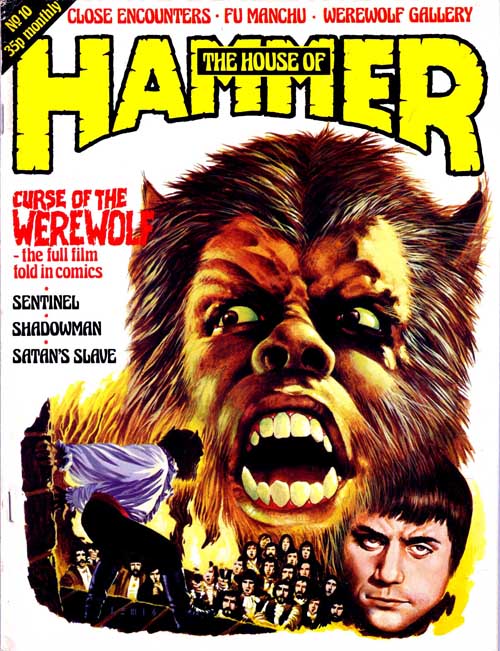
The House of Hammer #10 (January 1978) included a comic adaptation of THE CURSE OF THE WEREWOLF. Drawn by John Bolton, the strip acted as the flagship for this special werewolf issue.

With Reed not appearing until roughly the halfway mark, the extended prologue detailing Leon's lurid conception is suitably heady but prolonged. It is detrimental to the mechanics of the film that Reed and Evans' central performances could not be afforded more screen time, but the movie suffers from a number of time anomalies, surprising considering Fisher's trademark linear style: Leon’s feelings for his eternal love develop too quickly and off-screen, and Alfredo somehow narrates the preceding events which he could not have been akin to. Hammer also adheres to several cliches of the werewolf picture but also establishes new ones of its own. Lycanthropy is presented not as a disease but as an accursed birthright, and Leon's bestial instincts can be suppressed by the feelings of inner peace and comfort brought about by love, while the emotions of rage and frustration have precisely the opposite effect. Therefore Leon is subconsciously in control of his own fate, his werewolf dependent not just on the occurrence of a full moon but also upon Leon's state of mind. But like most cinematic werewolves, the character is not painted as a villain but as a personable young man ultimately condemned to a second existence of blood lust by circumstance.

Ashton's make-up effects for the wolfman, the Marquis and the beggar are uniformly excellent. Aston himself had suggested to Hinds that Reed's bone structure would be ideal for the role, and the success of the monster is that it is part-man and part-wolf, encapsulating Reed's ferocious snarls, especially starling when blood drips from his mouth. With this avenue for human expression, the tragedy of the werewolf is not lost, unlike later films which are reliant on mechanical effects and CGI, which overshadow any levels of performance. The Marquis' design explored how make-up could define a character's prolonged debauchery - especially memorable in the scene where Dawson picks his skin in an attempt to improve his appearance for the servant girl - and the beggar's own mutation into beast would not feel out of place on The Island of Doctor Moreau.

Universal - who owned the source material - contracted Hammer to make THE CURSE OF THE WEREWOLF. A film very much playing like THE WOLF MAN's bastardised relative, its horde of "Angry Mob" villagers who hound Leon at the climax - seen here underpinning this one-sheet - was Universalesque in its own right.

Dawson is suitably lecherous as the Marquis, and Wordsworth - having been similarly effective as the man/monster of THE QUATERMASS XPERIMENT - is both touching and frightening in a role ranging from abused beggar to feral man. Evans brings a subtle facade to the role of adoptive father, emotionally distraught yet resolved to end his sons misery. Without question, however, it is Reed's film. While the "Hammer Heavy" was evidently not quite the finished article at this point in his career, his portrayal conveys pathos and menace and amusingly, when he does appear, he's soon working in a winery, surrounded by bottles. Romain is enchanting as the exotic, raven-haired servant, but the rest of the cast are a mixed bag. Michael Ripper is wide-eyed as Old Soak and Desmond Llewellyn makes an appearance as a footman, but John Gabriel - as a priest - and Martin Matthews - as Leon's best friend - bring nothing to their roles. And in a refreshing quirk, Peter Sallis appears as mayor Don Enrique, 45 years away from similar circumstances voicing Wallace in the clay-mation favourite THE CURSE OF THE WERE-RABBIT.