Showing posts with label Christopher Wicking. Show all posts

Monday, April 1, 2019

The Man in the Crimson Hood

THE OBLONG BOX (1969)

Alister Williamson is doomed Edward Markham and Sally Geeson sexpot maid Sally in a promotional shot for this AIP release.

THE first film to co-star Vincent Price and Christopher Lee, Gordon Hessler's THE OBLONG BOX starts in Africa, where Julian Markham (Price) discovers that brother Edward (Alister Williamson) has been cursed by voodoo. Back in England, Julian keeps Edward chained in a remote room of the Markham estate, his mental and physical states disintegrating. However, Edward plans to escape with the help of Trench (Peter Arne), Norton (Carl Rigg) and witch doctor N'Galo (Harry Baird), drugging him to give the temporary appearance of death; once buried, Trench and Norton will exhume the coffin and grant him freedom. But Trench pockets his fee and Edward is actually dug up by grave robbers - replete with coffin - for the use of Dr Neuhartt (Lee). Wearing a crimson hood, Edward vows to repay "some very important debts" while staying with Neuhartt, blackmailing the physician for his liaisons with body snatchers.

Scripted by Lawrence Huntington with "additional dialogue" by Christopher Wickling, THE OBLONG BOX has the thinnest of connections to its source Edgar Allan Poe story (it all owes more to H.P. Lovecraft - with its arcane lore and a disfigured outsider - and Rudyard Kipling's The Mark of the Beast). Originally to be directed by Michael Reeves before his own premature death, to further WITCHFINDER GENERAL connections Price is reunited with Hilary Dwyer as his younger sweetheart Elizabeth, but the actor - originally to play both brothers - looks disinterested and tired. Although beautifully shot by John Coquillon, it is a picture of missed opportunities; Price and Lee only share one scene together despite their marquee value (in fact, Lee's death scene), and the reveal of Edward's condition results in what looks to be little more than a bee-stinged nose, particularly disappointing after its long build-up.
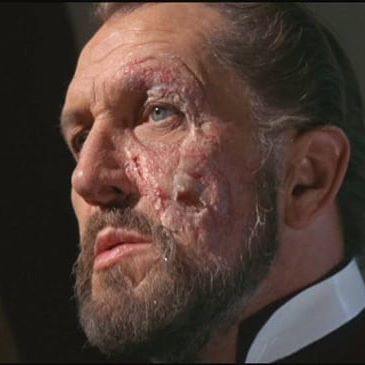
Vincent Price as the diseased Julian Markham. By this stage in his career the actor grew weary of the Edgar Allan Poe adaptations, particularly within the saturation of the late 1960s horror film market.

THE OBLONG BOX belongs to that horror subgenre - THE MUMMY, PLAGUE OF THE ZOMBIES, THE REPTILE, THE GHOUL et al - that echo colonial guilt (remarkably, Hessler's film was banned in Texas for being "pro-Negro"). Julian laments his attitude ("we sinned out there in Africa all right, plundering their land - and we're still stealing their wealth, though they're too innocent to know it") and is revealed to have been the intended recipient of the curse. There is a quiet justice to the conclusion, as Edward bites the hand of his brother, passing on the psoriasis-based condemnation. But ultimately the much re-worked and bloated script carries little gravitas, instead grabbing from more substantive works with no cohesive payoff. This unfocused starting point is further undermined by turgid pacing and padding (the tavern sequences in particular).
Saturday, July 1, 2017

Demons of the 1970's (Part I of II)

DEMONS OF THE MIND (1972)

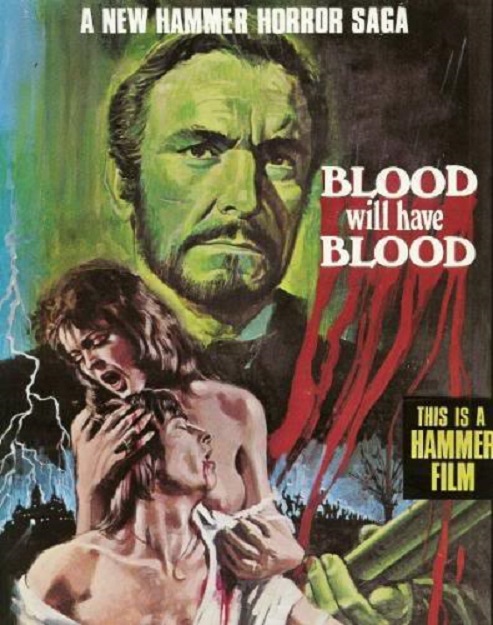
One of Britain's last costumed Gothics, DEMONS OF THE MIND was filmed as BLOOD WILL HAVE BLOOD, exploring "dreams of sexual fear supressed through guilt."

AMID the dying embers of the 1970's British film industry, attempts to move into more psychological thrillers resulted in a number of underappreciated efforts. Dumped onto the wrong end of a double bill with TOWER OF EVIL, DEMONS OF THE MIND - directed by Peter Sykes and written by Christopher Wicking - is a Hammer production which focuses on Baron Friedrich Zorn (Robert Hardy), who fears he has passed on the "family madness" to son Emil (Shane Briant) and daughter Elizabeth (Gillian Hills). Held captive to curb their incestuous desires, Emil is at least released at night to murder women, while Elizabeth is "bled" to make her weak (making use of a vintage Scarificator from the British Museum). When discredited psychologist Falkenberg (Patrick Magee) arrives with his associate scholar Carl (Manfred Man singer Paul Jones), an experiment to rid Emil of his lust involving Inge (Virginia Wetherell) ends in another strangulation. The villagers, influenced by a deranged, self-styled Holy Man (Michael Hordern), decide that Zorn is the true demon, and stake him with a burning cross.

A mix of Hammer's Mittel Europe and fledgling psychiatry was one way the company attempted to make its product fresh, another was by infusing proceedings with new young directors and screenwriters. But DEMONS OF THE MIND is more cynical than satisfying, conveying a relentless dourness (quoting Psalm 38 "For my loins are filled with a loathsome disease, and there is no soundness in my flesh") where conventions are either twists or throwbacks: Magnee's unhinged Mesmerist and Van Helsing substitute helps no one ("Better men than I have been booted out of Vienna!"), an alleged Priest is a dangerous zealot, and the villagers revel in their own sadism.

In a role originally intended for Marianne Faithfull, Gillian Hills plays somnambulant Elizabeth Zorn. Faithfull was pulled late on due to insurance issues on her drug use.

A Poe-like story of an incestuous, murderous dynasty crumbling to dust, Zorn is driven by subconscious compulsions of his peasant bride's "virgin blood" and bare flesh (Zorn is a character undermined by Hardy's pantomime performance; to think we might have had Eric Porter, Paul Scofield, Dirk Bogarde or James Mason). Hordern is also overtly loopy, barely able to carry his over-sized wooden cross, and despite the emotional slant, DEMONS OF THE MIND actually serves up a copious amount of exploitative, early 70's gore: although optically fogged, Zorn's wife is seen to slash her wrists and throat in front of her children, but further scenes of Emil killing maiden aunt Helda (Yvonne Mitchell) with a bunch of keys and Zorn's climactic impalement are in no way shrouded.

The original pitch to Hammer by Frank Godwin - the composer-cum-independent producer who penned Strange Love for LUST FOR A VAMPIRE - was actually a werewolf picture. The studio was intrigued by Godwin's knowledge of the legend of Blutlust, and together with Wicking, formulated a treatment based on the Bavarian story of a man-wolf which was actually a psychopathic condition not understood by the medicine of the time. However, the tale was a complete fabrication, and Hammer did not warm to the werewolf elements anyway, leaving only a vague lycanthropic reference in the finished film where Zorn imagines himself stalking as an animal (to further the pseudo-werewolf angle, the muted cinematography is lensed by Arthur Grant, making his last Hammer picture in an association which started with THE CURSE OF THE WEREWOLF).

Saturday, December 15, 2012

Composite Beings and Zombie Bikers

SCREAM AND SCREAM AGAIN (1970)
PSYCHOMANIA (1972)

In SCREAM AND SCREAM AGAIN, two hikers out on the moors are being shot at by Nazi-like soldiers. The female ambler is  played by a pre-LUST FOR A VAMPIRE Yutte Stensgaard, who is subsequently taken to a castle for torture.

BOTH these pictures come from a period in British horror where more outlandish themes were being explored rather than the increasingly dated Hammer Gothics. Gordon Hessler's SCREAM AND SCREAM AGAIN is a conspiracy thriller like no other, an AIP/Amicus co-production that features a delirious mix of body parts, gallows humour and police pursuits. With the major draw of Vincent Price, Christopher Lee and Peter Cushing, the film basically is another take on the Frankenstein legend. Opening with a runner collapsing in a London park and finding himself waking in a strange hospital where he's missing a leg, the story weaves its way through three main plot threads: rogue general Konratz (Marshall Jones) murdering his way into power of an unnamed Eastern bloc country; serial vampire rapist Keith (Michael Gothard) preying on young women he picks up in 'happening' nightclubs; and Dr Browning (Vincent Price)'s Composite programme, a plan to infest the world with controllable beings of organic and synthetic tissue.

Based on the 1966 SF novel The Disorientated Man by "Peter Saxon" - in reality a pen name used by W.Howard Baker and Stephen Frances - the film rights were picked up by Milton Subotsky, who turned in his usual old-fashioned treatment which was re-written by Christopher Wicking. The resulting screenplay is remarkably faithful to the book, apart from dropping an alien explanation for a paranoid political message. Price fares best of the top-billed stars, with Lee and Cushing given disposable roles: the former as a government official and the latter as a very disposable military superior. However it is Gothard and Alfred Marks - who apparently ad-libbed much of his dialogue as Inspector Bellaver - who give the most memorable performances. Marks shines in the grand pantheon of disgruntled police inspectors that populate British horror, and in a part described by Jonathan Rigby in English Gothic: a Century of Horror Cinema as resembling "a bionic Mick Jagger", Gothard carries out a very unpleasant alley attack and later there is a celebrated car chase sequence. Its all infectiously ridiculous, capped by a maniacal climactic battle between Browning and Konratz, filled with a vulcan-like shoulder squeeze and hearty swings of a gas cylinder.
John Cameron's score is the highlight of PSYCHOMANIA, essentially a rock soundtrack that achieves the gravitas of a sweeping orchestra.

Don Sharp's PSYCHOMANIA tells of Tom Latham (Nicky Henson), the leader of The Living Dead motorcycle gang, who terrorise the Home Counties and hang around standing stones called The Seven Witches. Tom's mother (Beryl Reid) is a medium aided by butler Shadwell (George Sanders), and there is a mystery surrounding the death of Mr Latham ("why did my father die in that locked room? Why do you never get any older? And what is the secret of the living dead?") When Tom achieves "the ton," he crashes off a bridge and dies; the gang bury him upright on his bike, and he comes back to life a couple of days later, terrorising the local populace and convincing his gang members that in order to come back from the dead you only have to believe you will. Only Tom’s girlfriend Abby (Mary Larkin) refuses.

PSYCHOMANIA's incoherent and kitsch charm mixes the trademark tranquil eccentricity of British horror with Frog cults and zombie bikers, becoming a metaphor for teen rebellion and anger at the establishment (all the members of The Living Dead want to do is cause trouble and "blow some squares’ minds"). The film was almost universally blasted by critics on release - The Times wrote that PSYCHOMANIA was only fit to be shown at an "SS reunion party" - but today this Benmar production is a guilty pleasure. Like Tom's early exchange with Shadwell, there are more questions than answers: what actually occurred at Tom's birth?; what is the history of the magic room?; who is Shadwell servant to?; and did Mrs Latham's powers turn seven witches into the standing stones? Henson is the lifeblood, but Sanders' bizarre presence has the distinction of seemingly being the film that drove the actor to suicide. Leaving behind an aptly Wildesque note, Sanders wrote "Dear World, I am leaving because I am bored. I feel I have lived long enough. I am leaving you with your worries in this sweet cesspool. Good luck."

Tuesday, September 11, 2012

Hammer Rides Out

THE DEVIL RIDES OUT (1968)
TO THE DEVIL A DAUGHTER (1976)

"The Goat of Mendes! The Devil Himself!" Eddie Powell dons the monster suit for Hammer's  THE DEVIL RIDES OUT.

TERENCE Fisher's THE DEVIL RIDES OUT is based on Dennis Wheatley's pot-boiling 1934 novel, and benefits from a Richard Matheson script which surgically cuts the fat from the author's most famous - but sprawling - work. It is also the most sumptuous-looking Hammer film produced by the studio after their move from Bray to Elstree. Set in 1920s London, Nicholas, the Duc de Richleau (Christopher Lee) and Rex Van Ryn (Leon Greene, dubbed by Patrick Allen) decide to pay a visit to Simon (Patrick Mower), the son of a late comrade. The duo find him hosting a gathering of The Left Hand Path, and under the influence of satanic priest Mocata (Charles Gray), Simon escapes. Consequently, our heroes must seek out the mysterious Tanith (Nike Arrighi) - the daughter of a French countess - who is destined to join their friend at a satanic ritual. When de Richleau and Van Ryn rescue the seemingly doomed pair, Mocata sends his supernatural forces to obtain those promised to him.

Aleister Crowley served as technical adviser to Wheatley's book, and THE DEVIL RIDES OUT illustrates a series of genuine arcana. Ceremonial details, allegiances to nineteenth century magician Eliphas Levi and dialogue (the Susamma ritual is not Matheson but the actual incantation) are all Crowleyesque in tone. A penny-dreadful villain in the novel, Gray's Mocata is the living incarnation of what Fisher often described as "the charm of evil." His central battle of wills with Lee are perfectly played, and the casting of Arrighi is also noteworthy, as her quirky beauty is suited to a role for a woman seeking spiritual awakening. But even with these strengths, the film was not the box office success Hammer had hoped, and packs less dread today when viewed outside of the cycle of satanic movies that would sweep through cinema until the mid-1970s. Particularly detrimental are the special effects, and the orgy that presages The Goat of Mendes is too tame to seem even remotely diabolical.

Christopher Lee and Nastassja Kinski in TO THE DEVIL A DAUGHTER. A tour de force for Lee, even Astaroth's effigy - a crucified bat in the source novel but a spread-legged hermaphrodite mounted on an inverted black cross in the film - befits Dracula.

Crowley's mandate to bring the Devil's offspring to Earth was channelled into his 1929 work Moonchild. This inspired a 1953 Wheatley novel that acts as the springboard for TO THE DEVIL A DAUGHTER, the last Classic Era Hammer Horror. The film tells of excommunicated Father Michael Rainer (Lee), who is head of a cult which rears innocent minors in a closed Catholic convent to serve Astaroth. One of his charges - Catherine Beddows (Nastassja Kinski) - has been chosen as the Devil's representative when she comes of age. Catherine's haunted father Henry (Denholm Elliott) enlists occult author John Verney (Richard Widmark) - an obvious Wheatley alter ego - as the girl's temporary guardian, and with the aid of his agent Anna (Honor Blackman) and her gallery-owner boyfriend David (Anthony Valentine), aim to halt Rainer's plans.

Directed by Peter Sykes, TO THE DEVIL A DAUGHTER was afforded the largest budget for any Classic Era Hammer film, but it was a troubled production. Widmark allegedly punched an electrician on set and considered the subject matter distasteful and beneath him; Christopher Wicking's typically anarchic script was constantly being rewritten by THE DUELLISTS scribe Gerald Vaughn-Hughes; and stuntman Eddie Powell suffered burns when set on fire for David's church-bound demise. There was also controversy surrounding Kinski, the scandalous teenage lover of Roman Polanski at the time; her naked cavorting in the final scenes - as the actress was born in 1961 - made them highly illegal. Even the money shot - when Catherine presses the bloodied demon child into her womb - exists only to adhere to EXORCIST-style shock tactics. Equally disappointing is the notoriously flat ending: in the original rough cut, an alternate conclusion saw Catherine return to the Bavarian convent to perpetuate the evil of Father Michael, but all we get is Verney halting the wave of evil by throwing a rock at Rainer's head.

Thursday, July 1, 2010

Queen of Darkness

BLOOD FROM THE MUMMY'S TOMB (1971)

Valerie Leon enjoys British cult status ten times over: one Hammer horror, seven CARRY ON's, and two James Bond's. From 1969 to 1975, she was best known for her Hai Karate commercials, and later spoofed her man eater image by playing a whip-cracking dominatrix in REVENGE OF THE PINK PANTHER.

BLOOD FROM THE MUMMY'S TOMB is a lurid Hammer adaptation of Bram Stoker's first-person narrative The Jewel of Seven Stars published in 1903; it is a film as much about images as it is characters: snake and cat statues, the skull of a jackal, a ruby ring and a fixation with throat-cutting and Valerie Leon's breasts. In early 1970s London, Margaret (Leon) suffers a recurring nightmare about an ancient Egyptian Queen to whom she bears an uncanny resemblance. The priests who entomb the Queen first chop off her hand but, after throwing the member to the jackals, are killed by a mysterious force that lacerates their throats (as are the animals). A day before her birthday, Margaret's father, archaeologist Professor Fuchs (Andrew Keir), gives her a ruby ring. This artifact was discovered when, twenty years before, Fuchs and four others broke into the tomb of Queen Tera and found the item on a disembodied hand. At that moment, thousands of miles away, Margaret's mother died giving birth to her, signaling the start of Tera's sorcery.

With the marginal exception of THE WITCHES, this is Hammer's first Gothic to have a contemporary setting, and the production moves towards the ambiguous endings that would become standard for horror in the 70s: is it Margaret or Tera, swathed in bandages, that survives in the hospital bed? Dubbed throughout, Leon gives a suitably dream-like performance in her dual role. Shakespearean actress Amy Grant was initially cast as Margaret/Tera, but Sir James Carreras soon over-ruled in favour of Leon, despite her inexperience in leading roles. Consequently the actress felt insecure on set, and one can only yearn for the part to have been offered to Martine Beswick. Of the other players Keir's Fuchs is underwritten, even hinting at incest; James Villiers is suave as the scheming Corbeck; Aubrey Morris is bizarre as the sunglass-wearing Dr Putnam; and on a trivial note, in an early attempt at an in-joke, Australian Mark Edwards plays Margaret's boyfriend Tod Browning, who is written out well before the climax even though he receives an "and introducing" credit.

Bruce Timm's rendering of Leon for the back cover of Richard Klemensen's Hammer fanzine Little Shoppe of Horrors #24 (May 2010).

Fitting for its subject matter, BLOOD FROM THE MUMMY'S TOMB was one of Hammer's most cursed pictures. Peter Cushing was initially cast as Fuchs, but Keir was hurriedly drafted in because of Helen Cushing's ill health. Screenwriter Christopher Wicking was banned from the set after an altercation with producer Howard Brandy, a young art department employee died in a motorcycle accident, and director Seth Holt succumbed to a sudden, fatal heart attack with a week's filming still to complete. Michael Carreras, who had just became the studio's Managing Director, prepared for a total re-shoot, but ultimately finished the production and supervised the assembly himself. 

Despite all this behind the scenes chaos, the film is a welcome re-imagining of the often maligned Mummy sub-genre, moving away from a shambling monster. It also possesses an atmosphere unlike any other Hammer, which is refreshing particularly in context with the studio's cheapening output; the drab modern suburbia seems almost permanently overcast, the nocturnal gloom an appropriate atmosphere for the return of Tera. It is as if Holt's spirit hangs over the production, creating an eeriness and melancholy that crosses the barrier between life and death. The problems that plagued the film inadvertently contributed to its non-linear style, but BLOOD FROM THE MUMMY'S TOMB has a Lovecraftian feel, and also benefits from an effective severed hand, where disturbing shots of Tera's lactating stump ooze blood after each killing.