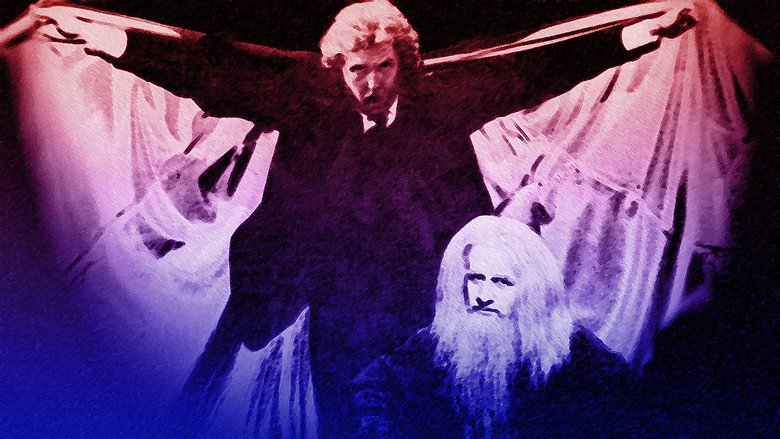
AGAINST the backdrop of several Trustee murders who support an orphanage on a Scottish island, one young girl, Mary Valley (Gwyneth Strong), is taken to a London hospital after a coach crash and suffers psychological issues. Psychiatrist Dr Haynes (Keith Barron) and journalist Joan Foster (Georgia Brown) interview the girl's wayward biological mother Anna Harb (Diana Dors), a prostitute and convicted murderer. When Haynes is killed, the hospital's senior member Sir Mark Ashley (Peter Cushing) and friend Colonel Charles Bingham (Christopher Lee) take their enquiries to the orphanage, as Anna also travels to the location hoping to reunite with her child. Ashley and Bingham eventually uncover the sinister truth: personalities are being transplanted into the children.
Sunday, June 1, 2025
"Where Science and the Occult Clash!"
AGAINST the backdrop of several Trustee murders who support an orphanage on a Scottish island, one young girl, Mary Valley (Gwyneth Strong), is taken to a London hospital after a coach crash and suffers psychological issues. Psychiatrist Dr Haynes (Keith Barron) and journalist Joan Foster (Georgia Brown) interview the girl's wayward biological mother Anna Harb (Diana Dors), a prostitute and convicted murderer. When Haynes is killed, the hospital's senior member Sir Mark Ashley (Peter Cushing) and friend Colonel Charles Bingham (Christopher Lee) take their enquiries to the orphanage, as Anna also travels to the location hoping to reunite with her child. Ashley and Bingham eventually uncover the sinister truth: personalities are being transplanted into the children.
Saturday, June 1, 2024
Highgate Horror (Part II of II)
Monday, April 1, 2024
Highgate Horror (Part I of II)
Friday, April 1, 2022
Doctor In Distress
PRODUCER John Nathan-Turner was in charge of DOCTOR WHO's increasingly disastrous stint through the 1980s. In Richard Marson's 2013 book The Life and Scandalous Times of John Nathan-Turner, it is alleged that the producer and long-term partner Gary Downie prayed on young fans well below the then gay consent age of twenty-one. But the results on screen were equally alarming, not helped by Nathan-Turner's tumultuous working relationship with script editor Eric Saward. Against a backdrop of referencing - which both limited writers and confused the casual viewer - light entertainment performers also consistently appeared rather than those from the drama department. Novelty casting was evident even in the companions, with Australian air-stewardess Tegan Jovanka (Janet Fielding) for the large fan base Down Under, and American Peri Brown (Nicola Bryant) appealing to the vastly increasing United States market. Then there were The Doctors he signed themselves: Peter Davison, Colin Baker and Sylvester McCoy were all dissatisfied with quirky costume decisions, adding to the pantomime feel.
The awkwardly titled A GIRL'S BEST FRIEND, with a running time of fifty minutes, was helmed by television veteran John Black, who was apparently labeled John Grey by the cast and crew because of his lifeless direction (another TV regular penned the laboured script - Terence Dudley). For the story, The Doctor gifts a Mark III K-9 (voiced by John Leeson) to former companion Sarah Jane Smith (Sladen). Now back to her roots as a rustic-costumed investigative journalist in the fictional English village of Moreton Harwood, Sarah Jane gains a companion of her own - her aunt's ward Brendan Richards (a wooden Ian Sears) - in a tale of the black arts. But before the underwhelming robed pagans and masked goddesses, we are subjected to one of the worst opening title sequences in television history; the theme was originally composed by record producer Ian Levine as an orchestral score, but was instead arranged directly from his electronic demonstration by Peter Howell without Levine's knowledge.
Wednesday, September 1, 2021
Séance and Sensibility
Abramelin and its demand for intricate, long-term preparation is credited to 14th-century Egyptian magician Abra-Melin, and plays out like a binding contract. In 1897, The Book of the Sacred Magic of Abramelin the Mage was translated into English by British occultist Samuel L. MacGregor Mathers, and was highly influential in the Hermetic Order of the Golden Dawn. Aleister Crowley - at the time a young member - started preparations for seeking the angel in Boleskine House, but abandoned this plan during the Hermetic Order division of 1901. The one thing that Mathers, Crowley and, indeed, most occultists, take from Abramelin is the existence of a benevolent demigod; consequently, a master or supreme magus can feed any number of charismatic and egotistical myth-makers.
Sunday, September 1, 2019
"No flesh shall be spared"
DUST DEVIL (1992)
DUST DEVIL: THE FINAL CUT of 1993 is the only version which shows any coherency. An extensive cut was screened for only a week in Britain due to the financial problems of Palace Pictures, and a similar release was put out by American distributor Miramax, who had pressured Stanley to make it "more like THE SILENCE OF THE LAMBS." Initial audiences were bemused, particularly by a final act where most of the editing had occurred. Yet whatever version, the 'Dust Devil' is too abstract to form any new, lasting horror mythos ("there is no good or evil, only spirit and matter. Only movement toward the light - and away from it").
A metaphysical stylist, Richard Stanley is never too far away from supernatural ancient rites.
Stanley himself is a fascinating individual. Raised by a mother who he claims was a witch, the writer and director is fittingly descended from famous journalist and explorer of Africa Sir Henry Morton Stanley. After moving to London in 1987, Stanley directed music videos for the likes of Fields of the Nephilim and Public Image Limited, and it was while he was documenting the Soviet-Afghan War that HARDWARE was given the go-ahead. Making a slew of interesting documentaries and short films - including The Secret Glory of SS officer Otto Rahn's search for The Holy Grail - his most infamous claim to fame was being sacked from his own version of H. G. Wells' The Island of Doctor Moreau. Replaced by John Frankenheimer, the true story of this catastrophic New Line production is expertly detailed in David Gregory's amazing LOST SOUL: THE DOOMED JOURNEY OF RICHARD STANLEY'S ISLAND OF DR MOREAU.
Friday, February 1, 2019
Skeletons in the Closet
GHOST STORIES (2017)
THESE two films focus on academics who have to question their sceptic beliefs towards the paranormal. Adapted from Fritz Leiber's 1943 novel Conjure Wife, Sidney Hayer's NIGHT OF THE EAGLE has sociology Professor Norman Taylor (Peter Wyngarde) discovering that his perfect wife Tansy (big-band singer Janet Blair) is actually a Witch, and has been practising her craft since their honeymoon. Tansy has manipulated Taylor's rising career at Hempnell Medical College, and discovering this, the Professor destroys all of her inventory of magical paraphernalia. Thereafter Taylor suffers a number of sinister situations, one of which is an accusation of "violating" one of his students. It transpires that his path is now being orchestrated by the hostile intent of another faculty wife, Flora Carr (Margaret Johnston), driven by both educational and sexual jealousy.
Fittingly shot in moody monochrome by Reginald Wyer, the movie is underplayed in the tradition of Val Lewton, and possesses a tangible chill. NIGHT OF THE EAGLE is comparable to NIGHT OF THE DEMON in its more adult approach to the uncanny, and Hayers cut large portions of occult and voodoo material from the original script - by Richard Matheson, Charles Beaumont and George Baxt - to concentrate on the plight of the Taylors. The Eagle itself - a stone embodiment that rests at the entrance of the school - comes to life with risible results, but it can't take away the fact that Hayer's film is a beautifully played classic of British horror; Wyngarde and Blair convince at every level of their descent, but Johnston steals the show with her permanently off-kilter performance.
Based on their own Olivier Award-nominated stage show, Jeremy Dyson and Andy Nyman's GHOST STORIES arrived on a wave of glowing reviews and hype that no film could fully justify. This three-part anthology mashes together Amicus and the BBC GHOST STORY FOR CHRISTMAS strand for old school scares and J-Horror that builds to a hokey finale that undermines its own building premise. Professor Goodman (Nyman) is given a trio of unsolved mysteries by his assumed-deceased idol Charles Cameron: Tony Matthews (Paul Whitehouse) is a night watchman of a disused female correctional facility, haunted by the spirit of a young girl; jittery teenager Simon Rifkind (Alex Lawther) encounters a Satyr in the woods; and country-based stockbroker Mike Preddle (Martin Freeman) is plagued by a poltergeist while awaiting his IVF-induced child.
The performances embrace its emotional tropes of family resentment, belief systems and childhood traumas. Simon's story is the most effective - underpinned by some wonderful black humour (Sooty and Sweep anyone?) - but these powerfully-played themes grate somewhat with its peripheral ghosts and jump scares, and the atmospherically barren landscapes of concrete halls, a daytime pub and an out-of-season caravan park. It's worth a second watch to pick up the easter eggs, but they are not so much Ghost stories as Ghost settings. In conclusion, it contains too odd a mix even for a horror movie, and reeks heavily of Nyman's misdirection and overblown showmanship evident in his association with Derren Brown.
The most grounded argument from supernatural skeptics is not so much if ghosts exist, but why the human psyche actually needs them; ultimately it is a longing for comfort, away from the harsh and bleak reality of death. More specifically, the biggest difference in NIGHT OF THE EAGLE and GHOST STORIES handling of their respective Professor's is that Taylor's professional life is manipulated by the constant indignation of females, whether in the name of love - Tandy is even willing to die for him as he has much more to offer the world - or bitterness. Conversely, everything in Goodman's journey is devoid of women; partnerless and childless, he exists in a closed, work-dominated world. Though when Flora Carr sets fire to a pyramid of Tarot cards - the otherworldly equivalent of the character's beloved Bridge evenings - and spits "burn, Witch, burn," Goodman has certainly opted for a less suffocating existence.
Wednesday, August 1, 2018
Paranormal Activity
ignited the wrath of moral crusader Mary Whitehouse.
BBC Scotland's THE OMEGA FACTOR is a forerunner to THE X-FILES, but without the budget or pretention. Born from the ashes of the cancelled second series of journalist drama THE STANDARD, here the lead protagonist is occult writer Tom Crane (James Hazeldine). Crane's latent psychic abilities lead him into Department 7, a government agency which investigates the paranormal, where he is partnered with family acquaintance Dr Anne Reynolds (Louise Jameson, a recently resigned Leela from DOCTOR WHO). Crane joins the organisation as a means of finding rogue psychic Edward Drexel (Cyril Luckham) and assistant Morag (Natasha Gerson), both involved in the death of his wife; yet, after Drexel is killed, Tom becomes increasingly aware of another shadow enterprise, one which strives to assemble the cream of extrasensory perceptive individuals.
For a programme steeped in otherworldly abilities, THE OMEGA FACTOR feels strangely grounded because of its lack of money and threadbare effects. This enhances Hazeldine's already standout performance, mixing his drive to avenge his wife's death, to come to terms with his own powers, and the vain attempt to assimilate within Department 7 with a secretive superior, namely psychiatrist Dr Roy Martindale (John Carlisle). Like any anthology shows - here with a wide range of writers and directors over ten episodes - there is an inherent unevenness in style and quality, encompassing a heady and diverse set of topics: spectral analogue technology (VISITATIONS), sonic weaponry (NIGHT GAMES), sleep deprivation (AFTER-IMAGE), poltergeists (CHILD'S PLAY), and even astral projection to political means (OUT OF BODY, OUT OF MIND).
of BBC paranormal drama, with added intimacy.
POWERS OF DARKNESS is the episode the show is most remembered for, infamously labelled "thoroughly evil [and] one of the most disturbing things I have seen on television" by Mary Whitehouse. History student Jenny (Maggie James) is possessed by a witch, culminating in an altar ritual involving a dead blackbird and a Demon. Mixing a seance, drug use, knife violence and human combustion, this fed into Whitehouse's disgust at any portrayal of Eucharist abstraction, and general distrust of popular entertainment. Two weeks later BBC Scotland Head of Drama Roderick Graham admitted that the BBC's own standards of decency had been breached during ST ANTHONY'S FIRE, where a woman kills her husband with a bread knife. The BBC's Guidance Notes on Violence, which dictated permissible levels, specifically mentioned that dramas were to avoid violent acts that could be easily copied. Graham stated that "the point has been forcibly made to those who were responsible for the programme".
The penultimate entry, DOUBLE VISION, is unnerving because it is so understated. Tom keeps seeing his dead wife Julia (Joanne Tope) in and around Edinburgh; in DON'T LOOK NOW fashion, when running after her, the red-coated figure darts around corners and remains constantly out of touching distance, like the dream sensation of a goal forever out of reach. For the husband to discover this was an elaborate ploy leaves an unsavory taste, as the show leads to its THE PRISONER-like conclusion. The final episode - called ILLUSIONS - ends fittingly on a closed door, leaving further adventures to be picked up in a series of Big Finish audio dramas, where Jameson returns as Reynolds, now head of the department.
Thursday, March 15, 2018
True Blue (Part II of II)
CONFESSIONS FROM THE DAVID GALAXY AFFAIR (1979)
BECAUSE of the unfathomable financial success of COME PLAY WITH ME, executive producer David Sullivan quickly announced his next venture, with lover Mary Millington taking on a more sizable role. Proclaiming the follow-up would be the "hottest film ever to be screened in Britain," THE PLAYBIRDS is actually an overblown exercise in self-promotion, but does capture the tawdry aspects of 70s Soho amongst its car chases and bombastic theme tune. Belonging to a genre of British film that rejoice in the psychopathic killing of models (COVER GIRL KILLER, PEEPING TOM et al), Harry Dougan (Alan Lake, as an on-screen persona of Sullivan) is a racehorse-owning millionaire glamour publisher, who starts a series of supernatural-themed spreads that has attracted a deranged killer (who the press term "The Chopper.") After dispatching two ladies of sexploitation royalty (Pat Astley and Suzy Mandel), the murderer becomes involved in a cat-and-mouse game against Scotland Yard's finest (Glynn Edwards and Gavin Campbell, with Millington as undercover WPC Lucy Sheridan).
The in joke of pouring a 4'11" porn non-actress into a Police uniform - especially one as harassed by the law as Millington - is quickly forgotten as Sheridan is more at home to her new assignment than somnambulantly delivering dialogue at cop shop meetings. Developing her talents as a sauna prostitute, Lucy soon has a lesbian fling and sleeps with Dougan to achieve her goal to become a Playbirds centrefold. Regardless of the film being moulded as a Mary vehicle, the real actress with sex appeal here is Mandel: it was no mistake that she shared equal space on Tom Chantrell's eye-popping posters of COME PLAY WITH ME and THE PLAYBIRDS alongside her more illustrious colleague. The cherubic Mandel could actually deliver her lines with a knowing twinkle, and was a mainstay of 70s smut in this country until she emigrated to the United States. If you actually care about the murder investigation you have a variety of suspects beyond Dougan, but the final "shock ending" will leave no one satisfied.
The following year Sullivan attempted to cash-in on the CONFESSIONS name with CONFESSIONS FROM THE DAVID GALAXY AFFAIR, another Roldvale production distributed by Tigon. Lake gives one of the most self-indulgent lead performances in British film history as the titular super stud astrologer, who may - or may not - have been involved in a Securicor robbery five years previous. Behind his sparkling medallion, large lapels and annoyingly knowing swagger, Lake regularly breaks into a series of excruciating impressions (embracing anyone from Basil Rathbone to Bruce Forsyth, and anything from racism to homophobia), and also breaks wind in one jaw-dropping love-making scene. Despite this goggle-eyed eccentricity, Galaxy is still irresistible to women, refers to his penis as Fido, and sleeps with the entire female cast except for real-life wife Diana Dors, who plays the new owner of his apartment block.
In new levels of cinematic tedium, there is endless offering and pouring of drinks (often involving the police, tokenly fronted again by Glynn Edwards) but the film is saved from total disposability by the appearances of Rosemary England (Miss Beauty Bust) and - in a subplot incidental to the main narrative - Mary Millington (high society heiress Millicent Cumming). Never having experienced orgasm, Cumming hooks up with Galaxy in a multi-positional sequence played out against the astrologer's mirrored headboard. Despite this lengthy scene being one of the most explicit in a British sex comedy - one press release even insinuated that Lake and Millington actually had intercourse, much to Dors' disgust - the picture was a box office and critical disaster.
Monday, January 1, 2018
Neither Blood Nor Legacy
THE LEGACY (1978)
Originally optioned by Hammer, director Fred Burnley attempted to ensure that the film would not be known as "another Tigon horror movie" (Tigon would be rebranded LMG by the time of release), but regardless of genre expectations, it was labelled by Time Out as "one of the worst films of the decade." NEITHER THE SEA NOR THE SAND - nor entertainment - is a ponderous love story without charisma, and a supernatural tale with little Fortean interest (reincarnation within Dabernon history is briefly hinted, as is Robinson being a witch). With no connection on screen, Hampshire and Petrovitch are doomed from the onset, Hampshire's theatrics grating with Petrovitch's distant portrayal; when Hugh's rigor mortis starts to set in, there is no difference to our male lead's performance. What remains is ninety minutes of meaningful stares and glances.
The Peasants are revolting: Oliver Reed not so much chews the scenery than spits it out in BLUE BLOOD.
Directed by Andrew Sinclair, BLUE BLOOD is a delirious story of Devil worship set and filmed at Wiltshire's Longleat House. Gregory (Derek Jacobi) is a young aristocrat who complains of modern England while maintaining a servant lifestyle, which includes new German Nanny Beate (Meg Wynne Owen). Entrusting control of the house to butler Tom (Oliver Reed), and in a complicated relationship with his estranged singer wife Lily (an icy Fiona Lewis), the Lord succumbs to the unholy practises of the under classes, governed by his leading manservant. Adapted from Alexander Thynn's novel The Carry-Cot by Sinclair, Thynn is the 7th Marquess of Bath and grew up in his family's seat at Longleat (and to further the in-house connections, BLUE BLOOD features Thynn's wife Anna Grael as Gregory's mistress Carlotta). UPSTAIRS DOWNSTAIRS on acid, Reed's ham performance is either extraordinary inept or one that plays to the general foolishness; moving like an automaton, Tom's Satanic control is built up by a series of almost freeze-framed red-hued images of black masses and sacrifice, usually depicting Owen, Grael and Lewis draped around him while holding a bloodied knife.
THE LEGACY is another tale of Mansion-based Satanic shenanigans. Designers Maggie Walsh (Katharine Ross) and Pete Danner (Sam Elliott) leave California to work for an anonymous British client. On reaching their destination they are involved in an accident with a limousine, which is actually owned by their benefactor, Jason Mountolive (John Standing). Inviting them to his estate, Mountolive introduces Walsh and Danner to five guests, who die in a variety of ways: Maria (Marianne Broome) drowns; Clive (Roger Daltrey) chokes to death; Karl (Charles Gray) is burned alive; Barbara (Hildegard Neill) is pierced by a splintered mirror; and Jacques (Lee Montague) falls from a roof. All had chequered pasts, and were spared punishment due to Jason's unorthodox interventions: his mother being Lady Margaret Walsingham, a practitioner of witchcraft. It transpires that Walsh is actually Mountolive's great-granddaughter, and Jason's last acts were to kill the other heirs so Katharine can continue Satan's work.
Friday, December 1, 2017
Short-Lived Revival
A GHOST STORY FOR CHRISTMAS - NUMBER 13 (2006)
THE BBC GHOST STORY FOR CHRISTMAS strand from the 1970s returned with these two entries. Both add a layer of weird science to their ghostly goings-on, as the laws of physics are played with fancifully. A VIEW FROM A HILL - adapted from M. R. James by Peter Harness and directed by Luke Watson - sees young Fitzwilliam Museum curator Dr Fanshawe (Mark Letheren) discovering some homemade binoculars while cataloguing the archaeological collection of the late father of debt-laden Squire Richards (Pip Torrens). The field glasses - created by deceased local watchmaker and amateur necromancer Baxter (Simon Linnell) - give Fanshawe visions of Fulnaker Abbey in all its splendour and a gibbet on Gallows Hill, in reality locations now dissolved. It transpires that Baxter's "very peculiar ... 'abits" of boiling the bones of condemned men resulted in a noxious fluid, some of which has remained sealed inside the binoculars.
Never previously adapted on film or television, A View from a Hill was first published in the May 1925 edition of the London Mercury, and in the same year formed part of the A Warning to the Curious and Other Ghost Stories anthology. Harness and Watson successfully evoke the washed-out landscapes and corner-of-the-eye creepiness of the best 70s output and it is also beautifully played; moving James' Edwardian setting to the post-WWII decline of country estates, social status is reflected as weary condemnation. When Fanshawe makes clear to Richards that he is an archaeologist and a doctor, the Squire caustically responds "have to get you to take a look at my feet."
Greg Wise is more Indiana Jones than M.R. James in NUMBER 13.NUMBER 13 - adapted from James by Justin Hopper and directed by Pier Wilkie - had been brought to the screen on two, presumed lost, occasions: as part of NBC's GREAT GHOST TALES of 1961, and as a second season episode of MYSTERY AND IMAGINATION in 1966. Originally appearing in the 1904 Ghost Stories of an Antiquary, the location of the story is moved from Viborg, Denmark, to Winchester Cathedral, where Oxford academic Professor Anderson (Greg Wise) is sucked into a spatial-distorting hotel room occupied by a sixteenth-century diabolist. It seems somewhat out of place that Anderson is a handsome adventurer, and the Phantom's hand is black-gloved like a Dario Argento serial killer. NUMBER 13's other frissons are similarly abstract: the English hotelier using the centre panel of Bosch's The Garden of Earthly Delights, and a mention for Witchfinder General Matthew Hopkins.
Saturday, April 15, 2017
Downe and Out
Actually completed in 1972, Starr's excruciatingly dull vanity project failed to pick up any distribution. Realising that this comedy actually had no jokes - and hid behind Nilsson's musical numbers and message of love - the ex-Beatle turned to Graham Chapman to re-write and re-dub. However this version allegedly made even less sense, and has never been made public (SON OF DRACULA eventually was shown on a limited run in the States). The film is a pedestrian pantomime at best, with generous amounts of padding (Count Downe foils a completely random attack by a werewolf, for instance). Francis further laces the production with classic interpretations of monsters (Meaden's Dracula actually takes Nosferatu as a blueprint, and there are also appearances by Frankenstein's creature, the Mummy and even a Medusa and a Fu Manchu). In fact the only point of interest are the musicians on show, which includes John Bonham and Keith Moon exchanging drumming duties in Downe's band.
Wednesday, February 15, 2017
The Love of Darkness
RASPUTIN THE MAD MONK (1966)
Aside from Shelley and Milton, the performances are self-conscious (even leopard Chiefy, a performing cat from Southport Zoo, surprisingly lacks menace), and Ayres makes for a particularly characterless 'hero'. Shaughnessy - directing his only fantastic film before creating UPSTAIRS DOWNSTAIRS and planting the seed that would become Pete Walker's HOUSE OF WHIPCORD - couldn't remain positive about the release's own main legacy, lamenting in his autobiography "by using [Barbara Shelley] I fear we condemned a very beautiful and talented actress to a long career in horror films."
"Everything else is darkness"; the hypnotic stare of Christopher Lee as RASPUTIN THE MAD MONK.
Directed by Don Sharp and scripted by Anthony Hinds, Hammer's RASPUTIN THE MAD MONK casts Shelley again under the spell of Christopher Lee in redressed sets from DRACULA PRINCE OF DARKNESS. After healing an innkeeper's wife and cutting off the hand of the keeper's daughter's suitor, Grigori Rasputin (Lee) is hauled before an Orthodox bishop on grounds of sexual immorality and violence. Preferring to give God "sins worth forgiving", Rasputin is unperturbed by the bishop's claims of Satanism. Heading for St Petersburg, the exiled Monk befriends struck-off Dr Zargo (Richard Pasco) and begins his campaign to infiltrate highest Russian society. This includes gaining influence over the Tsarina's ladies-in-waiting Sonia (Shelley) and Vanessa (Suzan Farmer), but his relentless sexual appetite and pursuit of wealth eventually leads to his death at the hands of Zargo and Ivan (Francis Matthews).
Initially announced in 1961 as THE SINS OF RASPUTIN, Hammer's brisk pseudo-exploration of "History's Man of Mystery" is dominated by Lee's extraordinary performance. Unlike his appearances as Dracula - often off-screen and reduced to set pieces - Rasputin is overpowering from his appearance at the Inn door. Passionately researching the role, the actor even sought advice on how to play a medically accurate death by cyanide poisoning. But the film was hampered by overspends on DRACULA PRINCE OF DARKNESS, foreshortening the script and scope; the production was also under the threat of legal action from Prince Felix and Princess Irina Yousoupoff, Felix being one of Rasputin's real-life assassins. Having successfully sued MGM over their 1932 release RASPUTIN AND THE EMPRESS, pressure from the Yousoupoff's is the reason that Hammer's surrogate assassin Ivan is Vanessa's brother rather than husband, and why Vanessa and Rasputin do not meet in the film's climax.
Sunday, January 1, 2017
Bridal Torment
WESSEX TALES - BARBARA OF THE HOUSE OF GREBE (1973)
IN his 1888 collection Wessex Tales, Thomas Hardy writes of the true nature of nineteenth century marriage and its inherent restrictions, the stance of women, and a society which could not cope with even minor diseases. Hardy did not explore the sensibility of Jane Austen or the vivid caricatures of Charles Dickens; rather, his poems and novels are filled with characters that are as functional and rustic as their clothes; his dramatis personae follow the hardened edge of nature, the intractable working of fate, and the inevitability of a relentless decline. There is also a sense of enigma, that something beyond our physical appearance is guiding our hand. For many people of a certain age, one such story - The Withered Arm - is remembered as an oddity of their school experience. Often included on English Literature syllabuses, it sits awkwardly between ambiguous morality tale and surreal horror.
Wessex Tales was made into a BBC anthology; the first broadcast was THE WITHERED ARM, and is a masterpiece of the form. In a Southern England rural community, wealthy farmer John Lodge (Edward Hardwicke) returns home with his new young bride Gertrude (Yvonne Antrobus). Gertrude awakes one morning to find four painful welts on her arm, and consults Conjuror Trendle (Esmond Knight) with the reluctant help from weathered milkmaid Rhoda Brook (Billie Whitelaw). Trendle prescribes a ghoulish cure: “you must touch with a limb the neck of a man who’d just been hanged.” It transpires that Rhoda’s son Jamie (William Relton) is the illegitimate spawn of Lodge, and it is he who is the man hanged for a frivolous reason.
Rhoda’s dream sequence of a grotesquely grinning Gertrude taunting her with her wedding ring - only to have Rhoda angrily grabbing the bride’s arm before awakening - is eerily effective, and in the programme’s standout image Whitelaw holds the distinction of the only actress to ever make milking a cow look ethereally sinister. A mix of jealousy and body horror, Gertrude is the Gothic Outsider not just existing in an unfamiliar world, but an ultimately unwanted one: she cannot bear children.
Directed by Desmond Davis - who would go on to direct the Ray Harryhausen opus CLASH OF THE TITANS - THE WITHERED ARM was dramatised by Rhys Adrian greatly indebted to THE BLOOD ON SATAN'S CLAW. Wandering wearily through the bracken and ploughed earth, Gertrude’s physical affliction makes for close relation to SATAN'S CLAW's yearning for devil skin. The programme is also enveloped by the hanging ethic, unsurprising as Hardy himself was an enthusiastic spectator of such public punishment. This is illustrated by scenes of locals jostling for position to see the noose being made, and an old man selling wooden hanging figures. There is also a cinematic shot of a silhouette of the gallows against the day-for-night sky.
The sixth and final WESSEX TALE was BARBARA OF THE HOUSE OF GREBE. Lord Uplandtowers (Ben Kingsley) wants to marry Barbara (Joanna McCallum); however, this daughter of Sir John Grebe (Leslie Sands) elopes with handsome Edmond Willowes (Nick Brimble). Marrying "beneath her," Barbara can only gain her parents consent by having Edmond "educated" in Italy for a year, while their lodge house is readied. During his stay in Europe, Edmond is facially disfigured in an opera house fire while saving others; on his return to England, Barbara is repelled, forcing him to leave a farewell letter. After leaning of his death several years later whilst in a loveless marriage with Uplandtowers, Barbara receives delivery of a commissioned statue of a pre-accident Edmond from Pisa. Worshipping this as a shrine, Uplandtowers learns of the original disfigurements and has the statue amended accordingly, at last receiving Barbara's affections.
Dramatised by David Mercer, this unnatural tale of social status was described by T. S. Eliot as "to have been written to provide a satisfaction for some morbid emotion." Barbara experiences love and loss at every extreme level, from its initial blooming to isolation and despair. Edmond's burned reveal is starling: what seems to be a simple mask turns into a full unveiling of face and wig, as if the forced exile is peeling an orange. While captured in their matrimonial hell, Kingsley and McCallum excel, Barbara caressing her model as Uplandtowers simmers to his ultimate victory.