Showing posts with label Joseph Larraz. Show all posts

Friday, March 1, 2019

Films That Vanished

CRUCIBLE OF TERROR (1971)
SCREAM - AND DIE! (1973)


In the same year as being burned at the stake in TWINS OF EVIL, Judy Matheson gives a memorable performance in the disposable curio CRUCIBLE OF TERROR.

THESE two Seventies horrors are hardly forgotten gems, more underrated guilty pleasures. Ted Hooker's CRUCIBLE OF TERROR tells of painter and sculptor Victor Clare (former pirate radio DJ Mike Raven), who lives in isolation above a disused Cornish tin mine with his troubled wife Dorothy (Betty Alberge) - who has regressed to a second childhood because of Clare's bullying and womanising - and Bill (John Arnatt), Victor's only friend and household cook. Victor's speciality is making bronze statues from murdered young women, which is rekindled when art dealer Jack Davies (James Bolam) and Clare's son Michael (Ronald Lacey, of RAIDERS OF THE LOST ARK fame) arrive with their wives Millie (Mary Maude) and Jane (Beth Morris). The artist's current muse Marcia (the extraordinary Caroline Munro lookalike Judy Matheson) is a constant presence, but as Jack and Michael try to acquire more pieces for their gallery, the power of possession ultimately trumps the body count.

After appearing in LUST FOR A VAMPIRE and I, MONSTER, Raven was the self-styled "next big thing" in British horror. Such a deluded reputation was severely dashed with this Glendale release (and a yearning that became terminal with his next attempt, the Super 16mm DISCIPLE OF DEATH). Afterwards, Mike retired to become a sheep farmer and sculptor in Bodmin; his distant acting style wanted to draw from Roger Delgado and Christopher Lee, but a more legitimate nod to Hammer's legacy here is the casting of Melissa Stribling, appearing as an art backer. The supernatural conclusion seems a little forced, especially after suffocation by plastic cushion, a screwdriver stabbing, rocks to the head and acid in the face, but the dialogue is priceless and the photography bracing.

Israeli poster for Joseph Larraz's dreamlike SCREAM - AND DIE!

In between his early psycho-thrillers and descent into late 70s Eurosmut, Barcelona-born Joseph Larraz helmed slow-burning British classic SYMPTOMS and perennial cult favourite VAMPYRES. He also made the sluggish English giallo SCREAM - AND DIE!, which is also known as THE HOUSE THAT VANISHED and DON'T GO IN THE BEDROOM. The film opens with glamour model Valerie Jennings (Andrea Allan) witnessing a murder in a fog-enveloped country house. After boyfriend Terry (Alex Leppard) goes missing and her flatmate Lorna Collins (an all too briefly used Judy Matheson) is raped and killed, Valerie discovers that her fresh-faced, mask-making compatriot Paul (Karl Lanchbury) is the culprit. 

Larraz started his career as a comics artist, specialising in action adventures. With a leap to script writing and directing, he attempted to rise above the too-generalistic term Eurotrash Cinema, and even today his output feels under analysed and under appreciated. Allan and Matheson make for alluring beauties, but the nudity doesn't stop there; the film is most (in)famous for sex involving Paul and his aunt Susanna (Maggie Walker). This being Larraz, the sequence holds a real sensual charge, and creeping use of British locations in winter add to the building bursts of depravity. The characters are unrealistic - Valerie brushes aside the missing Terry and the brutal demise of Lorna - yet this adds to an otherworldly canvas which even includes a nude woman and a monkey. 

Tuesday, August 1, 2017

Demons of the 1970's (Part II of II)

SYMPTOMS (1974)
FULL CIRCLE (1977)

"Changes in the weather always upset me ... I don't know why;" Angela Pleasence battles with her twisted psyche in SYMPTOMS.

UNLIKE his exploitative VAMPYRES, José Larraz’s SYMPTOMS is a slow-burning triumph, a film that was unexpectedly chosen as an official British entry at Cannes. Neurotic waif Helen Ramsey (a mesmerising Angela Pleasence) has invited girlfriend Anne (Lorna Heilbron) to stay at her English woodland estate. Anne is welcoming the retreat to write and evaluate the end of a romance, but Helen's behaviour becomes increasingly erratic as questions are asked of the portrait of Cora - Ramsey's disappeared friend and possible lover - and the brooding presence of handyman Brady (Peter Vaughan). Helen's manifestations of Cora mirror Anne's unease in the house, under the shadow of Cora's body festering in the lake after a passionate embrace with the burly handyman.

Larraz has long favoured mansions in his pictures, and the warring of the sexes; here they are quite literally foundations for exploring the horror motif of characters yearning for lost loves. Taking several inspirations from REPULSION, the director uses a mirror and the ticking of a clock to replicate Roman Polanski's idea of lulling the viewer into a false sense of security, before delivering bludgeoning shock tactics. Vanity Celis points out in her essay which accompanies the BFI Blu-ray that Larraz' contribution to the sexual anxieties of the Gothic tradition is "a safety net found in the auxiliary subtext of lesbian love," and the production - similar to Jorge Grau's THE LIVING DEAD AT MANCHESTER MORGUE, Juan Carlos Fresnadillo’s 28 WEEKS LATER and Alfronso Cuaron’s CHILDREN OF MEN - captures the English landscape more effectively than native filmmakers, creating an agitation that resonates more deeply in the outsider's eye.

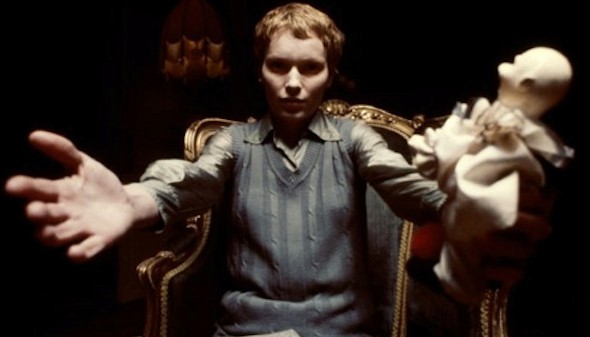
Mia Farrow brings a tragic vulnerability to her role in FULL CIRCLE, part of a Seventies Anglo-Canadian co-production deal which yielded lesser pictures THE UNCANNY and DEATH SHIP.

An eerie atmosphere of love and loss is also central to Richard Loncraine's FULL CIRCLE, based on Peter Straub's 1975 novel Julia. A decade on from her subjection to Polanski's ROSEMARY'S BABY, Mia Farrow is again entangled with an unearthly child, playing a mother grieving the loss of daughter Katie (Sophie Ward) who chokes to death at breakfast. During her self-imposed isolation at an old house in Kensington, Julia is stalked by another girl ghost, who led a gang in the brutal murder of a German boy in 1938. As a "feeling of hate" infiltrates the dwelling, the murderous infant is identified as Olivia Rudge, and Julia traces Olivia's mother (Cathleen Nesbitt) to a Swansea mental institution, who admits to killing her offspring and accuses her visitor of doing the same.

In a moving final scene Julia welcomes the ghostly Olivia into her arms, the camera then pans around an armchair to reveal that Julia has a fatal neck wound. This not only brings us full circle from Katie's demise, but leaves the viewer wondering if Olivia has claimed another victim from her otherworldly plane, or the tortured mother has committed suicide. The willowy Farrow carries the whole burden of grief superbly, and quite rightly male players are kept to the margins (husband Magnus (Keir Dullea) is purely abandoned, and friend Mark (Tom Conti) suffers an unnecessarily sensationalised death)). The film also benefits from beautiful cinematography and a piano/synthesiser score which manages to underpin and elaborate on the unease.

Tuesday, May 13, 2008

Blood Lust

VAMPYRES (1974)

This cult classic makes effective use of Hammer's Oakley Court stomping ground in its story of savage lust and supernatural desires.

THE 1970s offered a glut of lesbian vampire movies, and all of them seem to have attracted their own fanatical devotees. A rare horror film independently made in Britain, VAMPYRES is a collaboration between UK-resident Spanish director Joseph Larraz and editor Brian Smedley-Aston; yet its own precedent of the genre - Hammer’s conventional gothic THE VAMPIRE LOVERS - is shrugged aside in preference for Harry Kumel’s DAUGHTERS OF DARKNESS. Fran (Marianne Morris) and Miriam (Anulka Dziubinska) are the eponymous bisexual vampires, spending their days insensible in a cellar (filled with Carpathian wine), and their nights seducing unwary drivers who they proceed to sexually exhaust and kill.

The astonishing debauchery of the murder scenes - filmed mostly by Larraz using a hand-held camera - are poetic in their excess, as Fran and Miriam slice their victims and lap at open wounds with ferocious intensity. As Larraz explains, “I imagine my vampires (to) turn almost to cannibalism, to take the blood from anywhere. I can't imagine anyone coming to suck blood gently. It would be very quick with urgency … urgency for the kill, urgency for the blood, because it's what they need.” The wintry shots of the vampires waiting by the roadside are effective, but it is also the smaller details that add to the overall lingering chill: Ted (Murray Brown) is horrified by Fran’s habit of sleeping with her eyes open, and people’s watches stop when in the vicinity of the bloodsuckers.


The two stars also showed their flesh on the printed page: Dziubinska was Playboy’s Miss May 1973, and Morris appeared in the October 1976 edition of Mayfair.

The two leads were cast for their bodies and not their acting talent, and both were subsequently dubbed. But Morris and Dziubinska play their roles remarkably well; Fran is the hunter-gatherer, while Miriam is the petite blonde waif that belies her savagery. An unusual production as far as it has plenty of loose ends and unexplained back-story, VAMPYRES is nevertheless the definitive erotic horror film, a primal piece which is driven by emotion and lack of logic - both distinctive traits of the vampire ethos.