Showing posts with label Tigon. Show all posts

Sunday, October 1, 2023

Tomorrow's Headlines Today

DOOM WATCH (1970 - 72)
DOOMWATCH (1972)

Cyberman creators Kit Pedler and Gerry Davis also spawned DOOM WATCH, a plausibly terrifying apocalyptic drama.

BETWEEN February 1970 and August 1972, the BBC broadcast three seasons of DOOM WATCH, a sobering set of cautionary tales created by DOCTOR WHO story editor Gerry Davis and medical scientist/author Kit Pedler. In the show, a Government sponsored organisation - led by Physicist Dr Spencer Quist (John Paul) - investigate ecological and technological dangers in stories influenced by contemporary cases. This "Department for the Observation and Measurement of Science" combated intelligent carnivorous rats, mind-destroying sound waves, toxic mutations and a plastic-eating virus, and a final episode - exploring permissiveness and its impact on human behaviour - was banned. This story, SEX AND VIOLENCE, courted controversy not for its subject matter but for a scene where the footage of a real-life African execution is shown. Even though the programme attempted to make the serious and valid point that watching genuine violence has a different effect on viewers than fantasy harm, the episode was nevertheless pulled by nervous executives.

DOOM WATCH was one of the first examples of environmentally conscious television, where its audience were forced to think about the consequences of unregulated commercial exploitation of Earth’s resources (it was also one of the first to kill off its star - young chemist Toby Wren (Robert Powell) - after its first season). Prescient on a number of topics, it also influenced alarmist science fiction in general, despite basic production values, gaudy fashions and typical 1970s attitudes towards women. At one point the British Government considered setting up a real-life equivalent, with Labour MP Ray Fletcher planning a Westminster committee to include Pedler among its members. DOOM WATCH itself disappointingly succumbed to that popular mantra "creative differences," after friction with producer Terence Dudley.

DOOM WATCH followed in the footsteps of QUATERMASS and DOCTOR WHO to the silver screen with a limp, despite great make-up by British legend Tom Smith.

Helmed by Peter Sasdy from a Clive Exton script, the Tigon movie version sidelines the TV regulars - Quist, Dr John Ridge (Simon Oates), computer expert Colin Bradley (Joby Blanshard) and Dr Fay Chantry (Jean Trend) - for new character Dr Del Shaw (Ian Bannen). Shaw travels to the Cornish island of Balfe (actually Polkerris) to investigate the effects of oil pollution, where only school teacher Victoria Brown (Judy Geeson) gives him any kind of welcome. It is discovered that the islanders are suffering from acromegaly, brought on from a diet of contaminated fish. This has been caused by the Navy - headed by a disinterested George Sanders - legitimately dumping radioactive material near Castle Rock, which has reacted with a failed hormone dumped by a ramshackle waste company.

DOOMWATCH adheres to its umbrella brief of shady failed science, and belongs to that subgenre of cinema - which includes THE CRAZIES and C.H.U.D. - where ordinary folk are transformed into monsters because of unorganised or callous corporations. Whereas the television programme often suffered from verbal diarrhea, in an era where the medium was still viewed in many ways as theatre rather than film, the actual DOOMWATCH movie wastes its cinematic scope and location by becoming a plodding horror. The performances are earnest, but it would have played out better as a reworked one-off TV special.

Friday, March 15, 2019

Monkey Business

TROG (1970)

TROG is played by Joe Cornelius, a professional English wrestler known as The Dazzler. Cast for his physique and athletic abilities, the "missing link" costume was a salvaged 2001 ape mask and some fur.

HAVING grown up in poverty and suffered abuse as a child, Joan Crawford was famous for her fighting spirit. Directed by Freddie Francis from an original story by Peter Bryan and John Gilling, TROG was Crawford's final film. Concerning the discovery of an Ice Age troglodyte in contemporary Britain, the faded star probably needed her then preferred tipple of vodka to get through the production. As The New York Times stated, "[TROG] proves that Joan Crawford is grimly working at her craft. Unfortunately the determined lady, who is fetching in a variety of chic pants suits and dresses, has little else going for her."

When an ape-man is found in a Peak District cave, anthropologist Dr Brockton (Crawford) brings him back to her lab for study. This is especially irksome for businessman Sam Murdock (Michael Gough), who is equally venomous about a waste of taxpayers money for the research facility, and that Brockton has the audacity of being a woman. As the experiments continue, Trog relives his illogical past copiously illustrated by Ray Harryhausen/Willis O'Brien dinosaur footage from THE ANIMAL WORLD. Murdock remains troubled, particularly when the municipal court (headed by Thorley Walters) sides with Brockton and a now international band of scientists. Enraged, Murdock releases Trog, hoping the caveman will be killed by locals or the authorities.

Trog checks out Joan Crawford's muscles on set; in the picture, even a movie star can't save him in the name of science. However, to be fair, the "monster" does kill four men and a dog, plus kidnaps a child.

Developed by Tigon, the project was sold to American B-movie producer Herman Cohen (who can fleetingly be glimpsed as a barman). But TROG is a hilarious misstep by anyone's standards, the caveman's ramshackle appearance summed up by Inspector Greenham (Bernard Kay), when he states "it looks like something out of a student's rag week." Brightly lit in his cage, fully exposing its contrasting skin tones, Trog's initial training involves winding up a toy doll and swaying lovingly to classical music (his affinity to Brockton's scarf also makes one question his sexuality). But during his climactic rampage more brutish qualities come out, such as spiking a butcher on a meat-hook that predates the infamous scene from THE TEXAS CHAIN SAW MASSACRE.

A guilty pleasure even for the most hardened cult fan, TROG does play a significant role in horror history. A young John Landis saw the picture which led him to make his debut SCHLOCK, a homage where the director played an ape-man emerging from a Southern California cave. Having been a Fox mail-boy Landis knew John Chambers, the make-up maestro behind PLANET OF THE APES. The important thread was that after Chambers declined to make the required monkey man on budgetary grounds, Don Post Studios put Landis in contact with Rick Baker. Baker's suit for "The Banana Killer" is wonderful, and clearly the highlight of the movie.

Thursday, March 15, 2018

True Blue (Part II of II)

THE PLAYBIRDS (1978)
CONFESSIONS FROM THE DAVID GALAXY AFFAIR (1979)

"A Murder Thriller with Thrilling Bodies!" THE PLAYBIRDS provided Britain's premier 70s sexpot Mary Millington with her most substantial part.

BECAUSE of the unfathomable financial success of COME PLAY WITH ME, executive producer David Sullivan quickly announced his next venture, with lover Mary Millington taking on a more sizable role. Proclaiming the follow-up would be the "hottest film ever to be screened in Britain," THE PLAYBIRDS is actually an overblown exercise in self-promotion, but does capture the tawdry aspects of 70s Soho amongst its car chases and bombastic theme tune. Belonging to a genre of British film that rejoice in the psychopathic killing of models (COVER GIRL KILLER, PEEPING TOM et al), Harry Dougan (Alan Lake, as an on-screen persona of Sullivan) is a racehorse-owning millionaire glamour publisher, who starts a series of supernatural-themed spreads that has attracted a deranged killer (who the press term "The Chopper.") After dispatching two ladies of sexploitation royalty (Pat Astley and Suzy Mandel), the murderer becomes involved in a cat-and-mouse game against Scotland Yard's finest (Glynn Edwards and Gavin Campbell, with Millington as undercover WPC Lucy Sheridan).

The in joke of pouring a 4'11" porn non-actress into a Police uniform - especially one as harassed by the law as Millington - is quickly forgotten as Sheridan is more at home to her new assignment than somnambulantly delivering dialogue at cop shop meetings. Developing her talents as a sauna prostitute, Lucy soon has a lesbian fling and sleeps with Dougan to achieve her goal to become a Playbirds centrefold. Regardless of the film being moulded as a Mary vehicle, the real actress with sex appeal here is Mandel: it was no mistake that she shared equal space on Tom Chantrell's eye-popping posters of COME PLAY WITH ME and THE PLAYBIRDS alongside her more illustrious colleague. The cherubic Mandel could actually deliver her lines with a knowing twinkle, and was a mainstay of 70s smut in this country until she emigrated to the United States. If you actually care about the murder investigation you have a variety of suspects beyond Dougan, but the final "shock ending" will leave no one satisfied.

The start of a stormy union: Diana Dors and third husband Alan Lake on their Wedding Day, November 1968. In 1972 after his release from prison, Lake broke his back during a horse riding accident, starting a descent into alcoholic violence and eventual gunshot suicide.

The following year Sullivan attempted to cash-in on the CONFESSIONS name with CONFESSIONS FROM THE DAVID GALAXY AFFAIR, another Roldvale production distributed by Tigon. Lake gives one of the most self-indulgent lead performances in British film history as the titular super stud astrologer, who may - or may not - have been involved in a Securicor robbery five years previous. Behind his sparkling medallion, large lapels and annoyingly knowing swagger, Lake regularly breaks into a series of excruciating impressions (embracing anyone from Basil Rathbone to Bruce Forsyth, and anything from racism to homophobia), and also breaks wind in one jaw-dropping love-making scene. Despite this goggle-eyed eccentricity, Galaxy is still irresistible to women, refers to his penis as Fido, and sleeps with the entire female cast except for real-life wife Diana Dors, who plays the new owner of his apartment block.

In new levels of cinematic tedium, there is endless offering and pouring of drinks (often involving the police, tokenly fronted again by Glynn Edwards) but the film is saved from total disposability by the appearances of Rosemary England (Miss Beauty Bust) and - in a subplot incidental to the main narrative - Mary Millington (high society heiress Millicent Cumming). Never having experienced orgasm, Cumming hooks up with Galaxy in a multi-positional sequence played out against the astrologer's mirrored headboard. Despite this lengthy scene being one of the most explicit in a British sex comedy - one press release even insinuated that Lake and Millington actually had intercourse, much to Dors' disgust - the picture was a box office and critical disaster.

Thursday, March 1, 2018

True Blue (Part I of II)

MISS BOHRLOCH (1970)
ESKIMO NELL (1975)

Translating the German Bohrlock ('borehole', 'blast-hole') was too difficult for most British porn fans; the film consequently enjoyed a variety of alternative titles such as MISS BAWLOCK and even MISS BOLLOCK.

BRITAIN's sex superstar of the saucy 70s, Mary Millington's girl-next-door demeanor actually encompassed everything from magazine cover girl to hardcore actress. An outspoken opponent of the Obscene Publications Act, she also starred - often fleetingly - in British sex comedies, including COME PLAY WITH ME, which holds the record of the longest-ever theatrical booking in domestic cinema history. Her open bisexuality - she cited Harold Wilson and Diana Dors as lovers - illustrated a genuine love of carnal activity ("the old slogan of 'make love, not war' was a very good one"), before the predictable spiral to prostitution, kleptomania and cocaine abuse. A chance meeting in a Kensington coffee shop with pioneering Scottish pornographer John Lindsay led Mary to play the title role of MISS BOHRLOCH, the first of around twenty hardcore 8mm shorts made in Britain and on the continent over a four-year period.

Filmed in Frankfurt, MISS BOHRLOCH was a huge success in Europe (some 300,000 copies were sold) and created an underground following back home. Millington runs the whole gamut in her initial outing, and is mesmerizingly unrelenting (no wonder it was awarded the Golden Phallus Award at the Wet Dream Festival in Amsterdam). An insatiable and upbeat call girl in a fur coat, stockings and suspenders, Bohrloch welcomes two men to her flat for a "full service," after giving her address over the phone ("6 Pop Street") and dropping a ping pong ball from her vagina. Dubbed back in the UK, Mary becomes a Southern Belle while her clients are Irish-American, which makes the banal dialogue slightly amusing ("yes, we'll have a little music here"). In best British seaside postcard tradition, there is a punchline of sorts: having spent all their money on the activities, the duo cannot pay for the service charge; Bohrlock smiles and leads them off screen, "you've been well fed, now you can wash the dishes".

ESKIMO NELL is a British sex comedy about the industry in which Mary Millington would become so deeply entrenched.

Directed by Martin Campbell and produced by Stanley Long, ESKIMO NELL saw Mary's mainstream sex comedy debut, albeit for approximately ten seconds. Then a jobbing actress and model using her married name Mary Maxted, Millington's role as a stripping traffic warden auditioning for a film-within-a-film is speed up for comedic effect. But this is more of a footnote for one of the few genuinely entertaining and funny entries in the much maligned sub-genre, which sees fledgling film auteur Dennis Morrison (Michael Armstrong, who also scripted), producer Clive Potter (Terence Edmond) and screenwriter Harris Tweedle (Christopher Timothy) hired by seedy erotic film linchpin Benny U. Murdoch (Roy Kinnear, in his element) to make a dirty movie based on the bawdy poem 'The Ballad of Eskimo Nell'. When each of the backers request a completely different style - and Murdoch makes off with the money - the budding filmmakers attempt to keep everyone happy by providing the first gay Western/hardcore/kung-fu musical for all the family. With four different versions in the can, the hardcore cut is then mistakenly shown at the Royal Charity premiere.

The triumph of ESKIMO NELL is that it is a thinly veiled critique of the film industry itself, and an illustration of the moral guardians of the day: Lady Longhorn and Lord Coltwind - backers of the wholesome version - are caricatures of Mary Whitehouse and Lord Longford; Murdoch is based on Tigon supremo Tony Tenser; and Bick Dick - played by Gordon Tanner - ridicules Louis "Deke" M. Heyward, the London representative of AIP who had previously clashed with Armstrong during the shambles of THE HAUNTED HOUSE OF HORROR. Of other interest is DOCTOR WHO's Katy Manning, who appears as Hermione Longhorn; this was Manning second film after leaving the services of UNIT, the first being the screen adaptation of the Whitehall farce DON'T JUST LIE THERE, SAY SOMETHING! (written by Jon Pertwee's brother Michael).

Monday, January 1, 2018

Neither Blood Nor Legacy

NEITHER THE SEA NOR THE SAND (1972)
BLUE BLOOD (1973)
THE LEGACY (1978)

Mills and Boon meets George A. Romero as Michael Petrovitch shifts from misty-eyed romance to the annals of the undead.

IN July 2017, Screenbound collected these three pictures in a handily disposable budget DVD. Adapted from his own novel by ITN newsreader Gordon Honeycombe, NEITHER THE SEA NOR THE SAND sees Anna Robinson (Susan Hampshire) taking a winter break in Jersey from a lifeless marriage, where she falls in love with introverted Hugh Dabernon (Michael Petrovitch). Hugh has a strange affinity with the rugged coastline, and his antiques dealer brother George (Frank Finlay) takes a disliking to Anna, who threatens the insular Dabernon lifestyle. While the inseparable couple are in the North of Scotland, Hugh suddenly has a fatal heart attack, and is issued a death certificate. Through the strength of love he is reanimated; now without conventional speech (conversations are limited to what may well be Anna's imagination), Hugh physically deteriorates, leading the lovers to a watery grave.

Originally optioned by Hammer, director Fred Burnley attempted to ensure that the film would not be known as "another Tigon horror movie" (Tigon would be rebranded LMG by the time of release), but regardless of genre expectations, it was labelled by Time Out as "one of the worst films of the decade." NEITHER THE SEA NOR THE SAND - nor entertainment - is a ponderous love story without charisma, and a supernatural tale with little Fortean interest (reincarnation within Dabernon history is briefly hinted, as is Robinson being a witch). With no connection on screen, Hampshire and Petrovitch are doomed from the onset, Hampshire's theatrics grating with Petrovitch's distant portrayal; when Hugh's rigor mortis starts to set in, there is no difference to our male lead's performance. What remains is ninety minutes of meaningful stares and glances.

The Peasants are revolting: Oliver Reed not so much chews the scenery than spits it out in BLUE BLOOD.

Directed by Andrew Sinclair, BLUE BLOOD is a delirious story of Devil worship set and filmed at Wiltshire's Longleat House. Gregory (Derek Jacobi) is a young aristocrat who complains of modern England while maintaining a servant lifestyle, which includes new German Nanny Beate (Meg Wynne Owen). Entrusting control of the house to butler Tom (Oliver Reed), and in a complicated relationship with his estranged singer wife Lily (an icy Fiona Lewis), the Lord succumbs to the unholy practises of the under classes, governed by his leading manservant. Adapted from Alexander Thynn's novel The Carry-Cot by Sinclair, Thynn is the 7th Marquess of Bath and grew up in his family's seat at Longleat (and to further the in-house connections, BLUE BLOOD features Thynn's wife Anna Grael as Gregory's mistress Carlotta). UPSTAIRS DOWNSTAIRS on acid, Reed's ham performance is either extraordinary inept or one that plays to the general foolishness; moving like an automaton, Tom's Satanic control is built up by a series of almost freeze-framed red-hued images of black masses and sacrifice, usually depicting Owen, Grael and Lewis draped around him while holding a bloodied knife.

THE LEGACY is another tale of Mansion-based Satanic shenanigans. Designers Maggie Walsh (Katharine Ross) and Pete Danner (Sam Elliott) leave California to work for an anonymous British client. On reaching their destination they are involved in an accident with a limousine, which is actually owned by their benefactor, Jason Mountolive (John Standing). Inviting them to his estate, Mountolive introduces Walsh and Danner to five guests, who die in a variety of ways: Maria (Marianne Broome) drowns; Clive (Roger Daltrey) chokes to death; Karl (Charles Gray) is burned alive; Barbara (Hildegard Neill) is pierced by a splintered mirror; and Jacques (Lee Montague) falls from a roof. All had chequered pasts, and were spared punishment due to Jason's unorthodox interventions: his mother being Lady Margaret Walsingham, a practitioner of witchcraft. It transpires that Walsh is actually Mountolive's great-granddaughter, and Jason's last acts were to kill the other heirs so Katharine can continue Satan's work.

British character actor John Standing is under the emaciated
makeup of a dying Occultist in THE LEGACY.

Although graced with exquisite cinematography both externally (the lush country setting) and internally (white cats on marble staircases), this tepid Anglo-American production suffers from an inappropriate upbeat soundtrack and lengthy dull patches between the body count. Directed by Richard Marquand, THE LEGACY is all too twee to adhere effectively to the twin 70s fixations of black magic and haunted houses (to further amplify the Seventies feel, we have an opening credits "love-in" with a song from Kiki Dee). The original treatment was written by Jimmy Sangster and "polished" by British SF author Patrick Tilley and Paul Wheeler; Sangster unsurprisingly disowned the film as the "tinkering" involved moving the setting wholesale from a rundown Detroit hospital to the grounds of Mountolive's Ravenhurst.

Sunday, March 15, 2015

Behind Forbidden Doors


THE HAUNTED HOUSE OF HORROR (1969)

THE HAUNTED HOUSE OF HORROR makes the cover of German magazine Film Neues-Programm, where it was released under a title which translates to GOOSEBUMPS.

AN early attempt at the teen slasher movie that would explode a decade later, Michael Armstrong's THE HAUNTED HOUSE OF HORROR begins during a less than swinging shindig in Carnaby Street. A group of bored youths - including Chris (twenty-nine year old Frankie Avalon, in a role intended for Ian Ogilvy), Sheila (Jill Haworth), Gary (Mark Wynter) and Peter (Richard O'Sullivan) - leave the party and drive to a deserted mansion haunted by a killer who murdered his family in a frenzied knife attack twenty years previously. When Gary is slayed, rather than report the incident to the police, the group hide the body and try to solve the mystery themselves.

After all the problems with THE HAUNTED HOUSE OF HORROR, it is amazing that director/writer Armstrong had the inclination to continue in the industry. Developed from his script THE DARK from 1960, Armstrong envisioned the film as a vehicle to showcase the talents of then unknown David Bowie, who the filmmaker had worked with on the 1967 avant-garde short THE IMAGE. With this being a joint Tigon/AIP picture, American International's head of British productions Louis M. Hayward ordered a new draft to add sex scenes, Americanise characters, and include an ill Boris Karloff so the literally fading star could see out the last three days on his AIP contract. "Deke" Hayward also rejected any involvement with Bowie, insisting that Stateside audiences wouldn't except any songs unless they were sung by Avalon. Deke then butchered Armstrong's revised draft anyway, turning Karloff into a crazed Police Inspector in a wheelchair, somehow rampaging around a derelict house before proving to be a red herring; this was a similar synopsis for Karloff that actually reached some kind of fruition a year previously with CURSE OF THE CRIMSON ALTAR.

Michael Armstrong encountered endless front office interference while making his debut picture, but things didn't get better for his next project, filming the notorious MARK OF THE DEVIL in Austria. The Bolton-born filmmaker would later write numerous 1970's British sex comedies and Pete Walker's HOUSE OF THE LONG SHADOWS.

To ease tensions between Armstrong and Hayward, Tigon head Tony Tenser intended to shoot two versions: essentially Armstrong's third draft, and Deke's AIP/Karloff version. But when it became evident that Karloff was too ill to participate - even in a desperately proposed introductory speech - the inspector role was awarded to Dennis Price. While Hayward was called away on problems with Cy Enfield's DE SADE, Armstrong shot his scenes while Tenser attempted to capture Deke's wheelchair killer; with a rough cut not ready for an international sales pitch by AIP heads Arkoff and Nicholson, Tenser cut together what he could - to disastrous results. With Tigon trying to appease AIP and Hayward attempting to hide his meddling, Armstrong then discovered that Gerry Levy was shooting additional scenes (essentially giving Sylvia (Gina Warwick) an affair with sugar daddy Kellett (George Sewell), a pub sing-a-long, and generally toning down the feel of the film - under the pseudonym Peter Marcus). Filled with clichéd lines ("I really dig this place", "Let's hold a séance!", "I think its a gas!"), Armstrong's intended darker, sexually edgier piece is not surprisingly lost in the mess.

Sunday, March 1, 2015

Sixties Sorcery

THE SORCERERS (1967)
CURSE OF THE CRIMSON ALTAR (1968)

"You enjoyed it, didn't you?" In an allegory for the thrills of cinema itself, THE SORCERERS tells of an old couple who invent a machine to live vicariously through a young man.

MICHAEL Reeves was a true cineaste and perhaps the greatest lost talent of the British film industry. Although he only directed three pictures, the Sutton-born Reeves increasingly became frustrated about the difficulty of getting projects off the ground. Suffering from depression and insomnia, on the 11th of February 1969 he died at the age of twenty-five from an alcohol and barbiturate overdose which many - including lifelong friend Ian Ogilvy - believe to have been purely accidental (indeed, the coroner's report stated that the level of barbiturate dosage was too marginal to suggest any dark intention). There is nothing critics like more than to mythologise an untimely artistic death (Brian Jones would follow five months later), but there is no mistaking that Reeves was a precocious talent. This is a man who travelled to Hollywood at the age of sixteen, sought out the address of his favourite director - Don Siegel - and subsequently gained employment. But after the critical and commercial success of WITCHFINDER GENERAL in 1968, Reeves seemingly lost his way. Starting to drink heavily, the boy wonder was also taking uppers and downers, and those close offered a variety of reasons: the development hells, the strain of his on-set clashes with Vincent Price, a failed romance, and an underlying nihilism.

There is much to enjoy in Reeves' second feature under consideration here, which followed the British/Italian REVENGE OF THE BLOOD BEAST shot in 1966. THE SORCERERS is a trippy slasher movie made as the 1960s neared its dizzying end. Retired and discredited hypnotist Professor Marcus Monserrat (Boris Karloff) and wife Estelle (Catherine Lacey) are an elderly couple who, through hypnosis, can "live" through young people and feel their emotions. Marcus picks up a bored youth - Mike Roscoe (Ogilvy) - at a Wimpy bar, who partakes in a ground-breaking experiment at the Monserrat household. When the pensioners choose to 'tune in' their fun begins mundane enough - Estelle instructs Roscoe to steal a fur coat - but soon she becomes hooked on the strength of her manipulative powers, forcing the hipster into carrying out a series of increasingly gruesome acts (such as a scissor murder of Audrey (Susan George)). As Marcus becomes mentally and physically overpowered by his wife, the husband manages to break the spell by causing Mike to die in a fireball of a car crash; the film ends on the image of the Monserrat's charred remains miles away at their home.

"... as though Boris Karloff's going to pop up at any moment." Barbara Steele's only home-grown horror - and Boris Karloff's last - CURSE OF THE CRIMSON ALTAR also wastes the talents of a bored Christopher Lee, who wears his own tweed jacket throughout.

By 1967 exploitation guru Tony Tenser had left Compton-Tekli and formed Tony Tenser Films, which would soon be renamed Tigon. THE SORCERERS was a co-production with the American company Curtwel - run by the husband-and-wife team of Patrick Curtis and Raquel Welch - and it is an effectively edited and lively lensed film which confronts cinema's inherent voyeurism. It also deftly contrasts gyrating youth culture with the dreary existence and tired home décor of the older generation; quieter sequences are governed by the sound of a ticking clock, as if to signify the both the passing joy of youth and the beginning of the end. Reeves makes the most of a derisory budget (£11,000 of the total £50,000 went to Karloff), though Monserrat's laboratory set is achingly threadbare. Karloff - sporting a pinstripe suit and goatee - gives a strong performance in his twilight years, still managing to sustain a erudite presence but also very much under the shadow of past glories. But it is Lacey who is the star, her demented wide-eyed enjoyment of Roscoe's building mania made even more disturbing by the fact that it is portrayed through violence rather than sexual yearning.

If Karloff was fading here, Tigon nearly finished the star off totally during Vernon Sewell's CURSE OF THE CRIMSON ALTAR, where Boris contracted pneumonia during night scenes filmed in freezing rain. Based uncredited on H.P. Lovecraft's The Dreams in the Witch House, Robert Manning (Mark Eden) goes in search of his brother, who was last known to have visited Craxted Lodge, Greymarsh. Manning is invited to stay by Eve (Virginia Wetherell) - the niece of Lodge owner Morley (Christopher Lee) - but is haunted by nightmares. When wheelchair-bound Professor Marshe (Karloff) informs Manning about a cult based around Lavinia Morley (Barbara Steele), and Robert discovers that he is descended from Lavinia's chief accuser, Craxted Lodge is burned to the ground, and Morley - exposed as the head of the followers - is consumed in flames. Starting with a written extract about hallucinatory drugs, the film descends into an unintentionally hilarious attic ritual, where Lavinia is aided by a man wearing an antlers head cap and leather underpants, and a woman with nipple-patches and horsewhip. The camp continues at a swinging party at the Lodge, which includes an exotic dancer pouring champagne over her breasts, but this is where the fun ends. Eden and Wetherell are functional at best, and the climactic notion that Morley and Lavinia are the same person - which would have made sense under the shooting title THE REINCARNATION - is left unexplored.

Tuesday, October 1, 2013

There's Something About Mary

COME PLAY WITH ME (1977)

David Sullivan’s (The New Blue) Exciting Cinema was ostensibly created as another platform in which to promote Mary Millington's appearance in COME PLAY WITH ME. This issue - from February 1978 - shows Mary posing next to her Mercedes-Benz.

MADE by Roldvale and distributed by Tigon, COME PLAY WITH ME features - rather than stars - Britain's favourite 1970s sexpot, Mary Millington. Born into unmarried parents, and suffering low-esteem during her formative years, bisexual Millington committed suicide in 1979 at the age of 33. Described by the Sunday Mirror's Colin Wills as the "Tooting Marilyn Monroe," Mary became an uninhibited performer for magazine shoots - including her lover David Sullivan's Playbirds and Whitehouse - and the modelling funded her beloved Mother's cancer treatment. On the printed page and on screen, the 4'11" non-actress clearly rejoiced in the naked form and loved being the centre of attention. Mary was also a high-class call girl, and her list of 'conquests' allegedly included Harold Wilson. Enjoying her celebrity status and lavish home, Millington's shrewd public image shrouded her private "little girl lost" demeanor, a savage contrast that determined a fall as swift as her rise.

Latterly Mary suffered from depression, kleptomania and cocaine abuse, becoming increasingly frazzled following the death of her mother in 1976. After this, Millington's bizarre level of morbidity included taking a Mortician course, and she even considered opening a funeral home. Mary was also a long-standing campaigner against censorship, having a disregard for authority that was fueled by repeated raids of her sex shop by the Obscene Publications Squad, and pressure from the Inland Revenue. Even an amateur psychologist can see the cracks: rejected by her father at birth, and with such a gulf between the public and real Mary, the need for value to offset her emptiness was recognised by money (she once proclaimed that cashing up at her sex shops was more gratifying than any carnal activity). As Julian Upton states in Fallen Stars: Tragic Lives and Lost Careers, Millington's films "...will never stand up, but her life story is a cautionary tale with a timeless significance."

The cover to Odeon's 2010 DVD. The disc also includes a 1975 8mm short made by George Harrison Marks and featuring Mary Millington - SEX IS MY BUSINESS - and publicist John M. East's dubious 1980 documentary MARY MILLINGTON'S TRUE BLUE CONFESSIONS.

An atrocious, star-studded sex comedy, COME PLAY WITH ME amazingly broke box office records throughout the UK and went on to become one of the most profitable movies of the decade, strongly sold by the image of Millington - who only appears on screen for a few minutes. The film tells of Cornelius Clapworthy (George Harrison Marks, also director/writer) and Maurice Kelly (Alfie Bass), two elderly forgers flooding the UK with fake £20 banknotes. On the run from gangster boss Slasher (Ronald Fraser) and government official Podsnap (Ken Parry), the pair pretend to be musicians, hiding out at a struggling Scottish B&B run by Lady Bovington (Irene Handl). When Bovington’s choreographer nephew Rodney (Jerry Lorden) arrives with his troupe of dancing girls business picks up, as the females - vaguely under the leadership of Rena (Suzy Mandel) - decide to help out by dressing up as nurses and re-opening the Manor as a brothel.

COME PLAY WITH ME gestated from an old Marks script bullishly pushed into production by Sullivan, who at this point was keen to produce movies. By 1976 "glamour" photographer/publisher Marks had endured two obscenity trials and seen his business empire go into receivership, but initially this team-up between the British porn kings seemed amicable, especially when Sullivan gave Marks a £120,000 budget without reading the full script. When footage was shown to the producer - a tired mix of music hall and veteran performers fluffing their lines or blankly gazing into camera - Sullivan was horrified, and extra filming took place at the Mayfair Burlesque Club and his own sauna in Croydon (plus extensive scenes on and around Brighton Pier). Sullivan also ordered shooting of additional hardcore sequences for the continental version, but the strong cut was never sold and was only screened once by mistake in North London. But the damage had been done; furious at the inclusion of blue material, Handl, Bass and Fraser all made complaints to Equity. This was all priceless publicity for a film which stands as one of the most bafflingly popular motion pictures in history.

Sunday, May 26, 2013

Cushing Centenary (Part I of II)

THE FLESH AND THE FIENDS (1960)
THE BLOOD BEAST TERROR (1968)

100 years young today; Peter Cushing's Dr Knox commands the screen in THE FLESH AND THE FIENDS.

"THIS is the story of lost men and lost souls. It is a story of vice and murder. We make no apologies to the dead. It is all true." So begins THE FLESH AND THE FIENDS, John Gilling's take on Burke and Hare. The film is not only one of the finest British horror films, but a production that may well have provided Peter Cushing with his best ever performance. Capturing the squalid atmosphere of 1828 Edinburgh, the film sees "brilliant, aggressive, provocative" Dr Knox (Cushing) use "resurrection men" Burke (George Rose) and Hare (Donald Pleasence) to supply fresh cadavers for his medical students. When one of these students Chris (John Cairney) becomes involved with feisty prostitute Mary (Billie Whitelaw), the communion begins a chain of events that brings the murders too close to home: Burke is hanged, Hare avoids prosecution only to be blinded by the angry mob, and Knox sees the error of his ways.

Knox is the only person that ultimately changes. Beginning with a flow of intelligence, authority and conviction, this rationality for his beloved medical cause ("men of medicine are the modern miracle workers ... you are entering the most honorable profession in the world") is eventually melted by the fears of a young girl. After instructing Chris that "emotion is a drug that dulls the intellect," Knox quietly tells niece Martha (June Laverick) "as a child, I believed in God and the devil; it took a child to show me what I am now." Cushing's posture and delivery is pitch-perfect across his character arc, and his disagreements with the medical council are laced with a wondrous snideness ("now, if you would be so good as to incline your heads slightly to the right, you will observe the door; please use it.") Cushing is complimented by sly performances from Rose and Pleasence, who further inject the film with sardonic black humour. 

The Vampire-Beast Craves Blood. Together with Japan's Mothra, the creature of THE BLOOD BEAST TERROR is part of a pretty exclusive club of moth-related monsters.

On the other end of the scale, Vernon Sewell's THE BLOOD BEAST TERROR was described by Cushing as perhaps the worst film he ever made. Two murders have left the police perplexed, with the only witness insane and several petal-like scales left at the crime scenes. Inspector Quennell (Cushing) is drawn to the house of entomologist Doctor Mallinger (Robert Flemyng, replacing Basil Rathbone after his fatal heart attack two weeks before principal photography). When a further slaying implicates Mallinger and his daughter Clare (Wanda Ventham) the couple flee, but Quennell traces them and - together with daughter Meg (a stilted Vanessa Howard) - travels to a remote fishing village. It is discovered that Mallinger has created a Death's Head moth/female human hybrid, which drinks blood and kills when sexually aroused.

An erratically-edited programmer, Tigon's THE BLOOD BEAST TERROR suffers from a formulaic script by Peter Bryan (though there is a bizarre departure with an amateur theatrics sequence), threadbare special effects (that makes the moth on a par with Roger Corman's THE WASP WOMAN) and alleged comic relief (from Roy Hudd as the cliched mugging mortuary attendant who enjoys eating lunch among the corpses). Flemyng's mad scientist is blatantly suspicious from the opening lecture scene, and Cushing's customarily stoicism allegedly included extensive re-writing by the actor himself. In America, distributor Pacemaker re-christened the film THE VAMPIRE-BEAST CRAVES BLOOD, followed by some even more deranged hyperbole by the publicity department: "A ravishing Psycho-Field with diabolical power to turn into a Giant Death Head Vampire, to feast on the blood of her lovers before clawing them to death."

Thursday, September 1, 2011

Weird Science

I, MONSTER (1971)
THE ASPHYX (1973)

The performance of Christopher Lee is the highlight of Milton Subotsky's take on the Dr Jekyll and Mr Hyde story, I, MONSTER.

AMICUS'S I, MONSTER and Glendale's THE ASPHYX are two stylistically-shot early 70s releases which not only centre around warped experiments, but also attempt to adhere to the ever-distinguishing genre of the horror period drama. Set in 1906, I, MONSTER tells of Dr Charles Marlowe (Christopher Lee), a psychologist who rejects the findings of Freud and develops a more immediate treatment which uses character-modifying drugs. Marlowe confides in his solicitor Utterson (Peter Cushing) and friend Dr Lanyon (Richard Hurndall) that his experiments are causing changes in his patients, and rather than continue to subject them to unpredictability, decides to use himself as the test. In the early stages Marlowe/Blake commits theft and vandalism, but as addiction increases, his actions escalate to a street knife fight and to the brutal murder of a prostitute.

I, MONSTER was directed by Stephen Weeks on the recommendation of Lee, after the actor had seen the filmmaker's WWI trench warfare featurette for Tigon, 1917. Weeks only directed four films between 1971 and 1984, yet he demonstrated a visual flair in projects with a fantastic and historical backbone that made him comparable to Michael Reeves (the Utterton's dream sequence is memorable here). In his feature-length article on Amicus in Little Shoppe of Horrors #20 (published in 2008), Philip Nutman is dismissive of Week's filmography, calling GAWAIN AND THE GREEN KNIGHT "disappointing and muddled," cult favourite GHOST STORY "painful and dull," and SWORD OF THE VALIANT "truly wretched." Closer to the truth is that the filmmaker suffered distribution problems and behind-the-scenes tinkering on his films. Week's trails with I, MONSTER included a particularly cumbersome Milton Subotsky script ("I was coming home from - oh, some place at the end of the world") and the folly of abandoning an experimental 3D process during shooting (which Subotsky championed after reading an article in New Scientist). 

In THE ASPHYX, Robert Stephens and Robert Powell are enthralled then repelled by imp-like banshees and cursed immortality.

THE ASPHYX is set in 1875, where Sir Hugo Cunningham (Robert Stephens) returns from a trip with his fiancee Anna (Fiona Webster), and informs his children Christina (Jane Lapotaire), Clive (Ralph Arliss) and adopted son Giles (Robert Powell) that he will soon remarry. A photographic specialist, Sir Hugo shows a series of slides to a psychic investigation committee, which show smudges that he believes illustrates the spirit leaving the body at the point of death. One afternoon, Sir Hugo captures on film the deaths of Clive and Anna in a boating accident; footage shows a black presence which he terms The Asphyx - a Greek mythological term for the spirit of the dead. Stricken with grief, Sir Hugo becomes obsessed in capturing his own Asphyx so he can become immortal, and when Giles asks for his blessing to wed Christina, Sir Hugo withholds his approval until they too agree to become imperishable. Things spiral out of control when Christina is accidentally decapitated, and Giles commits suicide in a gas chamber during their Asphyx-inducing stagings.

THE ASPHYX is a truly sumptuous-looking, a rich canvas brought to live by LAWRENCE OF ARABIA veterans Freddie Young (photography), John Stoll (art direction) and director Peter Newbrook (who acted as second unit cameraman on David Lean's film). The production design envelops a wonderful premise, yet this ashen-faced tale - very loosely based on the exploits of Parisian gynecologist-cum-neurologist Hippolyte Baraduc - falls short by presenting a series of absurdities. Mainly, we have the implausibility of Sir Hugo not only being a photography and psychic expert, he also invented the motion picture camera (with zoom lens no less) and seems to master electricity for his Asphyx-turn on a home-made electric chair. After uttering the wonderful line "bring me a guinea pig," the critter remains Sir Hugo's only friend in the aftermath, despite inadvertently setting in motion Christina's demise by chewing through a crucial rubber pipe. The Asphyx itself is portrayed as a risible, shrieking, rod-puppet, and Sir Hugo's rubber mask in the contemporary climax - which tidies an opening car crash sequence - is horrendous for the wrong reasons.

Monday, August 1, 2011

Two from Tigon

ZETA ONE (1970)
THE BEAST IN THE CELLAR (1970)

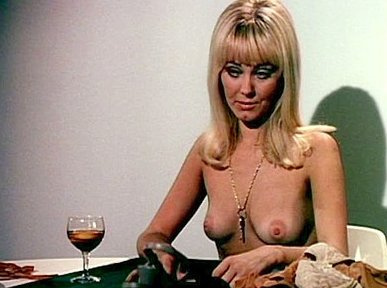
ZETA ONE even manages to make strip poker with Yutte Stensgaard boring. The Danish au pair/model had a versatile association with British pop culture: she auditioned for the part of DOCTOR WHO companion Jo Grant, appeared as the hostess on THE GOLDEN SHOT, and is most famous for her role in Hammer's LUST FOR A VAMPIRE.

FOUNDED by Tony Tenser in 1966, Tigon released a range of films - from sexploitation to an acclaimed adaptation of MISS JULIE starring Helen Mirren - but were most famous for making WITCHFINDER GENERAL and BLOOD ON SATAN'S CLAW. These two films, however, represent Tigon at its worst. ZETA ONE sees secretary Ann Olsen (Yutte Stensgaard) learning that Special Agent James Word (Robin Hawdon) is investigating Public Enemy Number 1, Major Bourdon (James Robertson Justice). Attractive young women are being abducted from Earth and brainwashed into serving space queen Zeta (Dawn Addams) from Angvia (an anagram of vagina). Word is given the task of protecting Edwina (Wendy Lingham), a stripper who is to be the next kidnap victim, though she is working for Bourdon. With the assistance of the inept Swyne (Charles Hawtrey, in a role intended for Frankie Howerd), Bourdon is planning to be the new ruler of this race of scantily clad super women. However, Olsen is another Angvian trying to stop Word from thwarting their unexplained plans.

Described by Films & Filming as "a piece of science fiction pornography," ZETA ONE is a kitsch, one-dimensional romp through the fifth dimension. Based on the swinging sixties London-published Zeta - a magazine which contained captioned photo-stories of naked girls in the name of sci-fi - ZETA ONE opens with a numbingly long strip poker sequence, where after Word and Olson jump into bed and the not so Special Agent narrates the story of his investigation. By the time director Michael Cort had run out of his meagre £60,000 budget, he barely had sixty minutes of footage, and this scene was one of many tweaks to a film that Tenser tried to salvage. The production was an unhappy one, filming in an uncompleted Camden complex where dressing rooms and offices would remain only partially operational. Robertson Justice and Hawtrey seem tired and embarrassed as they await their pay cheques, and the climax - where the aliens, lead by Atropos (Valerie Leon), annihilate a group of hunters by a zap sound effect from their fingertips - brings new meaning to artistic license.

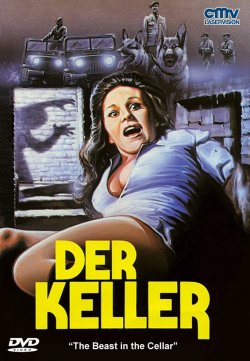
A delightfully misrepresentative German DVD cover for the drab THE BEAST IN THE CELLAR. The appearance of the military at the top of the design - who are key to the plot - seems like an afterthought.

James Kelly's THE BEAST IN THE CELLAR at once reveals its punchline rather than use its more intriguing original title ARE YOU DYING, YOUNG MAN?. Joyce (Flora Robson) and Ellie (Beryl Reid) are two elderly sisters living in an isolated, rural family house. Murders of soldiers at a nearby base are initially blamed on an animal ("a leopard in Lancashire?"), but the culprit turns out to be the spinsters' brother Stephen (Dafydd Havard), who was walled-up in the cellar before WWII to prevent his enlisting and ending up shell-shocked and disfigured like their WWI father. After continually escaping from his confinement, Stephen appears in his taloned-Neanderthal form to haunt his siblings in a thunderstorm-set climax.

THE BEAST IN THE CELLAR was the first Tigon to be shot at Pinewood, yet there is no scope in this static, talkative production; even a 'sex in the barn' scene delivers nothing of interest. The anti-war allegory still resonates, but is lost amidst the endless regurgitation of dialogue - celery is a particular talking point - which are interrupted by jarring, quickly edited murder scenes with minor flashes of blood. Publicity was milked to try to gather some interest (UK trade ads even tried to associate the film to the Edgar Allan Poe quote "and much of madness, and more of sin, and of horror the soul of the plot"), but to no avail. Robson and Reid give stoic performances more associated to the stage, and Robson apparently only took the part after a chance train meeting with Laurence Olivier, who persuaded her to take the offer of work.

Sunday, June 12, 2011

Beneath the Skin

THE CREEPING FLESH (1973)

Peter Cushing plays man of science Emmanuel Hildern, whose good intentions lead him to disaster, professionally and personally. Once again Cushing delivers a performance that not only saves the film, but offers a poignant parallel to the recent real-life loss of his wife. 

THE CREEPING FLESH - directed by Freddie Francis - is clearly Hammer-Victorian, though largely shot on redressed sets from Amicus's THE HOUSE THAT DRIPPED BLOOD. The film has gathered momentum over the years as one of the few period British horror classics of the 1970s, yet the storyline - which has to thread together waring half-brothers, a family mental disorder, curing evil through science, an escaped lunatic, and a skeleton which grows back its flesh when in contact with water - is too disparate to create a cohesive whole. Despite juggling the Victorian obsessions of palaeontology and psychology, this overly ambitious mix makes the film needlessly sluggish and the ending - despite its playful twist - leaves a monster roaming for a sequel that never came.

Revealed in flashback, Anthropologist Emmanuel Hildern (Peter Cushing) returns from New Guinea with a giant skeleton. His daughter, Penelope (Lorna Heilbron), has been waiting anxiously for his return, unaware that the mother she believed long-dead has in fact only just died in a mental institution run by her father's cold and calculating half-brother James (Christopher Lee). Working on the relic - believed to be the legendary Shish Kang, the Evil One - Hildern and assistant Waterlow (George Benson) conclude that evil is a disease of the blood, and that the skeleton may hold the key to a vaccine. Hildern is startled to find that the skeleton's tissue can regenerate when touched by water, and is certain that its reconstituted blood can create an immunity from evil. He injects his daughter with a serum to stop her being afflicted with the madness that drove his wife Marguerite (Jenny Runacre) insane, but instead it turns Penelope into a psychopathic killer. James grows jealous of Emmanuel's work, stealing his research papers and the bones; but when his coach crashes during a storm, the skeleton develops into humanoid form.
 
By 1973, the world had moved on from Hammer Gothic. Yet THE CREEPING FLESH embraces it, with mixed results.

Cushing and Lee (top-billed for a second-string role) are unsurprisingly the highlight. Emmanuel's eroding mental stability is expertly portrayed by Cushing, expressing tender protectiveness of his innocent daughter and the grief of a widower, to the stern focus of a scientist on the brink of a major discovery. Lee is in his element as the scheming asylum head, showing no compassion for the inmates and using them as guinea pigs in his quest for the Richter Prize ("unfortunately, in the state of society as it exists today, we are not permitted to experiment on human beings. Normal human beings.") Dauntingly cast alongside Cushing and Lee, Heilbron consistently holds her screen presence, transforming from repressed young woman to leering, murdering seductress. Also, Kenneth J.Warren gives a sympathetic performances as the escaped mental patient, Lenny. The scene where a crazed Penelope gleefully sends him to his death - after the escapee acknowledges her as a potential companion - is shocking and saddening.

A joint Tigon/World Film Services feature, the unevenness of THE CREEPING FLESH mirrors the directorial career of Francis, in stark contrast to his illustrious credits as a cinematographer. At the helm, Francis worked almost exclusively in horror, struggling to stretch low budgets to accommodate overambitious screenplays (on his apparent typecasting as a genre director, Francis said, "horror films have liked me more than I have liked horror films.") At least Francis enjoyed some familiar faces behind the scenes here, including photographer Norman Warwick, editor Oswald Hafenrichter - who worked on arguably Francis's finest hour, THE SKULL - and make-up artist Roy Ashton. In fact, a further nod to THE SKULL is the use of the same camera trick of shooting through the eye-sockets of the creature. Francis made numerous workmanlike pictures for Hammer and Amicus, but usually managed stylish bursts of visual energy. Particularly memorable in this feature is the monster's huge shadow, slowly creeping up and covering the house.

Tuesday, April 12, 2011

Virgin of Evil

VIRGIN WITCH (1970)
TOWER OF EVIL (1972)

VIRGIN WITCH's Vicki Michelle would later be best remembered as waitress Yvette in the BBC's WWII catchphrasefest 'ALLO 'ALLO. Unsurprisingly shying away from her schlock past, Vicki can also be glimpsed in QUEEN KONG and THE SENTINEL.

RAY Austin's VIRGIN WITCH sees two sisters - Christine and Betty (played by real life siblings Ann and Vicki Michelle) run away from home with dreams of fame and fortune in London. This being a 1970s British sexploitation flick, they are promptly picked up by a smooth-talker in a sports car (in this case, Johnny (Keith Buckley)), and swept off to a comfortable flat where opportunity waits around every corner. Christine is hired for a photo shoot by Sybil Waite (Patricia Haines), a predatory lesbian who uses her modeling agency as bait to lure attractive, naïve young women to the pagan coven she acts as high priestess; what Sybil doesn't know is that Christine is gifted with supernatural powers of her own. With Christine arriving at the Wychwold manor house for her assignment - and the innocent Betty in tow - it is soon discovered that the voyeuristic owner of the house, Dr Gerald Amberley (Neil Hallett), is a high priest who is (conveniently) holding a Sabbat that very evening.

VIRGIN WITCH was actually shot in 1970, but it took two further years to get it into theatres due to issues with the BBFC. The blend of horror and sex was always a problem for the censor, but viewed today it is difficult to understand why this timid release should be withheld for such a period, particularly as these ingredients were inseparable for British filmmakers at the dawn of the decade. Whereas Hammer's Karnstein Trilogy was old-fashioned horror spiced up with liberal sprinklings of flesh, VIRGIN WITCH is first and foremost a skin flick, with supernatural and horror elements so ineffectual they scarcely warrant a mention. In fact, the most unnerving thing about the film is that producer "Ralph Solomans" was actually a joint pseudonym for wrestling commentator Kent Walton and Hazel Adair, creator of that zenith of daytime soaps, CROSSROADS.

TOWER OF EVIL's Candace Glendenning has a tough time in this proto-slasher.

Jim O' Connolly's TOWER OF EVIL can boast one of the most delirious plots in British film history. John Gurney (George Colouris) and his son Hamp (Jack Watson) make their way by small boat to Snape, a fog-bound island off the South-West coast of England. They discover the mutilated remains of three American teenagers (played with bogus accents by British sex film actors Robin Askwith, John Hamill and Serretta Wilson) before shrieking, naked survivor Penny (Candace Glendenning) knifes John to death and is knocked out by his son. One teen had been killed by a gold Phoenician ceremonial spear, which leads four love tangled archaeologists - Adam (Mark Edward), Rose (Jill Haworth), Dan (Derek Fowlds) and Nora (Anna Palk) - to travel to Snape, together with Brent (Bryant Halliday), a private eye intent on clearing Penny's name. As the archaeologists delve deeper, they are attacked by Hamp's Neanderthal brother Saul (Frederic Abbot) and his son Michael (Mark McBride); it is claimed that the duo have become unhinged after the death of Saul's "calming influence" wife Martha, whose seaweed-covered, crab-chewed corpse is kept in a rocking chair.

Together with Mario Bava's equally convoluted A BAY OF BLOOD released the previous year, TOWER OF EVIL contains a potent blend of nudity and violence that helped set the template for the American slasher craze. Released in the United States as HORROR ON SNAPE ISLAND, then reissued as BEYOND THE FOG, this uproarious film also mixes old world Gothic with a riot of 1970s paraphernalia in its hippie dialogue ("bravery isn't my bag, man"), psychedelia (Penny's very unorthodox interrogation involves regressive hypnosis induced by disco lights) and fashion (the use of skin-tight flared jeans leave little to the imagination – and that's just the men). Ultimately there is something very British in having a dank, foggy island as a hotbed of sexual activity and intrigue, where scrambling crabs over the dead act as a delicious metaphor.

Wednesday, May 21, 2008

An Angel for Satan

THE BLOOD ON SATAN'S CLAW (1971)
EXPOSE (1975)

A charming publicity photograph of Linda Hayden for THE BLOOD ON SATAN’S CLAW…

A graduate of the Aida Foster stage school, Linda Hayden's first role was in BABY LOVE, playing an amoral 15-year old who seduces a man (who may well be her father), his wife and his son. This was a stepping stone to her later roles, as the actress was frequently cast in horror productions - TASTE THE BLOOD OF DRACULA, VAMPIRA, MADHOUSE - or as window dressing for British 1970s softcore (often with then partner Robin Askwith). Her career path belittled her obvious talent: stunningly attractive, and able to absorb the screen through looks and observation, Hayden often mixed a naughty demeanour with a perverse sex appeal - with her eyebrows Satan-sent.

Tigon British was a relatively short-lived company that made a handful of classics amongst quite a bit of rubbish. Piers Haggard’s THE BLOOD ON SATAN’S CLAW is one of Tigon’s best; an eerie gothic which was intended as a successor - in spirit if not in story - to the company’s crowning achievement WITCHFINDER GENERAL. It is an intelligent study of repression set towards the end of the 17th Century, where the children of a small rural community start to play sinister games: pouting leader Angel Blake (Hayden) is in league with a half-glimpsed cowled Behemoth, while the others donate body parts to make the creature complete.

…and Hayden as she appears as Angel Blake, ringleader
of a group of Devil-worshipping children.

Hayden is a revelation as Angel; her false accusation of sexual assault against Reverend Fallowfield (Anthony Ainley) holds a powerful charge, and the moment where Blake stabs Cathy Vespers (Wendy Padbury) to death and languorously smells and licks the blade is preceded by a tour de force unrivalled in British horror: Vespers is lured to a ruined chapel and raped as the crowd of mutilated children (and a toothless old couple) look on in undisguised excitement, as the offscreen demon rasps “give me my skinn-n-n-n.” Not only does THE BLOOD ON SATAN’S CLAW provide a blueprint for the lethal potential of teenagers, children and babies that would wreck havoc in 1970s cinema, it portrays a turn-of-the-decade stench of the Manson Murders and child-strangler Mary Bell.

James Kenelm Clarke’s EXPOSE builds a claustrophobic mood of sweaty summer expectancy in its tale of blood, breasts and rubber gloves. Here Hayden plays a manipulative secretary - Linda - for Paul Martin (Udo Kier), a best-selling author of pulp fiction who can only work in complete silence and seclusion in his rented country cottage. Under pressure to meet the deadline for his second novel Straw Summer, Martin is tormented by nightmarish delusions; a control freak who is only able to make love to his girlfriend Suzanne (Fiona Richmond) while wearing surgical gloves, it transpires that his last book was actually written by Linda’s husband, who was driven to suicide when Paul tricked him out of the manuscript.

“You look really, really good”: Linda Hayden
seduces Fiona Richmond in EXPOSE.

EXPOSE was the only British entry in the Department of Public Prosecutions’ list of banned movies during the video nasties furore of the early 1980s, and it is hard to see why the film deserved such a fate. Linda’s sex game with two gun-toting Essex boys could be interpreted as a rape scene in which the victim starts to enjoy herself - mirroring the controversy of Susan George in STRAW DOGS - but this hardly warrants the branding of a video nasty. Of the performances, Kier is sufficiently deranged and unlikeable, and Richmond is amicable in her first sizeable film role, yet it is Hayden who excels, charting Linda’s progress from seducer to psychopath with consummate skill. Hayden has subsequently disowned the film, claiming that material was inserted after she finished work on it somehow lowered the tone. Given the conspicuous absence of body doubles in her masturbation scenes and seduction of Richmond, Hayden’s attitude is a perplexing one.