Showing posts with label Christopher Lee. Show all posts

Sunday, June 1, 2025

"Where Science and the Occult Clash!"

NOTHING BUT THE NIGHT (1973)

Here is a film starring Christopher Lee and featuring a Police investigation on a Scottish island that isn't THE WICKER MAN. The climax - where Lee is tied around the neck and arms and propelled into a bonfire by minors - mirrors Edward Woodward's demise in Robin Hardy's cult favourite, which was actually released nine months later.

AGAINST the backdrop of several Trustee murders who support an orphanage on a Scottish island, one young girl, Mary Valley (Gwyneth Strong), is taken to a London hospital after a coach crash and suffers psychological issues. Psychiatrist Dr Haynes (Keith Barron) and journalist Joan Foster (Georgia Brown) interview the girl's wayward biological mother Anna Harb (Diana Dors), a prostitute and convicted murderer. When Haynes is killed, the hospital's senior member Sir Mark Ashley (Peter Cushing) and friend Colonel Charles Bingham (Christopher Lee) take their enquiries to the orphanage, as Anna also travels to the location hoping to reunite with her child. Ashley and Bingham eventually uncover the sinister truth: personalities are being transplanted into the children.

Based on the novel by John Blackburn and directed by Peter Sasdy, NOTHING BUT THE NIGHT was the only film from independent Charlemagne, set up by Lee and former Hammer producer Anthony Nelson Keys. A commercial failure, the picture suffers from a laboured script by Brian Hayles - mostly known for his television work and creator of The Ice Warriors for DOCTOR WHO - and also wastes its outstanding cast, as no character is fully fleshed out. Cushing and Lee are almost playing themselves, and Dors is totally unhinged with her red wig. In fact the acting standout is thirteen year old Strong, and it was a shame no substantial big screen roles came her away, the actress becoming forever known as Cassandra from ONLY FOOLS AND HORSES.

Barely seen in America, NOTHING BUT THE NIGHT became THE RESURRECTION SYNDICATE, a title which unveils its premise. The picture was also released on video as THE DEVIL'S UNDEAD.

As a thematic exercise NOTHING BUT THE NIGHT is troublesome in its use of children, portraying orphans and castaways as scientific guinea pigs and exploitative commodities. Apart from Haynes, the leads are using the unfortunate youngsters for their own needs: Anna views Mary as property which has long been denied to her, Foster and Ashley see the minors as their particular professional interests, and Bingham engages in the mystery for his murdered friend but relishes the thrill of the chase. As an interesting side note, with Blackburn's novel published in 1968, a similar theme is explored in the 1971 United States offering THE BROTHERHOOD OF SATAN. Here, in an inversion of the thesis, a coven are kidnapping souls of children to transfer into their bodies.

Thursday, February 1, 2024

The Hammer Vampire and Batman

Detective Comics - Heart of a Vampire (1976)

The undead and Gotham City's favourite son: The Dark Knight depicted by Gene Colan for the splash page of Batman #351 (September 1982).

IN 1970, artist and historian Jim Steranko wrote in The Steranko History of Comics: "Heavily steeped in Teutonic atmosphere, Batman conjured up visions of vampires with his black cloak, grim visage and white slit eyes. He moved through cubist backgrounds of warped perspectives and paranoiac tilt shots, of shadows and silhouettes that gave credence to the thought that he was more bat than man."

There is undoubtedly a subliminal connection between the vampire myth and the original specification of Batman. In an attempt to strike fear into the hearts of criminals and become a creature of the night, one of The Caped Crusader's inspirations was Bela Lugosi in Universal's 1931 DRACULA. Indeed, an initial foe was The Monk - a red suited vampire and hypnotist - that shows even during the early years the notion was firmly in play. Similarly Neal Adams - whose dynamic style restored Batman to his dark roots - cited Christopher Lee and the use of his cape as a major influence. In 1968, when the artist began his approach to the character, Lee was making his third appearance as The Count for Hammer with DRACULA HAS RISEN FROM THE GRAVE.

In the Detective Comics story Heart of a Vampire, after being dismissed from medical school, Gustav DeCobra continued his unorthodox experiments by robbing graves, which unfortunately included the resting place of a bloodsucker. 

The most literal merging of these two pop culture icons occurred in Detective Comics #455 (January 1976). Heart of a Vampire - written by Elliot S. Maggin and illustrated by Mike Grell (from uncredited thumbnails by Bernie Wrightson) - begins with Alfred and Bruce Wayne's car overheating miles outside of Gotham. When they enter a boarded-up house to find water for the radiator, they discover a coffin and vampire Gustav DeCobra. Batman puts a wooden stake through Gustav's chest, but hasn't penetrated the heart. A former doctor, DeCobra's research was in heart transplants, and Batman realises that he may have surgically moved his organ elsewhere. To find it, Bruce fights Gustav vigorously and listens for a rapid heartbeat; Batman notices that the grandfather clock gets louder as the confrontation progresses and grabs a wooden bow and arrow. Shooting the clock where the vampire had placed his heart, DeCobra dies as his corpse turns to a skeleton at the break of dawn.

Using photographic reference, Grell draws DeCobra as Christopher Lee, though the artist reluctantly changed the hair style and nose (and added a scar) at the insistence of editor Julie Schwartz. In addition, Heart of a Vampire references Hammer design and narrative: the house interior resembles the 1958 DRACULA (the tale also mimics the climactic battle), and a closeup of the coffin's padlock - dropping onto the floor without opening - is a direct lift from the non-Lee BRIDES OF DRACULA. 

Sunday, August 1, 2021

Ghost Breakers

CATACOMBS (1965)
DARK PLACES (1973)

Released in the United States as THE WOMAN WHO WOULDN'T DIE, the Hitchcockian CATACOMBS subscribes to that age old task of murdering one's wife.

CATACOMBS is a largely forgotten gem of British horror, the story of wealthy businesswoman Ellen Garth (Georgina Cookson), her downtrodden husband Raymond (Gary Merrill), and their Art student niece Alice Taylor (Jane Merrow). Ellen needs control over everything in her life, even her sudden physical pains in which she induces a trance to escape from. A murder plot between Raymond and her seedy secretary Corbett (Neil McCallum) is played out with Alice starting an affair with Raymond. The planned scheme involving actress Rachel Thomas (Christine Glynn) is prematurely halted by the overbearing Ellen finally breaking her husband's patience at their cottage retreat: Raymond drowns her in the bathroom sink and buries her in the potting shed. But this doesn't seem to end Ellen's yearning to act revenge on her husband and niece.

It was during his time as story editor on ALFRED HITCHCOCK PRESENTS that director Gordon Hessler discovered the film's source novel by Jay Bennett. An adaptation was rejected for the show, but became his theatrical directorial debut. Yet CATACOMBS cannot shake off its feel of an extended anthology episode; Merrill - himself a veteran of Hitchcock's TV programme - is perfectly cast as the aging gigolo, and Cookson is frightening and glacially fragile (when Raymond carries his wife in his arms, Ellen seems to eerily transform into a mannikin). The tension is simple but effective (the sound of Ellen's walking cane, the moving of locked door knobs), and although the double twist ending will not surprise all, it nevertheless is a satisfying climax to a well made and entertaining thriller.

Shot at an old psychiatric hospital near Uxbridge, DARK PLACES was the only release from Glenbeigh/Sedgled, but it had a great poster. 

Helmed by Don Sharp, DARK PLACES is a pedestrian haunted house/psychological thriller that is also rarely discussed at length. Following the death of an aging asylum inmate, Edward Foster (Robert Hardy) inherits an old mansion with a grim reputation: a woman, the housekeeper and two children have disappeared without trace. However Edward is more interested in the £210,000 hidden somewhere behind the walls. Unfortunately there are others who also want the money: Dr Ian Mandeville (Christopher Lee) and his sister Sarah (Joan Collins), together with solicitor Mr Prescott (Herbert Lom). With Sarah helping Edward at the mansion, and the siblings faking paranormal occurrences, the building and its backstory start to affect Foster's fragile psyche. Possessed by the spirits of the deceased, he begins his own murder spree.

Similar to the feel of CATACOMBS, DARK PLACES plays more like a TV movie, hampered by uncharismatic direction and photography. Hardy has a lot of character aspects to grapple with and manages to just about carry the film, while the all-star cast are wasted (although Collins inevitably shines as the sexually conniving sleuth). Even the flashback sequences have quality performers in small roles, with Jean Marsh and Jane Birkin. The notion of the Mandeville fake haunting is never developed; in fact, the realisation that strange things are actually happening is only met with brief puzzlement. It's a shame, as this interesting trope dates back to earlier stories such as THE CAT AND THE CANARY and THE GHOST BREAKERS, particularly in the context of money and induced madness.

Saturday, May 1, 2021

Come and Get It

THE MAGIC CHRISTIAN (1969)

Raquel Welch and Ringo Starr share a moment on set.

BASED on Terry Southern's irreverent novel, THE MAGIC CHRISTIAN is an anti-establishment black comedy/satire so laboured to the point of self-nihilism. Eccentric billionaire Sir Guy Grand (Peter Sellers), together with newly adopted homeless person Youngman (Ringo Star), bribe people with vast sums of money for "educational" whim. The narrative that every man has his price is spread thinly over a series of jaw-droppingly unfunny skits and cameo appearances. These include cutting out a portrait's nose at a Sotheby's auction - much to the astonishment of director Mr Dugdale (John Cleese) - and approaching the Oxford rowing team - one played by Graham Chapman - to purposely ram the Cambridge crew. The film ends with Guy and Youngman, having returned to the park where the film opened, bribing the park warden to allow them to sleep there.

Working from an endlessly rewritten screenplay by Southern and director Joseph McGrath (with additional material by Sellers, Cleese and Chapman), the sketches are often homoerotic: there is a homosexual boxing match and a Hamlet striptease. The only amusement is of a dog show where a new breed is feeding on the contestants. One wonders that if the climactic vat of urine, blood and excrement - liberally sprinkled with money - is a statement for the production itself (the inclusion of a newsreel Vietcong execution is bewildering and contemptible). The stars are particularly abundant on the good ship Magic Christian, on its maiden voyage from London to New York: Christopher Lee as a vampire, a whip-wielding Raquel Welch, and Yul Brynner in drag singing "Mad About the Boy" to a suitably unimpressed Roman Polanski.

Peter Sellers bribes Spike Milligan into eating his own parking ticket in one of many heavy-handed meditations on capitalism and human vanity.

Amongst the mess we find British stalwarts swallowing their pride (Hattie Jacques, John Le Mesurier, Dennis Price, Wilfred Hyde-White et al), and Starr is disposable behind Sellers' foppish onslaught (allegedly imposed by Sellers himself). At least Cleese is seen honing his petulance, and the unfilmed Cleese/Chapman contribution - The Mouse Problem - became a classic as part of the second episode of MONTY PYTHON'S FLYING CIRCUS. A presage of Furry Fandom, the sketch is an obvious parody of the secretive lives and social condemnation of gay men, the piece mimicking techniques used in serious television documentary exposés.

Monday, February 1, 2021

School of Shadows

SCHOOL FOR SEX (1969)
HOUSE OF THE LONG SHADOWS (1983)

SCHOOL FOR SEX unfairly lures the viewer into a cliched catastrophe; even its director/producer/writer Pete Walker calls it "terrible."

MOST British sex comedies are unsexy and unfunny, but Pete Walker's SCHOOL FOR SEX - sold on its title alone - is also terminally boring. After the sudden death of his parents, bounder Giles Wingate (Derek Aylward) - on a suspended sentence for embezzlement - inherits a country estate. Yet his wealth is soon diminished by a series of gold-digging wives, leading him to take revenge: setting up a "school for sex" which trains young female offenders to fleece money from millionaires for a third of the profit. Wingate converts his house for the venture and employs ex-boxer Hector (Nosher Powell) and dipsomaniac Duchess of Burwash (Rose Alba) as staff; with a steady flow of girls from a corrupt probation service, anti vice campaigners finally lead Wingate back to court.

Similar to COME PLAY WITH ME, SCHOOL FOR SEX was a triumph of marketing, hiding the embarrassment underneath. One of Walker's biggest box office successes, the film was particularly popular in the United States and France, where punters - high on the sexual revolution - were duped with fake promises of underage sex even in the more risqué export version (in fact, American success is enshrined: during the opening of SHAFT, when Richard Roundtree strides down 42nd Street, he passes the Rialto Cinema advertising "first New York show, SCHOOL FOR SEX.") Yet, while Walker draws on the permissive age, the result is a regressive opposite; we are still in the realm of the stereotypical British farce, pigeon-holing carnal urges like a pre-war sex tussle.

In Pete Walker's only film as a "director for hire," Christopher Lee, John Carradine, Peter Cushing and Vincent Price occupy the HOUSE OF THE LONG SHADOWS. 

Fourteen years later, Walker's final release HOUSE OF THE LONG SHADOWS is also renowned for cranking up the boredom and living in the past. Publisher Sam Allyson (Richard Todd) makes a $20,000 bet with author Kenneth Magee (Desi Arnaz Jr) that he cannot write a novel in the classic tradition within 24 hours. Allyson arranges for Magee to write at the secluded and empty Baldpate mansion in Wales as not to be distracted. The writer is soon interrupted by Allyson's secretary Mary Norton (Julie Peasgood), holidaying couple Andrew and Diana Caulder (Richard Hunter and Louise English), and buyer Corrigan (Christopher Lee). The main source of disruption however are the Grisbanes, with father Elijah (John Carradine) and daughter Victoria (Sheila Keith, in a role originally intended for Elsa Lanchester) initially posing as caretakers. It transpires that the Grisbanes are the house owners - welcoming back sons Lionel (Vincent Price) and Sebastian (Peter Cushing) - for a final night of retribution on their murderous sibling Roderick.

Based on the 1913 novel Seven Keys to Baldpate by Earl Derr Biggers, which became the hit stage play by George M. Cohan, this often adapted story is given a Gothic makeover but wastes a stellar cast. Scripted by Michael Armstrong for Cannon, HOUSE OF THE LONG SHADOWS is too much of a throwback for 1980s blockbuster cinema, and consequently was a box office failure. The Seven Keys to Baldpate foundation itself was old school, with its gangsters, stolen jewels and femme fatales, and morphing into a comedic chiller only changes the nature of the cliched failure. The production escalates into a number of absurd twist endings, but Price, Lee and Cushing play off each other delightfully, and are obviously relishing this opportunity of screen time together. In fact Lionel's dialogue "All of us, locked in the past forever ... now we too must crumble into dust" acts an obituary for the films that made them famous. Unfortunately there is little chemistry between Arnaz and Peasgood, though the actresses' theatrical delivery could be seen to make sense in hindsight.

Louise English as bickering Diana Caulder in HOUSE OF THE LONG SHADOWS. The actress, singer and dancer is best remembered as a regular on THE BENNY HILL SHOW.

The photography of Norman Langley attempts to capture a Roger Corman/Poe vibe, but cannot shake the crusty ambience that sank that other "out of time" failure THE MONSTER CLUB. It is ironic that Walker should bow out with such blandness, after making his name with gratuitous sex and violence (English's acid demise is the only nastiness here). Another factor against the Walker grain is the moral of the climactic cop-outs; Magee - known for pulp novels - learns that he should be more empathetic to his craft and value characterisation over cash. However post-production tinkering over the more comedic elements, in order to promote the work as a horror film, did not create any winners.

Thursday, October 1, 2020

Space Invaders

NIGHT OF THE BIG HEAT (1967)
THEY CAME FROM BEYOND SPACE (1967)

Sizzling Jane Merrow as secretary Angela Roberts in NIGHT OF THE BIG HEAT. A seasoned stage, TV and film actress, her most famous role, as the mistress of King Henry in THE LION IN WINTER, earned a Golden Globe nomination.  

NIGHT OF THE BIG HEAT completes a loose trilogy of science fiction films directed by Terence Fisher from the mid 1960s (following THE EARTH DIES SCREAMING and ISLAND OF TERROR). Based on the novel by John Lymington, this tepid alien invasion yarn from Planet was first adapted for a now lost ITV PLAY OF THE WEEK from 1960, the telescript actually forming the foundation for the movie version. On the Orkney island of Fara, author Jeff Callum (Patrick Allen) and wife Frankie (Sarah Lawson) run The Swan Inn; when Callum's new secretary arrives - Angela Roberts (Jane Merrow) - sexual tension rises in tandem with a heat wave, even though it is the middle of winter. The wanton Roberts has had an affair with Jeff, and with temperatures rising daily, Callum, mysterious scientist Godfrey Hanson (Christopher Lee) - who has converted his room at The Swan into a research centre - and Dr Stone (Peter Cushing) try to halt the spread of omelette-like creatures. 

Four years after debuting in Britain, NIGHT OF THE BIG HEAT was theatrically released in the United States as ISLAND OF THE BURNING DAMNED on a double bill with GODZILLA'S REVENGE. The blobbish space visitors challenge the worst of American cinematic aliens, glowing motionless before being washed away by rain (they are certainly up there with the carpet monster from THE CREEPING TERROR). With refreshingly abrupt dialogue, it is more a domestic melodrama than a SF epic, the performances all raise the bar to an undeserved level (Lee at his arrogant best, and Cushing's dignified doctor - despite the searing temperatures - leaves his coat on in best English tradition). Unlike the visual flourishes in his Hammer Gothics, Fisher had little time for science fiction, generating only pockets of suspense in any of his otherworldly terrors.

Similar to his attitude of the horror genre, Milton Subotsky turned science fiction into childsplay for THEY CAME FROM BEYOND SPACE.

Released the same month, THEY CAME FROM BEYOND SPACE ("to enslave Earth!") is another SF B-movie helmed by a genre director (in this case Freddie Francis), for one of Amicus's worst productions. Written by Milton Subotsky from the book The Gods Hate Kansas by Joseph Millard, it uses many of the sets and props from DALEKS - INVASION EARTH 2150 AD. Described by Subotsky as "almost a Cold War parable," the film starts with blue meteorites landing in a field. They are investigated by the government department of Dr Curtis Temple (Robert Hutton), who has a metal plate in his head due to a motor accident. This renders him impervious to alien mind control and an unleashed space plague, as he attempts to infiltrate the visitor's compound. It transpires that the aliens are using humans as slave labour on the moon to repair their spaceship, an operation headed by The Master of the Moon (Michael Gough).

THEY CAME FROM BEYOND SPACE originated from a deal struck between Max Rosenberg and producer Joseph E. Levine; if Amicus could make two pictures for £200,000, Levine would finance and distribute them. Consequently, Montgomery Tully's THE TERRORNAUTS - another nadir in Amicus SF - was awarded £80,000, with the rest allocated here. Woefully mechanical, Subotsky would dismiss the problems by blaming distractions putting together the studio's next portmanteau, TORTURE GARDEN. Francis's film arguably shows the greatest British hallmarks in a science fantasy setting: not only do the aliens apply for a bank loan, it is ultimately all a great misunderstanding, and ends on a firm handshake. More interesting is the casting of Pakistani actor Zia Mohyeddin as Temple’s best friend Farge, who has to melt down his silver cricket trophies to manufacture the laughable anti-mind-control colander.

Monday, July 1, 2019

Devils of Death

DEVILS OF DARKNESS (1965)
THEATRE OF DEATH (1967)


Horror films have always used the colour red to inflame the senses, but even smart ceremonial robes can't ignite DEVILS OF DARKNESS.

THE only claim to fame for Lance Comfort's DEVILS OF DARKNESS is that it was the first British horror film to feature vampirism in a modern setting. Yet this Planet MARK OF THE VAMPIRE imitation is a painfully dull affair, as stone-cold Paul Baxter (William Sylvester) encounters a Brittany-based Satanic cult headed by suave, self-styled "Leader of the Living Dead" Count Sinistre (Hubert Noel). The vacation takes a turn for the worse when Keith and Dave (Geoffrey Kenion and Rod McLennan) succumb to a cavern housing a group of coffins, and Keith's sister Anne (Rona Anderson) is found dead in a lake. Returning to England with a talisman that Sinistre has conveniently dropped, Baxter enlists the aid of scientist friend Dr Kelsey (Eddie Byrne) in exploring black magic. But when Kelsey adds to the body count, it transpires that the only other survivor from the French trip - antique shop owner Madeleine (Diana Decker) - is helping Sinistre to get a foothold in this country, as The Count focuses his attentions on red-head model and shop assistant Karen (Tracy Reed).

The opening French section is littered with 'ALLO 'ALLO style accents, but starts promisingly in an eight-minute pre-titles sequence where Sinistre - in bat form - takes gypsy Tania (Carole Gray) as his bride (there is also a sumptuous Hammeresque shot of Tania's coffin, her head wreathed in roses). Unfortunately, when the picture shifts to Blighty, even Madeleine's impromptu beatnik parties are staged and stodgy; but fangless Sinistre seems at home under his artist guise living in Chelsea (unlike DRACULA A.D. 1972, at least Noel actually mingles with society). Not only is everything pedestrian, there are no star turns (even seasoned performer Sylvester would have to wait three years to achieve his particular screen immortality, as Dr Floyd in 2001: A SPACE ODYSSEY).

"Fanaticism bordering on insanity;" Christopher Lee controls the THEATRE OF DEATH from Pennea Productions, a film originally released in the United States as BLOOD FIEND.

Playwright Samuel Gallu's THEATRE OF DEATH is another contemporary vampire tale with French connections which aims at Hammer acolytes. Svengali-like Philippe Darvas (Christopher Lee) is the director of the Theatre de Mort in the Paris backstreets, carrying on the Grand Guignol theme of sensationalist entertainment. As police surgeon Charles Marquis (Julian Glover) protects his former patient and Theatre employee Dani Gireaux (Lelia Goldoni) from a spate of murders, Darvas' protegee Nicole Chapelle (a pasty Jenny Till) is revealed as the killer, a haemotagiac whose thirst was initiated when feeding on her brother's blood as her Romanian family fled the Nazis in the Alps. With Lee killed off-screen at the half-way mark, he takes most of the interest with him; what remains is a drawn-out mystery thriller with too many red herrings and a late, out of leftfield sting. This reveal is at least different, and grounds the picture more successfully than the usual supernatural trappings in Comfort's film.

Monday, April 1, 2019

The Man in the Crimson Hood

THE OBLONG BOX (1969)

Alister Williamson is doomed Edward Markham and Sally Geeson sexpot maid Sally in a promotional shot for this AIP release.

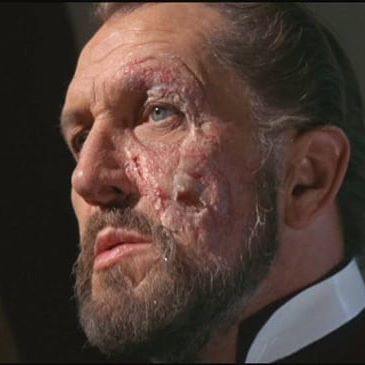
THE first film to co-star Vincent Price and Christopher Lee, Gordon Hessler's THE OBLONG BOX starts in Africa, where Julian Markham (Price) discovers that brother Edward (Alister Williamson) has been cursed by voodoo. Back in England, Julian keeps Edward chained in a remote room of the Markham estate, his mental and physical states disintegrating. However, Edward plans to escape with the help of Trench (Peter Arne), Norton (Carl Rigg) and witch doctor N'Galo (Harry Baird), drugging him to give the temporary appearance of death; once buried, Trench and Norton will exhume the coffin and grant him freedom. But Trench pockets his fee and Edward is actually dug up by grave robbers - replete with coffin - for the use of Dr Neuhartt (Lee). Wearing a crimson hood, Edward vows to repay "some very important debts" while staying with Neuhartt, blackmailing the physician for his liaisons with body snatchers.

Scripted by Lawrence Huntington with "additional dialogue" by Christopher Wickling, THE OBLONG BOX has the thinnest of connections to its source Edgar Allan Poe story (it all owes more to H.P. Lovecraft - with its arcane lore and a disfigured outsider - and Rudyard Kipling's The Mark of the Beast). Originally to be directed by Michael Reeves before his own premature death, to further WITCHFINDER GENERAL connections Price is reunited with Hilary Dwyer as his younger sweetheart Elizabeth, but the actor - originally to play both brothers - looks disinterested and tired. Although beautifully shot by John Coquillon, it is a picture of missed opportunities; Price and Lee only share one scene together despite their marquee value (in fact, Lee's death scene), and the reveal of Edward's condition results in what looks to be little more than a bee-stinged nose, particularly disappointing after its long build-up.

Vincent Price as the diseased Julian Markham. By this stage in his career the actor grew weary of the Edgar Allan Poe adaptations, particularly within the saturation of the late 1960s horror film market.

THE OBLONG BOX belongs to that horror subgenre - THE MUMMY, PLAGUE OF THE ZOMBIES, THE REPTILE, THE GHOUL et al - that echo colonial guilt (remarkably, Hessler's film was banned in Texas for being "pro-Negro"). Julian laments his attitude ("we sinned out there in Africa all right, plundering their land - and we're still stealing their wealth, though they're too innocent to know it") and is revealed to have been the intended recipient of the curse. There is a quiet justice to the conclusion, as Edward bites the hand of his brother, passing on the psoriasis-based condemnation. But ultimately the much re-worked and bloated script carries little gravitas, instead grabbing from more substantive works with no cohesive payoff. This unfocused starting point is further undermined by turgid pacing and padding (the tavern sequences in particular).

Wednesday, February 15, 2017

The Love of Darkness

CAT GIRL (1957)
RASPUTIN THE MAD MONK (1966)

"The love of darkness, the craving for warm flesh and blood … it is my legacy to you ... passed on from generation to generation of our family …  for 700 years!" Ernest Milton and Barbara Shelley provide the only sparks to this pedestrian programmer.

PRODUCED by Val Lewton and directed by Jacques Tourneur, RKO's 1942 CAT PEOPLE divided critics at the time, but is now considered a sophisticated classic. Telling the story of young Serbian Irena (Simone Simon), who believes herself to be a descendant of a race of people who turn into cats when sexually aroused, the style of the film concentrates on the theory that unseen terrors are more effective than visual ones (what Lewton referred to as "patches of prepared darkness"). This use of suggestive shadow, and the genre-defining shock Lewton Bus moment, was in contrast to the Universal trend of the time, who would make FRANKENSTEIN MEETS THE WOLF MAN a year later.

CAT GIRL - a British CAT PEOPLE from Insignia directed by Alfred Shaughnessy - barely registers as horror, its stagy and stilted execution making it hard to believe it was released in the wake of Hammer's game-changer, CURSE OF FRANKENSTEIN. Leonora (Barbara Shelley) is summoned to her ancestral estate by uncle Edmund Brandt (Shakespearean actor Ernest Milton, doing his best Ernest Thesiger impression). Recently married to Richard (Jack May), Leonora also brings friends Cathy and Allan (Patricia Webster and John Lee) to the house. Brandt's niece discovers that she is to be united with the soul of Edmund's pet leopard, continuing a family curse which enables mental control of the big cat to "kill ... kill." Under Leonora's control, the leopard savages her husband for having an affair with Cathy, then turns its attentions to Dorothy (Kay Callard), the wife of Leonora's true love Dr Marlowe (Robert Ayres).

Barbara Shelley - the "first leading lady of British horror" - is haunted Leonora. Shelley's looks and stature command the screen, with Barbara playing it commandingly straight.

Aside from Shelley and Milton, the performances are self-conscious (even leopard Chiefy, a performing cat from Southport Zoo, surprisingly lacks menace), and Ayres makes for a particularly characterless 'hero'. Shaughnessy - directing his only fantastic film before creating UPSTAIRS DOWNSTAIRS and planting the seed that would become Pete Walker's HOUSE OF WHIPCORD - couldn't remain positive about the release's own main legacy, lamenting in his autobiography "by using [Barbara Shelley] I fear we condemned a very beautiful and talented actress to a long career in horror films."

Similar to Shelley's Helen in DRACULA PRINCE OF DARNESS, when a hex kicks in, Leonora's sexual repression is unshackled. Now infused with feline aggression, things get weird when she briefly imagines herself turning into a leopard, and eats a budgie (off screen); Leonora's eyebrows also suggest a sudden predatory look (critic David Pirie argues that it is with CAT GIRL that British film heroines started to distort from their emotional norm, even if they are portrayed as mental patients and die violently). In her first starring role Shelley atypically shows off areas of flesh; yet any real charge is smothered by the picture's mundaneness, as a lingering shot of Leonora's naked back sees the camera pan away, leaving the maid to comment on her beauty.

"Everything else is darkness"; the hypnotic stare of Christopher Lee as RASPUTIN THE MAD MONK.

Directed by Don Sharp and scripted by Anthony Hinds, Hammer's RASPUTIN THE MAD MONK casts Shelley again under the spell of Christopher Lee in redressed sets from DRACULA PRINCE OF DARKNESS. After healing an innkeeper's wife and cutting off the hand of the keeper's daughter's suitor, Grigori Rasputin (Lee) is hauled before an Orthodox bishop on grounds of sexual immorality and violence. Preferring to give God "sins worth forgiving", Rasputin is unperturbed by the bishop's claims of Satanism. Heading for St Petersburg, the exiled Monk befriends struck-off Dr Zargo (Richard Pasco) and begins his campaign to infiltrate highest Russian society. This includes gaining influence over the Tsarina's ladies-in-waiting Sonia (Shelley) and Vanessa (Suzan Farmer), but his relentless sexual appetite and pursuit of wealth eventually leads to his death at the hands of Zargo and Ivan (Francis Matthews).

Initially announced in 1961 as THE SINS OF RASPUTIN, Hammer's brisk pseudo-exploration of "History's Man of Mystery" is dominated by Lee's extraordinary performance. Unlike his appearances as Dracula - often off-screen and reduced to set pieces - Rasputin is overpowering from his appearance at the Inn door. Passionately researching the role, the actor even sought advice on how to play a medically accurate death by cyanide poisoning. But the film was hampered by overspends on DRACULA PRINCE OF DARKNESS, foreshortening the script and scope; the production was also under the threat of legal action from Prince Felix and Princess Irina Yousoupoff, Felix being one of Rasputin's real-life assassins. Having successfully sued MGM over their 1932 release RASPUTIN AND THE EMPRESS, pressure from the Yousoupoff's is the reason that Hammer's surrogate assassin Ivan is Vanessa's brother rather than husband, and why Vanessa and Rasputin do not meet in the film's climax.

Sunday, March 1, 2015

Sixties Sorcery

THE SORCERERS (1967)
CURSE OF THE CRIMSON ALTAR (1968)

"You enjoyed it, didn't you?" In an allegory for the thrills of cinema itself, THE SORCERERS tells of an old couple who invent a machine to live vicariously through a young man.

MICHAEL Reeves was a true cineaste and perhaps the greatest lost talent of the British film industry. Although he only directed three pictures, the Sutton-born Reeves increasingly became frustrated about the difficulty of getting projects off the ground. Suffering from depression and insomnia, on the 11th of February 1969 he died at the age of twenty-five from an alcohol and barbiturate overdose which many - including lifelong friend Ian Ogilvy - believe to have been purely accidental (indeed, the coroner's report stated that the level of barbiturate dosage was too marginal to suggest any dark intention). There is nothing critics like more than to mythologise an untimely artistic death (Brian Jones would follow five months later), but there is no mistaking that Reeves was a precocious talent. This is a man who travelled to Hollywood at the age of sixteen, sought out the address of his favourite director - Don Siegel - and subsequently gained employment. But after the critical and commercial success of WITCHFINDER GENERAL in 1968, Reeves seemingly lost his way. Starting to drink heavily, the boy wonder was also taking uppers and downers, and those close offered a variety of reasons: the development hells, the strain of his on-set clashes with Vincent Price, a failed romance, and an underlying nihilism.

There is much to enjoy in Reeves' second feature under consideration here, which followed the British/Italian REVENGE OF THE BLOOD BEAST shot in 1966. THE SORCERERS is a trippy slasher movie made as the 1960s neared its dizzying end. Retired and discredited hypnotist Professor Marcus Monserrat (Boris Karloff) and wife Estelle (Catherine Lacey) are an elderly couple who, through hypnosis, can "live" through young people and feel their emotions. Marcus picks up a bored youth - Mike Roscoe (Ogilvy) - at a Wimpy bar, who partakes in a ground-breaking experiment at the Monserrat household. When the pensioners choose to 'tune in' their fun begins mundane enough - Estelle instructs Roscoe to steal a fur coat - but soon she becomes hooked on the strength of her manipulative powers, forcing the hipster into carrying out a series of increasingly gruesome acts (such as a scissor murder of Audrey (Susan George)). As Marcus becomes mentally and physically overpowered by his wife, the husband manages to break the spell by causing Mike to die in a fireball of a car crash; the film ends on the image of the Monserrat's charred remains miles away at their home.

"... as though Boris Karloff's going to pop up at any moment." Barbara Steele's only home-grown horror - and Boris Karloff's last - CURSE OF THE CRIMSON ALTAR also wastes the talents of a bored Christopher Lee, who wears his own tweed jacket throughout.

By 1967 exploitation guru Tony Tenser had left Compton-Tekli and formed Tony Tenser Films, which would soon be renamed Tigon. THE SORCERERS was a co-production with the American company Curtwel - run by the husband-and-wife team of Patrick Curtis and Raquel Welch - and it is an effectively edited and lively lensed film which confronts cinema's inherent voyeurism. It also deftly contrasts gyrating youth culture with the dreary existence and tired home décor of the older generation; quieter sequences are governed by the sound of a ticking clock, as if to signify the both the passing joy of youth and the beginning of the end. Reeves makes the most of a derisory budget (£11,000 of the total £50,000 went to Karloff), though Monserrat's laboratory set is achingly threadbare. Karloff - sporting a pinstripe suit and goatee - gives a strong performance in his twilight years, still managing to sustain a erudite presence but also very much under the shadow of past glories. But it is Lacey who is the star, her demented wide-eyed enjoyment of Roscoe's building mania made even more disturbing by the fact that it is portrayed through violence rather than sexual yearning.

If Karloff was fading here, Tigon nearly finished the star off totally during Vernon Sewell's CURSE OF THE CRIMSON ALTAR, where Boris contracted pneumonia during night scenes filmed in freezing rain. Based uncredited on H.P. Lovecraft's The Dreams in the Witch House, Robert Manning (Mark Eden) goes in search of his brother, who was last known to have visited Craxted Lodge, Greymarsh. Manning is invited to stay by Eve (Virginia Wetherell) - the niece of Lodge owner Morley (Christopher Lee) - but is haunted by nightmares. When wheelchair-bound Professor Marshe (Karloff) informs Manning about a cult based around Lavinia Morley (Barbara Steele), and Robert discovers that he is descended from Lavinia's chief accuser, Craxted Lodge is burned to the ground, and Morley - exposed as the head of the followers - is consumed in flames. Starting with a written extract about hallucinatory drugs, the film descends into an unintentionally hilarious attic ritual, where Lavinia is aided by a man wearing an antlers head cap and leather underpants, and a woman with nipple-patches and horsewhip. The camp continues at a swinging party at the Lodge, which includes an exotic dancer pouring champagne over her breasts, but this is where the fun ends. Eden and Wetherell are functional at best, and the climactic notion that Morley and Lavinia are the same person - which would have made sense under the shooting title THE REINCARNATION - is left unexplored.

Friday, August 15, 2014

Ghoulish Murders at the Dark House

THE GHOUL (1933)
MURDER IN THE RED BARN (1935)
SWEENEY TODD: THE DEMON BARBER OF FLEET STREET (1936)
CRIMES AT THE DARK HOUSE (1940)


Boris Karloff carves a hieroglyph onto his chest in THE GHOUL. Assumed to be lost since screenings in 1938 - at least in a viewable print - a perfect negative of this Gaumont-British film surfaced in a forgotten vault at Shepperton in the early 1980s.

THE pictures here exist in two twilight zones of cinema, development arcs that bridge silents to talkies, then defuse staged melodrama to open up more erudite levels of performance. THE GHOUL sees Boris Karloff return home after achieving stardom with Universal - in a film influenced by those golden horrors - while the three Tod Slaughter releases play as last gasps to Victorian Gothic, a tradition of spectacle illustrated by the lurid Penny Dreadfuls and Madame Tussaud's Chamber of Horrors. In THE GHOUL - very loosely adapted from Frank King's 1928 bestseller - Egyptologist Professor Morlant (Karloff) believes that his devotion to Anubis and possession of 'The Eternal Light' jewel will resurrect him and give him immortality. He forces his manservant Laing (Ernest Thesiger) to bind the jewel into his palm on his deathbed, but after being entombed in the family mausoleum with the stone stolen from his grasp, Morlant returns from the grave to stalk those he suspects betrayed him.

In front and behind the camera, THE GHOUL was given star treatment. Together with Karloff and Thesiger, the sterling thespian cast also includes Cedric Hardwicke as Morlant's attorney Broughton, and a young Ralph Richardson as snooping parson Hartley. Cinematographer Gunther Krampf creates a musty ambience, and Louis Levy provides a stirring score. But it is hardly the classic heralded by critics upon its R1 DVD restoration in 2003, as viewers will find their patience tried by T. Hayes Hunter's languid pacing, pregnant pauses and over-stated dialogue and dramatics, as the picture crawls to its non-supernatural, SCOOBY DOO climax. Karloff, who, to the film's detriment, disappears for a large portion of the prolonged 80m running time, obviously uses his role as Im-Ho-Tep from Karl Freund's THE MUMMY as the prototype here, with the distinctive make-up - devised by the specifically imported Henrich Heitfeld - swathed in thick wrinkles and scar tissue so prominent as to occlude one eye almost completely.

Tod Slaughter in his breakthrough picture, MURDER AT THE RED BARN. Although Karloff, Lionel Atwill, Charles Laughton and Claude Rains were successfully exported to Hollywood, Slaughter was Britain's first home-grown horror star.

Born Norman Carter Slaughter in March 1886 and adapting the name Tod in 1925, this English actor and stage proprietor became infamous for his melodramatic performances in macabre theatre and film adaptations. It is said he briefly retired from acting to become a chicken farmer at the start of the 1930s, but he was soon back touring with his trademark repertoires. Exploiting his toothy grin, throaty voice and amphibious façade, Slaughter was publicised as 'Mr Murder' in the 1931 New Theatre run of 'The Crimes of Burke and Hare,' and shortly after played urban legend Sweeney Todd for the first of over 2,000 performances. Consequently, the persona of an over-the-top lunatic gripped his character similar to the career not necessarily enjoyed by Bela Lugosi with Dracula. By the early 1950s the public's appetite for sensationalism had abated, and Slaughter went bankrupt. He continued to act in stage productions such as 'The Gay Invalid' opposite Peter Cushing and was still performing to the very end, dying of coronary thrombosis in 1956. This timescale conveniently connects the coming of Hammer and the more sophisticated performances of Cushing and Christopher Lee.

In 1935, at the age of 49, he started in a run of poverty row pictures with MURDER AT THE RED BARN. Based on the true story of 1827, Slaughter plays Squire William Corder, who seduces farmer's daughter Maria Marten (Sophie Stewart) then murders and buries her beneath a barn floor - "you shall be a bride, a bride of death!" - after discovering she is pregnant. This does not fall into Corder's plan at all, as he aims to marry a wealthy spinster to pay off a dicing debt. In the darkly humorous finale, Corder's own dog marks the spot where Marten is buried, the Squire forced to dig to incriminate himself knowing one of his pistols lies by the body; there is further irony when Corder is hanged by a volunteer executioner, Gypsy Carlos (Eric Portman), Maria's lover. Flaunting its stage origins by starting with a Master of Ceremonies in front of a painted backdrop, Slaughter's portrayal of the seemingly cordial Squire morphing into a gambling murderer provided a template for a career of maniacal dual personalities.

Californian Sleazemeister and rockabilly musician Johnny Legend presented this DVD double-bill of SWEENEY TODD and CRIMES AT THE DARK HOUSE.

A year later Slaughter reprised his most famous stage role for the screen. In SWEENEY TODD: THE DEMON BARBER OF FLEET STREET, the eponymous character "polishes off" wealthy customers who sit in a mechanical barber's chair which dumps them head-first down into the basement; there, the victims are ready to have their throats cut ("a lovely lot of throats, the lot of 'em ... rich and mellow to the razor.") Neighbour Mrs Lovatt (Stella Rho) disposes of the bodies by processing them in pies for a share of the stolen money (but similar to Marten's pregnancy in MURDER AT THE RED BARN, this is only implied). Todd has an eye for Johanna Oakley (Eve Lister), who is in love with seaman Mark (Bruce Seton), and in a Slaughteresque twist both these characters adapt a more literal disguise to fool the demon barber, eventually plunging him down his own trap door to an infernal damnation. This is Slaughter's consistently most entertaining picture, with the actor at his cackling, vindictive and money-grabbing best, and rife with double entendre (at one point he leers at Mark "when I'm finished with you, you won't know yourself.")

Loosely based on Wilkie Collins' 1859 ground-breaking detective/mystery novel The Woman in White, CRIMES AT THE DARK HOUSE
opens in the gold fields of Australia, where Slaughter creeps into a tent to kill Sir Percival Glyde by hammering a tent peg into his ear. Assuming Percival's identity in order to inherit his English estate, on arrival back in Blighty the scheming prospector discovers that the Glyde's are in fact bankrupt. Benefiting from higher production values - which included future Hammer designer Bernard Robinson's first gothic sets - there is also a more convoluted but dramatically satisfying storyline, encompassing an insane illegitimate daughter, a blackmailing doctor, mistaken identities and the obligatory impregnation and murder of a maid. Slaughter may be at his most archetypal for SWEENEY TODD, but CRIMES sees his most polished, sly and sexually sardonic performance. Almost every line is delivered in a suggestive manner, and his lascivious excitement at bedding his new reluctant bride is particularly depraved.

Saturday, December 15, 2012

Composite Beings and Zombie Bikers

SCREAM AND SCREAM AGAIN (1970)
PSYCHOMANIA (1972)

In SCREAM AND SCREAM AGAIN, two hikers out on the moors are being shot at by Nazi-like soldiers. The female ambler is  played by a pre-LUST FOR A VAMPIRE Yutte Stensgaard, who is subsequently taken to a castle for torture.

BOTH these pictures come from a period in British horror where more outlandish themes were being explored rather than the increasingly dated Hammer Gothics. Gordon Hessler's SCREAM AND SCREAM AGAIN is a conspiracy thriller like no other, an AIP/Amicus co-production that features a delirious mix of body parts, gallows humour and police pursuits. With the major draw of Vincent Price, Christopher Lee and Peter Cushing, the film basically is another take on the Frankenstein legend. Opening with a runner collapsing in a London park and finding himself waking in a strange hospital where he's missing a leg, the story weaves its way through three main plot threads: rogue general Konratz (Marshall Jones) murdering his way into power of an unnamed Eastern bloc country; serial vampire rapist Keith (Michael Gothard) preying on young women he picks up in 'happening' nightclubs; and Dr Browning (Vincent Price)'s Composite programme, a plan to infest the world with controllable beings of organic and synthetic tissue.

Based on the 1966 SF novel The Disorientated Man by "Peter Saxon" - in reality a pen name used by W.Howard Baker and Stephen Frances - the film rights were picked up by Milton Subotsky, who turned in his usual old-fashioned treatment which was re-written by Christopher Wicking. The resulting screenplay is remarkably faithful to the book, apart from dropping an alien explanation for a paranoid political message. Price fares best of the top-billed stars, with Lee and Cushing given disposable roles: the former as a government official and the latter as a very disposable military superior. However it is Gothard and Alfred Marks - who apparently ad-libbed much of his dialogue as Inspector Bellaver - who give the most memorable performances. Marks shines in the grand pantheon of disgruntled police inspectors that populate British horror, and in a part described by Jonathan Rigby in English Gothic: a Century of Horror Cinema as resembling "a bionic Mick Jagger", Gothard carries out a very unpleasant alley attack and later there is a celebrated car chase sequence. Its all infectiously ridiculous, capped by a maniacal climactic battle between Browning and Konratz, filled with a vulcan-like shoulder squeeze and hearty swings of a gas cylinder.
John Cameron's score is the highlight of PSYCHOMANIA, essentially a rock soundtrack that achieves the gravitas of a sweeping orchestra.

Don Sharp's PSYCHOMANIA tells of Tom Latham (Nicky Henson), the leader of The Living Dead motorcycle gang, who terrorise the Home Counties and hang around standing stones called The Seven Witches. Tom's mother (Beryl Reid) is a medium aided by butler Shadwell (George Sanders), and there is a mystery surrounding the death of Mr Latham ("why did my father die in that locked room? Why do you never get any older? And what is the secret of the living dead?") When Tom achieves "the ton," he crashes off a bridge and dies; the gang bury him upright on his bike, and he comes back to life a couple of days later, terrorising the local populace and convincing his gang members that in order to come back from the dead you only have to believe you will. Only Tom’s girlfriend Abby (Mary Larkin) refuses.

PSYCHOMANIA's incoherent and kitsch charm mixes the trademark tranquil eccentricity of British horror with Frog cults and zombie bikers, becoming a metaphor for teen rebellion and anger at the establishment (all the members of The Living Dead want to do is cause trouble and "blow some squares’ minds"). The film was almost universally blasted by critics on release - The Times wrote that PSYCHOMANIA was only fit to be shown at an "SS reunion party" - but today this Benmar production is a guilty pleasure. Like Tom's early exchange with Shadwell, there are more questions than answers: what actually occurred at Tom's birth?; what is the history of the magic room?; who is Shadwell servant to?; and did Mrs Latham's powers turn seven witches into the standing stones? Henson is the lifeblood, but Sanders' bizarre presence has the distinction of seemingly being the film that drove the actor to suicide. Leaving behind an aptly Wildesque note, Sanders wrote "Dear World, I am leaving because I am bored. I feel I have lived long enough. I am leaving you with your worries in this sweet cesspool. Good luck."

Tuesday, September 11, 2012

Hammer Rides Out

THE DEVIL RIDES OUT (1968)
TO THE DEVIL A DAUGHTER (1976)

"The Goat of Mendes! The Devil Himself!" Eddie Powell dons the monster suit for Hammer's  THE DEVIL RIDES OUT.

TERENCE Fisher's THE DEVIL RIDES OUT is based on Dennis Wheatley's pot-boiling 1934 novel, and benefits from a Richard Matheson script which surgically cuts the fat from the author's most famous - but sprawling - work. It is also the most sumptuous-looking Hammer film produced by the studio after their move from Bray to Elstree. Set in 1920s London, Nicholas, the Duc de Richleau (Christopher Lee) and Rex Van Ryn (Leon Greene, dubbed by Patrick Allen) decide to pay a visit to Simon (Patrick Mower), the son of a late comrade. The duo find him hosting a gathering of The Left Hand Path, and under the influence of satanic priest Mocata (Charles Gray), Simon escapes. Consequently, our heroes must seek out the mysterious Tanith (Nike Arrighi) - the daughter of a French countess - who is destined to join their friend at a satanic ritual. When de Richleau and Van Ryn rescue the seemingly doomed pair, Mocata sends his supernatural forces to obtain those promised to him.

Aleister Crowley served as technical adviser to Wheatley's book, and THE DEVIL RIDES OUT illustrates a series of genuine arcana. Ceremonial details, allegiances to nineteenth century magician Eliphas Levi and dialogue (the Susamma ritual is not Matheson but the actual incantation) are all Crowleyesque in tone. A penny-dreadful villain in the novel, Gray's Mocata is the living incarnation of what Fisher often described as "the charm of evil." His central battle of wills with Lee are perfectly played, and the casting of Arrighi is also noteworthy, as her quirky beauty is suited to a role for a woman seeking spiritual awakening. But even with these strengths, the film was not the box office success Hammer had hoped, and packs less dread today when viewed outside of the cycle of satanic movies that would sweep through cinema until the mid-1970s. Particularly detrimental are the special effects, and the orgy that presages The Goat of Mendes is too tame to seem even remotely diabolical.

Christopher Lee and Nastassja Kinski in TO THE DEVIL A DAUGHTER. A tour de force for Lee, even Astaroth's effigy - a crucified bat in the source novel but a spread-legged hermaphrodite mounted on an inverted black cross in the film - befits Dracula.

Crowley's mandate to bring the Devil's offspring to Earth was channelled into his 1929 work Moonchild. This inspired a 1953 Wheatley novel that acts as the springboard for TO THE DEVIL A DAUGHTER, the last Classic Era Hammer Horror. The film tells of excommunicated Father Michael Rainer (Lee), who is head of a cult which rears innocent minors in a closed Catholic convent to serve Astaroth. One of his charges - Catherine Beddows (Nastassja Kinski) - has been chosen as the Devil's representative when she comes of age. Catherine's haunted father Henry (Denholm Elliott) enlists occult author John Verney (Richard Widmark) - an obvious Wheatley alter ego - as the girl's temporary guardian, and with the aid of his agent Anna (Honor Blackman) and her gallery-owner boyfriend David (Anthony Valentine), aim to halt Rainer's plans.

Directed by Peter Sykes, TO THE DEVIL A DAUGHTER was afforded the largest budget for any Classic Era Hammer film, but it was a troubled production. Widmark allegedly punched an electrician on set and considered the subject matter distasteful and beneath him; Christopher Wicking's typically anarchic script was constantly being rewritten by THE DUELLISTS scribe Gerald Vaughn-Hughes; and stuntman Eddie Powell suffered burns when set on fire for David's church-bound demise. There was also controversy surrounding Kinski, the scandalous teenage lover of Roman Polanski at the time; her naked cavorting in the final scenes - as the actress was born in 1961 - made them highly illegal. Even the money shot - when Catherine presses the bloodied demon child into her womb - exists only to adhere to EXORCIST-style shock tactics. Equally disappointing is the notoriously flat ending: in the original rough cut, an alternate conclusion saw Catherine return to the Bavarian convent to perpetuate the evil of Father Michael, but all we get is Verney halting the wave of evil by throwing a rock at Rainer's head.

Monday, April 2, 2012

Birth of Amicus

THE CITY OF THE DEAD (1960)

In an astonishing final sequence, Tom Naylor uproots a graveyard cross and stumbles toward an intended sacrifice; as the shadow of the cross falls upon cowled satanic acolytes, they combust.

IN 1692 the small village of Whitewood, Massachusetts, sees the burning of Elizabeth Selwyn (Patricia Jessel) and consort Jethro Keene (Valentine Dyall) for witchcraft. Jumping to the modern day, Professor Driscoll (Christopher Lee) recommends his hometown of Whitewood as an ideal place for student Nan Barlow (Venetia Stevenson) to research her paper on the black arts. Staying at the Ravens Inn Hotel - which is managed by Mrs Newless (also played by Jessel) at the exact spot where the burnings took place - Nan discovers that all the other guests only appear as darkness falls, hears chanting beneath the floorboards of her room, and is abducted into the catacombs. Nan’s brother Richard (Dennis Lotis) and her boyfriend Bill (Tom Naylor) investigate her disappearance; while Bill suffers a car accident and remains on the sidelines, Richard meets Patricia (Betta St. John), the daughter of the aging local Reverend (Norman Macowan), and discovers that Selwyn still presides over a coven in the locale.

Working alongside British company Vulcan, Americans Milton Subotsky (who co-produces and provides the treatment) and partner Max J. Rosenberg would later found Amicus, and many horror historians look upon THE CITY OF THE DEAD as the first unofficial Amicus release. If only that studio continued with such quality; amusingly Driscoll states early on "the basis of fairy tales is reality, basis of reality is fairy tales," which acts as a much more apt mandate for Subotsky's later films of the fantastic. At a time when Hammer had established the colour period horror film, THE CITY OF THE DEAD is a present era monochrome gem, drawing from the stage bound atmospherics of Val Lewton. Consequently, the film exists in a TWILIGHT ZONE-like alternative universe, directed with finesse by John Moxey, who is greatly assisted by the atmospheric photography of Desmond Dickinson. On the down side the picture suffers from laden performances and Ken Jones' jarringly inappropriate partial jazz score.

Released in America as HORROR HOTEL with the tag "just ring for Doom Service!," this seemingly acknowledged the film's narrative similarities to PSYCHO. A hit in Britain, the black and white film suffered in the US, with the distributor cutting the picture and inserting 3-D footage from Julian Roffman's THE MASK.

The major bone of contention with THE CITY OF THE DEAD is the connection to PSYCHO. Like Alfred Hitchcock's chiller, a young woman travels to a hotel, only be be killed in the middle of the feature. Another similarity are friends embarking to find her as heroine 2 narrowly escapes with her life; even the final shot of Mrs Newless' flame-ravaged corpse echoes the mummified Mrs Bates in her rocking chair. In his book English Gothic, Jonathan Rigby surprisingly fights Subotsky's corner by listing production start dates - THE CITY OF THE DEAD began on 12th October 1959 compared to PSYCHO's on 30th November - but, as Philip Nutman explains in Little Shoppe of Horrors #20, Robert Bloch's source novel was actually first published in 1959, with Hitchcock's film following the structure of the book. Amicus would later have a fruitful relationship with Bloch - and this certainly indicates that Subotsky would have been aware of the narrative - but the situation is clouded further by screenwriter George Baxt claiming it was his idea to prematurely kill Nan.

THE CITY OF THE DEAD was described by Lee as "an American Gothic with a Lovecraftian flavour," with Whitewood replacing that writers Dunwich as a cursed township. Indeed, the writings of H. P. Lovecraft have seldom been successfully transferred to the screen, struggling to find the right mix between hinted horrors and the money shot for expectant audiences. It is ironic that the most memorable slices of Lovecraftian cinema haven't been adaptations at all, rather films that have attempted to portray the author's trademark otherworldly ambiance. Yet while Whitewood may lack the true depth of the Cthulhu mythos, figures loom in and out of dense fog like chess pieces in a game of much greater scale.