Showing posts with label H.P.Lovecraft. Show all posts

Monday, June 1, 2020

"Chant to strange gods, and beat unhallowed gongs"

The Courtyard (2003)
Neonomicon (2010-11)
Providence (2015-17)

A concert by the Ulthar Cats - referencing a H. P. Lovecraft short story - is a gateway to the sequential horror of The Courtyard; this is the cover of #2 (February 2003).

THESE three Avatar comics - a publishing house renowned for its creative freedom (code for graphic sex and violence) - cover Alan Moore's main association with H. P. Lovecraft. Originally planned to appear in Yuggoth Cultures and Other GrowthsThe Courtyard became a two part release in its own right. Written by Antony Johnston and illustrated by Jacen Burrows, it is based on a 1994 narrative by Moore which appeared in the Creation anthology The Starry Wisdom. Unorthodox FBI agent Aldo Sax investigates three seemingly unrelated ritual murders in the United States using anomaly theory, a method that correlates disparate data into a cohesive whole. His exploration leads him to Club Zothique and a drug called Aklo, peddled by veiled Johnny Carcosa. Sax is given a potent white powder and experiences spectral planes and primordial creatures. Understanding that Aklo is not a drug but the language Carcosa had spoken, the visions drive Sax to kill his neighbor using the same modus operandi as the cases he was examining.

Inspired by the ninth sonnet of Fungi from Yuggoth, Moore creates the long-faced Sax almost as a modern Lovecraft facsimile, and even in such a short story it is laced with inevitable fan service. Aklo has been used by many authors after its inception in Arthur Machen's 1899 The White People, a mystical language which has been used by Lovecraft himself (The Dunwich Horror, The Haunter of the Dark); Zothique is an imaged future continent in the works of Clark Ashton Smith; the action takes place in Red Hook, with the protagonist mimicking the blatant racism from HPL's The Horror at Red Hook; and to flag the sexualities to come, Carcosa offers to sell Aldo "a cock ring from Innsmouth."

Neonomicon (or "New Necronomicon") explores two of H. P. Lovecraft's most notable undercurrents, literally fleshing out his unnatural rituals and sexual shyness. Here FBI agent Brears gives a Deep One a handjob.

The story continues in the notorious four-issue Neonomicon, which Moore has described as "really fucking horrible." FBI agents Gordon Lamper and Merril Brears visit Sax at a psychiatric hospital. They are investigating a copycat killer, and want to question him about his motives, yet he only speaks unintelligible gibberish. Lamper and Brears track down Carcosa whose disturbing paraphernalia lead them to a specialty shop in Salem - Whisperers in Darkness - stockists of occult books and weird sex toys (which include dildo tentacles, Cthulhu gimp masks and an Elder Thing as an inflatable doll). Going undercover as husband and wife, Lamper and Brears attend an orgy hosted by the owners, members of the Esoteric Order of Dagon who regularly indulge in rituals to attract the sexual attention of a race of fishmen. 

This grotesque melange continues with the agents exposed and Lamper murdered by the cultists. Brears is sexually assaulted by the Order then locked in a room with a Deep One, which rapes her continuously for several days. During this ordeal Brears has a vision of Carcosa, who reveals himself as an avatar of Great Old One Nyarlathotep. When the sea creature tastes a drop of Brears' urine, it determines that she is pregnant and helps her escape into the ocean. Brears returns to the city and contacts the FBI, who raid the specialty shop John Woo-style. Three months later Brears visits Sax and is able to understand his speech as Aklo, the language of the Deep Ones. Brears realises that the events in Lovecraft's fiction are actually premonitions of a future apocalypse, an event that will be heralded by the birth of her child, Cthulhu.

The prolonged interracial rape in Neonomicon owes little to Lovecraftian cosmic horror. It's more like the comic book equivalent of passing a car crash; you look, but you know you shouldn't.

In a 2010 interview with Wired.com, Moore labels Neonomicon "one of the most unpleasant things I have ever written," and forged against fallout from the WATCHMEN movie and an impending issue with HMRC. "Although I took it to pay off the tax bill," says Moore, "I’m always going to make sure I try and make it the best possible story I can. Because I was in a very misanthropic state, I probably wasn’t at my most cheery. So Neonomicon is very black, and I’m only using black to describe it because there isn’t a darker colour." Suppressed Lovecraft themes - from underlying racism to lack of female characters and carnal activity - are given a brutal makeover, feeling as if the reader is experiencing a snuff movie. Lamper is black and dies quickly, and Brears is a recovering sex addict; it's as if Merril's past has made it justifiable that her epiphany encompesses a building and uncontrollable despair.

In contrast, the twelve-issue Providence is a dry, historical thesis. Exhaustively researched - as you would expect - Providence is similar to From Hell when Sir William Gull examines London architecture; but that was only a chapter, here it is over eleven issues. Author Robert Black tours New England and the outsiders of society, befriending Lovecraft who is inspired by Black's travels to write prophetic stories. In the final issue we reconnect with Brears, who gives birth to a baby Cthulhu as the Earth becomes a fiction based dreamstate. One looks at Moore's trilogy wondering if he has devalued Lovecraft for his own dramatic gain, similar to Gull's Masonic whim. The core of the Cthulhu mythos is that interdimensional entities look at humanity as not even a footnote; yet Moore has argued that there is a different relationship between humans and Cthulhu, as the Great Old One is a caricature of our form, rather than the more abstract deities. In the end, to quote Dr Pretorius in THE BRIDE OF FRANKENSTEIN, "to a new world of gods and monsters!".

Avatar mainstay Jacen Burrows drew all three tales. His clear line and almost cartoonish style is greatly influenced by Hergé and Mike Baron; this is the limited Century cover to Providence #11 (November 2016).

Moore has a long and problematic history of sexual violence in his comics. Notable examples include Silk Spectre in Watchmen, the attempted rape of Kid Marvelman, and The Joker's treatment of Barbara Gordon in Batman The Killing Joke. Rape did occur fleetinging with Lovecraft but off page, in The Curse of Yig and The Horror at Red Hook; and in contrast to Neonomicon, Deep Ones in The Shadow over Innsmouth appear to prefer willing human partners. Providence riffs on The Thing on the Doorstep for its own rape scene of choice, a particularly warped body swap involving a possessed Black and a thirteen-year-old girl. Moore used a similar trait for Swamp Thing when Abby had sex with her husband Matt Cable, who was controlled by her uncle Anton Arcane.

Monday, April 1, 2019

The Man in the Crimson Hood

THE OBLONG BOX (1969)

Alister Williamson is doomed Edward Markham and Sally Geeson sexpot maid Sally in a promotional shot for this AIP release.

THE first film to co-star Vincent Price and Christopher Lee, Gordon Hessler's THE OBLONG BOX starts in Africa, where Julian Markham (Price) discovers that brother Edward (Alister Williamson) has been cursed by voodoo. Back in England, Julian keeps Edward chained in a remote room of the Markham estate, his mental and physical states disintegrating. However, Edward plans to escape with the help of Trench (Peter Arne), Norton (Carl Rigg) and witch doctor N'Galo (Harry Baird), drugging him to give the temporary appearance of death; once buried, Trench and Norton will exhume the coffin and grant him freedom. But Trench pockets his fee and Edward is actually dug up by grave robbers - replete with coffin - for the use of Dr Neuhartt (Lee). Wearing a crimson hood, Edward vows to repay "some very important debts" while staying with Neuhartt, blackmailing the physician for his liaisons with body snatchers.

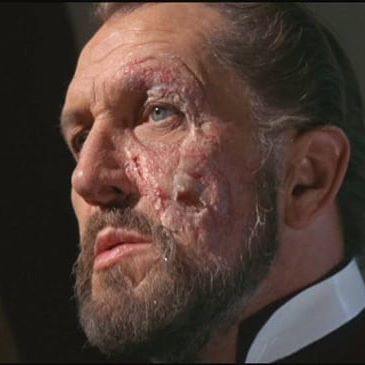
Scripted by Lawrence Huntington with "additional dialogue" by Christopher Wickling, THE OBLONG BOX has the thinnest of connections to its source Edgar Allan Poe story (it all owes more to H.P. Lovecraft - with its arcane lore and a disfigured outsider - and Rudyard Kipling's The Mark of the Beast). Originally to be directed by Michael Reeves before his own premature death, to further WITCHFINDER GENERAL connections Price is reunited with Hilary Dwyer as his younger sweetheart Elizabeth, but the actor - originally to play both brothers - looks disinterested and tired. Although beautifully shot by John Coquillon, it is a picture of missed opportunities; Price and Lee only share one scene together despite their marquee value (in fact, Lee's death scene), and the reveal of Edward's condition results in what looks to be little more than a bee-stinged nose, particularly disappointing after its long build-up.

Vincent Price as the diseased Julian Markham. By this stage in his career the actor grew weary of the Edgar Allan Poe adaptations, particularly within the saturation of the late 1960s horror film market.

THE OBLONG BOX belongs to that horror subgenre - THE MUMMY, PLAGUE OF THE ZOMBIESTHE REPTILE, THE GHOUL et al - that echo colonial guilt (remarkably, Hessler's film was banned in Texas for being "pro-Negro"). Julian laments his attitude ("we sinned out there in Africa all right, plundering their land - and we're still stealing their wealth, though they're too innocent to know it") and is revealed to have been the intended recipient of the curse. There is a quiet justice to the conclusion, as Edward bites the hand of his brother, passing on the psoriasis-based condemnation. But ultimately the much re-worked and bloated script carries little gravitas, instead grabbing from more substantive works with no cohesive payoff. This unfocused starting point is further undermined by turgid pacing and padding (the tavern sequences in particular).

Sunday, March 1, 2015

Sixties Sorcery

THE SORCERERS (1967)
CURSE OF THE CRIMSON ALTAR (1968)

"You enjoyed it, didn't you?" In an allegory for the thrills of cinema itself, THE SORCERERS tells of an old couple who invent a machine to live vicariously through a young man.

MICHAEL Reeves was a true cineaste and perhaps the greatest lost talent of the British film industry. Although he only directed three pictures, the Sutton-born Reeves increasingly became frustrated about the difficulty of getting projects off the ground. Suffering from depression and insomnia, on the 11th of February 1969 he died at the age of twenty-five from an alcohol and barbiturate overdose which many - including lifelong friend Ian Ogilvy - believe to have been purely accidental (indeed, the coroner's report stated that the level of barbiturate dosage was too marginal to suggest any dark intention). There is nothing critics like more than to mythologise an untimely artistic death (Brian Jones would follow five months later), but there is no mistaking that Reeves was a precocious talent. This is a man who travelled to Hollywood at the age of sixteen, sought out the address of his favourite director - Don Siegel - and subsequently gained employment. But after the critical and commercial success of WITCHFINDER GENERAL in 1968, Reeves seemingly lost his way. Starting to drink heavily, the boy wonder was also taking uppers and downers, and those close offered a variety of reasons: the development hells, the strain of his on-set clashes with Vincent Price, a failed romance, and an underlying nihilism.

There is much to enjoy in Reeves' second feature under consideration here, which followed the British/Italian REVENGE OF THE BLOOD BEAST shot in 1966. THE SORCERERS is a trippy slasher movie made as the 1960s neared its dizzying end. Retired and discredited hypnotist Professor Marcus Monserrat (Boris Karloff) and wife Estelle (Catherine Lacey) are an elderly couple who, through hypnosis, can "live" through young people and feel their emotions. Marcus picks up a bored youth - Mike Roscoe (Ogilvy) - at a Wimpy bar, who partakes in a ground-breaking experiment at the Monserrat household. When the pensioners choose to 'tune in' their fun begins mundane enough - Estelle instructs Roscoe to steal a fur coat - but soon she becomes hooked on the strength of her manipulative powers, forcing the hipster into carrying out a series of increasingly gruesome acts (such as a scissor murder of Audrey (Susan George)). As Marcus becomes mentally and physically overpowered by his wife, the husband manages to break the spell by causing Mike to die in a fireball of a car crash; the film ends on the image of the Monserrat's charred remains miles away at their home.

"... as though Boris Karloff's going to pop up at any moment." Barbara Steele's only home-grown horror - and Boris Karloff's last - CURSE OF THE CRIMSON ALTAR also wastes the talents of a bored Christopher Lee, who wears his own tweed jacket throughout.

By 1967 exploitation guru Tony Tenser had left Compton-Tekli and formed Tony Tenser Films, which would soon be renamed Tigon. THE SORCERERS was a co-production with the American company Curtwel - run by the husband-and-wife team of Patrick Curtis and Raquel Welch - and it is an effectively edited and lively lensed film which confronts cinema's inherent voyeurism. It also deftly contrasts gyrating youth culture with the dreary existence and tired home décor of the older generation; quieter sequences are governed by the sound of a ticking clock, as if to signify the both the passing joy of youth and the beginning of the end. Reeves makes the most of a derisory budget (£11,000 of the total £50,000 went to Karloff), though Monserrat's laboratory set is achingly threadbare. Karloff - sporting a pinstripe suit and goatee - gives a strong performance in his twilight years, still managing to sustain a erudite presence but also very much under the shadow of past glories. But it is Lacey who is the star, her demented wide-eyed enjoyment of Roscoe's building mania made even more disturbing by the fact that it is portrayed through violence rather than sexual yearning.

If Karloff was fading here, Tigon nearly finished the star off totally during Vernon Sewell's CURSE OF THE CRIMSON ALTAR, where Boris contracted pneumonia during night scenes filmed in freezing rain. Based uncredited on H.P. Lovecraft's The Dreams in the Witch House, Robert Manning (Mark Eden) goes in search of his brother, who was last known to have visited Craxted Lodge, Greymarsh. Manning is invited to stay by Eve (Virginia Wetherell) - the niece of Lodge owner Morley (Christopher Lee) - but is haunted by nightmares. When wheelchair-bound Professor Marshe (Karloff) informs Manning about a cult based around Lavinia Morley (Barbara Steele), and Robert discovers that he is descended from Lavinia's chief accuser, Craxted Lodge is burned to the ground, and Morley - exposed as the head of the followers - is consumed in flames. Starting with a written extract about hallucinatory drugs, the film descends into an unintentionally hilarious attic ritual, where Lavinia is aided by a man wearing an antlers head cap and leather underpants, and a woman with nipple-patches and horsewhip. The camp continues at a swinging party at the Lodge, which includes an exotic dancer pouring champagne over her breasts, but this is where the fun ends. Eden and Wetherell are functional at best, and the climactic notion that Morley and Lavinia are the same person - which would have made sense under the shooting title THE REINCARNATION - is left unexplored.

Monday, April 2, 2012

Birth of Amicus

THE CITY OF THE DEAD (1960)

In an astonishing final sequence, Tom Naylor uproots a graveyard cross and stumbles toward an intended sacrifice; as the shadow of the cross falls upon cowled satanic acolytes, they combust.

IN 1692 the small village of Whitewood, Massachusetts, sees the burning of Elizabeth Selwyn (Patricia Jessel) and consort Jethro Keene (Valentine Dyall) for witchcraft. Jumping to the modern day, Professor Driscoll (Christopher Lee) recommends his hometown of Whitewood as an ideal place for student Nan Barlow (Venetia Stevenson) to research her paper on the black arts. Staying at the Ravens Inn Hotel - which is managed by Mrs Newless (also played by Jessel) at the exact spot where the burnings took place - Nan discovers that all the other guests only appear as darkness falls, hears chanting beneath the floorboards of her room, and is abducted into the catacombs. Nan’s brother Richard (Dennis Lotis) and her boyfriend Bill (Tom Naylor) investigate her disappearance; while Bill suffers a car accident and remains on the sidelines, Richard meets Patricia (Betta St. John), the daughter of the aging local Reverend (Norman Macowan), and discovers that Selwyn still presides over a coven in the locale.

Working alongside British company Vulcan, Americans Milton Subotsky (who co-produces and provides the treatment) and partner Max J. Rosenberg would later found Amicus, and many horror historians look upon THE CITY OF THE DEAD as the first unofficial Amicus release. If only that studio continued with such quality; amusingly Driscoll states early on "the basis of fairy tales is reality, basis of reality is fairy tales," which acts as a much more apt mandate for Subotsky's later films of the fantastic. At a time when Hammer had established the colour period horror film, THE CITY OF THE DEAD is a present era monochrome gem, drawing from the stage bound atmospherics of Val Lewton. Consequently, the film exists in a TWILIGHT ZONE-like alternative universe, directed with finesse by John Moxey, who is greatly assisted by the atmospheric photography of Desmond Dickinson. On the down side the picture suffers from laden performances and Ken Jones' jarringly inappropriate partial jazz score.

Released in America as HORROR HOTEL with the tag "just ring for Doom Service!," this seemingly acknowledged the film's narrative similarities to PSYCHO. A hit in Britain, the black and white film suffered in the US, with the distributor cutting the picture and inserting 3-D footage from Julian Roffman's THE MASK.

The major bone of contention with THE CITY OF THE DEAD is the connection to PSYCHO. Like Alfred Hitchcock's chiller, a young woman travels to a hotel, only be be killed in the middle of the feature. Another similarity are friends embarking to find her as heroine 2 narrowly escapes with her life; even the final shot of Mrs Newless' flame-ravaged corpse echoes the mummified Mrs Bates in her rocking chair. In his book English Gothic, Jonathan Rigby surprisingly fights Subotsky's corner by listing production start dates - THE CITY OF THE DEAD began on 12th October 1959 compared to PSYCHO's on 30th November - but, as Philip Nutman explains in Little Shoppe of Horrors #20, Robert Bloch's source novel was actually first published in 1959, with Hitchcock's film following the structure of the book. Amicus would later have a fruitful relationship with Bloch - and this certainly indicates that Subotsky would have been aware of the narrative - but the situation is clouded further by screenwriter George Baxt claiming it was his idea to prematurely kill Nan.

THE CITY OF THE DEAD was described by Lee as "an American Gothic with a Lovecraftian flavour," with Whitewood replacing that writers Dunwich as a cursed township. Indeed, the writings of H. P. Lovecraft have seldom been successfully transferred to the screen, struggling to find the right mix between hinted horrors and the money shot for expectant audiences. It is ironic that the most memorable slices of Lovecraftian cinema haven't been adaptations at all, rather films that have attempted to portray the author's trademark otherworldly ambiance. Yet while Whitewood may lack the true depth of the Cthulhu mythos, figures loom in and out of dense fog like chess pieces in a game of much greater scale.