Showing posts with label Patrick Magee. Show all posts

Friday, July 1, 2022

The Road to Unreason

SIR HENRY AT RAWLINSON END (1980)

Thespian and alcoholic Trevor Howard is in his element as Sir Henry Rawlinson, Vivian Stanshall's most famous comedy creation.

MUSICIAN and wit Vivian Stanshall was best known for his work with the surrealist comedy/art revue group Bonzo Dog Doo-Dah Band, and his outlandish exploration of the British upper classes at Rawlinson End. This latter concept first appeared as a track on the Bonzo's contractual obligation album Let's Make Up and Be Friendly, then as thirteen radio broadcasts on The John Peel Show as an individual performer, before evolving into a fully-fledged LP in 1978. This anarchic movie version - filmed in sepia monochrome and running a shade over seventy minutes - follows drunken aristocrat Sir Henry (Trevor Howard)'s attempts to exorcise the ghost of his brother Hubert (played by Stanshall). Hubert was accidentally killed in a duck-shooting incident whilst escaping trouser less from an illicit liaison. Apparently, this ghost will not rest until it is supplied with another pair of trousers; until then, the spirit walks the corridors, accompanied by his possessed stuffed dog Gums.

Bigoted imperialism is expertly brought to life by the cinematography of Martin Bell, as if a fading photograph. The eccentric family members, mad servants and unhinged acquaintances - players include Patrick Magee, Sheila Reid and Suzanne Danielle - all seem to exist in a world that isn't quite Monty Python, The Goons, Peter Cook or anything else, more a haphazard set of observations on the absurdity of being British. Incoherency is evident both in its sequences (Sir Henry is shown blacked up on a unicycle wearing a tutu, billiards played on a horse) and its dialogue ("generally speaking when I eat something I don't want to see it again," "I don't know what I want, but I want it now!")

Stanshall's behaviour was never straightforward. He once held a reporter captive for three hours until he would listen to his favourite records, and visited the East End with Keith Moon dressed up as Nazis.

A heavy drinker who also suffered from depression and a tranquiliser addiction, Stanshall was full of contradictions: both pleasant and threatening, even his voice could be posh (an order from his tyrannical father) or sport a cockney accent. At the time of his death - at fifty-one due to an electrical fire at his Muswell Hill bedsit - Vivian was developing a project about Loch Ness, and Warner's had approved a second Sir Henry album. Generously championed by Stephen Fry as "one of the most talented Englishmen ever," Stanshall's legacy is one more of infrequent flashes of oddness, an absurdist world which was too fragmented and silly for its own good.

Sunday, November 1, 2020

"It's a nasty night innit?"

JACK THE RIPPER (1959)
THE FIEND (1972)

Unlike the documented slayings, the controversial Tempean production JACK THE RIPPER features strangulation followed with knifings that are almost an afterthought.

DIRECTED by renowned producers Robert S. Baker and Monty Berman (who also helmed THE HELLFIRE CLUB), JACK THE RIPPER belongs to a quartet of British chillers - HORRORS OF THE BLACK MUSEUM, PEEPING TOM, CIRCUS OF HORRORS - that pushed the bar on sadism. Both the Mercy Hospital for Women, and the Whitechapel police, are laden with the archetypal angry mob as a black-clad figure with a surgical bag is haunting the East End, asking his victims "Are you Mary Clark?" Inspector O'Neill (Eddie Byrne) welcomes a visit from his friend, NYPD detective Sam Lowry (Lee Patterson), who becomes attracted to Anne Ford (Betty McDowall). While the leading red herrings are Ford's guardian Dr Tranter (John Le Mesurier) and hunchbacked orderly Louis (Endre Muller), this Saucy Jack turns out to be Sir David Rogers (Ewan Solon), who finally corners and kills Clark (Barbara Burke) as revenge for the suicide of his son, who found out his lover was a prostitute.

Loosely based on Leonard Matters' book The Mystery of Jack the Ripper and scripted by Jimmy Sangster, JACK THE RIPPER was given an aggressive promotional campaign in the States - which even included a Steve Allen novelty single - and the American version disposes of Stanley Black's score and also has a colour insert of oozing blood for Rogers' lift squashing. A spiced-up continental version adds four minutes to the running time, and was particularly popular in France. Here the murders had extended knife thrusts and exposed breasts, with the nudity quota increased by a showgirl changing room. But the most salacious difference was a private sequence where champagne is poured over Maggie (Dorinda Stevens)'s chest.

Hungarian actor Endre Muller adds monster value to this particular JACK THE RIPPER backstory.

The timing of the "Sadistic quartet" is significant. Between 1957 and 1960, Hammer had injected a large amount of hubris into the British film industry despite the best efforts of the censors. Consequently, the office of John Trevelyan could not be seen to allow one company to flourish within the new boom, even when producers were prepared to go the extra mile on gore and nudity. Yet JACK THE RIPPER was still involved in a prolonged set of altercations, the first version of the script described by a BBFC examiner as "even the title [is] too full of sordid and sadistic association to be acceptable as a film." After a meeting with Trevelyan himself the BBFC softened their stance, Berman cleverly turning up to the appointment with Sangster himself as a bargaining clip after the board's reservations on THE CURSE OF FRANKENSTEIN. This lead to a battle over cuts which give the picture a feverish edge, though Trevelyan's preference for shadow and fog is also entertained.

Matters and his source publication are an interesting topic in itself. An Adelaide-born journalist who fought in the Second Boer War and became a Labour politician, Matters proposed in a 1926 article that Jack was a doctor whose son had died from syphilis caught from Marie Kelly; dubbed "Dr Stanley," he committed the murders in revenge and then fled to Argentina (where the author had been editor of the Buenos Aires Herald). The Mystery of Jack the Ripper was an expansion of this, an alleged deathbed confession which stumbles at the first step because Kelly's autopsy found no evidence of sexual disease. Nevertheless this 1929 book was marketed as the first serious study of the Whitechapel murders, and at least has an authentic sense of the locale as all murder sites were then unchanged since 1888.

"Sinner ... Your Evil Shall Destroy You." Tony Beckley and Ann Todd prey for THE FIEND to be removed from their résumé.

A religious fanatic is the serial killer of choice for Robert Hartford-Davis' THE FIEND. The Minister (Patrick Magee) leads a sect called The Brethren, where widow Birdy Wemys (Ann Todd) has become a devoted member, together with her troubled son Kenny (Tony Beckley). The socially inept Kenny - who works as both a security guard and a swimming pool attendant - has been dominated by his mother and the church, and descents to a murder spree of what he deems to be sinful young women (one is picked up in a foyer of a cinema showing the Hammer SCARS OF DRACULA / HORROR OF FRANKENSTEIN double bill). Birdy is dependent on insulin banned by The Brethren, and flat-sharing sisters Nurse Brigitte (Madeleine Hinde) and chain-smoking tabloid reporter Paddy Lynch (Suzanna Leigh) are ensnared into this sordid world in an attempt to save the mother and expose the gospel-loving, nonconformist gatherings. 

Hartford-Davis was hardly a neglected auteur, but THE BLACK TORMENT and CORRUPTION were notable entries for British horror. However THE FIEND - released in a cut version as BEWARE MY BRETHREN for United States markets - makes tedious use of puritanical ideology and plays like a tepid Pete Walker production (Kenny's use of a tape recorder to play back the death throes of his victims references another filmic mainstay, PEEPING TOM). But religious extremism was hardly a subject matter on many people's lips in early 1970s Britain, yet the overwrought Magee tries his best to raise the bar before dying on his 'Jesus Saves' cross.

Saturday, July 1, 2017

Demons of the 1970's (Part I of II)

DEMONS OF THE MIND (1972)

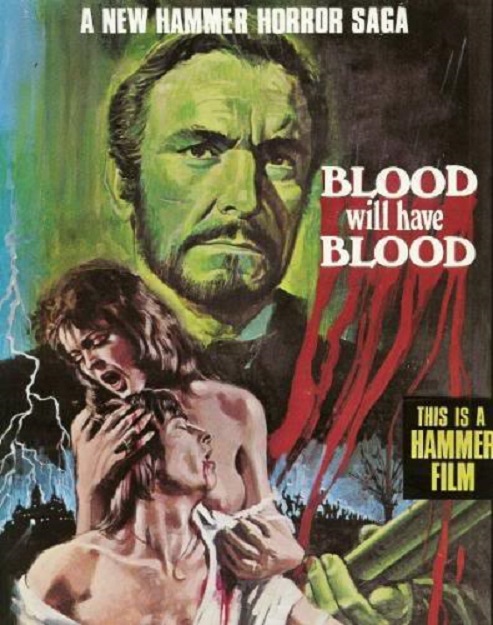
One of Britain's last costumed Gothics, DEMONS OF THE MIND was filmed as BLOOD WILL HAVE BLOOD, exploring "dreams of sexual fear supressed through guilt."

AMID the dying embers of the 1970's British film industry, attempts to move into more psychological thrillers resulted in a number of underappreciated efforts. Dumped onto the wrong end of a double bill with TOWER OF EVIL, DEMONS OF THE MIND - directed by Peter Sykes and written by Christopher Wicking - is a Hammer production which focuses on Baron Friedrich Zorn (Robert Hardy), who fears he has passed on the "family madness" to son Emil (Shane Briant) and daughter Elizabeth (Gillian Hills). Held captive to curb their incestuous desires, Emil is at least released at night to murder women, while Elizabeth is "bled" to make her weak (making use of a vintage Scarificator from the British Museum). When discredited psychologist Falkenberg (Patrick Magee) arrives with his associate scholar Carl (Manfred Man singer Paul Jones), an experiment to rid Emil of his lust involving Inge (Virginia Wetherell) ends in another strangulation. The villagers, influenced by a deranged, self-styled Holy Man (Michael Hordern), decide that Zorn is the true demon, and stake him with a burning cross.

A mix of Hammer's Mittel Europe and fledgling psychiatry was one way the company attempted to make its product fresh, another was by infusing proceedings with new young directors and screenwriters. But DEMONS OF THE MIND is more cynical than satisfying, conveying a relentless dourness (quoting Psalm 38 "For my loins are filled with a loathsome disease, and there is no soundness in my flesh") where conventions are either twists or throwbacks: Magnee's unhinged Mesmerist and Van Helsing substitute helps no one ("Better men than I have been booted out of Vienna!"), an alleged Priest is a dangerous zealot, and the villagers revel in their own sadism.

In a role originally intended for Marianne Faithfull, Gillian Hills plays somnambulant Elizabeth Zorn. Faithfull was pulled late on due to insurance issues on her drug use.

A Poe-like story of an incestuous, murderous dynasty crumbling to dust, Zorn is driven by subconscious compulsions of his peasant bride's "virgin blood" and bare flesh (Zorn is a character undermined by Hardy's pantomime performance; to think we might have had Eric Porter, Paul Scofield, Dirk Bogarde or James Mason). Hordern is also overtly loopy, barely able to carry his over-sized wooden cross, and despite the emotional slant, DEMONS OF THE MIND actually serves up a copious amount of exploitative, early 70's gore: although optically fogged, Zorn's wife is seen to slash her wrists and throat in front of her children, but further scenes of Emil killing maiden aunt Helda (Yvonne Mitchell) with a bunch of keys and Zorn's climactic impalement are in no way shrouded.

The original pitch to Hammer by Frank Godwin - the composer-cum-independent producer who penned Strange Love for LUST FOR A VAMPIRE - was actually a werewolf picture. The studio was intrigued by Godwin's knowledge of the legend of Blutlust, and together with Wicking, formulated a treatment based on the Bavarian story of a man-wolf which was actually a psychopathic condition not understood by the medicine of the time. However, the tale was a complete fabrication, and Hammer did not warm to the werewolf elements anyway, leaving only a vague lycanthropic reference in the finished film where Zorn imagines himself stalking as an animal (to further the pseudo-werewolf angle, the muted cinematography is lensed by Arthur Grant, making his last Hammer picture in an association which started with THE CURSE OF THE WEREWOLF).

Saturday, June 1, 2013

Cushing Centenary (Part II of II)

ASYLUM (1972)
--AND NOW THE SCREAMING STARTS! (1973)

ASYLUM's Richard Todd is attacked by that favourite of Amicus plot devices - the severed limb - for the cover of Famous Monsters of Filmland #97 (April 1973).

DIRECTED by Roy Ward Baker and with Robert Bloch adapting his own tales, ASYLUM was the fifth of Amicus' seven portmanteau pictures and one of the silliest, despite a strong framing story. Dr Martin (Robert Powell) arrives at Dunsmore Asylum and meets wheelchair-bound Dr Rutherford (Patrick Magee). Rutherford tells Martin that he will be considered for employment if he can deduce who is Dr Starr - the former head of the facility - now among the inmates. Attendant Max Reynolds (Geoffrey Bayldon) admits Martin to the cells where he interviews each in turn: in Frozen Fear, Bonnie (Barbara Parkins) tells of lover Walter (Richard Todd), who suffered the consequences of murdering voodoo-studying wife Ruth (Sylvia Syms); The Weird Tailor has Bruno (Barry Morse) recount how Mr Smith (Peter Cushing) requested an elaborate suit made from a mysterious fabric; and Lucy Comes to Stay is a split personality story featuring Barbara (Charlotte Rampling). The final tale - Mannikins of Horror - is not viewed in flashback but sees Martin encounter Dr Byron (Herbert Lom), who is working on soul transference to small automatons.

Bloch had constructed the flow of stories to build tension slowly, intending the order to be The Weird Tailor, Lucy Comes to Stay, Frozen Fear and Mannikins of Horror. After seeing a first edit, Amicus co-founder and financier Max Rosenberg ordered the stories to be re-arranged, on the basis that distributors would need a more action-orientated start. Both Bloch and Baker were unhappy about the restructuring, but it is hard to see the film vastly improved no matter what the order (the Lucy Comes to Stay segment would grind any release to a halt). ASYLUM packs out-of-work British star quality - most of whom in their twilight years - into very little, and it is up to Cushing, yet again, to bring depth into his small role of a grieving father planning to resurrect his son. As Tim Lucas states in Video Watchdog, the film "...suffers from an out-moded script, more appropriate to 1940s horror radio than 1970s horror cinema," another example of Amicus' juvenile approach.

Catherine Fengriffen (Stephanie Beacham) is drawn into the mystery and madness of --AND NOW THE SCREAMING STARTS!.

Amicus assembled much the same cast and crew - including director Baker, stars Cushing, Lom, Magee, and the crawling hand - for the peculiarly titled costumed gothic --AND NOW THE SCREAMING STARTS!. This meandering effort is set in the late 18th century, where newlywed Catherine (Stephanie Beacham) moves into the mansion of her husband Charles Fengriffen (Ian Ogilvy). Almost immediately, the bride is plagued by visions, including an eyeless, one-handed phantom. We learn that the family curse originates from Silas the woodsman (Geoffrey Whitehead) having his hand chopped off on his wedding night by Charles' lecherous ancestor Henry (Lom), who also deflowered the woodsman's young bride. Family doctor Whittle (Magee) summons psychiatrist Pope (Cushing), who witnesses the birth of Catherine's baby, an infant that sports Silas' facial birthmark and hand less stump.

Based on David Case's 1970 novella Fengriffen: A Chilling Tale, the use of Oakley Court Manor - a location that would soon become THE ROCKY HORROR PICTURE SHOW castle - provides a rich backdrop for such a meagre-budgeted film. Cushing's character does not appear on screen until half-way, and although this is a welcome adage, without doubt it remains Beacham's film; the actress gives the most rounded performance made the more evident by the fact that Catherine is surrounded by soon-to-be-murdered ciphers. Even husband Ogilvy seems a bit-part among the turmoil of his own family's sordid history, though he belatedly comes alive in an unsettling rage at Henry's tomb during a downpour. The final shot of Catherine with her mutant son clashes wildly with the confusing opening narration, which recollects these historic events in a forced sereneness, rather than the bludgeoning horrors that unfold.

Friday, March 1, 2013

Beast of Burden

AGAINST THE CROWD - MURRAIN (1975)
BEASTS (1976)

The thing in the wall: Jo (Jane Wymark) increasingly feels that she 
and her unborn child are in danger, in the BEASTS episode BABY.

MADE for the ATV anthology series AGAINST THE CROWD - a set of self-contained dramas focusing on outsiders - the Nigel Kneale-penned MURRAIN acted as an impromptu pilot for BEASTS, produced for the same ITV studio a year later. MURRAIN is the story of young vet Alan Crich (David Simeon), who discovers that a stretch of farmland may be hexed by Mrs Clemson (Una Brandon-Jones). Crich attempts to mediate between the alleged witch and the disgruntled local farmers, led by Mr Mably (Bernard Lee). Featuring Kneale's preoccupation of the clash between the supernatural and the rational, the play is also influenced by the writer's own superstitious locale growing up on the Isle of Man. There are no real scares in the programme, rather it is a character-and-mood piece where the viewer is left to draw their own conclusions.

Kneale's six stories for BEASTS would detail another of his favourite themes, that of primal instincts within civilised man, and the effects when repressed feelings are set free. BABY sees the mummified remains of a strange creature found in a country cottage; BUDDYBOY features a haunted dolphinarium; THE DUMMY has an actor taken over by his monster suit; SPECIAL OFFER tells of a gremlin loose in a mini-market; WHAT BIG EYES shows an amateur scientist carrying out experiments to turn himself into a wolf; and rats are on the rampage in DURING BARTY'S PARTY.

Set in North Cornwall, the farmers of MURRAIN believe a witch is responsible for the plight of their pigs, and the illness of a local boy.

Kneale was always an "ideas" man, but BEASTS shows a developing flair for character and dialogue. Thankfully then that the series features a number of stoic performances from fresh faces and seasoned veterans - including Simon MacCorkindale, T.P. McKenna, Martin Shaw, Clive Swift, Thorley Walters, Pauline Quirke and Elizabeth Sellars. Particularly effective are the verbal battles between Michael Kitchen's RSPCA officer and Patrick Magee's eccentric pet-shop owner in WHAT BIG EYES. For a such a character-driven series, the misses are uniform to a handful of weaker performances. Quirke is fine in SPECIAL OFFER, but her co-workers seem staid in what is in itself the silliest and most repetitive episode. BUDDYBOY is the oddest of the tales, and the fusion of Shaw as a porn theatre owner taking over a disused dolphin pool never quite gels in story or execution. The actor is suitably bullish, but the performance of Pamela Moiseiwitsch as a girl who has an umbilical connection with the ghost of the star dolphin is overtly glacial.

As BEASTS is made up of six totally unrelated entries, the quality ultimately dips, despite Kneale's impressive scope of imagination. The doom-laden BABY is almost a companion piece to MURRAIN, as it features another vet at odds with a superstitious rural community. It is widely considered to be the best - and certainly the most chilling - of the series, and as Andy Murray points out in his programme notes to the Network BEASTS DVD, BABY also has connections to QUATERMASS AND THE PIT, with builders unearthing "a sinister, ancient capsule which turns out to contain ... something." THE DUMMY is also a highlight, and a real joy for Hammer fans, as Kneale draws on his underwhelming experiences working for the production house. There is little doubt that with the casting of Walters and the feature being made by a fictional British company - REVENGE OF THE DUMMY - are thinly veiled snipes at his time with the famous studio.

Sunday, February 1, 2009

The Crypt of Horror

TALES FROM THE CRYPT (1971)
THE VAULT OF HORROR (1973)

In a rare appearance under heavy make-up Peter Cushing is Grimsdyke, an avenging zombie, in TALES FROM THE CRYPT.

ONCE targeted as agents of juvenile delinquency by righteous politicians - and tossed into bonfires by outraged parents across North America - the banned in Britain EC Comics provided the drive behind two of Amicus' seemingly endless stream of portmanteau: Freddie Francis' TALES FROM THE CRYPT and Roy Ward Baker's THE VAULT OF HORROR. Essentially McCarthy-era morality tales, the publications were obsessively consistent in punishing corruption in the sickest way possible. Yet while Amicus provided some thrills, you need only look at a handful of the originals to realise that the literary source were more cinematic than cost-conscious Max J. Rosenberg and Milton Subotsky would care or cater for.

TALES FROM THE CRYPT was the biggest commercial success of all Amicus multi-tale terrors. Francis' visuals mix bright, basic colours with grey to approach the look of a comic book panel, but the masterstroke is how well the EC style of divine retribution fits into the festering middle-class resentment of the working classes in Edward Heath-era Britain. Opening to the ominous chords of Bach’s Toccata & Fugue in D Minor, the framing story sees five visitors losing their way in a labyrinthine set of catacombs, who are shown glimpses of their pasts - or futures? - by the cowled Crypt Keeper (Sir Ralph Richardson). Best remembered for its lively opening story And All Through the House - pitting a murderous wife (Joan Collins) against a killer Santa - the other four segments are split equally between the cumbersome and the classic. Reflections of Death and Wish You Were Here are both weak fillers, the former featuring a philandering husband (Ian Hendry) and the latter a wife (Barbara Murray) using an Oriental idol to bring back the dead. The remaining two episodes are so superior they seem to be from a different production altogether.

Everything in its right place. THE VAULT OF HORROR’s The Neat Job is the highlight in an otherwise bland production.

Poetic Justice sees kindly old Grimsdyke (Peter Cushing) driven to suicide by loathsome neighbours covetous of his land, who send him malicious Valentine rhymes. A simple tale of walking-corpse vengeance in the tried and tested EC tradition, the story is given extra resonance by Cushing's delicate performance, which has a quality rarely seen within the usually character-restraining portmanteau film. The actor was newly widowed at the time, and used a photograph of his late wife Helen, which he addresses by name on screen. Blind Alleys also has wonderful performances at its core, with Rogers (Nigel Patrick) - a retired army officer taking charge of a home for the blind - and Carter (Patrick Magee) - a spokesman for the unsighted. A slow-burning tale of redemption, Rogers' new rules for efficiency (food rationing, no heating) ultimately has him forced to choose between confronting his hunger-crazed Alsatian or hurtling to safety down a narrow corridor bristling with razor blades, set up by the spectrally-portrayed blind.

In comparison, THE VAULT OF HORROR is formulaic at best and signalled the end of any EC endorsement for Amicus. Five men inexplicably find themselves locked in the basement of a skyscraper, and pass the time by recounting their nightmares. Bargain In Death is a weak insurance scam story, while Midnight Mess is an allegedly humorous tale of small-town vampirism starring Daniel and Anna Massey. This Trick'll Kill You is a none-too-subtle allegory about a married pair of magicians murdering fakirs in India, but the other two stories fare better because they subscribe more to the twisted EC mythos. Drawn and Quartered features a struggling artist (Tom Baker) in a voodoo-laced variation on The Picture of Dorian Gray, but the only story that really seems in its element is The Neat Job, in which a disorderly housewife (Glynis Johns) tries to cope with her fussy, perfectionist husband (Terry-Thomas); it’s a delicious presentation of domestic EC-style terror.