Sunday, August 1, 2021

Ghost Breakers

CATACOMBS (1965)
DARK PLACES (1973)

Released in the United States as THE WOMAN WHO WOULDN'T DIE, the Hitchcockian CATACOMBS subscribes to that age old task of murdering one's wife.

CATACOMBS is a largely forgotten gem of British horror, the story of wealthy businesswoman Ellen Garth (Georgina Cookson), her downtrodden husband Raymond (Gary Merrill), and their Art student niece Alice Taylor (Jane Merrow). Ellen needs control over everything in her life, even her sudden physical pains in which she induces a trance to escape from. A murder plot between Raymond and her seedy secretary Corbett (Neil McCallum) is played out with Alice starting an affair with Raymond. The planned scheme involving actress Rachel Thomas (Christine Glynn) is prematurely halted by the overbearing Ellen finally breaking her husband's patience at their cottage retreat: Raymond drowns her in the bathroom sink and buries her in the potting shed. But this doesn't seem to end Ellen's yearning to act revenge on her husband and niece.

It was during his time as story editor on ALFRED HITCHCOCK PRESENTS that director Gordon Hessler discovered the film's source novel by Jay Bennett. An adaptation was rejected for the show, but became his theatrical directorial debut. Yet CATACOMBS cannot shake off its feel of an extended anthology episode; Merrill - himself a veteran of Hitchcock's TV programme - is perfectly cast as the aging gigolo, and Cookson is frightening and glacially fragile (when Raymond carries his wife in his arms, Ellen seems to eerily transform into a mannikin). The tension is simple but effective (the sound of Ellen's walking cane, the moving of locked door knobs), and although the double twist ending will not surprise all, it nevertheless is a satisfying climax to a well made and entertaining thriller.

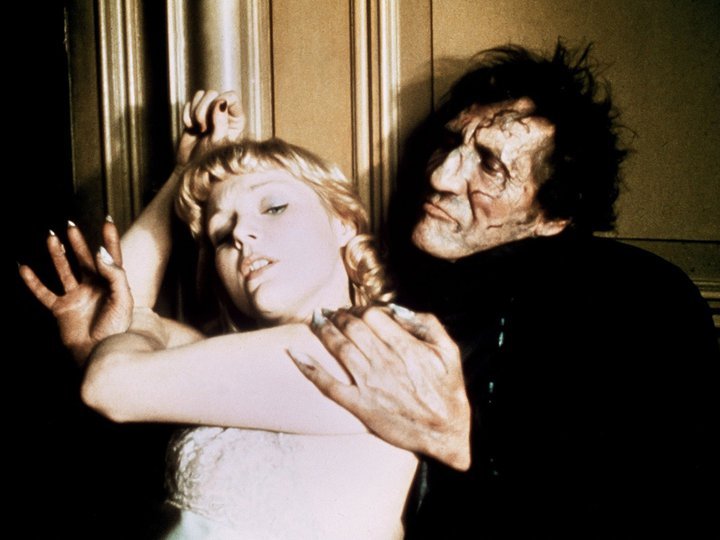
Shot at an old psychiatric hospital near Uxbridge, DARK PLACES was the only release from Glenbeigh/Sedgled, but it had a great poster. 

Helmed by Don Sharp, DARK PLACES is a pedestrian haunted house/psychological thriller that is also rarely discussed at length. Following the death of an aging asylum inmate, Edward Foster (Robert Hardy) inherits an old mansion with a grim reputation: a woman, the housekeeper and two children have disappeared without trace. However Edward is more interested in the £210,000 hidden somewhere behind the walls. Unfortunately there are others who also want the money: Dr Ian Mandeville (Christopher Lee) and his sister Sarah (Joan Collins), together with solicitor Mr Prescott (Herbert Lom). With Sarah helping Edward at the mansion, and the siblings faking paranormal occurrences, the building and its backstory start to affect Foster's fragile psyche. Possessed by the spirits of the deceased, he begins his own murder spree.

Similar to the feel of CATACOMBS, DARK PLACES plays more like a TV movie, hampered by uncharismatic direction and photography. Hardy has a lot of character aspects to grapple with and manages to just about carry the film, while the all-star cast are wasted (although Collins inevitably shines as the sexually conniving sleuth). Even the flashback sequences have quality performers in small roles, with Jean Marsh and Jane Birkin. The notion of the Mandeville fake haunting is never developed; in fact, the realisation that strange things are actually happening is only met with brief puzzlement. It's a shame, as this interesting trope dates back to earlier stories such as THE CAT AND THE CANARY and THE GHOST BREAKERS, particularly in the context of money and induced madness.
Thursday, July 1, 2021

The Cat Creeps

THE CAT AND THE CANARY (1978)

Carol Lynley and The Cat in the only colour film of the celebrated but dated play. The production was not released theatrically until 1982 due to litigation with the original distributor, and consequently sat uncomfortably with the glut of slashers of the period. 

JOHN Willard's black comedy stage play The Cat and the Canary originally opened on Broadway in early 1922, and has become a cornerstone of the "old dark house" subgenre and "creepy clutching hand" motif. The story concerns the death and inheritance of a rich eccentric who felt that his relatives "have watched my wealth as if they were cats, and I - a canary." To date the tale has been adapted into four motion pictures: the 1927 Universal silent directed by German expressionist Paul Leni, the 1930 pre-code sound remake released as THE CAT CREEPS, the 1939 Bob Hope and Paulette Goddard take, and this British-made offering helmed by American cult filmmaker Radley Metzger.

In 1934, on the twentieth anniversary of his death, the remaining relatives of Cyrus Canby West (Wilfred Hyde-White) are called to his Surrey mansion to view the filmed reading of his will. Cyrus lets it be known how much he despised and loathed his kin - calling them "bastards" and "leeches" - by setting up a psychological struggle for his fortune. With a history of insanity in the family, West reveals that Annabelle (Carol Lynley) is to be the sole beneficiary, but to claim the inheritance she must spend the night in the house and be deemed sane the next morning. The situation is further complicated when a "chief psychologist at the Fairview Sanitarium, an asylum for the criminally insane; we're just up the road..." - Hendricks (Edward Fox) - informs the guests that a homicidal maniac known as The Cat has escaped and is hiding in the area. But this is revealed as a ploy by the unhinged second heir to drive Annabelle insane.

Wendy Hiller robustly plays family lawyer Mrs Crosby, and is removed half way through the film by becoming the first victim.

Metzger was a pioneer famous for his lavishly designed, adult-orientated films such as THE LICKERISH QUARTETSCORE and THE OPENING OF MISTY BEETHOVEN (he also edited THE FLESH EATERS, regarded as the first ever splatter movie). His career-long fascination with self-destructive beautiful people morphs here into a group of desperate misfits, a de-sexualised mansion mystery of secret rooms and building resentment. Even the cinematography is against type, casting a well-lit glow as opposed to the usual cobwebs and shadows, and Alex Thomson's wide-lenses providing a sense of anti-claustrophobia. The stand-out touch, however, illustrates Metzger's pendant for the juxtaposition of actors and the projected image, when the family's faithful retainer Mrs Pleasant (Beatrix Lehmann) moves behind West's home movie only to reappear on screen - monochrome and twenty years younger - with Cyrus during the reading.

The all-star cast give performances that could generously be described as unconventional, portrayals of people who are all killers one way or another: disgraced doctor Henry (Daniel Massey, whose father Raymond had spent a night at James Whale's THE OLD DARK HOUSE), big game hunter Susan (Honor Blackman) and her lesbian lover Cicily (Olivia Hussey), who shot an employer attempting to rape her, war hero Charlie (Peter McEnery) and songwriter Paul (Michael Callan), obliquely "the biggest killer of all" according to West. It's a hodgepodge of goofiness undermined by strange lapses: why is Cyrus' formalities in sound, for example, and the two climatic shootings are completely bloodless. 

Tuesday, June 1, 2021

Black Smoke and Red Dust

THE WAR OF THE WORLDS (2019)

Eleanor Tomlinson and Rafe Spall run from a Martian war machine in a promotional image. For this version, the familiar steampunk design for the alien "boilers on stilts" are replaced with a more organic, insectoid look.

PETER Harness' three-part BBC adaptation of H.G. Wells' seminal invasion novel is not only the first British television stab at the story, but one that follows a female lead. Even before the Martians arrive, Amy (Eleanor Tomlinson) and partner George (Rafe Spall) have problems. In quite the Edwardian scandal, George has left his wife/cousin for the younger Amy, which has caused friction with his politician brother Frederick (Rupert Graves). Denied a divorce, Amy announces she is expecting George's baby. It seems their only friends are sprightly astronomer Ogilvy (Robert Carlyle) and maid Mary (Freya Allan), although the latter is killed under a pile of rubble during the first wave of attacks. 

Wells' narrator hero is described as a "professed and recognised writer on philosophical themes," yet here George is a Woking journalist and superficial wet fish, branded a coward by his ex-wife and failing to help a dying soldier. The flash forward/back structure of the leading players separation denies any workable screen time for Amy and George, which is probably for the best, as when they do share scenes Tomlinson and Spall's chemistry is insipid (Spall seems under varying levels of sedation). Thankfully this is Amy's tale, providing much needed ballast in what is more than just an angle on our current fixation with political correctness; unlike most female evaluations of major franchises, the character is intelligent and driven in complex, emotional situations.

Over 120 years after its first serialisation, the influence of H.G. Wells' The War of the Worlds remains; this is because of the heady contexts, which include colonialism, natural selection and religion. Pictured is Frank R. Paul's cover for Amazing Stories, August 1927.

The main allegory of Wells' novel - decaying imperialism - is illustrated by Amy having been raised in the British Raj, and the jingoistic comments of the military and politicians. "It seems that something has arrived in England" announces Chamberlain (Nicholas Le Prevost), a battle cry that today can be viewed as xenophobia. Initially planned to screen over the 2018 festive season, it would have been particularly hard for the masses to swallow such a slow, doom-laden miniseries; the death and devastation is shrouded in war machine black smoke and wasteland red hues, highlighting another interpretation of the narrative: climate change. In fact The War of the Worlds has always portrayed a foreboding and prophetic end of days template: Orson Welles' radio broadcast occurred during the escalation of Nazi Germany, George Pal's 1953 film was released at the start of the Cold War, and Steven Spielberg, following his 2005 big screen take, said that "after 9/11 [the book] began to make more sense to me."

Saturday, May 1, 2021

Come and Get It

THE MAGIC CHRISTIAN (1969)

Raquel Welch and Ringo Starr share a moment on set.

BASED on Terry Southern's irreverent novel, THE MAGIC CHRISTIAN is an anti-establishment black comedy/satire so laboured to the point of self-nihilism. Eccentric billionaire Sir Guy Grand (Peter Sellers), together with newly adopted homeless person Youngman (Ringo Star), bribe people with vast sums of money for "educational" whim. The narrative that every man has his price is spread thinly over a series of jaw-droppingly unfunny skits and cameo appearances. These include cutting out a portrait's nose at a Sotheby's auction - much to the astonishment of director Mr Dugdale (John Cleese) - and approaching the Oxford rowing team - one played by Graham Chapman - to purposely ram the Cambridge crew. The film ends with Guy and Youngman, having returned to the park where the film opened, bribing the park warden to allow them to sleep there.

Working from an endlessly rewritten screenplay by Southern and director Joseph McGrath (with additional material by Sellers, Cleese and Chapman), the sketches are often homoerotic: there is a homosexual boxing match and a Hamlet striptease. The only amusement is of a dog show where a new breed is feeding on the contestants. One wonders that if the climactic vat of urine, blood and excrement - liberally sprinkled with money - is a statement for the production itself (the inclusion of a newsreel Vietcong execution is bewildering and contemptible). The stars are particularly abundant on the good ship Magic Christian, on its maiden voyage from London to New York: Christopher Lee as a vampire, a whip-wielding Raquel Welch, and Yul Brynner in drag singing "Mad About the Boy" to a suitably unimpressed Roman Polanski.

Peter Sellers bribes Spike Milligan into eating his own parking ticket in one of many heavy-handed meditations on capitalism and human vanity.

Amongst the mess we find British stalwarts swallowing their pride (Hattie Jacques, John Le Mesurier, Dennis Price, Wilfred Hyde-White et al), and Starr is disposable behind Sellers' foppish onslaught (allegedly imposed by Sellers himself). At least Cleese is seen honing his petulance, and the unfilmed Cleese/Chapman contribution - The Mouse Problem - became a classic as part of the second episode of MONTY PYTHON'S FLYING CIRCUS. A presage of Furry Fandom, the sketch is an obvious parody of the secretive lives and social condemnation of gay men, the piece mimicking techniques used in serious television documentary exposés.

Thursday, April 1, 2021

Beware the Triffids

THE DAY OF THE TRIFFIDS (1962)
THE DAY OF THE TRIFFIDS (2009)

"Beware the Triffids ... they grow ... know ... walk ... talk ... stalk ... and kill!" Also known for her roles in SCHOOL FOR SCOUNDRELS and PARANOIAC!, Janette Scott - the daughter of Thora Hird - has husband and killer plant trouble in THE DAY OF THE TRIFFIDS

FOR the wayward Security Pictures version of THE DAY OF THE TRIFFIDS, the eponymous organism arrives on Earth from a meteor shower; Triffids are mobile carnivorous plants which can communicate with each other and possess a whip-like, venomous sting. The narrative follows two strands: American Navy officer Bill Masen (Howard Keel) is recovering from an eye operation in a London hospital, where his bandages have shielded him from a celestial event which has blinded most people. With society disintegrating Masen rescues schoolgirl Susan (Janina Faye) from a crashed train, leading them to a continental journey of survival. Meanwhile alcoholic scientist Tom Goodwin (Kieron Moore) and wife Karen (Janette Scott) battle a Triffid siege at a Cornish Lighthouse; Goodwin eventually discovers that salt water dissolves the multicellular menace.

In John Wyndham's source novel, nation state erosion as a result of mass blindness is used to explore social and political anxieties of the postwar period. This Wellsian apocalypse has Wyndham questioning methods of communal organisation and scientific ideas, including evolution and genetic mutation. However all is dispatched in this elementary adaptation for a generic monster movie. The hairy Triffids even move in the opposite way described in the book, by extending a pseudopod and dragging the "body" forward (trivially, their odd clucking sound was allegedly achieved by smoking a bong).

"When the solid world of everyday reality disintegrates ... and the whole population is driven by fear towards insanity." It can only be Howard Keel in THE DAY OF THE TRIFFIDS.

Directed by Hungarian Istvan Szekely - credited as Steve Sekely - and written by Bernard Gordon, both financiers (Rank in the UK and USA's Allied Artists) only accepted around an hour of Szekely's completed footage, which was a problem for a projected ninety minute feature. Consequently Gordon wrote the Lighthouse subplot to crank up the terror and the Triffids, and push the running time to the required length (Freddie Francis directing the sequences at Shepperton). At least this enabled Scott to be referenced in the opening song of THE ROCKY HORROR PICTURE SHOW ("and I really got hot when I saw Janette Scott fight a Triffid that spits poison and kills.") The film also greatly influenced the 1965 AVENGERS episode MAN-EATER OF SURREY GREEN, where a plant from outer space takes horticulturists as prisoners in an effort to germinate the world.

After their highly regarded and faithful adaptation of 1981, the BBC returned to the world of the Triffids in a 2009 all-star version. Placed into modern concerns ("Triffid oil saved the world from global warming"), the mass blinding is also more plausibly caused by solar flares, and environmental protestor Walter Strange (Ewen Bremner) sets the plant threat in motion. We follow Biologist Bill Masen (Dougray Scott) and BBC radio reporter Jo Playton (Joely Richardson), as they encounter a number of factions attempting to restore order on their own terms. Major Coker (Jason Priestley) starts a compassionate group, which is soon taken over by the tyrannical Torrence (Eddie Izzard), who forms a garrison in London. Torrence deliberately tells Jo that Bill is dead so he can claim her for himself, in fact Masen and Coker start a trek to find a solution to the soon-sporing Triffid problem.

"The Human race has had its day;" Mist-shrouded Triffids on the march for THE DAY OF THE TRIFFIDS. In John Wyndham's original prose, their true origin is never explained, but surmised they are a result of biological meddling. For the 2009 mini-series, the plants naturally occur in Zaire.

THE DAY OF THE TRIFFIDS has little interest in sociological perspective, with this stylized two-part, three hour take focusing on human conflict and resentment. Richardson makes for a bland heroine, and Izzard's amateur dictator hilariously survives a plane crash on a par with Brad Pitt in WORLD WAR Z. One typically bombastic difference to the book is the use of Durrant. In Wyndham, Miss Durrant naively tries to create a Christian community; here Durrant (Richardson's mother, Vanessa Redgrave) is an unhinged nun who feeds the weakest in her flock to the Triffids. Other aspects are added, the most notable being Bill's father Dennis (Brian Cox), attempting to cure the plant plague by cross-pollination. But the real stars are the CGI effects and animatronics, which give the Triffids a sense of brooding menace. Their appearances and attacks are excitingly staged, heads snapping like Cobras and roots creeping like a Lovecraftian horror.

Monday, March 1, 2021

We Are for the Dark

NIGHT VOICES - THE HOSPICE (1987)
GHOSTS - THREE MILES UP (1995)

The weird tales of Robert Aickman (1914 - 81) have a psychological and expressive richness which have gained comparison with M.R. James. Still relatively unknown, four of his stories were adapted for NIGHT VOICES: The Hospice, The Inner Room, Hand in Glove and The Trains.

THE obscure HTV anthology NIGHT VOICES was produced by Patrick Dromgoole, a coordinator of fondly remembered ITV programmes such as SKY and CHILDREN OF THE STONES. THE HOSPICE was directed by Dominique Othenin-Girard, who would go on to very little notoriety by helming franchise entries HALLOWEEN 5 and OMEN IV: THE AWAKENING. THE HOSPICE is based on a story by the master of strangeness, Robert Aickman, and beautifully adapted by XTRO scribe Robert Smith. A bizarre purgatory tale, Maybury (Jack Shepherd) finds himself in the eponymous building, a lavish country house filled with ambiguous and eccentric characters such as the maître d’ (Alan Dobie) and an alluring young woman (Marthe Keller). Maybury begrudgingly accepts the offer to stay the night and is put in a room with Bannard (Jonathan Cecil), but a surreally restless night continues to an evenly more unsettling dawn, as he at last escapes the confines by being given a lift in the back of a hearse.

Like all great artists and writers, their essence is difficult to pin down; on the written page The Hospice begins "It was somewhere at the back of beyond," a good place to start in the unravelling of Aickmanesque. The six episodes of NIGHT VOICES were made in 1987 and 1988 but not broadcast until 1993, creating a fitting state of flux richly illustrated in the author's netherworlds. Aickman’s characters often find themselves trapped in a series of poetic events unconnected by logic, and few stories end clearly. A driven conservationist, Aickman had a disdain for modern living, and his draw to the supernatural can in some part be explained by giving him a platform to unmake an ordinary world. Yet for a person who preferred the past, this did not seem to include conventional gender roles; Aickman’s best stories feature women as liberated protagonists, while men suffer from varying strains of anxiety and repression.

Blackpool-born Jacqueline Leonard commands the GHOSTS episode THREE MILES UP. Leonard has been one of our leading television actresses, which has included runs in PEAK PRACTICE, EASTENDERS and CORONATION STREET. 

GHOSTS was another six episode series, this time on BBC1 primetime in January and February 1995. THREE MILES UP is an adaptation of a story written by Elizabeth Jane Howard, which first appeared in the 1951 collection We Are for the Dark, co-authored by her then lover Aickman. Directed by Lesley Manning - best known for GHOSTWATCH - Billy (Douglas Henshall) and John (Dan Mulland) are estranged brothers who aim to repair their relationship after the death of their mother. They decide to go on a houseboat holiday, and after Billy blows an old whistle that the mother said to use if they were in trouble, they soon discover Sara (Jacqueline Leonard) sleeping under a fallen tree. As the trip becomes increasingly dreamlike - together with a recurring vision of the brothers as boys watching the mother drown in a freak cellar flood - Billy and John both fall under Sara's measured spell. When she recommends taking a route unmarked on the map, the brothers also succumb to a watery demise.

With Billy's history of mental illness and John resenting all the years he had looked after him, this premise is already alienating and underlyingly hostile. The passing landscape of a waterways journey adds to the detachment, and apart from one effective jolt scare THREE MILES UP is a slow-burning descent into impending doom. Henshall and Mulland are functional at best, and it is Leonard who carries the story, eerily glacial as her particular Mother Earth overpowers thoughts and processes. It is a fitting entry for both Aickman and Howard; Aickman co-founded the Inland Waterways Foundation, where Howard was a part-time secretary.

Monday, February 1, 2021

School of Shadows

SCHOOL FOR SEX (1969)
HOUSE OF THE LONG SHADOWS (1983)

SCHOOL FOR SEX unfairly lures the viewer into a cliched catastrophe; even its director/producer/writer Pete Walker calls it "terrible."

MOST British sex comedies are unsexy and unfunny, but Pete Walker's SCHOOL FOR SEX - sold on its title alone - is also terminally boring. After the sudden death of his parents, bounder Giles Wingate (Derek Aylward) - on a suspended sentence for embezzlement - inherits a country estate. Yet his wealth is soon diminished by a series of gold-digging wives, leading him to take revenge: setting up a "school for sex" which trains young female offenders to fleece money from millionaires for a third of the profit. Wingate converts his house for the venture and employs ex-boxer Hector (Nosher Powell) and dipsomaniac Duchess of Burwash (Rose Alba) as staff; with a steady flow of girls from a corrupt probation service, anti vice campaigners finally lead Wingate back to court.

Similar to COME PLAY WITH ME, SCHOOL FOR SEX was a triumph of marketing, hiding the embarrassment underneath. One of Walker's biggest box office successes, the film was particularly popular in the United States and France, where punters - high on the sexual revolution - were duped with fake promises of underage sex even in the more risqué export version (in fact, American success is enshrined: during the opening of SHAFT, when Richard Roundtree strides down 42nd Street, he passes the Rialto Cinema advertising "first New York show, SCHOOL FOR SEX.") Yet, while Walker draws on the permissive age, the result is a regressive opposite; we are still in the realm of the stereotypical British farce, pigeon-holing carnal urges like a pre-war sex tussle.

In Pete Walker's only film as a "director for hire," Christopher Lee, John Carradine, Peter Cushing and Vincent Price occupy the HOUSE OF THE LONG SHADOWS

Fourteen years later, Walker's final release HOUSE OF THE LONG SHADOWS is also renowned for cranking up the boredom and living in the past. Publisher Sam Allyson (Richard Todd) makes a $20,000 bet with author Kenneth Magee (Desi Arnaz Jr) that he cannot write a novel in the classic tradition within 24 hours. Allyson arranges for Magee to write at the secluded and empty Baldpate mansion in Wales as not to be distracted. The writer is soon interrupted by Allyson's secretary Mary Norton (Julie Peasgood), holidaying couple Andrew and Diana Caulder (Richard Hunter and Louise English), and buyer Corrigan (Christopher Lee). The main source of disruption however are the Grisbanes, with father Elijah (John Carradine) and daughter Victoria (Sheila Keith, in a role originally intended for Elsa Lanchester) initially posing as caretakers. It transpires that the Grisbanes are the house owners - welcoming back sons Lionel (Vincent Price) and Sebastian (Peter Cushing) - for a final night of retribution on their murderous sibling Roderick.

Based on the 1913 novel Seven Keys to Baldpate by Earl Derr Biggers, which became the hit stage play by George M. Cohan, this often adapted story is given a Gothic makeover but wastes a stellar cast. Scripted by Michael Armstrong for Cannon, HOUSE OF THE LONG SHADOWS is too much of a throwback for 1980s blockbuster cinema, and consequently was a box office failure. The Seven Keys to Baldpate foundation itself was old school, with its gangsters, stolen jewels and femme fatales, and morphing into a comedic chiller only changes the nature of the cliched failure. The production escalates into a number of absurd twist endings, but Price, Lee and Cushing play off each other delightfully, and are obviously relishing this opportunity of screen time together. In fact Lionel's dialogue "All of us, locked in the past forever ... now we too must crumble into dust" acts an obituary for the films that made them famous. Unfortunately there is little chemistry between Arnaz and Peasgood, though the actresses' theatrical delivery could be seen to make sense in hindsight.

Louise English as bickering Diana Caulder in HOUSE OF THE LONG SHADOWS. The actress, singer and dancer is best remembered as a regular on THE BENNY HILL SHOW.

The photography of Norman Langley attempts to capture a Roger Corman/Poe vibe, but cannot shake the crusty ambience that sank that other "out of time" failure THE MONSTER CLUB. It is ironic that Walker should bow out with such blandness, after making his name with gratuitous sex and violence (English's acid demise is the only nastiness here). Another factor against the Walker grain is the moral of the climactic cop-outs; Magee - known for pulp novels - learns that he should be more empathetic to his craft and value characterisation over cash. However post-production tinkering over the more comedic elements, in order to promote the work as a horror film, did not create any winners.

Friday, January 1, 2021

Time Warp Terror

BLOODY NEW YEAR (1987)

Welcome to the Grand Island Hotel, where FIEND WITHOUT A FACE plays at the theatre, a magazine proclaims Michael Landis was in I WAS A TEENAGE WEREWOLF, and the music is by Cry No More.

THE horror film output of Norman J. Warren was cheaply derivative and mundanely surreal. Starting when both Hammer and Amicus were already past their death throes, Warren's take on SUSPIRIA created the surprise hit TERROR, a catalogue of genre cliches and Dario Argento-inspired sequences which basically views as a highlights package. Yet this is nothing compared to BLOODY NEW YEAR, a dire patchwork in which the filmmaker fully subscribes to Argentoesque nonsensical plotlines and riffs on a number of other hits (A NIGHTMARE ON ELM STREET and the demonic cacklings of THE EVIL DEAD in particular).

High in concept but very low in budget, an aircraft carrying a Government-funded experiment crashes on an island, causing a time displacement permanently fixed between 1959 and 1960. American Carol (Catherine Roman) is visiting England and killing time by being harassed by some hoodlums at a funfair. Rescued by five strangers, the group go sailing in a boat owned by Rick (Mark Powley), but run into trouble when tiresome lothario Spud (Colin Heywood) steers them onto rocks. The gang wade ashore and discover the Grand Island Hotel (actually Butlins Barry Island), which appears deserted and festively decorated even though it is July. With a disappearing chambermaid and only fifties-style party clothes found in the rooms, the visitors are soon entangled in more bizarre events.

June Whitfield's daughter Suzy Aitchison 
becomes an imitation EVIL DEAD "Deadite." 

It is not clear why a rip in time causes such relentless, unconnected mayhem. Amongst other attacks, the cast are subjected to a killer vacuum cleaner, flying kitchen utensils, a haunted snooker table, deadly fishing nets, a seaweed monster and an indoor snowstorm (Janet (Nikki Brooks) also grapples with a reptile-shaped bannister end cap). To add to their problems, Lesley (Suzy Aitchison) transforms into a pasty-faced ghoul with a New Wave hairdo. The haphazardness is made worse by the acting, and only Roman gives anything you could call a performance. But as the whole film takes place in the light of day, BLOODY NEW YEAR fails to generate any atmosphere; the bustling funfair and disparate island too abstract for an involving experience.

Tuesday, December 1, 2020

Trial and Retribution

A GHOST STORY FOR CHRISTMAS - MARTIN'S CLOSE (2019)

Peter Capaldi sports the worst wig in costume drama history.

WRITTEN and directed by Mark Gatiss, this is a laboured adaptation of a minor M.R. James' tale included in the 1911 collection More Ghost Stories. Introduced by unnecessary modern armchair dweller Stanton (Simon Williams), we are soon back in 1684, where Judge Jeffreys (Elliot Levey) is presiding over the murder trial of his cousin, Squire John Martin (Wilf Scolding), a "young gentleman of quality." Prosecutor Dolben (Peter Capaldi) presents the case that Martin slit the throat of backward peasant Ann Clark (Jessica Temple); Martin played with Clark's affections, and this callous action had ruined a promising marriage proposal for him. What makes the proceedings unique is that Clark makes herself known to Martin after her death, with Ann haunting the Squire in the courtroom, in his cell, and following him to his hanging.

MARTIN'S CLOSE should not use the A GHOST STORY FOR CHRISTMAS moniker at all, as it is an underwhelming historical drama with only flashes of creepiness. This celebrated BBC strand of the 1970s is a prime example of what has become the Hauntology concept; with their pre-digital, incomplete history, paranormal programming in this decade has become particularly astute to these nostalgic otherworlds. Contemporary culture's constant recycling of old entertainments and inability to escape from them is at the heart of the phrase, leading franchises to - at best - tired facsimiles of past glories. MARTIN'S CLOSE has a whimsical portrayal of Jeffreys - the notorious hanging judge and vengeful alcoholic - with Capaldi attempting to hold the half-hour together in his Brian May wig. But its superficial theme of social standing is lost under bright photography (it was filmed in late July) and a micro budget that would make the piece more a candidate for daytime television than a late night chiller.

The ghosts of M. R. James do not uniformly convey to neat resolution. Sometimes protagonists steer clear altogether, in others a haunting ends only when a vindicated act of revenge is carried out.

In a 2015 Guardian article, Michael Newton makes the shrewd point that our general acceptance of Christmas ghost tales has shifted to the Americana of Halloween. This has been illustrated in the disappointing later entries of the A GHOST STORY FOR CHRISTMAS series. James brought spectres to the snowbound feast with a cosy anxiety, while Halloween mirrors our now jolted directness. But perhaps it is because of the march of time - and more importantly, technological levels of communication - that the effectiveness of cathedral closes and windswept locales has now eroded into shock scares that we can act out ourselves. The widespread yearning for social media and, inevitably, untouchable levels of self-importance, has no rationale for old school atmosphere and tradition.

Sunday, November 1, 2020

"It's a nasty night innit?"

JACK THE RIPPER (1959)
THE FIEND (1972)

Unlike the documented slayings, the controversial Tempean production JACK THE RIPPER features strangulation followed with knifings that are almost an afterthought.

DIRECTED by renowned producers Robert S. Baker and Monty Berman (who also helmed THE HELLFIRE CLUB), JACK THE RIPPER belongs to a quartet of British chillers - HORRORS OF THE BLACK MUSEUM, PEEPING TOM, CIRCUS OF HORRORS - that pushed the bar on sadism. Both the Mercy Hospital for Women, and the Whitechapel police, are laden with the archetypal angry mob as a black-clad figure with a surgical bag is haunting the East End, asking his victims "Are you Mary Clark?" Inspector O'Neill (Eddie Byrne) welcomes a visit from his friend, NYPD detective Sam Lowry (Lee Patterson), who becomes attracted to Anne Ford (Betty McDowall). While the leading red herrings are Ford's guardian Dr Tranter (John Le Mesurier) and hunchbacked orderly Louis (Endre Muller), this Saucy Jack turns out to be Sir David Rogers (Ewan Solon), who finally corners and kills Clark (Barbara Burke) as revenge for the suicide of his son, who found out his lover was a prostitute.

Loosely based on Leonard Matters' book The Mystery of Jack the Ripper and scripted by Jimmy Sangster, JACK THE RIPPER was given an aggressive promotional campaign in the States - which even included a Steve Allen novelty single - and the American version disposes of Stanley Black's score and also has a colour insert of oozing blood for Rogers' lift squashing. A spiced-up continental version adds four minutes to the running time, and was particularly popular in France. Here the murders had extended knife thrusts and exposed breasts, with the nudity quota increased by a showgirl changing room. But the most salacious difference was a private sequence where champagne is poured over Maggie (Dorinda Stevens)'s chest.

Hungarian actor Endre Muller adds monster value to this particular JACK THE RIPPER backstory.

The timing of the "Sadistic quartet" is significant. Between 1957 and 1960, Hammer had injected a large amount of hubris into the British film industry despite the best efforts of the censors. Consequently, the office of John Trevelyan could not be seen to allow one company to flourish within the new boom, even when producers were prepared to go the extra mile on gore and nudity. Yet JACK THE RIPPER was still involved in a prolonged set of altercations, the first version of the script described by a BBFC examiner as "even the title [is] too full of sordid and sadistic association to be acceptable as a film." After a meeting with Trevelyan himself the BBFC softened their stance, Berman cleverly turning up to the appointment with Sangster himself as a bargaining clip after the board's reservations on THE CURSE OF FRANKENSTEIN. This lead to a battle over cuts which give the picture a feverish edge, though Trevelyan's preference for shadow and fog is also entertained.

Matters and his source publication are an interesting topic in itself. An Adelaide-born journalist who fought in the Second Boer War and became a Labour politician, Matters proposed in a 1926 article that Jack was a doctor whose son had died from syphilis caught from Marie Kelly; dubbed "Dr Stanley," he committed the murders in revenge and then fled to Argentina (where the author had been editor of the Buenos Aires Herald). The Mystery of Jack the Ripper was an expansion of this, an alleged deathbed confession which stumbles at the first step because Kelly's autopsy found no evidence of sexual disease. Nevertheless this 1929 book was marketed as the first serious study of the Whitechapel murders, and at least has an authentic sense of the locale as all murder sites were then unchanged since 1888.

"Sinner ... Your Evil Shall Destroy You." Tony Beckley and Ann Todd prey for THE FIEND to be removed from their résumé.

A religious fanatic is the serial killer of choice for Robert Hartford-Davis' THE FIEND. The Minister (Patrick Magee) leads a sect called The Brethren, where widow Birdy Wemys (Ann Todd) has become a devoted member, together with her troubled son Kenny (Tony Beckley). The socially inept Kenny - who works as both a security guard and a swimming pool attendant - has been dominated by his mother and the church, and descents to a murder spree of what he deems to be sinful young women (one is picked up in a foyer of a cinema showing the Hammer SCARS OF DRACULA / HORROR OF FRANKENSTEIN double bill). Birdy is dependent on insulin banned by The Brethren, and flat-sharing sisters Nurse Brigitte (Madeleine Hinde) and chain-smoking tabloid reporter Paddy Lynch (Suzanna Leigh) are ensnared into this sordid world in an attempt to save the mother and expose the gospel-loving, nonconformist gatherings. 

Hartford-Davis was hardly a neglected auteur, but THE BLACK TORMENT and CORRUPTION were notable entries for British horror. However THE FIEND - released in a cut version as BEWARE MY BRETHREN for United States markets - makes tedious use of puritanical ideology and plays like a tepid Pete Walker production (Kenny's use of a tape recorder to play back the death throes of his victims references another filmic mainstay, PEEPING TOM). But religious extremism was hardly a subject matter on many people's lips in early 1970s Britain, yet the overwrought Magee tries his best to raise the bar before dying on his 'Jesus Saves' cross.