Friday, November 1, 2019

Most Haunted

BORLEY RECTORY (2017)
ULTRASOUND OF A HAUNTING: THE MAKING OF BORLEY RECTORY (2019)

A ghostly nun has been at the forefront of the Borley Rectory legend. Whether in life or afterlife, the nun has a rich tradition in horror; their distinctive dress and unwavering devotion have creeped out audiences in an array of religious hysteria on film, including HAXAN, THE DEVILS and SCHOOL OF THE HOLY BEAST. 

THE gothic rectory of Borley in Essex - which stood between 1862 and 1944 - has been described by psychic researcher Harry Price as "the most haunted house in England." By the late 1940s, a study by the Society for Psychical Research had rejected most of the sightings as either imagined or fabricated, and cast doubt on Price's credibility. A convoluted history includes the ghost of a nun, headless horsemen, spirit messages, a human skull and failed exorcisms; and although having no basis, ghost hunters often quote the story of a nearby Benedictine monastery, to which a monk conducted a relationship with a nun. After their affair was discovered, the monk was executed and the nun bricked up alive.

To add to this, in 1938 Helen Glanville conducted a planchette séance in Streatham. Price reported that she made contact with two spirits, the first of which was that of a young woman, Marie Lairre. Marie was a French nun who travelled to England to marry a member of the Waldegrave family, the owners of Borley's 17th-century manor house. She was said to have been murdered in a building once on the site of the rectory, and her body buried either in a cellar or thrown into a disused well, with the spirit messages her pleas for help from beyond the grave. In 1939 the rectory was severely damaged in a fire when new owner Captain W. H. Gregson was involved in an insurance scam; whether the blaze was accidental or incidental, it mirrored the 1841 fate of a first rectory.

Ashley Thorpe of Carrion Films. Carrion prides itself in bringing to the screen the spirit of our wind-swept myths and penny dreadful traditions (previous shorts include Scayrecrow, about a vengeful ghostly highwayman, The Screaming Skull, and The Hairy Hands, taking inspiration from the Dartmoor legend). 

The first inhabitants – the Bull family – soon reported ghostly phenomena, largely thought to be a combination of local rumour and the imagination of the Bull daughters. In 1929 Mr and Mrs Smith became the new incumbents, and the supernatural shenanigans persisted. The Smiths approached the Daily Mirror, asking for their help in contacting the Society for Psychical Research, and a series of sensationalist articles appeared before the paper facilitated the involvement of Price. When the Foysters moved in during 1930 Price maintained his interest, as the strange occurrences seemed to intensify around Mrs Marianne Foyster.

This peculiar tale is the basis for the first feature-length release of Carrion Films, led by Devon-based writer and illustrator Ashley Thorpe. Operating a rotoscope-style fusion of animation and green screen, BORLEY RECTORY recalls a movie heritage of James Whale and THE INNOCENTS in its 75 minute docudrama format. Narrated by Julian Sands, the details are built upon by its flickering monochrome images, creating a dreamworld of pale faces and pitch black shadows (most memorably, a figure sits at the end of a child's bed, and the phantom nun's face transforms into a grimacing skull). The cast are uniformly excellent: Reverend Harry (Richard Strange) and Ethel Bull (Sara Dee), Reverend Guy (Nicholas Vince) and Mabel Smith (Claire Louise Amias) and the Reverend Lionel (Steve Furst) and Marianne Foyster (Annabel Bates), all shine in their stylised make-up and costumes. And for genre enthusiasts it is a joy to see film historian Jonathan Rigby as Price and Reece Shearsmith as journalist V. C. Wall.

Annabel Bates as Marianne Foyster. During the Foyster tenure of the rectory - between 1930 and 1935 - the alleged paranormal activity was at its height. In fact, the unconventional personal life of the couple would make a fascinating feature in its own right.

ULTRASOUND OF A HAUNTING: THE MAKING OF BORLEY RECTORY is the centrepiece bonus on Nucleus' recent Blu-ray disc, which runs thirty minutes longer than the film it documents. And it needs to: a nostalgic labour of love that goes back to the 1977 publication of Usborne's World of the Unknown: All About Ghosts, and the loss of a childhood friend. The most astute observation is that the hauntings can be traced not just through the tall stories, but to the needs for monetary recognition and sexual fulfilment of the Borley females; perhaps the stuffy men of God saw them as second best to their faith. BORLEY RECTORY itself is a triumph of getting the job done after six years of trials and (often personal) tribulations. Yet even in his darkest days, Thorpe's escape back to Borley cements the power of wondrous childhood memories and the need for simpler times. After all, it is us human beings - with all our yearnings and motives - that create the reality or unreality we experience. 

We can all relate to Ashley's sentimentality; popular culture exists in a whirlwind of nostalgia. First described as a psychosomatic disease, we can confuse the past and the present, the real and the imaginary; our preference for the sights, sounds and smells of yesteryear has its foundation in our carefree childhoods. It was Immanuel Kant who stated that people were triggered not so much for an actual place as for the time of youth. David Lowenthal's The Past is a Foreign Country considers that nostalgia constructs a form of escapism; and by savouring these ruins of artificiality, author Susan Stewart condemns the condition as a "social disease," maintaining that the past is utopian and unreachable.

Tuesday, October 1, 2019

Global Warnings

DOCTOR WHO - INFERNO (1970)
DOCTOR WHO - THE CLAWS OF AXOS (1971)


The partially hunchbacked Primords of INFERNO.

THESE Third Doctor serials addressed concerns of global consumption; the first is relatively grounded, the second almost hallucinogenic. INFERNO has an experimental drilling enterprise penetrating the Earth's crust, and releasing an untapped source of energy (labelled Stahlman's Gas after it's discovering Professor (Olaf Pooley)). Dismissing health and safety the work is carried on unabated, and an oily green ooze starts to transform humans into bestial Primords (once humans come into contact with the seepage or another infected, they transform into a furry humanoid state). Accidentally transferred to a parallel universe by a partially repaired TARDIS, The Doctor (Jon Pertwee) sees a totalitarian England where the drilling is at a far more advanced state. Here the technique causes the planet's destruction, and the Time Lord escapes back to his own timeline in an attempt to warn of the disaster.

INFERNO gives a clear message against the meddling of the human race, and at the time of broadcast the UK was in the early stages of exploiting North Sea oil reserves. Although viewed by some as padding, the parallel universe gives the cast and crew an opportunity to playfully exaggerate the norm (UNIT are now the RSF - Republican Security Forces - with Brigade Leader Lethbridge Stewart (Nicholas Courtney with eye patch) and Section Leader Shaw (Caroline John)). And instead of DOCTOR WHO's infamous QUATERMASS plagiarism, here we have a gritty QUATERMASS-like story, where the oil refinery location adds to the hardy feel. Unfortunately this is undermined by the appearance of the Primords.

Masking their true form, Axons first appear as psychedelic, benevolent "beautiful people" in THE CLAWS OF AXOS.

Similar to Stahlman's Gas, another discovery that is too good to be true is explored In THE CLAWS OF AXOS. Golden humanoids called Axons land their Axos ship in England, where they wish to replenish "nutrition and energy cycles." In return for our hospitality the aliens offer Axonite, a molecule which can cause animals to grow to enormous size, consequently ending world hunger. However the visitors are actually tendrilled-monsters which form a gestalt entity, who have also ensnared The Master (Roger Delgado). Striving to conquer time travel to acquire unlimited "feeding," Axos is eventually locked into a time loop by The Doctor. 

Developed under working titles such as THE FRIENDLY INVASION and THE VAMPIRE FROM SPACE, this trippy, organic adventure provides one of the most powerful races in WHO history (their manipulation of matter can even accelerate the aging process, as experienced by Jo (Katy Manning)). Initially wearing glam rock leotards and eyes made from halved ping pong balls, their red spagetti state makes for an arresting rampaging monster (a good creature is worth repeating, as a surviving Axon suit was sprayed green and used as a Krynoid in THE SEEDS OF DOOM). 

Sunday, September 1, 2019

"No flesh shall be spared"

HARDWARE (1990)
DUST DEVIL (1992)


HARDWARE exists in a future shock world of killer robots and MAD MAX decor, surrounded by a pounding soundtrack. 

SOUTH African filmmaking auteur Richard Stanley made two British cult films in the early 1990s - one plagiaristic, one pretentious - but both surreally beguiling. HARDWARE opens with a scavenger nomad (Fields of the Nephilim frontman Carl McCoy) finding the remains of a robot in a post-apocalyptic wasteland. While visiting junk dealer Alvy (Mark Northover), zone trooper Mo (Dylan McDermott) and friend Shades (John Lynch) are also in residence; Mo buys the parts from the nomad and sells them on to Alvy, but retains a headpiece which he gives to artist girlfriend Jill (Stacey Travis) as a Christmas gift. While Jill works the robot skull into a new piece, she is unknowingly watched by salivating voyeuristic neighbour Lincoln (William Hootkins); it transpires that the robot is actually a M.A.R.K 13 - part of a government initiative for human sterilisation - which goes on a re-animated, poison-taloned rampage. 

With Iggy Pop as DJ Angry Bob and Lemmy as a river taxi driver (in a role intended for Sinead O'Connor), HARDWARE has a carefree aesthetic and is a triumph of enthusiasm over budget. A trippy, violent movie inspired by Harry Harrison's Make Room! Make Room! and Roger Zelazny's Damnation Alley, Fleetway brought a successful lawsuit that the film copied one of its comic strips. A notice was added to later releases giving credit to the publisher and creators Steve MacManus and Kevin O'Neill; the work in question was SHOK!, which first appeared as part of the 1981 Judge Dredd Annual. Here, the action plays out in the Andy Warhol block of Mega City One, where the head of a S.H.O.K. Trooper is rejuvenated by the power supply of a talking upright hoover. 

DUST DEVIL merges horror and occultist mysticism.

Shot entirely in Namibia, DUST DEVIL is a meandering, darkly sensual serial killer movie which has more interest in desert landscapes than slayings. Wendy Robinson (Chelsea Field) - on the run from a disintegrating marriage - encounters a mysterious hitch-hiker who is actually a shape-shifting 'Dust Devil' (Robert Burke). This creature - which collects human fingers - preys on broken and suicidal individuals, and it is left to troubled police officer Ben Mukurob (Zakes Mokae) to track it down with the aid of a shaman. The murders are the work of the naghtloper, a demon who gains power over the material world through ritual murder. This entity must keep moving to work such ceremonies; if it is tricked to step over a kierie stick, it will be bound to one spot and its power can be taken.

DUST DEVIL: THE FINAL CUT of 1993 is the only version which shows any coherency. An extensive cut was screened for only a week in Britain due to the financial problems of Palace Pictures, and a similar release was put out by American distributor Miramax, who had pressured Stanley to make it "more like THE SILENCE OF THE LAMBS." Initial audiences were bemused, particularly by a final act where most of the editing had occurred. Yet whatever version, the 'Dust Devil' is too abstract to form any new, lasting horror mythos ("there is no good or evil, only spirit and matter. Only movement toward the light - and away from it").

A metaphysical stylist, Richard Stanley is never too far away from supernatural ancient rites.

Stanley himself is a fascinating individual. Raised by a mother who he claims was a witch, the writer and director is fittingly descended from famous journalist and explorer of Africa Sir Henry Morton Stanley. After moving to London in 1987, Stanley directed music videos for the likes of Fields of the Nephilim and Public Image Limited, and it was while he was documenting the Soviet-Afghan War that HARDWARE was given the go-ahead. Making a slew of interesting documentaries and short films - including The Secret Glory of SS officer Otto Rahn's search for The Holy Grail - his most infamous claim to fame was being sacked from his own version of H. G. Wells' The Island of Doctor Moreau. Replaced by John Frankenheimer, the true story of this catastrophic New Line production is expertly detailed in David Gregory's amazing LOST SOUL: THE DOOMED JOURNEY OF RICHARD STANLEY'S ISLAND OF DR MOREAU. 

Thursday, August 1, 2019

Little Monsters

I DON'T WANT TO BE BORN (1975)
THE GODSEND (1980)

George Claydon and Joan Collins in I DON'T WANT TO BE BORN. This outrageous film typifies the output of mid-1970s British horror, reduced to hanging onto the coattails of themes made more skillfully elsewhere.

IN 1968, ROSEMARY'S BABY begin a new era of mainstream Satanic cinema, setting up the archetypal "Seventies Demon Child"; and after THE EXORCIST, major studios viewed The Devil as big business. Lucifer's screen time in both pictures is actually limited: an impregnation scene in the former, the appearance of Pazuzu the demon in the latter. Instead, we are watching movies that embrace paranoia, corrupted innocence and body horror within the family unit. The spawn of Mia Farrow and the infliction of Linda Blair propelled menacing minors and frayed social groups into a gamut of releases, forming the fatherly despair of IT'S ALIVE, the rise of Damien in THE OMEN, the telekinetic teenager of CARRIE, and the painful divorce of THE BROOD. With the release of THE SHINING in 1980, Stanley Kubrick's loose Stephen King adaptation added to this downward spiral by reducing family in the horror film to that of festering resentment.

Joan Collins is touched up and cursed by a vaudeville dwarf in Peter Sasdy's I DON'T WANT TO BE BORN. Nightclub dancer Lucy (Collins) leaves her sleazy life with boss Tommy (John Steiner) and colleague Mandy (Caroline Munro) behind by marrying wealthy Italian Gino (Ralph Bates) and living in Kensington. The birth of their son signals a series of violent injuries and deaths - which includes family Dr Finch (Donald Pleasence) - and in an EXORCIST-inspired finale, Gino's sister Nun Albana (Eileen Atkins) performs a ritual on the baby, while at the same time at the strip club the dwarf Hercules (George Claydon) goes full Tommy Cooper and dies on stage. Sasdy cannot keep a lid on the banal performances and overwrought plotting: if the baby is indeed possessed by the Devil, it is less problematic than insinuating that dwarfs have black magic powers. As the infant lays waste to his nursery and gums anyone foolish to get close enough, it is unclear that - due to the constant cross-cutting between the baby's face and Hercules - more physical killings require the spirited aid of the dwarf. 

THE GODSEND is anything but, a flaccid picture of 
questionable English parenting and guardian skills.

Ten years after collaborating on THE CORPSE, Gabrielle Beaumont and Olaf Pooley re-teamed to make THE GODSEND, a late entry in the Demon Child stakes which should have been titled THE GODAWFUL. Adapted from Bernard Taylor's 1976 debut novel, illustrator Alan (Malcolm Stoddard) and "ex-TV personality" Kate Marlowe (Cyd Hayman) meet The Stranger (Angela Pleasence), an otherworldly pregnant woman who gives birth in their house and then promptly disappears. This new addition to family - the baby cuckoo as it were, blond Bonnie (Wilhelmina Green) - systematically strives to kill the Marlowe's four children, while maintaining a hold over the mother. During her decimation, Bonnie also causes Kate's miscarriage, and gives Alan mumps which renders him sterile.

Stoddard and Hayman make for abysmal partners and parents, not breaking an emotional sweat until the death of their third child (amazingly, Hayman won the best actress award at the Sitges - Catalan International Film Festival). Although third-billed, Pleasence is effortlessly effective and genuinely eerie in what is essentially a cameo - her character spells out the cuckoo connection by stating that she "always goes south" in winter - and its always amusing to see EASTENDERS and XTRO veteran Anna Wing in an even more fleeting role. Bloodless and gutless, THE GODSEND loses sight of any suspense through its predictability, Green scowling at her inherited siblings and smirking at their off-screen demises.

Monday, July 1, 2019

Devils of Death

DEVILS OF DARKNESS (1965)
THEATRE OF DEATH (1967)


Horror films have always used the colour red to inflame the senses, but even smart ceremonial robes can't ignite DEVILS OF DARKNESS.

THE only claim to fame for Lance Comfort's DEVILS OF DARKNESS is that it was the first British horror film to feature vampirism in a modern setting. Yet this Planet MARK OF THE VAMPIRE imitation is a painfully dull affair, as stone-cold Paul Baxter (William Sylvester) encounters a Brittany-based Satanic cult headed by suave, self-styled "Leader of the Living Dead" Count Sinistre (Hubert Noel). The vacation takes a turn for the worse when Keith and Dave (Geoffrey Kenion and Rod McLennan) succumb to a cavern housing a group of coffins, and Keith's sister Anne (Rona Anderson) is found dead in a lake. Returning to England with a talisman that Sinistre has conveniently dropped, Baxter enlists the aid of scientist friend Dr Kelsey (Eddie Byrne) in exploring black magic. But when Kelsey adds to the body count, it transpires that the only other survivor from the French trip - antique shop owner Madeleine (Diana Decker) - is helping Sinistre to get a foothold in this country, as The Count focuses his attentions on red-head model and shop assistant Karen (Tracy Reed).

The opening French section is littered with 'ALLO 'ALLO style accents, but starts promisingly in an eight-minute pre-titles sequence where Sinistre - in bat form - takes gypsy Tania (Carole Gray) as his bride (there is also a sumptuous Hammeresque shot of Tania's coffin, her head wreathed in roses). Unfortunately, when the picture shifts to Blighty, even Madeleine's impromptu beatnik parties are staged and stodgy; but fangless Sinistre seems at home under his artist guise living in Chelsea (unlike DRACULA A.D. 1972, at least Noel actually mingles with society). Not only is everything pedestrian, there are no star turns (even seasoned performer Sylvester would have to wait three years to achieve his particular screen immortality, as Dr Floyd in 2001: A SPACE ODYSSEY).

"Fanaticism bordering on insanity;" Christopher Lee controls the THEATRE OF DEATH from Pennea Productions, a film originally released in the United States as BLOOD FIEND.

Playwright Samuel Gallu's THEATRE OF DEATH is another contemporary vampire tale with French connections which aims at Hammer acolytes. Svengali-like Philippe Darvas (Christopher Lee) is the director of the Theatre de Mort in the Paris backstreets, carrying on the Grand Guignol theme of sensationalist entertainment. As police surgeon Charles Marquis (Julian Glover) protects his former patient and Theatre employee Dani Gireaux (Lelia Goldoni) from a spate of murders, Darvas' protegee Nicole Chapelle (a pasty Jenny Till) is revealed as the killer, a haemotagiac whose thirst was initiated when feeding on her brother's blood as her Romanian family fled the Nazis in the Alps. With Lee killed off-screen at the half-way mark, he takes most of the interest with him; what remains is a drawn-out mystery thriller with too many red herrings and a late, out of leftfield sting. This reveal is at least different, and grounds the picture more successfully than the usual supernatural trappings in Comfort's film.

Saturday, June 1, 2019

The Doctor and The Devils

BURKE & HARE (1972)

In a scene to rival her orgasmic eye-crossing in LUST FOR A VAMPIRE, Yutte Stensgaard appears as brothel starlet Janet, worse for wear after a drunken threesome with Derren Nesbitt and Francoise Pascal.

KNOWN as THE BODYSNATCHERS and HORRORS OF BURKE AND HARE in the United States, this was the last film made by Vernon Sewell, and a particularly dull take on the West Port serial killers (despite its sexploitative (and CARRY ON musical cue) angle). In 19th century Scotland, slum landlord Thomas Hare (Glynn Edwards) and cobbler William Burke (Derren Nesbitt) learn of a very profitable side-line: to provide dead bodies to anatomical lecturer Dr Knox (Harry Andrews). Initially relying on Hare's lodgers, the pair soon start killing the destitute and vulnerable by smothering them. At the local brothel one of Knox’s students Arbuthnot (Alan Tucker) becomes involved with Marie (Francoise Pascal); when Marie becomes a victim, this links the two disparate threads of the picture together, before ending abruptly to its loutish theme by The Scaffold.

Any cinematic attempt at the Burke and Hare murders will be in the shadow of John Gilling's 1960 masterpiece THE FLESH AND THE FIENDS, and Sewell instead seeks to tap into the same bawdy milieu of early 1970s breast-fixated Hammer. Within the erstwhile taverns all the players repeatedly have time for a "wee dram," and overall make solid efforts at their Irish and Scottish accents. But the historical facts behind the case are more interesting than anything offered here; in 1828 Edinburgh, Irish immigrant Williams Burke and Hare met as labourers on the Union Canal, before embarking on sixteen murders. Existing at a time of great medical science advancement but with corpses on state quotas, even esteemed surgeons would overlook their suspect sources. Eventually Hare turned King’s Evidence to convict Burke, was was publicly hanged and dissected. To this day, his preserved skeleton is on display in the Anatomical Museum at Edinburgh University, and his death mask - together with a book bound in Burke's tanned skin - is on show at Surgeon's Hall.

Francoise Pascal is the pick of the prostitutes in BURKE & HARE's brothel house. The Mauritius-born sexpot flirted numerously with British pop culture, from Norman J. Warren and Pete Walker to CORONATION STREET and MIND YOUR LANGUAGE.

Sewell was a veteran of British cinema, starting as a camera assistant in 1929 (his early Hammer outing THE DARK LIGHT starred Joan Carol, whom he married and who appears as the brothel madame here). A nautical cove, this lifelong fascination often bled into his filmography - collaborating with Michael Powell for THE SILVER FLEET for instance - but his output also often had supernatural themes with multiple flashbacks and complex timelines. Together with the macabre crime thriller THE MAN IN THE BACK SEAT, he is best known for adapting the French grand guignol play L'Angoisse into four releases across the decades: THE MEDIUM in 1934, LATIN QUARTER in 1945, GHOST SHIP in 1952 and 1961's HOUSE OF MYSTERY. In fact this last attempt is Sewell's most beguiling, and may well include the earliest example of the 'ghost in the television' motif.

Wednesday, May 1, 2019

Have a Butcher's

COVER GIRL KILLER (1959)
THE NIGHT CALLER (1965)

Steptoe and gun: Harry H. Corbett's speech as "The Man" - "surely sex and horror are the new gods in this polluted world of so-called entertainment" - is paraphrased in Frankie Goes to Hollywood's 1984 hit 'Two Tribes.'

WRITTEN and directed by Terry Bishop, and distributed by Britain's low-budget specialists Butcher's, the hour-long COVER GIRL KILLER is a bygone gem. It was made at the same time as PEEPING TOM, Michael Powell's serial killer movie which was a permanent detriment to his career. Cinemagoers could not accept a film so far away from Powell's partnership with Emeric Pressburger, topically covering the growth in seedy under-the-counter merchandise. Somehow such business seems more acceptable in the world of the B picture, and this beguiling Walton Studios piece was a clear inspiration for the 1970s Mary Millington vehicle THE PLAYBIRDS. 

Using a disguise of pebble glasses and ill-fitting toupee, The Man (Harry H. Corbett) is killing models featured on the cover of pin-up paper Wow! ("not for people who can read") in an attempt "to give man back his dignity." In between drinking endless cups of coffee, Inspector Brunner (Victor Brooks), Archaeologist-cum-publisher John Mason (Spencer Teakle) and showgirl girlfriend June Rawson (Felicity Young) plan to spring a trap. It's all flesh and violence free, but depicts the consequences beyond the girls themselves: a husband and father of separate victims both left grieving for females they could not control. Before his comedic persona took over, Corbett's creepy Soho bogeyman is eloquent and calculating ("I assure you miss, your nudity means nothing to me") as he variously poses as advertising executives and TV producers to snare his prey.

Aka THE NIGHT CALLER FROM OUTER SPACE and BLOOD BEAST FROM OUTER SPACE, THE NIGHT CALLER is a bizarre addition to Britain's monochrome SF/horror epics.

Also distributed by Butcher's was one of the weirdest pictures in the annals of British horror: THE NIGHT CALLER. Directed by John Gilling just before his Hammer "Cornish Classics" PLAGUE OF THE ZOMBIES and THE REPTILE, this is actually two genres in one. We start with scientists Dr Morley (Maurice Denham), Dr Jack Costain (John Saxon) and Ann Barlow (Patricia Haines) examining a small orb which has descended from the sky ("guided down with fantastic accuracy ... inhuman accuracy!"), complete with a geiger-counter equipped military (headed by John Carson). After forty minutes of science babble the film shifts to a much darker tone, as the sphere transports a shadowy alien with a rubbery claw from Jupiter's third moon, who kidnaps nubile Earth women for repopulation.

These abductions are carried out with a plot device similar to that of COVER GIRL KILLER; this agenda driven alien - named Medra - opens a small business (Orion Enterprises) and lures breeding stock by placing a classified ad in Bikini Girl magazine. The creaking narrative is further undermined by Medra's final speech, promising that all victims will not be harmed (tell this to Ann, who has been slashed and strangled in a sleazy second-hand bookstore). Based on a novel by Frank Crisp and scripted by TOWER OF EVIL helmsman Jim O'Connolly, it is all barking mad, the notion of an alien invader needing to advertise in a jazz mag rather than using scientific superiority is fittingly delirious. Yet the excellent cast keep things watchable, including a priceless scene with Warren Mitchell and Marianne Stowe as worried parents.

Monday, April 1, 2019

The Man in the Crimson Hood

THE OBLONG BOX (1969)

Alister Williamson is doomed Edward Markham and Sally Geeson sexpot maid Sally in a promotional shot for this AIP release.

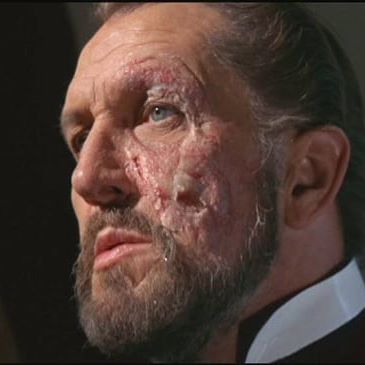
THE first film to co-star Vincent Price and Christopher Lee, Gordon Hessler's THE OBLONG BOX starts in Africa, where Julian Markham (Price) discovers that brother Edward (Alister Williamson) has been cursed by voodoo. Back in England, Julian keeps Edward chained in a remote room of the Markham estate, his mental and physical states disintegrating. However, Edward plans to escape with the help of Trench (Peter Arne), Norton (Carl Rigg) and witch doctor N'Galo (Harry Baird), drugging him to give the temporary appearance of death; once buried, Trench and Norton will exhume the coffin and grant him freedom. But Trench pockets his fee and Edward is actually dug up by grave robbers - replete with coffin - for the use of Dr Neuhartt (Lee). Wearing a crimson hood, Edward vows to repay "some very important debts" while staying with Neuhartt, blackmailing the physician for his liaisons with body snatchers.

Scripted by Lawrence Huntington with "additional dialogue" by Christopher Wickling, THE OBLONG BOX has the thinnest of connections to its source Edgar Allan Poe story (it all owes more to H.P. Lovecraft - with its arcane lore and a disfigured outsider - and Rudyard Kipling's The Mark of the Beast). Originally to be directed by Michael Reeves before his own premature death, to further WITCHFINDER GENERAL connections Price is reunited with Hilary Dwyer as his younger sweetheart Elizabeth, but the actor - originally to play both brothers - looks disinterested and tired. Although beautifully shot by John Coquillon, it is a picture of missed opportunities; Price and Lee only share one scene together despite their marquee value (in fact, Lee's death scene), and the reveal of Edward's condition results in what looks to be little more than a bee-stinged nose, particularly disappointing after its long build-up.

Vincent Price as the diseased Julian Markham. By this stage in his career the actor grew weary of the Edgar Allan Poe adaptations, particularly within the saturation of the late 1960s horror film market.

THE OBLONG BOX belongs to that horror subgenre - THE MUMMY, PLAGUE OF THE ZOMBIES, THE REPTILE, THE GHOUL et al - that echo colonial guilt (remarkably, Hessler's film was banned in Texas for being "pro-Negro"). Julian laments his attitude ("we sinned out there in Africa all right, plundering their land - and we're still stealing their wealth, though they're too innocent to know it") and is revealed to have been the intended recipient of the curse. There is a quiet justice to the conclusion, as Edward bites the hand of his brother, passing on the psoriasis-based condemnation. But ultimately the much re-worked and bloated script carries little gravitas, instead grabbing from more substantive works with no cohesive payoff. This unfocused starting point is further undermined by turgid pacing and padding (the tavern sequences in particular).

Friday, March 15, 2019

Monkey Business

TROG (1970)

TROG is played by Joe Cornelius, a professional English wrestler known as The Dazzler. Cast for his physique and athletic abilities, the "missing link" costume was a salvaged 2001 ape mask and some fur.

HAVING grown up in poverty and suffered abuse as a child, Joan Crawford was famous for her fighting spirit. Directed by Freddie Francis from an original story by Peter Bryan and John Gilling, TROG was Crawford's final film. Concerning the discovery of an Ice Age troglodyte in contemporary Britain, the faded star probably needed her then preferred tipple of vodka to get through the production. As The New York Times stated, "[TROG] proves that Joan Crawford is grimly working at her craft. Unfortunately the determined lady, who is fetching in a variety of chic pants suits and dresses, has little else going for her."

When an ape-man is found in a Peak District cave, anthropologist Dr Brockton (Crawford) brings him back to her lab for study. This is especially irksome for businessman Sam Murdock (Michael Gough), who is equally venomous about a waste of taxpayers money for the research facility, and that Brockton has the audacity of being a woman. As the experiments continue, Trog relives his illogical past copiously illustrated by Ray Harryhausen/Willis O'Brien dinosaur footage from THE ANIMAL WORLD. Murdock remains troubled, particularly when the municipal court (headed by Thorley Walters) sides with Brockton and a now international band of scientists. Enraged, Murdock releases Trog, hoping the caveman will be killed by locals or the authorities.

Trog checks out Joan Crawford's muscles on set; in the picture, even a movie star can't save him in the name of science. However, to be fair, the "monster" does kill four men and a dog, plus kidnaps a child.

Developed by Tigon, the project was sold to American B-movie producer Herman Cohen (who can fleetingly be glimpsed as a barman). But TROG is a hilarious misstep by anyone's standards, the caveman's ramshackle appearance summed up by Inspector Greenham (Bernard Kay), when he states "it looks like something out of a student's rag week." Brightly lit in his cage, fully exposing its contrasting skin tones, Trog's initial training involves winding up a toy doll and swaying lovingly to classical music (his affinity to Brockton's scarf also makes one question his sexuality). But during his climactic rampage more brutish qualities come out, such as spiking a butcher on a meat-hook that predates the infamous scene from THE TEXAS CHAIN SAW MASSACRE.

A guilty pleasure even for the most hardened cult fan, TROG does play a significant role in horror history. A young John Landis saw the picture which led him to make his debut SCHLOCK, a homage where the director played an ape-man emerging from a Southern California cave. Having been a Fox mail-boy Landis knew John Chambers, the make-up maestro behind PLANET OF THE APES. The important thread was that after Chambers declined to make the required monkey man on budgetary grounds, Don Post Studios put Landis in contact with Rick Baker. Baker's suit for "The Banana Killer" is wonderful, and clearly the highlight of the movie.

Friday, March 1, 2019

Films That Vanished

CRUCIBLE OF TERROR (1971)
SCREAM - AND DIE! (1973)


In the same year as being burned at the stake in TWINS OF EVIL, Judy Matheson gives a memorable performance in the disposable curio CRUCIBLE OF TERROR.

THESE two Seventies horrors are hardly forgotten gems, more underrated guilty pleasures. Ted Hooker's CRUCIBLE OF TERROR tells of painter and sculptor Victor Clare (former pirate radio DJ Mike Raven), who lives in isolation above a disused Cornish tin mine with his troubled wife Dorothy (Betty Alberge) - who has regressed to a second childhood because of Clare's bullying and womanising - and Bill (John Arnatt), Victor's only friend and household cook. Victor's speciality is making bronze statues from murdered young women, which is rekindled when art dealer Jack Davies (James Bolam) and Clare's son Michael (Ronald Lacey, of RAIDERS OF THE LOST ARK fame) arrive with their wives Millie (Mary Maude) and Jane (Beth Morris). The artist's current muse Marcia (the extraordinary Caroline Munro lookalike Judy Matheson) is a constant presence, but as Jack and Michael try to acquire more pieces for their gallery, the power of possession ultimately trumps the body count.

After appearing in LUST FOR A VAMPIRE and I, MONSTER, Raven was the self-styled "next big thing" in British horror. Such a deluded reputation was severely dashed with this Glendale release (and a yearning that became terminal with his next attempt, the Super 16mm DISCIPLE OF DEATH). Afterwards, Mike retired to become a sheep farmer and sculptor in Bodmin; his distant acting style wanted to draw from Roger Delgado and Christopher Lee, but a more legitimate nod to Hammer's legacy here is the casting of Melissa Stribling, appearing as an art backer. The supernatural conclusion seems a little forced, especially after suffocation by plastic cushion, a screwdriver stabbing, rocks to the head and acid in the face, but the dialogue is priceless and the photography bracing.

Israeli poster for Joseph Larraz's dreamlike SCREAM - AND DIE!

In between his early psycho-thrillers and descent into late 70s Eurosmut, Barcelona-born Joseph Larraz helmed slow-burning British classic SYMPTOMS and perennial cult favourite VAMPYRES. He also made the sluggish English giallo SCREAM - AND DIE!, which is also known as THE HOUSE THAT VANISHED and DON'T GO IN THE BEDROOM. The film opens with glamour model Valerie Jennings (Andrea Allan) witnessing a murder in a fog-enveloped country house. After boyfriend Terry (Alex Leppard) goes missing and her flatmate Lorna Collins (an all too briefly used Judy Matheson) is raped and killed, Valerie discovers that her fresh-faced, mask-making compatriot Paul (Karl Lanchbury) is the culprit. 

Larraz started his career as a comics artist, specialising in action adventures. With a leap to script writing and directing, he attempted to rise above the too-generalistic term Eurotrash Cinema, and even today his output feels under analysed and under appreciated. Allan and Matheson make for alluring beauties, but the nudity doesn't stop there; the film is most (in)famous for sex involving Paul and his aunt Susanna (Maggie Walker). This being Larraz, the sequence holds a real sensual charge, and creeping use of British locations in winter add to the building bursts of depravity. The characters are unrealistic - Valerie brushes aside the missing Terry and the brutal demise of Lorna - yet this adds to an otherworldly canvas which even includes a nude woman and a monkey.