Tuesday, November 9, 2010

Planet of Gold

DOCTOR WHO - REVENGE OF THE CYBERMEN (1975)

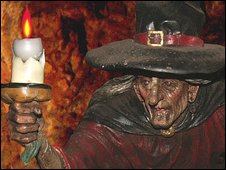
The highlight of this serial is its location shooting at Wookey Hole, home of the Witch of Wookey. A chagrined woman, she used her arts to blight girls' lives and keep them from the joys denied to herself. Turned to stone by the Holy Clerk of Glastonbury, the Witch still haunts the caverns.

THE Time Ring takes the Doctor (Tom Baker), Sarah (Elisabeth Sladen) and Harry (Ian Marter) back to the space station Nerva, but to a period many thousands of years earlier than their visit in THE ARK IN SPACE. The station is acting as a beacon warning space traffic of the existence of a new asteroid orbiting Jupiter, Voga, the planet of gold. A plague has killed all but a handful of Nerva's crew and visiting civilian scientist Kellman (Jeremy Wilkin) is in fact a traitor working with a group of Cybermen, who want to destroy Voga as gold dust can coat their breathing apparatus (and the plague is the result of poison injected by Cybermats). Kellman however is a double agent, working with one faction of the Vogan, whose plan has been to lure the Cybermen onto the beacon and destroy them with a rocket.

A weak link in DOCTOR WHO's excellent twelfth season, REVENGE OF THE CYBERMEN is nevertheless fondly remembered as the initial Cybermen serial in colour, as well as being the first commercially available story released on VHS in 1983. Scripted by Gerry Davis - who had devised the monsters with Kit Pedler - the tale has long been a guilty pleasure for Whovians. The four-part adventure features an alarming array of double entendre, knowingly enjoyed by cast and crew alike. "Take the Cybermen from behind," "we're still heading for the biggest bang in history," and "pull it harder, it's coming" are typical examples, and the black-helmeted Cyberleader (Christopher Robbie) is unintentionally hilarious; often arms on hips, his strangulation of the Doctor looks more like a Swedish massage. Sladen's experience of her attack by a limp Cybermat - which had to be hugged to make them seem even remotely threatening - led her to decide to quit the series, only for the actress to thankfully reconsider once the show moved onto much better-realised productions.

Chris Achilleos' cover for the Target novelisation of REVENGE OF THE CYBERMEN (#51, May 1976), written by Terrance Dicks.

The Vogans are an interesting addition to the series' mythology and can be seen as an allegory of 1970s Britain - a power that was once great but is now bitterly divided over how to exploit its remaining resources. But the story is spoiled by the titular menace; it may have been a return for the Cybermen after a long hiatus (they were last seen in 1968's THE INVASION), but they appear uncharacteristically emotional and have terrible dialogue. The idea of them being susceptible to gold dust is also less than inspired; previous entries have shown them to be vulnerable to radiation, solvents, gravity, low temperatures, electric currents, force fields, emotional impulses and grenades, and the revelation of this latest weakness only serves to further reduce their potency. This ineffectiveness is underpinned by the Doctor's outburst "you're nothing but a pathetic bunch of tin soldiers skulking about the galaxy in an ancient spaceship," a viewpoint reinforced by subsequent appearances.

Wookey Hole was an inspired choice of location for Voga. The show caves had gained a reputation for being haunted by a Dark Ages Witch, now petrified as one of the cave's rock formations, and stories of the serial's curse are more interesting than the programme itself. While scouting, director Michael E. Briant's wife discovered several Iron Age arrowheads, which she kept as mementos. This precipitated a chain of strange occurrences which beset the production, which began when Briant encountered a potholing ghost. Potentially the most serious incident occurred after certain crew members disobeyed instructions and interfered with the "Witch" formation. During the afternoon's shoot a boat driven by Sladen on the "Witch's Parlour" went haywire, forcing the actress to jump overboard to avoid smashing into a cavern wall.

Monday, November 1, 2010

The Beast Within

THE BEAST MUST DIE (1974)

Time is running out for Peter Cushing's Norwegian accent during
the infamous "Werewolf Break" of Amicus' cult curio.

AMICUS' THE BEAST MUST DIE mixes Blacksploitation, THE AVENGERS and Agatha Christie in an uproariously silly production made at the height of British horror desperation. Tom Newcliffe (Calvin Lockhart) is a black millionaire big game hunter whose elaborate mansion security system - run by Pavel (Anton Diffring) - has been constructed to keep tracks on a potential prized conquest, a werewolf. Newcliffe explains that his guests have been invited for one reason only – one of them is a lycanthrope. Everyone has a suspect past: outrageously accented Dr Lundgren (Peter Cushing), concert pianist Jan Jarmokowski (Michael Gambon) and socialite girlfriend Davinia (Ciaran Madden), artist Paul Foote (Tom Chadbon), and diplomat Arthur Bennington (Charles Gray) all have places at the table. Also, could the werewolf be Caroline (Marlene Clark), Tom's wife?

Adapted from James Blish's 1950 novelette There Shall Be No Darkness, THE BEAST MUST DIE was Amicus' last horror. Directed by Paul Annett - who devoted most of his career to television - the film plays more like a made-for-TV movie with obvious budgetary constraints: the werewolf is actually an Alsatian. A Valentine Dyall voice-over tells us to "watch for the werewolf break," so the viewer can contemplate their own decisions who is the shape-shifter. When it actually arrives it is a 30 second William Castle-style gimmick, but the whole premise is self-defeating, as the film does not portray any legitimate structure for sleuthing; everyone has been portrayed as being as guilty as everyone else, which rather debunks that the picture is "a detective story – in which YOU are the detective."

To illustrate the ramshackle nature of the production, even the werewolf in this one-sheet isn't actually from the project, rather an image from Universal's THE BOY WHO CRIED WEREWOLF.

THE BEAST MUST DIE's werewolf lore is also confusing, mixing wolfs bane, lymph glands and everyone's favourite party game Pass the Silver Candlestick. The performances range from the sublimely ridiculous to the ridiculous, and amazingly Lockhart was the first black actor to play leads with the Royal Shakespeare Company. Newcliffe's statement "Money buys…. things…." is as profound as the character gets, with the actor delivering his lines like Thornton Reed in GARTH MARENGHI'S DARKPLACE. Of the other cast members Gray is suitably slimy, Cushing uses the term "transmogrification" to prove he is a scientist, and Gambon's slightly troubled expression doesn't change throughout, even when playing out one of the most tedious car chase scenes in 1970s cinema.

Sunday, October 10, 2010

A Hammer Miscellany

THE HOUND OF THE BASKERVILLES (1959)
THE CURSE OF THE MUMMY'S TOMB (1964)
THE LEGEND OF THE 7 GOLDEN VAMPIRES (1974)

In THE HOUND OF THE BASKERVILLES, Marla Landi plays the tempestuous Cecile, descendant of Sir Hugo Baskerville. A Hammer vampire without the fangs, Cecile is the Fatal Woman of Gothic literature. Her introduction - waiting bare-legged to lead men to their marshy doom - is one of the great images of the Hammer oeuvre.

THESE Hammer releases typify their output by decade: the vibrant late 1950s, the rigor mortis that set in during the 1960s, and the experimental death throes of the 1970s. THE HOUND OF THE BASKERVILLES is steeped in sexual unease and the oaken veneer of English nobility, making it the clearest demonstration of the studio's class-conscious approach to horror. The transportation of Arthur Conan Doyle to the bloody red Hammer universe is dubious as an adaptation but successful as a blend of murder mystery and terror. To move the 1902 source novel closer to the Hammer template, liberties are made with the dialogue; Sherlock Holmes (Peter Cushing) is given several lines which seem to have strayed from the Van Helsing phrasebook, and Doctor Watson (Andre Morrell) provides a brief nod to Jack the Ripper when he reflects that the escaped convict Selden (Michael Mulcaster) "murdered a number of street woman."

Though meeting with a mixed reception at the time, Cushing's master detective looks very much the ideal incarnation. Cushing's suitably gaunt Holmes - the actor fortuitously losing weight after a mild bout of dysentery while making JOHN PAUL JONES in Spain - mirrors many traits of Van Helsing and Baron Frankenstein: the furious concentration, the fervor of his convictions, an impatience for fools, and a physical dynamism. A life-long Conan Doyle fan, poor box office halted Cushing starring in a series of Hammer Holmes pictures, thus limiting the imperious actor's popularity with retreads of Dracula and Frankenstein.

Peter Cushing seemed a natural for the part of Sherlock Holmes. Cushing also played the detective in the BBC series Sir Arthur Conan Doyle's Sherlock Holmes and Channel 4's The Masks of Death, portraying Holmes in old age.

THE HOUND OF THE BASKERVILLES bristles with life whenever Cushing is on screen, and it is to the film's detriment that the actor isn't visible enough. Absent from the 17th century prologue - which has Sir Hugo Baskerville (David Oxley) roasting a manservant in the fireplace as a prelude to gang rape of the victim's daughter - Holmes also vanishes for most of the second act. Cushing's commanding and flamboyant lead is the only portrayal whose goodness is more assertive than his eccentricities, and the only one who seems bright rather than odd or remote. Also, Morrell's Watson is closer to Conan Doyle's perception than any other: conservative but observant, aging but not yet incapable. Of the other cast members, Milles Malleson is a hoot as the sherry-guzzling Bishop, and Christopher Lee gives one of his most sympathetic and subtle performances as the beleaguered Sir Henry Baskerville.

THE HOUND OF THE BASKERVILLES remains one of the most entertaining of all Sherlock Holmes films, as well as being the first ever in colour. Jack Asher's Technicolor camerawork gives the work a rousing and surprisingly sensual feel; in the interiors, vivid reds (Sir Hugo's hunting jacket) and blues (the gloom of Baskerville Hall) are striking, and exterior scenes of Dartmoor have an autumnal, shrivelled state odd for the Summer setting. With battle lines so clearly drawn between Holmes's rational milieu and the dark cruelty behind the Baskerville legend, director Terence Fisher is in his element. The detective is the perfect Fisher hero, the Renaissance scholar with mystical undertones who, like Van Helsing, marks a liaison between orthodox religion and the science of detection.

For THE CURSE OF THE MUMMY'S TOMB, stuntman Dickie Owens makes the automaton pathetic rather than tragic, and without Christopher Lee under the bandages, Owen's eyes remain dead and expressionless.

A follow-up to THE MUMMY was long overdue, but THE CURSE OF THE MUMMY'S TOMB is a poor relation to Fisher's original. Produced, directed and written (as Henry Younger) by Michael Carreras, the film ties together the those-who-defile-the-tomb-shall-die scenario with the tale of Adam Beauchamp (Terence Morgan) - the cursed-to-immortality brother of Mummy Ra-Antef (Dickie Owens) - who needs to bring Ra back to life as he can only die at his hand. Beauchamp may produce a speech about how tired he is by witnessing three thousand years of man's inhumanity to man, but in 1900 he still takes time in seducing Annette (Jeanne Roland) away from her fiance John Bray (Ronald Howard).

THE CURSE OF THE MUMMY'S TOMB is a B-movie programmer which highlighted the extent to which Hammer were struggling to inject any inspiration into their early 60s horrors. This was not helped by Carreras' typically deadpan helming and the prodigal son's frustrated ambitions to move the studio away from its roots to more fantasy material. The original screenplay was suitably fantastic, which told of a group of archaeologists discovering an ancient tomb in the Sahara Desert and unleashing a giant Mummy which trashes Cairo. Unsurprisingly this draft was swiftly sidelined, though the pre-production image of a gargantuan Mummy clutching a girl was retained for the finished film's poster.

Julie Ege plays Vanessa Beren - a wealthy widowed suffragette who funds an expedition to exorcise evil - in the delirious THE LEGEND OF THE 7 GOLDEN VAMPIRES.

The comic relief is tedious, and the characters are cardboard throughout. Carreras has called Roland's performance "ornamental," but the twenty-one-year-old Anglo/Burmese model/non-actress doesn't even reach that level. When the film opens with her father's brutal slaying, Annette is hardly upset at all, preferring to spend the rest of the picture swooning after Beauchamp. Howard – who was close to fifty at the time – is far too old for the role of "intrepid young Egyptologist," and Fred Clark's crass, P. T. Barnum-like promoter Alexander King is irritating, but even so is the liveliest thing in the film. THE CURSE OF THE MUMMY'S TOMB leaves a bad taste in the mouth because, for all its mediocrity, the murder scenes are eerily memorable. The attacks are not staged with the vigor of Fisher, but instead are bludgeoning sadistic: archaeologist Sir Giles Dalrymple (Jack Gwillim) is hammered to death with a small statue of an Egyptian cat goddess, and George Pastell - playing a sympathetic Egyptian official after his high priest role in THE MUMMY - willingly sacrifices himself to Ra-Antef in a skull-crushing scene that ranks amongst Hammer's most vicious.

Billed as "The First Kung-Fu Horror Spectacular," THE LEGEND OF THE 7 GOLDEN VAMPIRES - directed by Roy Ward Baker - was Hammer's uneasy co-production with Run Run Shaw, a leading light in the Kowloon-based Shaw Brothers company. Not originally written as a Dracula film, the hasty prologue sees The Count (James Forbes-Robertson, thanklessly replacing Christopher Lee and looking like a drag queen) revived by Kah (Chan Sen). Dracula possesses Kah's body and returns to the village of Ping Kuei, where he commands the Seven Golden Vampires, who raid the town and harvest the blood of naked woman in a blood trough - eight gullied slabs arranged like petals around a central, bubbling cauldron. Lecturing at China's Chung King university, Professor Van Helsing (Peter Cushing) is approached by student Hai Ching (David Chiang), a native of Ping Kuei, for his help. The film benefits from a powerful James Bernard score and John Wilcox's Panavision framing, but is structured more like a Western than a Horror or Kung-Fu film. THE LEGEND OF THE 7 GOLDEN VAMPIRES possesses an entertaining air of derring-do, but ultimately acts as a substantial fall from grace for the often operatic Hammer vampire film. 

Friday, October 1, 2010

Houses of Horrible

BLOODBATH AT THE HOUSE OF DEATH (1983)
DR TERRIBLE'S HOUSE OF HORRIBLE (2001)

"What in hell is going on at Headstone Manor?" One of the most baffling things about BLOODBATH AT THE HOUSE OF DEATH is why Cleo Rocos doesn't take her clothes off.

BY 1983, Kenny Everett was one of the major stars of British television. Made to exploit this popularity, BLOODBATH AT THE HOUSE OF DEATH is a brave failure that sees the zany comedian play Dr Lukas Mandeville - a former surgeon with an on-off German accent and a metal leg - the spearhead of a group of scientists sent to investigate the strange activity at Headstone Manor ("Businessman’s Weekend Retreat and Girls’ Summer Camp"). Unknown to them, their presence is about to incur the wrath of a local coven of bumbling but determined Satanists, led by a 700-year-old disciple known only as The Sinister Man (Vincent Price).

Written by Ray Cameron and Barry Cryer, the film flopped disastrously in Britain but was a box office hit down under; in an interview to promote the film on Australian television, Everett attributed its lack of home-ground success to the fact that the British "have no class." But the main reason was the suicidal decision of giving the film an 18 certificate, alienating Everett's young fans but simultaneously fully exploiting its tit humour and comedic gore; in a tour-de-force scene of excess, for example, Mandeville attempts to retrieve his monocle after it drops into his patient during a flashback surgery sequence.

The Countess (Ronni Ancona) bares her fangs in Lesbian Vampire Lovers of Lust, from DR TERRIBLE'S HOUSE OF HORRIBLE.

BLOODBATH AT THE HOUSE OF DEATH is best viewed through a nostalgic haze; its all a juvenile mess, but an entertaining one, leading to a suitably perplexing climax. The cast is a checklist of familiar faces; the "distinguished international team of specialists" include Gareth Hunt and Don Warrington as the most bemused-looking gay couple in cinema history, Sheila Steafel as a butch lesbian, Pamela Stephenson, John Fortune, and Cleo Rocos, the latter redefining the meaning of non-actress. The film also revels in a lengthy list of movie parodies: Steafel in a school uniform (CARRIE), Stephenson being invisibly raped (THE ENTITY), a public house straight out of AN AMERICAN WEREWOLF IN LONDON, and Everett writhing on the table like John Hurt in ALIEN, before finding relief in a prolonged belch. 

When Steve Coogan's DR TERRIBLE'S HOUSE OF HORRIBLE first aired on the BBC in the winter of 2001, critical and public reaction was muted. Fans expecting a comedy akin to Alan Patridge were instead confronted with six quality homages to 1960s and 70s British horror, brimming with in-jokes and notable guest stars. And Now the Fearing apes the Amicus anthology, Frenzy of Tongs takes us back to yellow peril potboilers, and Curse of the Blood of the Lizard of Doom parodies the scientific-experiment-gone-wrong sub-genre. Lesbian Vampire Lovers of Lust is a sumptuous ode to the 70s Hammer vampire canon, Voodoo Feet of Death takes on the body-part-transplant movie, and Scream Satan Scream! is firmly ensconced in Tigon territory. Unlike the buffoonery of BLOODBATH AT THE HOUSE OF DEATH, there is a genuine love for the material being spoofed, which makes the series an incredibly affectionate viewing experience.

Friday, September 10, 2010

Nine Eternities in Doom

THE ABOMINABLE DR PHIBES (1971)
DR PHIBES RISES AGAIN (1972)

An iconic shot of Vincent Price as THE ABOMINABLE DR PHIBES. This cult favourite holds the distinction of being the film Who drummer Keith Moon was watching during his drug overdose of 1978. 

SINCE making WITCHFINDER GENERAL, Vincent Price had increasingly become an indigenous part of British productions at a time of declining audiences and stale output. American International Pictures had disengaged itself from further co-projects with Hammer after THE VAMPIRE LOVERS, but AIP was in danger of becoming just as out of touch with its core audience. Music had replaced movies as the premier entertainment for the young, and in July 1970 the BBFC had raised the age limit on X certificates from 16 to 18 years, enabling filmmakers to exploit a more liberal censorship regime and produce more lurid output to lure audiences back into theatres. Although THE ABOMINABLE DR PHIBES was a return to horror epitomised by HOUSE OF WAX in its Grand Guignol, it chimed with a prevailing mood among disenchanted youth, as Dr Phibes was seen to champion a lost ideal, making a last stand against impersonal capitalism. Additionally, its concept of nine murders in a single story - one per reel - would later become integral to the slasher boom.

This short lived series - both directed by Robert Fuest - is often applauded for giving Price the classic monster role his career had previously lacked, but the two titles can also lay claim to evoking the black humour of James Whale and even Monty Python (in THE ABOMINABLE DR PHIBES, Inspector Trout (Peter Jeffrey) is addressed as Pike or Bream). This first film sees Phibes - a hideously disfigured musical genius and doctor of theology - enacting an elaborate vendetta against the surgical team whom he holds responsible for the death of his wife Victoria (Caroline Munro), contriving their deaths to accord with the curses inflicted on the Pharaohs by Moses in the book of Exodus. Exactly why Phibes should choose to inflict Hebrew curses is never explained, though their nature would fit his raison d'etre of elaborate murder. This lack of detail is synonymous with the two movies, further illustrated by Phibes' sketchy survival from a car crash, and the origins of his mute female assistant Vulnavia (Virginia North).

Vulnavia (model and artist Valli Kemp) is summoned from the netherworld to aid Dr Phibes' Egyptian expedition in DR PHIBES RISES AGAIN.

As Phibes, Price contrives to tip a wink not only at his horror heritage, but also at his celebrity as an art authority; having drained every drop of blood from Dr Longstreet (Terry-Thomas), Phibes glides out of shot, only to glide back in to tut over his victim's taste in visual artifacts. Yet for its colourful touches and opulent production design, THE ABOMINABLE DR PHIBES is a shallow experience, undermined by its dramatis personae: the victims are only present as a prelude to their inventive deaths, and there are at least twice as many comedy police inspectors that are strictly necessary. Only Joseph Cotton - as Dr Vesalius - lends any gravitas to his role.

For DR PHIBES RISES AGAIN, the mad doctor is pitted against an adversary of similar cunning and intent, Biederbeck (Robert Quarry), who has been artificially sustaining his youth (which, again, is never fully explained). The film contrives to engineer Phibes' return but not that of Vulnavia (Valli Kemp), who is now represented as an ethereal spirit to be invoked at will. The elegant interiors of the first film are replaced by pastiche - Victoria's coffin sporting radiator grilles of a Rolls-Royce - and the sequel's obsessing over a sacred relic is the derivative stiff of Universal Mummy movies, not for the sophistication of Phibes. However, the film is buoyed by some notable guest appearances, such as Peter Cushing (intended as Vesalius for the first film) and Beryl Reid.

Wednesday, September 1, 2010

Derbyshire Dead

THE LIVING DEAD AT MANCHESTER MORGUE (1974)

Guthrie enjoys a liver in a film which has been released as BREAKFAST AT MANCHESTER MORGUE, LET SLEEPING CORPSES LIE and DON'T OPEN THE WINDOW.

IF you are looking for a connection between the trend-setting undead films of George A. Romero and the abstract-effectiveness of Lucio Fulci, Catalonian director Jorge Grau's THE LIVING DEAD AT MANCHESTER MORGUE acts as that bridge. This cult Spanish/Italian oddity can also be viewed as one of those releases - similar to Alfonso Cuaron's CHILDREN OF MEN and Juan Carlos Fresnadillo's 28 WEEKS LATER - that sees our green and unpleasant land with a quirky yet lovingly distant eye. The film isn't set in Manchester - though there are glimpses of Deansgate and John Dalton Street - most of the film is in fact shot in various locations around Derbyshire. Like many foreign filmmakers, what Grau finds is a stuffy environ on the verge of chaos and, in this sense, THE LIVING DEAD AT MANCHESTER MORGUE is a worthy addition to those other extraordinary views of this decaying country by great directors: FRENZY, STRAW DOGS and A CLOCKWORK ORANGE.

The movie begins as George (Ray Lovelock), an antiques dealer, has his motorbike damaged at a gas station by Edna (Christine Galbo), a nervous woman en route to her sister Katie (Jeannine Mestra)'s farmhouse in Southgate. While giving George a lift, Edna is attacked by a recently drowned homeless man Guthrie (Fernando Hilbeck), when the antiques dealer is asking directions from Ministry of Agriculture scientists who are field-testing experimental ultrasound equipment to rid crops of insects. These sonic tremors, however, have begun to revive the recently buried dead. The couple arrive at the farm to see Edna's brother-in-law Martin (Jose Ruiz Lifante) killed by Guthrie, where bigoted Irish Police Inspector McCormick (Arthur Kennedy, sporting a typically colourful accent) takes one look at George's long hair and beard - and the obvious signs of Katie's heroin addiction - and comes to a much more straightforward conclusion.

Vito Salier as the autopsy zombie of Southgate Hospital.

Grau provides the first colour treatment of the generic possibilities from Romero's NIGHT OF THE LIVING DEAD, while also anticipating the Pittsburgh director's developing social criticisms. McCormick despises any form of non-conformity - hippies, drugs, et al - placing the blame for the events squarely on our young leads. The idea that the police might pose as much of a threat as the zombies is rather apt considering that the film was released at a time when the UK constabulary were something of a law unto themselves. This uncompromising view of the Manchester police force will strike a chord with anyone who remembers that city's notorious Chief Constable James Anderton, who conducted a personal fatwa against pornography and once accused AIDS victims as "swirling in a cesspit of their own making." There is also a staunch pro-environment message; as well as the radioactive bug zapper, we see shots of nuclear power plants, crumbling buildings, gloomy riversides and rundown hospitals - suggesting a world dying under the influence of crass corporate and industrial practices.

THE LIVING DEAD AT MANCHESTER MORGUE is more sedate and low-key than Romero, channelling a steady accumulation of incidents and detours enveloped by a genuinely weird soundtrack of unnerving hums and distorted breathing. There are oddball elements - a busty female streaker, with two fingers held aloft in the traditional peace sign, jogs through traffic attracting little attention from the jaded motorists; the notion that the zombies can “create” members of their brood by the application of blood to the eyelids - but since Grau keeps everything else grounded, we buy their overall non-believability. In the satisfying twist ending, when the undead George takes revenge on McCormick, Grau asks the viewer to align with the zombies as a retributive force that needs to be unleashed.

Saturday, August 7, 2010

Alien Encounters

PREY (1977)
LIFEFORCE (1985)


A dog-nosed alien terrorises rural England in PREY, the strangest British horror movie of all time.

EXISTING in tandem with Hammer's decline was a vibrant sub-culture of independent filmmakers working with minuscule budgets but inspirational levels of enthusiasm. One such director was Norman J. Warren, who followed SATAN'S SLAVE with PREY, shot in ten days at Shepperton for around £50,000. A triumph of minimalism, with a principal cast of three, the film is the story of hesitant shape-shifting alien Kator (Barry Stokes), who adopts a human guise (and the name Anderson) from his first victim and finds himself stranded on Earth in the care of an unstable lesbian couple in their isolated home: possessive Josephine (Sally Faulkner) and childish Jessica (Glory Annen). Unnervingly bleak, PREY plays out its bizarre triangle with several moments of inspired weirdness: Anderson is forced to dress as a girl for a highly uncomfortable dinner party, and when the alien discovers he cannot walk on water, there is a seemingly endless slow-motion struggle in an improbably filthy stream. And when Anderson finally gets to go to bed with Jessica, Warren unleashes a truly shocking entrail-wreathed climax.

Josephine is more sinister than the alien, and has already killed one of her lover’s potential male suitors; Faulkner doesn't overplay this, and keeps the character at least two steps from insanity. PREY was Annan's first movie and despite a very halting style of delivery it is appropriate that she doesn't have the strength of Faulkner. Stokes is also memorable, his limited resources as an actor paying dividends where he's meant to seem awkward and an outsider. When he changes into his true form, however, Stokes looks less like a dangerous alien than a badly made-up dog on children's television. But considering the budget and the schedule, PREY is astonishingly effective and certainly deserves more attention. It’s also got one of the great final lines of any British horror movie.

Mathilda May's background in ballet lends her a certain onscreen elegance in the SF fiasco LIFEFORCE.

LIFEFORCE (commonly known as Lifefarce) is a film light years away from the intimate inventiveness of PREY, so conceptually ambitious that it bites off far more than it is ever capable of coherently presenting. Loosely based on Colin Wilson's 1976 novel Space Vampires, its tale of three sleeping humanoids brought back to Earth and draining London of its lifeforce plays more like a Quatermass scenario. Directed by American maverick Tobe Hooper, the film is remembered mostly for French actress Mathilda May - billed as Space Girl - who spends the entire film undressed. May is possessed of such a spectacularly statuesque physique that she could probably have conquered all of mankind even without her special talents, which include a form of electroshock vampirism and the ability to inhabit other bodies.

Hooper pays homage to his hosts, drawing on the British tradition of sci-fi drollness (tea is served as the country burns to a crisp), and much of its wryness is in the sincere performances: Peter Firth representing military authority and Frank Finlay playing the scientist ("well, in a sense, we are all vampires"). Producers Menahem Golan and Yoram Globus sank a then substantial $25 million into the production, clearly seeing LIFEFORCE as the next SF blockbuster. Hiring ALIEN co-scripter Dan O'Bannon and STAR WARS visual supremo John Dykstra, the film however was a box office disaster. In fact, LIFEFORCE and Hooper's other two Cannon projects - the INVADERS FROM MARS remake and THE TEXAS CHAIN SAW MASSACRE 2 - ended up almost single-handedly sinking Cannon's finances and forced Golan and Globus to declare bankruptcy by the 1990s.

Sunday, August 1, 2010

"It's in the trees ... it's coming!"

NIGHT OF THE DEMON (1957)

Despite being book-ended by appearances of a crudely
animated monster, NIGHT OF THE DEMON
is an effective exercise in atmosphere.

IN 1957, British horror cinema exploded into life with the garish, Eastmancolour THE CURSE OF FRANKENSTEIN. Terence Fisher's box office sensation was the starting point of Hammer's domination, but Jacques Tourneur's NIGHT OF THE DEMON - which started filming on the same day as Fisher's classic - was shot in black and white, and unlike Hammer's emphasis on physical violence, owes more to the power of suggestion. Tourneur's stylish project - an adaptation of M.R. James' Casting the Runes - predicted an anti-Hammer stance in the early 1960s that produced a triumvirate of successful monochrome horrors based on works of supernatural fiction: THE INNOCENTS (from Henry James' Turn of the Screw), NIGHT OF THE EAGLE (from Fritz Leiber's Conjure Wife) and THE HAUNTING (from Shirley Jackson's The Haunting of Hill House).

Scenes such as the storm invoked by black magician Julian Karswell (Niall MacGinnis), dressed in clown's makeup for a children's Halloween gathering, are genuinely unsettling, and this garden party suddenly interrupted by demonic intervention anticipates THE OMEN. As in that film, the leading protagonist is an American - here, Dr John Holden (Dana Andrews) - coming to terms with what he initially sees as bunkum. This theme of the modern, rationalist American adrift in a world of superstition can be traced through several films, including AN AMERICAN WEREWOLF IN LONDON, and even back to Universal's cycle of the 1930s and 1940s, were settings were often in generic old Europe.

Columbia's 2002 R1 DVD of NIGHT OF THE DEMON was sold as a "double feature" with CURSE OF THE DEMON, the film's Americanised, truncated version which cut fourteen minutes from the running time.

Screenwriter Charles Bennett crafts a meditation on the conflict between science and superstition, embodied by the personality clashes between Andrews' psychiatrist and MacGinnis's occultist. One of James's most important achievements was to redefine the ghost story by dispensing with many of the Gothic trappings of his predecessors, and replacing them with more realistic, contemporary settings. By using this trait cinematically, NIGHT OF THE DEMON sometimes seems somewhat dry, but this is a small price to pay for a movie that takes its subject matter with an utter conviction rarely seen.

Tourneur was a master of implied terror, his visual style the perfect film equivalent of James' prose; Holden's eerie encounters alone in forests, empty hallways and desolate farmhouses evoke a paranoid atmosphere. Ken Adam's production design is an effective blend of British antiquity and modernism, rendering library corridors and railway carriages as endless passages which need to be conquered. It has become a cliche to point out that Tourneur cut his directorial teeth on three of producer Val Lewton’s brooding 1940s horrors (THE CAT PEOPLE, I WALKED WITH A ZOMBIE, THE LEOPARD MAN), but NIGHT OF THE DEMON seems to be Tourneur's attempt to recreate the Lewton formula: the emphasis on solid scripting, the use of shadows, and belief versus skepticism. But none of the Lewton-produced films ever endorsed the supernatural; in fact, such beliefs were often equated with mental illness. Holden is not portrayed as a man sinking into madness; in fact, acting on his new-found knowledge saves him from death, and it is interesting that Andrews' wooden performance loses up as he gets closer to supernatural enlightenment.

Video Watchdog #93 (March 2003) featured a "duelling critics" piece where Kim Newman and Bill Cooke assess Columbia's DVD release, as well as detailed analysis by Cooke of the cuts made to produce CURSE OF THE DEMON.

A 1960s Mad magazine article pointed out that movie heroes and villains often act against type: villains are courteous, charming and open-minded, while heroes are bad-tempered, bigoted and thuggish. NIGHT OF THE DEMON illustrates this theory expertly. James' Karswell is a melodramatic character akin to George Zucco, but MacGinnis plays the Devil-bearded disciple with a touch of Celtic whimsy, treating his enemies with exaggerated politeness. The odd relationship between Karswell and his mother (Athene Seyler) is one of the many off-beat aspects of the film, suggesting that the magician is an insecure mother's boy who shows none of the insidious interest in the opposite sex so commonly demonstrated by screen devil worshippers. This hint of homosexuality doesn't progress further, leaving Karswell as a paunchy, balding character whose resemblance to Aleister Crowley is closer than any other actor.

Tourneur crafted NIGHT OF THE DEMON to exist in a shadow world which would evoke feelings of dread through expressive lighting and sound rather than any sensationalised effects such as a man in a monster suit. Bowing to pressure from executive producer Hal E. Chester, the director agreed to reveal the demon for a few frames in the finale. Much to Tourneur and Bennett's horror, Chester re cut the film so that Karswell's fire demon (a combination of a puppet, suit and a mechanical bust influenced from medieval woodcuts) was shown extensively at the beginning and end of the feature, and was on all publicity materials. For decades, the debate has raged whether Chester's use of the demon cheapens or enhances the overall product. Dubbed as a "monumental blunder" and "atrocious," the monster is over-used at the climax, but overall beneficial to the narrative though not perhaps the overall facade.

Sunday, July 11, 2010

The Circus of Nights

VAMPIRE CIRCUS (1971)

Bald, naked and coated in body paint, Serena is the Tiger Woman.

AS Hammer entered its wilderness years, Robert Young's VAMPIRE CIRCUS rediscovers the studio's vigour. Picking up the gauntlet thrown down by TWINS OF EVIL, this offering pushes Hammer further into the softcore sex and copious bloodletting required to maintain interest amongst pictures made outside of Elstree. Despite the film being Young's first picture, and the inevitable delays resulting from the extensive use of animals, Michael Carreras pulled the plug on the unfinished production when it had reached the end of its six-week shoot. The footage was subsequently spliced together, creating a Euro-horroresque charm of its own.

Opening with a twelve minute prologue which plays like a featurette, in 1810, vampire Count Mitterhaus (Robert Tayman) and his mistress Anna Mueller (Domini Blythe) are apparently destroyed by the villagers of Schtettel. Fifteen years later the village is riven with plague and quarantined, and The Circus of Nights, led by an enigmatic gypsy woman (Adrienne Corri), arrive to entertain the villagers nightly with a Tiger Woman (Serena), a Panther Man (Anthony Corlan), twin acrobats Heinrich (Robin Sachs) and Helga (Lalla Ward), and a clown dwarf (Skip Martin). In fact the troupe are undead, shape-shifting relatives of Mitterhaus, who seduce and procure the blood of the local young to resurrect him.

Written by Steve Parkhouse and illustrated by Brian Bolland, VAMPIRE CIRCUS was adapted into comics for The House of Hammer #17 (Feb 1978).

The Circus of Nights ("A hundred delights!") is one of the most subversive takes on the essential innocence of the carnival ethos. The villagers gasp in amazement at the antics of the troupe, and even though the performers change into bats and black panthers before their eyes, they take a remarkably long time to react to their visitors true nature. The villagers are portrayed as generally deserving of the various fates that the vengeful vampires see fit to bestow upon them. The undead are predominantly young, talented and sexy, whereas the town folk are sexually repressed, middle-aged, unattractive and riddled with fears and prejudices. When Anna watches her lover feed from the throat of a young girl in the prologue, watching in voyeuristic ecstasy in a prelude to making love with Mitterhaus, there is no question that she is truly liberated.

VAMPIRE CIRCUS is one of the few British horror films to understand the difference between nudity and eroticism. Not only does it break the taboo of unleashing violence to young children - a scene where two boys are lured to The Mirror of Life is particularly uncomfortable - it dares to be homoerotic, suggestively bestial and incestuous. Because of such lurid material the film has gone unappreciated, but this may be underscored by the lack of a name horror star. Laurence Payne's world-weary schoolmaster, the central heroic figure, only receives sixth billing in a large cast which includes David Prowse unsurprisingly as the circus strongman, Thorley Walters as the bumbling Burgomeister, John Moulder-Brown as the most unconvincing romantic lead in the whole Hammer canon, and Lynne Frederick as Dora.

Thursday, July 1, 2010

Queen of Darkness

BLOOD FROM THE MUMMY'S TOMB (1971)

Valerie Leon enjoys British cult status ten times over: one Hammer horror, seven CARRY ON's, and two James Bond's. From 1969 to 1975, she was best known for her Hai Karate commercials, and later spoofed her man eater image by playing a whip-cracking dominatrix in REVENGE OF THE PINK PANTHER.

BLOOD FROM THE MUMMY'S TOMB is a lurid Hammer adaptation of Bram Stoker's first-person narrative The Jewel of Seven Stars published in 1903; it is a film as much about images as it is characters: snake and cat statues, the skull of a jackal, a ruby ring and a fixation with throat-cutting and Valerie Leon's breasts. In early 1970s London, Margaret (Leon) suffers a recurring nightmare about an ancient Egyptian Queen to whom she bears an uncanny resemblance. The priests who entomb the Queen first chop off her hand but, after throwing the member to the jackals, are killed by a mysterious force that lacerates their throats (as are the animals). A day before her birthday, Margaret's father, archaeologist Professor Fuchs (Andrew Keir), gives her a ruby ring. This artifact was discovered when, twenty years before, Fuchs and four others broke into the tomb of Queen Tera and found the item on a disembodied hand. At that moment, thousands of miles away, Margaret's mother died giving birth to her, signaling the start of Tera's sorcery.

With the marginal exception of THE WITCHES, this is Hammer's first Gothic to have a contemporary setting, and the production moves towards the ambiguous endings that would become standard for horror in the 70s: is it Margaret or Tera, swathed in bandages, that survives in the hospital bed? Dubbed throughout, Leon gives a suitably dream-like performance in her dual role. Shakespearean actress Amy Grant was initially cast as Margaret/Tera, but Sir James Carreras soon over-ruled in favour of Leon, despite her inexperience in leading roles. Consequently the actress felt insecure on set, and one can only yearn for the part to have been offered to Martine Beswick. Of the other players Keir's Fuchs is underwritten, even hinting at incest; James Villiers is suave as the scheming Corbeck; Aubrey Morris is bizarre as the sunglass-wearing Dr Putnam; and on a trivial note, in an early attempt at an in-joke, Australian Mark Edwards plays Margaret's boyfriend Tod Browning, who is written out well before the climax even though he receives an "and introducing" credit.

Bruce Timm's rendering of Leon for the back cover of Richard Klemensen's Hammer fanzine Little Shoppe of Horrors #24 (May 2010).

Fitting for its subject matter, BLOOD FROM THE MUMMY'S TOMB was one of Hammer's most cursed pictures. Peter Cushing was initially cast as Fuchs, but Keir was hurriedly drafted in because of Helen Cushing's ill health. Screenwriter Christopher Wicking was banned from the set after an altercation with producer Howard Brandy, a young art department employee died in a motorcycle accident, and director Seth Holt succumbed to a sudden, fatal heart attack with a week's filming still to complete. Michael Carreras, who had just became the studio's Managing Director, prepared for a total re-shoot, but ultimately finished the production and supervised the assembly himself. 

Despite all this behind the scenes chaos, the film is a welcome re-imagining of the often maligned Mummy sub-genre, moving away from a shambling monster. It also possesses an atmosphere unlike any other Hammer, which is refreshing particularly in context with the studio's cheapening output; the drab modern suburbia seems almost permanently overcast, the nocturnal gloom an appropriate atmosphere for the return of Tera. It is as if Holt's spirit hangs over the production, creating an eeriness and melancholy that crosses the barrier between life and death. The problems that plagued the film inadvertently contributed to its non-linear style, but BLOOD FROM THE MUMMY'S TOMB has a Lovecraftian feel, and also benefits from an effective severed hand, where disturbing shots of Tera's lactating stump ooze blood after each killing.