Saturday, January 1, 2022

Bond Back to Earth (Part I of II)

FOR YOUR EYES ONLY (1981)

Even by 1981 standards, outrage greeted the original FOR YOUR EYES ONLY poster; consequently, the overly shown buttocks were obscured by an extended swimsuit or shorts. More than one model alleged that she was the owner of the perfect pins, but it was finally revealed they belonged to twenty-two-year-old New York model Joyce Bartle.

AFTER the outer space excess of MOONRAKER, James Bond returned with a more grounded thriller. This fifth 007 picture starring Roger Moore was the directorial debut of Bond editor and second unit helmsman John Glen, who would hold the post for the rest of the 1980s. While in Albanian waters, the British spy ship St George's sinks and takes with it a top-secret transmitter for Polaris submarines, the ATAC. Bond's retrieval of the device is complicated by the involvement of crossbow-wielding Melina Havelock (dubbed Carole Bouquet) - a daughter out to avenge the murder of her marine archeologist parents, who were assisting MI6 - and Greek shipping magnate Aris Kristatos (Julian Glover), who plans to sell the ATAC to the Russians. With the aid of Kristatos rival Columbo (Topol), James and Melina raid Aris' mountain stronghold, where Bond chooses to destroy the ATAC rather than let it fall into the hands of General Gogol (Walter Gotell). Personally arriving at the hide-out, Gogol seems strangely unconcerned about this conclusion.

Glen's tenure gave Bond a harder edge, but the silliness always crept in. Any serious tone is immediately lost here in the most ridiculous pre-credits sequence in 007 history. Riffing on the then furious legal battle between Eon and Kevin McClory over the ownership of SPECTRE and Blofeld, a nameless bald villain in a wheelchair (John Hollis) - replete with white cat - traps Bond in a remote-controlled helicopter. Filmed at Beckton Gasworks, the scene ends with James scooping up the wheelchair with the helicopter rail and dropping him into a smokestack (the villain's pleading line of offering 007 a "delicatessen in stainless steel" is also perplexing). It's all very AUSTIN POWERS, creating a particularly jarring feel as we next see a touching visit to Bond's wife's grave. The film also ends on a ludicrous note, with the appearance of Margaret and Denis Thatcher impersonators Janet Brown and John Wells.

Marvel adapted FOR YOUR EYES ONLY as Marvel Comics Super Special #19, also released as a two-issue run. Written by Larry Hama and penciled by Howard Chaykin, it was the second comic tie-in for Bond, following DR NO first published by British Classics Illustrated.

After MOONRAKER, Moore insisted he would not be returning. The usual panic of finding a replacement ensued - Mel Gibson has said he turned down the role - but Roger eventually struck a last-minute deal. It can be argued that Moore gives his best performance, despite the uneasy age difference between him and two of his leading ladies. Bouquet mixes haunted and glacial with wooden, as if she can hardly believe she is in a 007 movie, but any actual romantic involvement is left to late on. This is in stark contrast to Bond's awkward relationship with teenage bimbo ice-skater Bibi Dahl (real-life professional Lynn-Holly Johnson), sponsored by Kristatos as Olympic material. The character name play on baby doll may well fit the pouting attention-seeker, but her lusting for the secret agent and East German skiing champion/KGB agent Eric Kriegler (John Wyman) hardly fits the remit of a back-to-basics adventure. In fact, the most believable love interest is provided by Pierce Brosnan's late wife Cassandra Harris as fake countess Lisl, Columbo's mistress who spends a passionate evening with Bond before being murdered by Kristatos' mute hit man Locque (Michael Gothard).

Adapting themes from Ian Fleming's short stories For Your Eyes Only and Risico, the most effective action sequence - a shark-based keelhauling - is actually from Live and Let Die. Overlong and suffering from grainy photography and horrendous early 1980s fashions, FOR YOUR EYES ONLY plays it too safe, and is easily one of the most instantly disposable entries. At least the title song performed by Sheena Easton achieved notoriety - even though it replaced a highly superior Blondie effort - as it was nominated as Best Original Song at the Oscars and Golden Globes. To date, Easton is the only theme artist to appear in the actual title sequence.

Wednesday, December 1, 2021

Whispers of Fear

THE FALL OF THE HOUSE OF USHER (1950)
THE HOUSE OF USHER (1989)

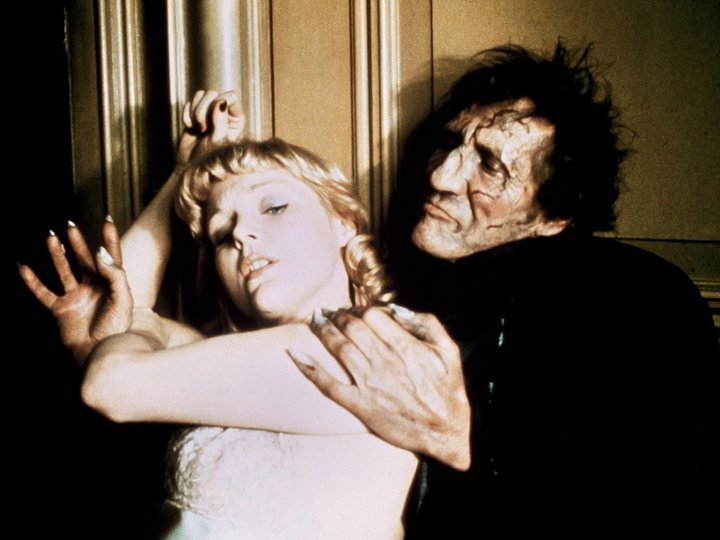
The Hag of THE FALL OF THE HOUSE OF USHER. The sequence where she approaches a hapless gardener with a raised knife is timelessly eerie, her distinctive lines looking like a Berni Wrightson comic panel.

EDGAR Allan Poe's 1839 short story The Fall of the House of Usher intertwines many Gothic threads, in particular madness, isolation and metaphysical identity. The last days of the Usher family are symbolised by a disintegrating mansion house; indeed, its windows are described as "eye-like" twice in the first paragraph, and the central crack of the building can be associated with a split personality. On the printed page Roderick Usher, his twin sister Madeline and the house all share one common gloom and guilt-laden soul, with the notion of a crumbling and haunted construct dating back to a tale which largely defined the Gothic genre itself, Horace Walpole's 1764 novel The Castle of Otranto. Atmospheric and emotional, Poe's story is given laden treatment in the two film adaptations under consideration here. 

Ten years before the Roger Corman/Vincent Price version of Poe's story, THE FALL OF THE HOUSE OF USHER was released by GIB Films (named after the photographer, producer and director here, George Ivan Barnett). Actually made in 1947, it uses a Gentlemen's club as a framing device ("talking of horror stories, those of Edgar Allan Poe take quite a lot of beating"), before discarding most of the source. When Jonathan (Irving Steen) visits friend Lord Roderick Usher (Kaye Tendeter) at his English mansion, he discovers that Usher and his sister Madeline (Gwen Watford) are both forlorn shells of human existence. By ignoring the nuances of Poe's association between the house and the Ushers, and making the family illness the result of a curse from their mother's lover, the production is instantly transported to the stilted melodrama of 1940s horror mysteries (replete with a creepy hag (Lucy Pavy), homemade torture chamber and a severed head with all the effectiveness of a Halloween mask).

Oliver Reed in THE HOUSE OF USHER. Two years later, Reed would appear in Stuart Gordon's take on THE PIT AND THE PENDULUM.

Despite the final third interpolating many of Poe's elements, by this stage there are more questions than answers: was Madeline slowly poisoned and buried alive? Is Roderick mad and imagining the end of the film? Why would a medical doctor so freely attribute a family illness to a curse, or not have institutionalised the mother? As we return to The Gresham Club, members are as perplexed as the viewer ("your guess is as good as mine.") With such uneven exposition and the unintentionally hilarious club, one wonders if the script is intended to whimsically play with the audience.

Alan Birkinshaw's modern adaptation THE HOUSE OF USHER not only acts as a metaphor for disintegrating buildings and psyches, but also crumbling reputations. Oliver Reed whispers his way through as Roderick Usher, and Donald Pleasence is the demented Walter, Roderick's brother who is locked in the attic with his drill-hand. LA hairstylist Molly McNulty (a somnolent Romy Windsor) accompanies English boyfriend Ryan Usher (Rufus Swart) to visit his family estate, but are involved in a car crash when two ghostly children appear in the middle of the road. Faking Ryan's death, Roderick - who suffers from hyper-acuteness to the senses - plans to keep Molly a prisoner in the house, to impregnate her and continue the Usher line.

Donald Pleasence in THE HOUSE OF USHER. A year later, Pleasence would appear in the Edgar Allan Poe-inspired BURIED ALIVE.

This US/UK co-production, filmed in South Africa, was one of many Poe film revivals of the late 1980s and early 1990s. THE HOUSE OF USHER is cheap but certainly not cheerful, a mishmash of dream sequences, under-developed ideas and gore (an overstepping family doctor is castrated by a rat, faux hand in meat mincer, head on platter et al). The robust Reed is woefully miscast, and it is left to Pleasence is give an insane star turn, literally dancing through the corridors with his budget power attachment. This leaves the rest of the cast in a nonsensical state of their own, typified by cook Mrs Derrick (Anne Stadi) uttering the immortal line to Molly: "I know you have a lot on your mind, but while you're here, can you do something with my hair?"

Monday, November 1, 2021

Tree of the Living Dead

WOMANEATER (1958)

"SEE the Woman Eater ensnare the beauties of two continents! SEE its hideous arms devour them in a death-embrace!" Released in the United States as THE WOMAN EATER, a tentacled tree that can revive the dead unfortunately can't put any life into this plodding production. 

BETWEEN 1960 and 1967, there were a slew of murderous plant movies: Roger Corman's LITTLE SHOP OF HORRORS had a florist assistant cultivating flora that feeds on human blood; Howard Keel's version of DAY OF THE TRIFFIDS was released; the homicidal creeping vine segment was part of DR TERROR'S HOUSE OF HORRORS; specimens of frozen tundra turn into acid-secreting carnivores for NAVY VS THE NIGHT MONSTERS; and MANEATER OF HYDRA sees Cameron Mitchell play a reclusive scientist crossbreeding dangerous varieties. But the dawn of this subgenre occurred in 1957 and 1958 with stories of more exotic origin: Dan Milner's FROM HELL IT CAME has a vengeful walking tree from the South Seas; and in this Charles Saunders picture, an Amazonian tribe possess a trunk-idol that can resurrect the departed, as long as it is regularly fed with nubile young woman to keep its secretions flowing.

Scientist and explorer James Moran (George Coulouris) transports the aforementioned "miracle-working Ju Ju" back to his English estate with loin-clothed Tanga (Jimmy Vaughn), who drums potential victims into a hypnotic state in a basement laboratory. Housekeeper and former lover to Moran, Margaret (Joyce Gregg), becomes resentful to new recruit Sally Norton (Very Day), an attractive ex-funfair worker who has started a relationship with mechanic Jack Venner (Peter Wayn). The scientist inadvertently strangles Margaret, who fleetingly returns as a brainless zombie; it is revealed that Tanga has kept the full secret of the tree to himself and his people ("only the body, not the mind!")

Blonde bombshell Vera Day makes for an appealing kidnap victim. Other credits for this London-born model/actress include QUATERMASS 2, GRIP OF THE STRANGLER and TOO MANY CROOKS.

WOMANEATER has the feel of a ponderous Bela Lugosi/Monogram film from the 1940s, and is a tired attempt to hang on to voodoo as an undead trope. The laboured script is played out by a disinterested and underdeveloped cast: the police force is unbelievably wooden and Coulouris - whose acting career spanned everything from CITIZEN KANE to BLOOD FROM THE MUMMY'S TOMB - stares blankly under a weight of research and family insanity ("several of them have been sent away.") Moran's plan is clearly at an early stage - he is having to kill people to revive them - but the most ludicrous notion is why Tanga has spun the situation to waste so much time, particularly as his prized idol burns over the closing credits.

Friday, October 1, 2021

Angel With Attitude

Samantha Fox and Page 3

Starting her glamour career at sixteen by coming second in the 1983 Sunday People’s Face and Shape competition, Samantha Fox was a model of irresistible contrasts: an angelic face with a mature body, and possessing large breasts with thin hips.

PUBLISHED in The Sun between 1970 and 2015, the inclusion of a topless model on Page 3 doubled the paper's circulation within a year of its introduction. As other tabloids scrambled to compete, was the notion harmless fun, or softcore pornography for the masses? Conservatives saw it as highly inappropriate for national newspapers, while feminists regarded it as a continuation of a misogynistic tradition. A number of the girls - such as Samantha Fox, Maria Whittaker and Debee Ashby - began their careers at sixteen, which was legally permitted in the UK until the 2003 Sexual Offences Act. But in the heyday of the 1980s the models were superstars, and Sam Fox became one of the most photographed women of the world, behind only Princess Diana and Margaret Thatcher.

In 1986 Fox retired from Page 3 at the age of twenty, and transitioned into pop music (although she did promote Page 3's 25th anniversary and appear in Playboy). It wasn't all plain sailing for the cheeky Mile Ender however, as Fox dodged fanatical stalkers and sued her father/former manager for embezzlement. Indeed, the title of her 2005 album Angel With an Attitude, and her appearances on chat shows, illustrated a grounded yet feisty "girl next-door" demeanour. Appearing on her record covers in sexy outfits and singing behind synthesized disco tracks, lyrics centred around the conflicts of love and lust. Although commercially successful, critics were less kind. Colin Irwin of Melody Maker called Fox "a small step for man, a huge step for lip gloss," while Alanna Nash, writing for Stereo Review, labeled her "airhead pop" and "less a singer than a sex fantasy."

Samantha Fox's debut single Touch Me (I Want Your Body) was a worldwide smash, reaching number three in the UK, and number four in the US Billboard Hot 100.

But if impressionable men were being conditioned to objectify and demean women, where does exploitation end and art begin? The historical definition of a nude shows the ideals of feminine and masculine beauty. Throughout the centuries this perception has shifted by cultural expectation; the first sculpture - the Venus of Willendorf - is known for her curvy figure and wide hips, and thought to be a deity for fertility. Female nudity also held an important place in prehistory, with Egyptian and Near-Eastern civilisations commonly featuring naked women as goddesses who ruled over love, war and even the underworld. Thus there is a mental and physical stature to the female form throughout history, possessing a real power over a variety of disciplines.

Contrastingly, throughout the Medieval period, women were mostly withheld from positions of power, or speaking their voice. In the time of the Renaissance, females were considered to legally belong to their husbands, and practically forbidden to practice art. An aura of seduction had replaced the perfection of these earlier figureheads, as an aesthetic landscape merged with a socio-political one. Samantha Fox certainly encapsulates the power of the female form, and a celebrated fantasy for girls yearning to be models and pop stars.

Wednesday, September 1, 2021

Séance and Sensibility

A DARK SONG (2016)

One location, two faces: Catherine Walker brings palatable turmoil to speak to the dead - forever shrouded by council estate sorcerer Steve Oram - in this Abramelin-inspired journey.

GRIEVING from the death of her son at the hands of an undisclosed ritual, Sophia Howard (Catherine Walker) rents an isolated house in Wales. Abrasive, alcoholic occultist Joseph Solomon (Steve Oram) leads her on a months-long rite based on The Book of Abramelin, to summon her guardian angel whom Sophia can then ask to speak with her son. The relationship between Sophia and Joseph becomes frayed as the grueling ceremonies unfold, and Solomon is seriously wounded when he accidentally falls on a kitchen knife. With Howard increasingly susceptible to sounds and shadows, Solomon succumbs from his injury. After breaking a seal surrounding the house, demons drag Sophia to the basement and torture her; but the deities retreat when Howard sees a white light, and an armoured angel awaits her. As it silently speaks behind aniridia eyes, Sophia’s redemption is one of forgiveness rather than revenge.

This confident British/Irish independent - the debut feature by writer-director Liam Gavin - contains such a detailed and methodical approach to occult ritual that it can only be a slow-burner (which is pretty unique in cinema, summoning is usually successful within minutes). But it is much more than a building psychological horror, its as if Ben Wheatley and Mike Leigh wrote a script after watching REPULSION and THE EXORCIST (the other prime example of systematic terror). When Solomon completes his salt circle around the retreat, not only are the duo cutting themselves from society, but from conventional reality. There is also a stripped-down enchantment here, a supernatural veneer that gives us hope against technological progress and the scientific march into an abyss. 

"Science describes the least of things;" the third act sees payoff from the Abramelin ritual, as Sophia confronts her warrior guardian angel, as if lifted from a Renaissance painting. 

Walker is magnificent as the tortured soul, blending steely determination with inquisitive desperation. Oram's gruff pie and chips mystic is no Stephen Strange, and sits uncomfortably with the seriousness of the narrative, but he is also uncomfortable in his skin. Before the terror takes hold, the audience is never sure of Howard's legitimacy (in a brief tea room scene with her sister, there are hints of mental illness), or if Solomon is just a pervert with a robe and ginger beard.

Abramelin and its demand for intricate, long-term preparation is credited to 14th-century Egyptian magician Abra-Melin, and plays out like a binding contract. In 1897, The Book of the Sacred Magic of Abramelin the Mage was translated into English by British occultist Samuel L. MacGregor Mathers, and was highly influential in the Hermetic Order of the Golden Dawn. Aleister Crowley - at the time a young member - started preparations for seeking the angel in Boleskine House, but abandoned this plan during the Hermetic Order division of 1901. The one thing that Mathers, Crowley and, indeed, most occultists, take from Abramelin is the existence of a benevolent demigod; consequently, a master or supreme magus can feed any number of charismatic and egotistical myth-makers.

Sunday, August 1, 2021

Ghost Breakers

CATACOMBS (1965)
DARK PLACES (1973)

Released in the United States as THE WOMAN WHO WOULDN'T DIE, the Hitchcockian CATACOMBS subscribes to that age old task of murdering one's wife.

CATACOMBS is a largely forgotten gem of British horror, the story of wealthy businesswoman Ellen Garth (Georgina Cookson), her downtrodden husband Raymond (Gary Merrill), and their Art student niece Alice Taylor (Jane Merrow). Ellen needs control over everything in her life, even her sudden physical pains in which she induces a trance to escape from. A murder plot between Raymond and her seedy secretary Corbett (Neil McCallum) is played out with Alice starting an affair with Raymond. The planned scheme involving actress Rachel Thomas (Christine Glynn) is prematurely halted by the overbearing Ellen finally breaking her husband's patience at their cottage retreat: Raymond drowns her in the bathroom sink and buries her in the potting shed. But this doesn't seem to end Ellen's yearning to act revenge on her husband and niece.

It was during his time as story editor on ALFRED HITCHCOCK PRESENTS that director Gordon Hessler discovered the film's source novel by Jay Bennett. An adaptation was rejected for the show, but became his theatrical directorial debut. Yet CATACOMBS cannot shake off its feel of an extended anthology episode; Merrill - himself a veteran of Hitchcock's TV programme - is perfectly cast as the aging gigolo, and Cookson is frightening and glacially fragile (when Raymond carries his wife in his arms, Ellen seems to eerily transform into a mannikin). The tension is simple but effective (the sound of Ellen's walking cane, the moving of locked door knobs), and although the double twist ending will not surprise all, it nevertheless is a satisfying climax to a well made and entertaining thriller.

Shot at an old psychiatric hospital near Uxbridge, DARK PLACES was the only release from Glenbeigh/Sedgled, but it had a great poster. 

Helmed by Don Sharp, DARK PLACES is a pedestrian haunted house/psychological thriller that is also rarely discussed at length. Following the death of an aging asylum inmate, Edward Foster (Robert Hardy) inherits an old mansion with a grim reputation: a woman, the housekeeper and two children have disappeared without trace. However Edward is more interested in the £210,000 hidden somewhere behind the walls. Unfortunately there are others who also want the money: Dr Ian Mandeville (Christopher Lee) and his sister Sarah (Joan Collins), together with solicitor Mr Prescott (Herbert Lom). With Sarah helping Edward at the mansion, and the siblings faking paranormal occurrences, the building and its backstory start to affect Foster's fragile psyche. Possessed by the spirits of the deceased, he begins his own murder spree.

Similar to the feel of CATACOMBS, DARK PLACES plays more like a TV movie, hampered by uncharismatic direction and photography. Hardy has a lot of character aspects to grapple with and manages to just about carry the film, while the all-star cast are wasted (although Collins inevitably shines as the sexually conniving sleuth). Even the flashback sequences have quality performers in small roles, with Jean Marsh and Jane Birkin. The notion of the Mandeville fake haunting is never developed; in fact, the realisation that strange things are actually happening is only met with brief puzzlement. It's a shame, as this interesting trope dates back to earlier stories such as THE CAT AND THE CANARY and THE GHOST BREAKERS, particularly in the context of money and induced madness.

Thursday, July 1, 2021

The Cat Creeps

THE CAT AND THE CANARY (1978)

Carol Lynley and The Cat in the only colour film of the celebrated but dated play. The production was not released theatrically until 1982 due to litigation with the original distributor, and consequently sat uncomfortably with the glut of slashers of the period. 

JOHN Willard's black comedy stage play The Cat and the Canary originally opened on Broadway in early 1922, and has become a cornerstone of the "old dark house" subgenre and "creepy clutching hand" motif. The story concerns the death and inheritance of a rich eccentric who felt that his relatives "have watched my wealth as if they were cats, and I - a canary." To date the tale has been adapted into four motion pictures: the 1927 Universal silent directed by German expressionist Paul Leni, the 1930 pre-code sound remake released as THE CAT CREEPS, the 1939 Bob Hope and Paulette Goddard take, and this British-made offering helmed by American cult filmmaker Radley Metzger.

In 1934, on the twentieth anniversary of his death, the remaining relatives of Cyrus Canby West (Wilfred Hyde-White) are called to his Surrey mansion to view the filmed reading of his will. Cyrus lets it be known how much he despised and loathed his kin - calling them "bastards" and "leeches" - by setting up a psychological struggle for his fortune. With a history of insanity in the family, West reveals that Annabelle (Carol Lynley) is to be the sole beneficiary, but to claim the inheritance she must spend the night in the house and be deemed sane the next morning. The situation is further complicated when a "chief psychologist at the Fairview Sanitarium, an asylum for the criminally insane; we're just up the road..." - Hendricks (Edward Fox) - informs the guests that a homicidal maniac known as The Cat has escaped and is hiding in the area. But this is revealed as a ploy by the unhinged second heir to drive Annabelle insane.

Wendy Hiller robustly plays family lawyer Mrs Crosby, and is removed half way through the film by becoming the first victim.

Metzger was a pioneer famous for his lavishly designed, adult-orientated films such as THE LICKERISH QUARTET, SCORE and THE OPENING OF MISTY BEETHOVEN (he also edited THE FLESH EATERS, regarded as the first ever splatter movie). His career-long fascination with self-destructive beautiful people morphs here into a group of desperate misfits, a de-sexualised mansion mystery of secret rooms and building resentment. Even the cinematography is against type, casting a well-lit glow as opposed to the usual cobwebs and shadows, and Alex Thomson's wide-lenses providing a sense of anti-claustrophobia. The stand-out touch, however, illustrates Metzger's pendant for the juxtaposition of actors and the projected image, when the family's faithful retainer Mrs Pleasant (Beatrix Lehmann) moves behind West's home movie only to reappear on screen - monochrome and twenty years younger - with Cyrus during the reading.

The all-star cast give performances that could generously be described as unconventional, portrayals of people who are all killers one way or another: disgraced doctor Henry (Daniel Massey, whose father Raymond had spent a night at James Whale's THE OLD DARK HOUSE), big game hunter Susan (Honor Blackman) and her lesbian lover Cicily (Olivia Hussey), who shot an employer attempting to rape her, war hero Charlie (Peter McEnery) and songwriter Paul (Michael Callan), obliquely "the biggest killer of all" according to West. It's a hodgepodge of goofiness undermined by strange lapses: why is Cyrus' formalities in sound, for example, and the two climatic shootings are completely bloodless. 

Tuesday, June 1, 2021

Black Smoke and Red Dust

THE WAR OF THE WORLDS (2019)

Eleanor Tomlinson and Rafe Spall run from a Martian war machine in a promotional image. For this version, the familiar steampunk design for the alien "boilers on stilts" are replaced with a more organic, insectoid look.

PETER Harness' three-part BBC adaptation of H.G. Wells' seminal invasion novel is not only the first British television stab at the story, but one that follows a female lead. Even before the Martians arrive, Amy (Eleanor Tomlinson) and partner George (Rafe Spall) have problems. In quite the Edwardian scandal, George has left his wife/cousin for the younger Amy, which has caused friction with his politician brother Frederick (Rupert Graves). Denied a divorce, Amy announces she is expecting George's baby. It seems their only friends are sprightly astronomer Ogilvy (Robert Carlyle) and maid Mary (Freya Allan), although the latter is killed under a pile of rubble during the first wave of attacks. 

Wells' narrator hero is described as a "professed and recognised writer on philosophical themes," yet here George is a Woking journalist and superficial wet fish, branded a coward by his ex-wife and failing to help a dying soldier. The flash forward/back structure of the leading players separation denies any workable screen time for Amy and George, which is probably for the best, as when they do share scenes Tomlinson and Spall's chemistry is insipid (Spall seems under varying levels of sedation). Thankfully this is Amy's tale, providing much needed ballast in what is more than just an angle on our current fixation with political correctness; unlike most female evaluations of major franchises, the character is intelligent and driven in complex, emotional situations.

Over 120 years after its first serialisation, the influence of H.G. Wells' The War of the Worlds remains; this is because of the heady contexts, which include colonialism, natural selection and religion. Pictured is Frank R. Paul's cover for Amazing Stories, August 1927.

The main allegory of Wells' novel - decaying imperialism - is illustrated by Amy having been raised in the British Raj, and the jingoistic comments of the military and politicians. "It seems that something has arrived in England" announces Chamberlain (Nicholas Le Prevost), a battle cry that today can be viewed as xenophobia. Initially planned to screen over the 2018 festive season, it would have been particularly hard for the masses to swallow such a slow, doom-laden miniseries; the death and devastation is shrouded in war machine black smoke and wasteland red hues, highlighting another interpretation of the narrative: climate change. In fact The War of the Worlds has always portrayed a foreboding and prophetic end of days template: Orson Welles' radio broadcast occurred during the escalation of Nazi Germany, George Pal's 1953 film was released at the start of the Cold War, and Steven Spielberg, following his 2005 big screen take, said that "after 9/11 [the book] began to make more sense to me."

Saturday, May 1, 2021

Come and Get It

THE MAGIC CHRISTIAN (1969)

Raquel Welch and Ringo Starr share a moment on set.

BASED on Terry Southern's irreverent novel, THE MAGIC CHRISTIAN is an anti-establishment black comedy/satire so laboured to the point of self-nihilism. Eccentric billionaire Sir Guy Grand (Peter Sellers), together with newly adopted homeless person Youngman (Ringo Star), bribe people with vast sums of money for "educational" whim. The narrative that every man has his price is spread thinly over a series of jaw-droppingly unfunny skits and cameo appearances. These include cutting out a portrait's nose at a Sotheby's auction - much to the astonishment of director Mr Dugdale (John Cleese) - and approaching the Oxford rowing team - one played by Graham Chapman - to purposely ram the Cambridge crew. The film ends with Guy and Youngman, having returned to the park where the film opened, bribing the park warden to allow them to sleep there.

Working from an endlessly rewritten screenplay by Southern and director Joseph McGrath (with additional material by Sellers, Cleese and Chapman), the sketches are often homoerotic: there is a homosexual boxing match and a Hamlet striptease. The only amusement is of a dog show where a new breed is feeding on the contestants. One wonders that if the climactic vat of urine, blood and excrement - liberally sprinkled with money - is a statement for the production itself (the inclusion of a newsreel Vietcong execution is bewildering and contemptible). The stars are particularly abundant on the good ship Magic Christian, on its maiden voyage from London to New York: Christopher Lee as a vampire, a whip-wielding Raquel Welch, and Yul Brynner in drag singing "Mad About the Boy" to a suitably unimpressed Roman Polanski.

Peter Sellers bribes Spike Milligan into eating his own parking ticket in one of many heavy-handed meditations on capitalism and human vanity.

Amongst the mess we find British stalwarts swallowing their pride (Hattie Jacques, John Le Mesurier, Dennis Price, Wilfred Hyde-White et al), and Starr is disposable behind Sellers' foppish onslaught (allegedly imposed by Sellers himself). At least Cleese is seen honing his petulance, and the unfilmed Cleese/Chapman contribution - The Mouse Problem - became a classic as part of the second episode of MONTY PYTHON'S FLYING CIRCUS. A presage of Furry Fandom, the sketch is an obvious parody of the secretive lives and social condemnation of gay men, the piece mimicking techniques used in serious television documentary exposés.

Thursday, April 1, 2021

Beware the Triffids

THE DAY OF THE TRIFFIDS (1962)
THE DAY OF THE TRIFFIDS (2009)

"Beware the Triffids ... they grow ... know ... walk ... talk ... stalk ... and kill!" Also known for her roles in SCHOOL FOR SCOUNDRELS and PARANOIAC!, Janette Scott - the daughter of Thora Hird - has husband and killer plant trouble in THE DAY OF THE TRIFFIDS. 

FOR the wayward Security Pictures version of THE DAY OF THE TRIFFIDS, the eponymous organism arrives on Earth from a meteor shower; Triffids are mobile carnivorous plants which can communicate with each other and possess a whip-like, venomous sting. The narrative follows two strands: American Navy officer Bill Masen (Howard Keel) is recovering from an eye operation in a London hospital, where his bandages have shielded him from a celestial event which has blinded most people. With society disintegrating Masen rescues schoolgirl Susan (Janina Faye) from a crashed train, leading them to a continental journey of survival. Meanwhile alcoholic scientist Tom Goodwin (Kieron Moore) and wife Karen (Janette Scott) battle a Triffid siege at a Cornish Lighthouse; Goodwin eventually discovers that salt water dissolves the multicellular menace.

In John Wyndham's source novel, nation state erosion as a result of mass blindness is used to explore social and political anxieties of the postwar period. This Wellsian apocalypse has Wyndham questioning methods of communal organisation and scientific ideas, including evolution and genetic mutation. However all is dispatched in this elementary adaptation for a generic monster movie. The hairy Triffids even move in the opposite way described in the book, by extending a pseudopod and dragging the "body" forward (trivially, their odd clucking sound was allegedly achieved by smoking a bong).

"When the solid world of everyday reality disintegrates ... and the whole population is driven by fear towards insanity." It can only be Howard Keel in THE DAY OF THE TRIFFIDS.

Directed by Hungarian Istvan Szekely - credited as Steve Sekely - and written by Bernard Gordon, both financiers (Rank in the UK and USA's Allied Artists) only accepted around an hour of Szekely's completed footage, which was a problem for a projected ninety minute feature. Consequently Gordon wrote the Lighthouse subplot to crank up the terror and the Triffids, and push the running time to the required length (Freddie Francis directing the sequences at Shepperton). At least this enabled Scott to be referenced in the opening song of THE ROCKY HORROR PICTURE SHOW ("and I really got hot when I saw Janette Scott fight a Triffid that spits poison and kills.") The film also greatly influenced the 1965 AVENGERS episode MAN-EATER OF SURREY GREEN, where a plant from outer space takes horticulturists as prisoners in an effort to germinate the world.

After their highly regarded and faithful adaptation of 1981, the BBC returned to the world of the Triffids in a 2009 all-star version. Placed into modern concerns ("Triffid oil saved the world from global warming"), the mass blinding is also more plausibly caused by solar flares, and environmental protestor Walter Strange (Ewen Bremner) sets the plant threat in motion. We follow Biologist Bill Masen (Dougray Scott) and BBC radio reporter Jo Playton (Joely Richardson), as they encounter a number of factions attempting to restore order on their own terms. Major Coker (Jason Priestley) starts a compassionate group, which is soon taken over by the tyrannical Torrence (Eddie Izzard), who forms a garrison in London. Torrence deliberately tells Jo that Bill is dead so he can claim her for himself, in fact Masen and Coker start a trek to find a solution to the soon-sporing Triffid problem.

"The Human race has had its day;" Mist-shrouded Triffids on the march for THE DAY OF THE TRIFFIDS. In John Wyndham's original prose, their true origin is never explained, but surmised they are a result of biological meddling. For the 2009 mini-series, the plants naturally occur in Zaire.

THE DAY OF THE TRIFFIDS has little interest in sociological perspective, with this stylized two-part, three hour take focusing on human conflict and resentment. Richardson makes for a bland heroine, and Izzard's amateur dictator hilariously survives a plane crash on a par with Brad Pitt in WORLD WAR Z. One typically bombastic difference to the book is the use of Durrant. In Wyndham, Miss Durrant naively tries to create a Christian community; here Durrant (Richardson's mother, Vanessa Redgrave) is an unhinged nun who feeds the weakest in her flock to the Triffids. Other aspects are added, the most notable being Bill's father Dennis (Brian Cox), attempting to cure the plant plague by cross-pollination. But the real stars are the CGI effects and animatronics, which give the Triffids a sense of brooding menace. Their appearances and attacks are excitingly staged, heads snapping like Cobras and roots creeping like a Lovecraftian horror.